Latest Comments

Guest - Aislinn Dyestuff Citizen Science.
09. Oktober 2026
This is a great project. I look forward to the results. Thanks for letting us know.
Guest - Aislinn Time for...
09. Oktober 2026
Looks delicious!
Guest - Katrin Sprang Discussion
18. September 2026
Hi Rachel, I have looked for more photos of you, but that was not very successful. I found a link on...
Guest - Beatrix Sprang Discussion
15. September 2026
That lozenge pattern element is not a photograph, but a scan. So it should be to scale. But I pinned...
Guest - Katrin Sprang Discussion
15. September 2026
I was not referring to Rachel's reconstruction (is the reconstruction you refer to the one photograp...
JUNI
12
0

NESAT pictures.

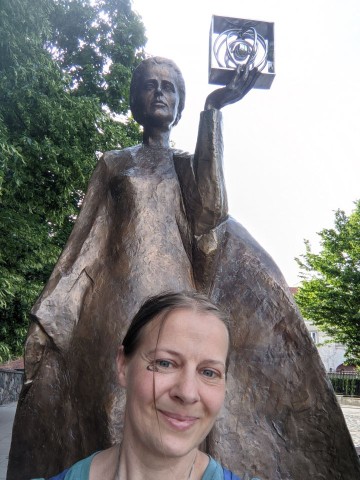
If you'd like to have a peek of how the NESAT looked like, you can find a few photos up on the website. My own photos from the conference are still not all sorted and labeled, though there has been some progress. And here's one of my bad selfies, in front of the Marie Curie Statue:

I had to take a picture with her, of course - after all, there's an actions scheme with funding run in her name, and I've heard "Marie Curie" more than once in connections with textiles. Also, apart from that, she was an awesome researcher! 

0
JUNI
11
0

Double CTR Lectures Tomorrow!

There are two hybrid lectures hosted by the CTR tomorrow:

Textile Research in the Pre-digital Age AND Vindolanda, Berenike, Qasr Ibrim: Securing Textile Records for the Future.
Lectures by Lise Bender Jørgensen, Emeritus Professor of Nordic Archaeology at the Norwegian University of Science & Technology, Dept. of Historical Studies and John-Peter and Felicity Wild.

Time: 12 June 2024, 14:00-14:45
Place: South Campus, room 11B-1-05 and on Zoom
Organizer: Centre for Textile Research (CTR)

Abstracts:
Textile Research in the Pre-digital Age
This talk will present Bender Jørgensen' work on archaeological textiles during the 1970s and 1980s, which included visiting museums in most of Northern Europe at the time of the Iron Curtain, followed by field work in Egypt during the 1990s.

Vindolanda, Berenike, Qasr Ibrim: Securing Textile Records for the Future
Detailed records of archaeological textiles, written, drawn and photographed in the field, are vulnerable, particularly when they are not digital and have no secure home. Total digitization is a partial solution. In this discussion we present and comment on the (incomplete) digital archives for three key Roman sites, copies of which are being deposited with CTR for long-term curation, and use.

You can join the Zoom Meeting with this link, or use the Meeting ID: 629 5654 6156 and Passcode: 468241.

And if you're interested in more events and lectures by the CTR, check out their website! 

0
JUNI
10
1

Presentation Ponderings.

I'm currently working on translating (and shortening...) our NESAT presentation for an upcoming conference in German, and this, together with some other things, has made me ponder how presentations at NESAT, but also other conferences, have changed during the past years. Or maybe I should really say decades, but that makes me feel old.

Back when I started out in Uni, standard was still having slides, and one of the guidelines that a tutoring archaeologist gave us was two slides (shown in parallel) per minute when you are planning your presentation. 

Then came the advent of PowerPoint, and the utter freedom to have as much text, and as many pictures, as you wanted. In as quick a sequence as you wished to, because you're doing the clicking yourself and don't have to say "weiter" (or knock) so your helper puts in the next slide.

At the last NESAT, we had one old-style paper presentation (with powerpoint, but the rest of how it was designed was really more like back when slides were the usual thing), and the rest of them were all "modern style". The big difference, for me, was that the old-style presentation was slow enough in both text and images that you had enough time to jot down the key points and you could even have made a quick sketch of the key parts of the images. With the modern style presentations, you stand no chance. Information density and slide speed is so high that you cannot write fast enough for all the key points, let alone try and sketch something. Very few exceptions apply, but for me, the way to get the most out of the papers in modern style is to write down the things I find important or interesting that the speaker says, but that are not written as bullet points on the corresponding slide - and I make a photo of the slide in addition to that. 

Thinking back, this has changed over the past years too, I remember being able to write down more of the content that was presented. I don't think I have gotten that much slower in writing; my impression really is that the papers have become more densely packed with information all the time. (I do confess guilty of trying to fit as much into my presentations as possible, so I have definitely played my part in this development. Case in point - our NESAT presentation had 47 slides in total, for a run time of max 20 minutes. That's about 25.5 seconds per slide if you distribute the time equally.)

Looking at it like this, it's a small wonder we were all so tired after the conference days! It also seems to be quite different in other disciplines... which I also find very interesting. Maybe I should venture out to more neighbouring discipline conferences in the near future, to compare. 

0
JUNI
07
0

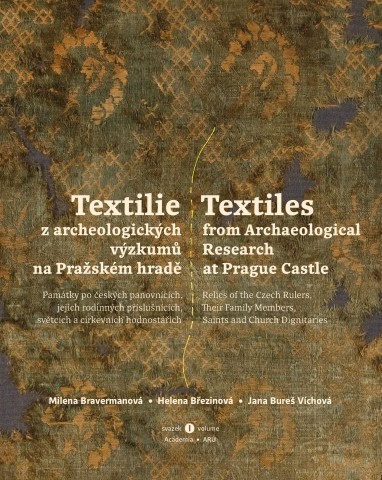
Textiles from Prague Castle - Book

 I found out at NESAT that I had completely missed a new book coming out last year - about the archaeological textile finds from Prague Castle! The book is written completely bilingual in Czech and English and spans textiles from the 10th to the 18th century. 

You can order it directly from the publisher's webshop here, or through your friendly book-dealer of choice. With almost a thousand pages, it's definitely a larger book, and I'm very much looking forward to it! 

0
JUNI
06
0

Colour Measurements...

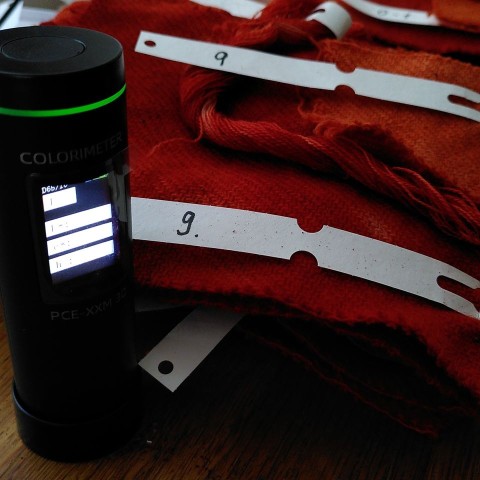
So after finding out about how difficult it is to judge, compare, and describe (or colour-list-match) colours by eye, I'm now trying to see if a colour checking tool is helpful in this regard. Which means... hearing a lot of beeps.

Because every time this thing here takes a measurement: 

...there's a little beep.

I'm going for averages, since the samples are not all completely evenly dyed, some more than others. So I've been taking 20+ measurements of each sample so far, and now I have enough to go and see if the data looks useful, or not.

For today I've definitely heard enough beeps!  

0
JUNI
05
0

Citizen Science Project "Deep Time"

A citizen science project called "Deep Time" has led to the discovery of a large number of archaeological sites. The project was made in collaboration with the National Trust, and was a large-scale analysis of LiDar scans.

You can read an article about the project on the Guardian's website here, or visit the digventure site to learn more about this and other projects.

0
JUNI
04
0

Refashioning the Renaissance.

There's new exciting projects popping up... and sometimes it takes me a few years to find out about them. Like the "Refashioning the Renaissance" project, a large research venture about everyday clothing and fashion in the Renaissance. It's based in Finland, but the website is in English.

The project encompasses quite a lot of different research bits and pieces, such as the re-making of a silk stocking, dyeing tests, and more - you can read about those on the project blog. The project will still continue for a while, and I hope they will get to do a lot more fascinating things!

0

By accepting you will be accessing a service provided by a third-party external to https://www.pallia.net/

Kontakt