Latest Comments

Guest - Aislinn Dyestuff Citizen Science.
09. Oktober 2026
This is a great project. I look forward to the results. Thanks for letting us know.
Guest - Aislinn Time for...
09. Oktober 2026
Looks delicious!
Guest - Katrin Sprang Discussion
18. September 2026
Hi Rachel, I have looked for more photos of you, but that was not very successful. I found a link on...
Guest - Beatrix Sprang Discussion
15. September 2026
That lozenge pattern element is not a photograph, but a scan. So it should be to scale. But I pinned...
Guest - Katrin Sprang Discussion
15. September 2026
I was not referring to Rachel's reconstruction (is the reconstruction you refer to the one photograp...
OKT.
27
0

Template Update.

Planning an experiment is like planning a reconstruction - it's really, really easy to forget something. Where something can be a minor detail or, if one is a bit unlucky, something that seems like a minor detail at first but turns out to be rather crucial. 

 I've also found, in the number of experiments that I've either run, or co-run, or been somehow a part of, that it is quite easy to forget that one had planned to make photos at a specific point, or that something has to be changed and this all results in a number of hectic notes that are scribbled somewhere.

Part of that is just business as usual. Not every experiment runs as planned, and sometimes adjustments have to be made on the fly. But I found that good prep is really helpful... and that having a good template for the planning makes the good prep easier.

I've recently updated the experiment planning template on the Textile Forum website, and if you're interested, you can find it here. In case you are using it, please let me know if you have any comments or feedback - I'm always happy to hear about this!

0
OKT.
26
0

Current Status: Busy.

Things done yesterday and today? Found out that there are test strips that will give an indication of stuff in water, including the interesting bits such as copper, iron, nitrites and nitrates, lead, hardness and so on. There's some that will give you 6 values and some that give 14 and some that give you 16 - so we're going to have the 16-value strips for some indication of how different our water samples are.

These are, of course, not very accurate and not comparable with a proper lab analysis of water, but it will be a quick and dirty solution to get indications of differences, and have a rough documentation of them. And then it's always possible to take a bit of the water and hand that in for a proper analysis, should it turn out that it would be really interesting. (Tap waters in Germany usually have an analysis available from the water works, but that might not be the case everywhere, and for the spring waters and creek waters, well, there's no analysis of them anyways.)

So that bit of our experiment is now sorted as well; other supplies and ingredients are on their way, the experiment protocol/guideline and documentation sheets are being worked upon, details are discussed, tea is being consumed, oh, and I've packed some goods to send off so a post run is on the agenda now as well.

I can't believe that it's less than two weeks from now that the Forum starts... 

0
OKT.
25
0

Zoom Presentations in Vienna

If you're interested in clothing and understand German, there's a lecture series currently ongoing, organised by the Art History faculty in Vienna. There will be three presentations about clothes as items of daily life, the next one on Wednesday, November 15.

The presentations will be streamed via Zoom, and you can join in for free. You can find more information and the link on the website. 

0
OKT.
24
2

Freshly Dug Out.

These are madder roots from our garden, freshly dug out. They'll make part of the second part of our experiment on madder dyeing - using different batches of madder with the same water, and see how different they will come out.

Madder is said to get better the longer it matures - first in the ground, then once harvested, resting time of a few years is also said to make it better. But I figure that too-fresh madder may be better than no madder at all...

It will be dried now and then ground up, and I hope for a yield of at least 30 g afterwards (though in a pinch, 10 g would be enough). It would definitely be nice to have some more samples to test. So - do you happen to have a bit of dried madder to spare? Would you be willing to donate 10 to 30 g of it for our experiment?

0
OKT.
23
1

Figs!

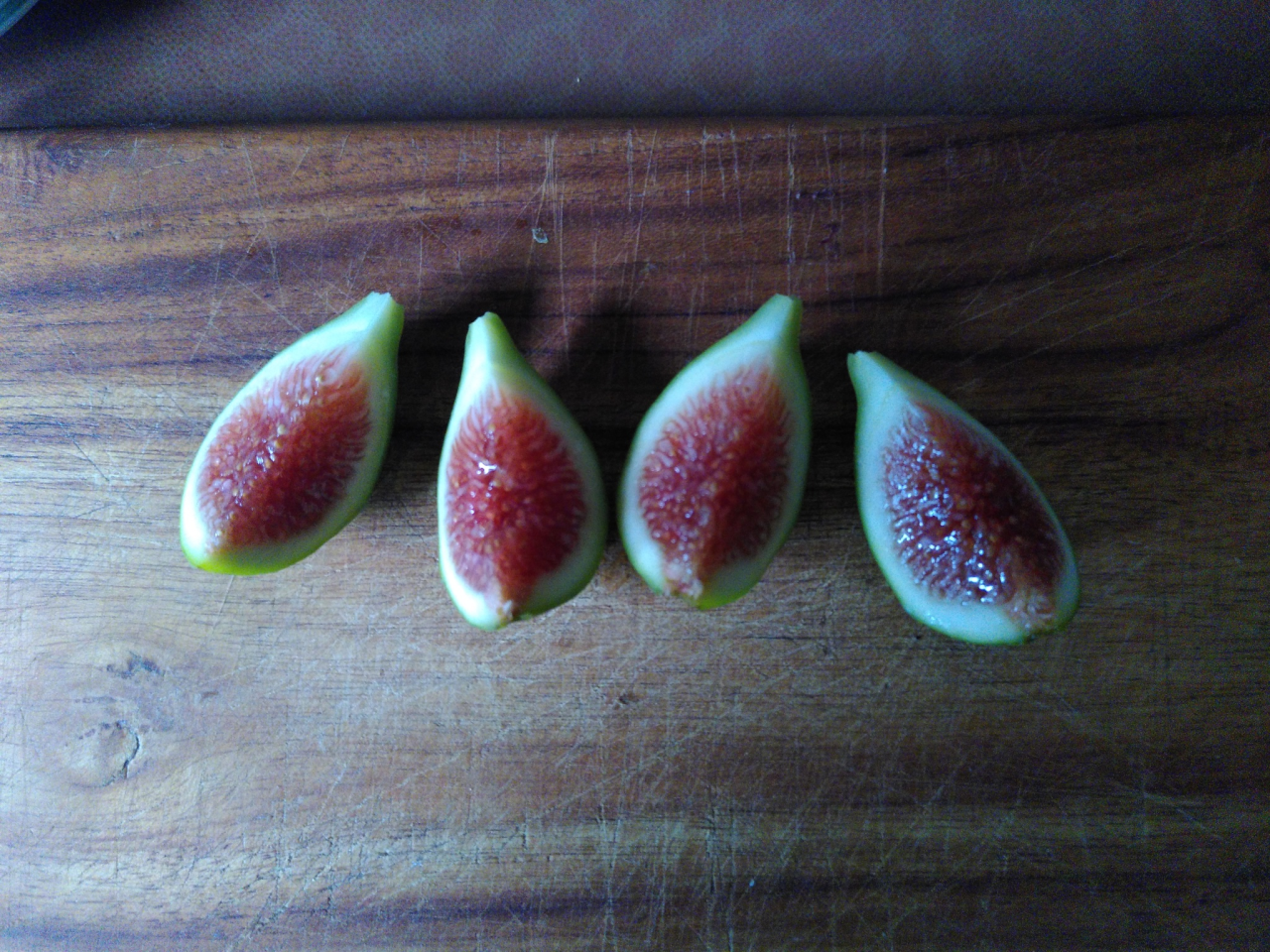
The weather has been weird for a good while here now, with autumns so long and so mild that the rose in our garden is regularly going for a last flowering in October/November. So I figured that we'd might as well make the most out of global warming, and planted a fig bush three years ago. It's hardy enough to survive the winters here, though it has to be protected against late frosts, because it will otherwise just go pouty and mope around and not grow leaves forever (or until it is pruned back a bit again). 

This year is the first time that it actually made figs that managed to ripen, though! Last year it put out about two fruits, and those were a complete disappointment. But this time around, they are actually nice.

They are not very large, but (since the Most Patient Husband of Them All is not as fond of them as I am), they are all mine :)

Next one up to make fruits will be the passionfruit plants and the fig cactus. Though the latter might still need a year or two to grow...

0
OKT.
20
0

Dyer's Strong Water!

Dyeing recipes are, well, let's say they often are interesting. And usually they will raise a lot of questions. And then some more.

First of all, just like old recipes for cooking, medieval and early modern dyeing recipes go easy on the measurements. Which makes a lot of sense because measuring stuff easily and precisely, like it's possible with modern scales, was not a thing back then. Also, just like with cooking food, variabilities can be quite large, which means that you'd have to gauge by experience if this is too much, too little, or just right.

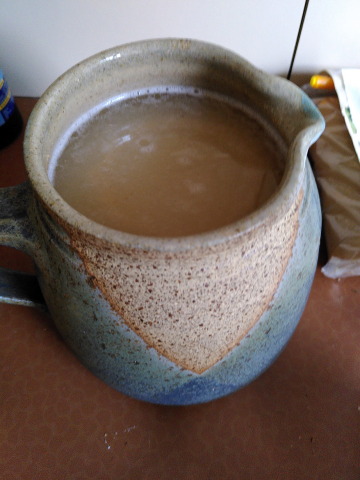
And then there's the question of what is meant by a specific term. Such as... bran. That, it seems, can either be bran (as in wheat bran) just added to the dyebath, or it's fermented bran - if you let the stuff sit in a bit of water, it starts to ferment, turning slightly acidic.

Some of the recipes that we plan to look at during the Textile Forum also mention that as an ingredient - it also goes by the moniker "dyer's strong water" in some cases.

So guess what happened here in the kitchen?

It's fermented bran - I got a taste of it when I was in Romania, where it's called "borș", and it does have a quite pleasant taste. If you're curious now, you can read more about it in Wikipedia, and if you google for recipes, you will get some instructions about it. I tried with added (dry, actual Romanian) bread in the mix first, as many of the instructions tell you to, but I left it for a bit too long and the bread went mouldy. So in the second attempt, I used only bran and water - it took a bit longer for it to turn sour, but it was a success that time.

So now I'm looking forward to trying this in the dyeing! 

0
OKT.
19
0

Weekend Prep: Animal Done.

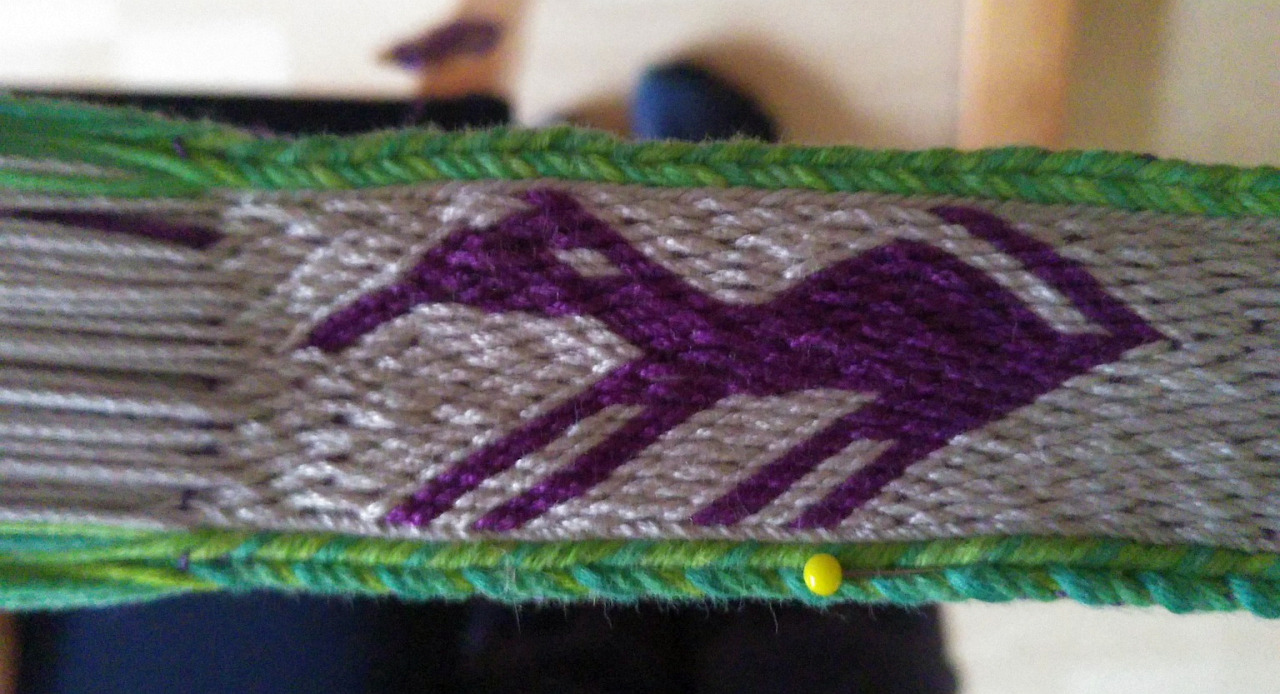
The weekend prep is continuing, and one of the tasks was to get the "show band" ready for... well... the show. Which meant finishing the half-done motif that was currently on there.

Last time I played around with that was way too long ago, and it was trying to freestyle copy the Evebø dog (or whatever it's supposed to be). I can't remember exactly what happened at some point when it was time to split the forelegs, but something must have happened. Maybe I made a mistake, or something came up and I had no more time, or - well. The result, in any case, was me stopping the weave for a while.

A long while.

So I now sat down, undid the last twists to make sure everything was aligned properly, fiddled with the tension, and tried to figure out where I'd been and what to do next. As usual in my attempts to do the doggy beast, it did not work out entirely as I had planned...

...so I have another slightly faulty, slightly weird and crooked animal to add to the zoo. One of these days, though, I'll manage to do one properly. Without weird butts, or weird forelegs, or weird eyes, or weird snouts and foreheads.

Anyway, the beast is done, and now I will add a little bit of white background (just a centimetre or two) before segueing into diagonals, which is what I have planned for the demonstration. 

Go see me in the Stadtmuseum on Saturday 20:00 to 22:30 to meet this little beast in person! 

0

By accepting you will be accessing a service provided by a third-party external to https://www.pallia.net/

Kontakt