Latest Comments

Guest - Aislinn Dyestuff Citizen Science.
09. Oktober 2026
This is a great project. I look forward to the results. Thanks for letting us know.
Guest - Aislinn Time for...
09. Oktober 2026
Looks delicious!
Guest - Katrin Sprang Discussion
18. September 2026
Hi Rachel, I have looked for more photos of you, but that was not very successful. I found a link on...
Guest - Beatrix Sprang Discussion
15. September 2026
That lozenge pattern element is not a photograph, but a scan. So it should be to scale. But I pinned...
Guest - Katrin Sprang Discussion
15. September 2026
I was not referring to Rachel's reconstruction (is the reconstruction you refer to the one photograp...
APR.
11
0

Embroidery & Stitches

The Royal School of Needlework has celebrated its 150th anniversary by making a Stitch Bank - a website where you can explore and learn different embroidery stitches. It's up to 200 now, with the latest addition of 50 newcomers in January.

You can find the Stitch Bank here. The stitch entries usually feature a series of photos and illustrations to show you how the stitch is done, plus a video. If you are all delighted with this and would like to support the project, there's the option of donating to adopt a stitch.

On a related note, here's an article about the meaning of traditional Ukrainian embroidery patterns. 

0
APR.
08
2

More About Riding in Dresses.

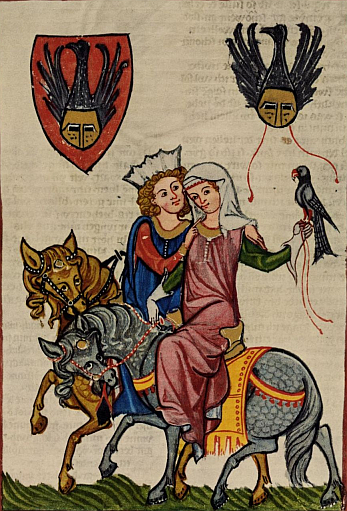
 So - there was discussion already about the riding slits, and how folds fall in dresses with and without a middle gore, and then I got a question via Instagram about women on horses. The examples given are taken from the Codex Manesse, which is the very splendid, very famous illuminated manuscript in the Uni Heidelberg (here's the full digitised MS).

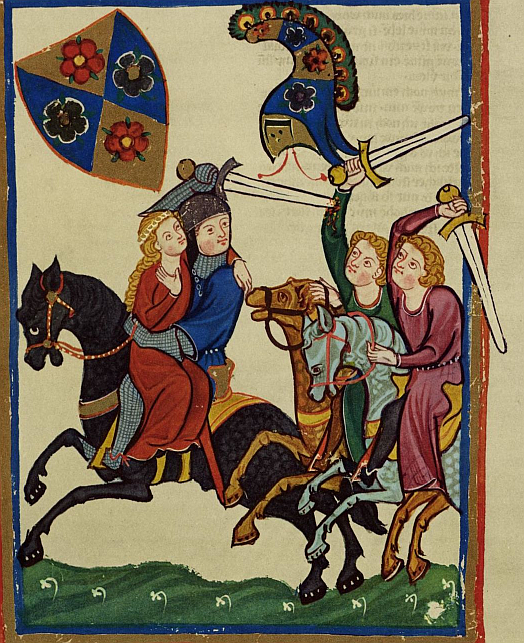
There are three women on horses in the book's images: on fol. 69, fol. 183v,  fol. 251, and fol. 316v. The last is the easiest, because the lady in question is not sitting astride, but sideways, and she's held by a man sitting in the saddle as you'd expect him to:

Cod. Pal. germ. 848, fol. 316 v. This lady is clearly seated sideways, and the dress looks too narrow to accommodate sitting astride without riding up a huge lot.

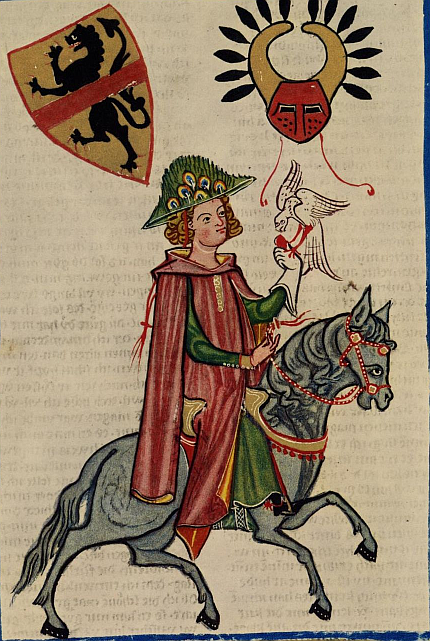
Now, the others are more difficult to gauge. First of all, for comparison, a man dressed in a riding coat (Reisekappe), sitting on a horse, from the same MS: 

Cod. Pal. germ. 848, fol. 73.

That is a rather typical garment for travelling, and it - like the tunic worn beneath it - definitely has a riding slit cut in here. Both fall very smoothly, with almost no folds, and certainly no bunch-up folds to be visible.

For the women sitting on the horses, it looks different.

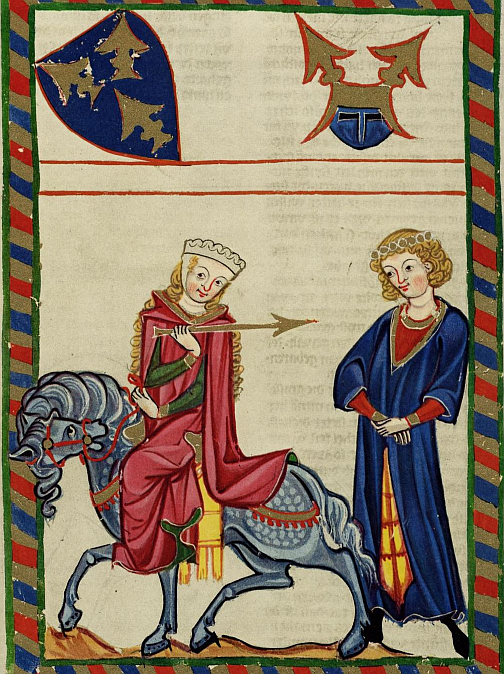
Cod. Pal. germ. 848, fol. 251.

This is actually the only one of the three women where I'd be sure that she is sitting astride. There is one foot definitely visible, and it's in the correct position for medieval riding. She's also looking straight ahead with a straight body position.

Note how the fabric drapes over her leg, and how a fold comes down from under her butt behind her knee towards her ankle. My suspicion is that the bunch-up problem was solved here by having a really generous amount of fabric in the dress - so there's enough both in width and length of the dress to make it work.

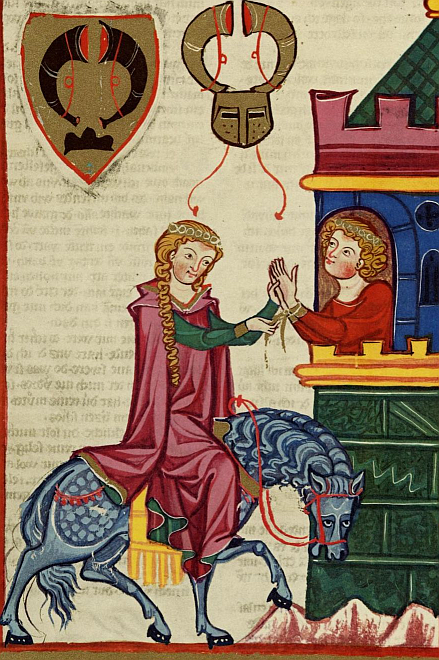
For the next two women, there's also folds draping around their legs, and a cascade of folds going down under the butt towards the knee.  

Cod. Pal. germ. 848, fol. 183v.

She's either sitting astride and turning backwards towards the man, or she is sitting sideways in the saddle. I lean towards astride, but I'm not completely sure. Unfortunately, all her feet are hidden.

Cod. Pal. germ. 848, fol. 69.

This lady is sitting even more sideways, with really curious folds of the garment. They might be intended to show bunching up - but the rest of the folding actually looks a bit more like sitting sideways to me. 

There's an image in a British Library MS that shows, very clearly, an un-slitted dress, with the wearer sitting astride, as it drapes over the horse. 

As far as I can tell, there's thus two possible solutions to the bunch-up problem: Either having garments with sufficient width and length to cover everything that is supposed to be covered even when adding part of a horse to the equation, or sitting sideways. Another thing that would be interesting to test with reconstructed garments - and some horses with reconstructed saddles...

2
APR.
07
0

The Time It Takes.

I've been doing textile maths again recently - regarding weaving processes, and how long things take. The question of "how long did it take" for medieval fabric production is one that comes up again and again.

Quite often, these calculations run for a single garment, or a small piece of cloth. I've had a sort-of revelation regarding spinning time when I did a rough estimate for a bolt of cloth about 20 m in length, medium quality - which would take me approximately half a year to spin the yarn for, working full-time.

Full time. Half a year.

The funny thing, though? If you're looking for yarn for fabric replicas, and you want to get a spinning mill to make your yarn for you, it won't take much shorter... because a lot of the small mills have waiting times of several months before they are able to process your order.

So, just in case you're a museum thinking about getting a textile replica? Be aware that it will take a lot of time even in the best case, unless it's only a very small item. I think most planners are not aware of how complex making a textile replica is. Of course there are several categories here as well, from "should look roughly like it from a distance of 2 metres in low light" to "our visitors are encouraged to touch and handle the piece". 

If it's the latter, things start with researching details of the original pieces such as type of fibre, fibre thickness, yarn diameter, the amount of twist and the look of the finished fabric. Then the hunt for the appropriate materials starts, followed by making the yarn, followed by weaving (or whatever other textile technique was used in the original). Not all modern weavers will work with historical style yarns, by the way. They are different than the yarns people are used to today... Dyeing, if required (which it often is) is another interesting beast to tame, and will also take some time.

With the masses of fabrics available these days in the shops, and the easy and quick buying of clothes, it's not on most people's radar anymore how time-consuming textile work is. Knitters will know about it, as will people who spin, or sew their own garments, but in most of those cases, the activities are hobby activities. Which means that there will be a general awareness of "it takes a long time", but the actual time is not measured objectively, and we all know perception can be misleading.

I have no good idea yet on how to propagate the knowledge to museums, though... 


0
APR.
06
3

Flax on the field?

Lauresham is always good for some interesting and exciting projects - and their most recent one is "A Year on the Field". This is about crops raised in historical times, and this year's crop is flax (linum usitatissimum). 

For their project, Lauresham is looking for participants who have raised flax in the past years, or are joining in to grow it this year. Especially welcome are farmers, open-air museums, museums, or living history places - but they also look for scientists and crafters who work with linen and are willing to share their knowledge and insights.

You can learn more about the project (and get into contact) here. 

Just in case you are wondering, I won't be joining in. My preferred gardening technique is "demented squirrel", as in "I put things in the ground and then forget about them". Flax is a crop that needs a minimum of care, or so I'm told, and, well... the tomatoes and woad and, this year, fuller's thistles that I am growing are more than enough for me to handle. I will be keeping an eye on the project, though, I find it is a wonderful idea!

0
APR.
05
2

Middle Gores and Riding Slits, Continued.

...but wait, there's more!

Florence commented on the post about Herjolfsnaes 42 (with some issues thanks to the blog software, it seems it is very non-mathematic-symbol-friendly):

I agree that if a person is buried wearing a garment does not prove that they also wore it in life - just that their family or community deemed it proper for them to be buried in them. And then, as you mentioned, there are the Greenland finds, where the corpses were wrapped in the garments and are not wearing them, so that's another thing altogether.


My point is: Proving a negative empirically can only be done on a large amount of data. Women never wearing short garments: Sure thing, loads of pictorial evidence for that. Women not wearing garments with a riding slit: Also loads of pictorial evidence, including the pictures of women riding astride. Now, women never wearing long gowns with a closed (as in sewn shut) middle gore: I cannot tell from a picture if there is a closed middle gore or not, could you give me a few examples?
In extant garments, we only have a few examples where we are quite sure those were worn by a woman. So, out of less than 5, none have a middle gore. But that's not a lot of data.


(Granted, I'm a physicist, a sample size of n=5 tells you nothing in my field)

I don't even know an extant long garment with a closed middle gore that is a associated with a person/corpse of any gender.


..

First of all - yes, that is not a lot of data I am working on. Unfortunately, we do not have a lot of data to work on, and I completely agree that a sample size of five or less is very, very scant. 

When I looked for garment evidence for my thesis, I got about 175 items altogether, from most of Europe (with limited things from Finland, and next to nothing from Eastern Europe) and for the timespan of 500 to 1500. I tried to include extant pieces that could give information on how something was tailored, so no pieces that have just a piece of seam or hem. There's probably some more that I missed, and in the years since, some more pieces have been found (Lengberg for instance), but I'd surmise that we haven't gotten up to significantly above 200 items.

Garment finds are really, really rare.

And now for the really juicy bit... is it possible to tell from the medieval images whether there's a middle gore sewn in, or not?

There is, to my eyes, a subtle difference between how folds in women's dresses and in men's tunics are shown. It's really subtle, though, and it took me a while to sort of put my finger on it. The difference gets less pronounced when the dress is wider, and it's not visible if the dress is tucked up into the belt as to fall in different folds.

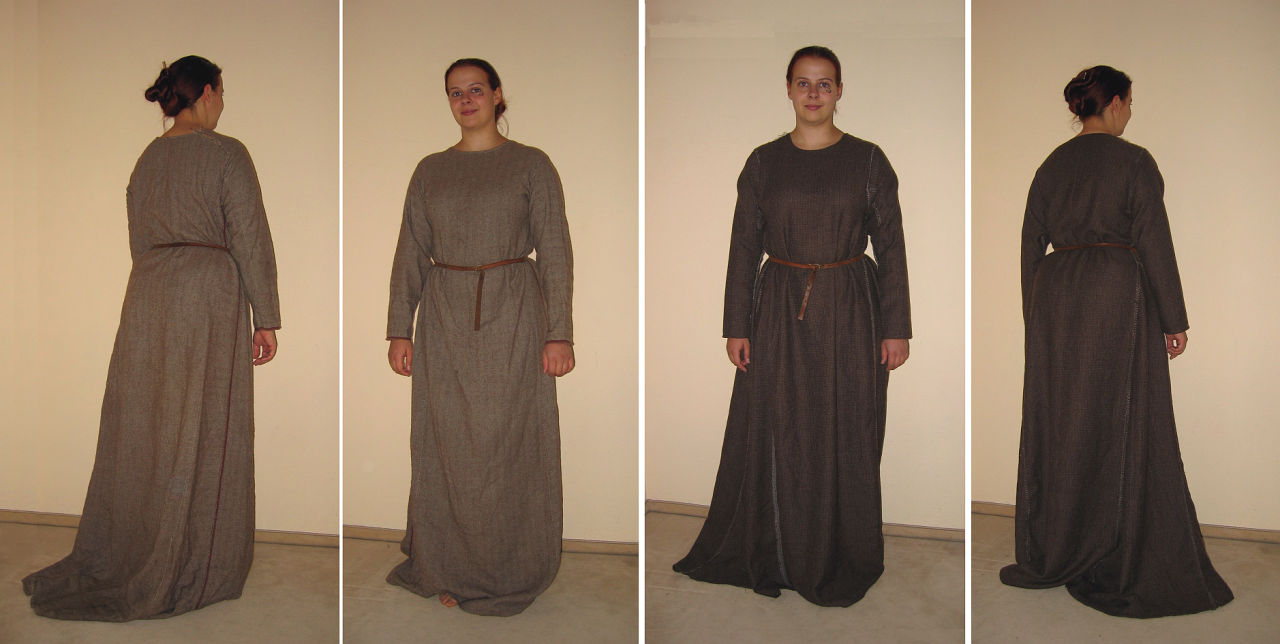
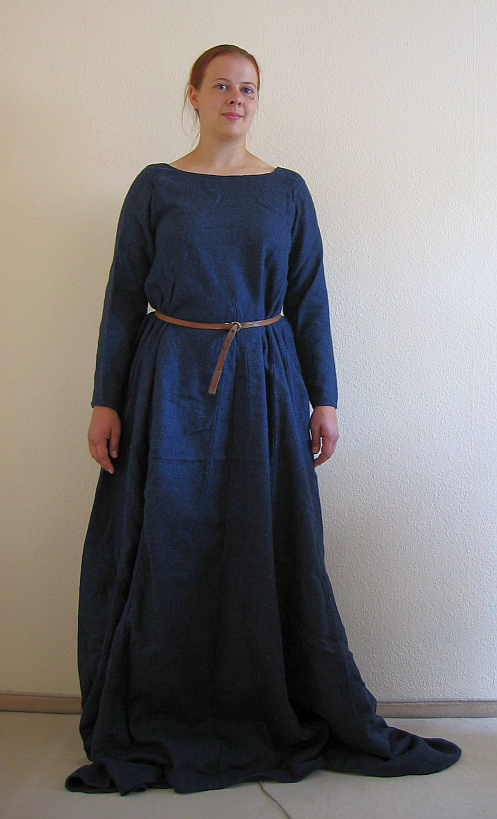
What I have only seen shown on women's dresses in artwork is the V- or U-shape of folds in the front part of the dress. These can both be seen on my dress reconstructions of St Elizabeth's and St Clare's dress, here:

You can see the U-form of the folds on the left dress, and a more subtle version of the folds running together in the front on the right. In comparison, the folds on the Herjolfsnes 42 look like this:

The folds are running straight downwards to outwards here. 

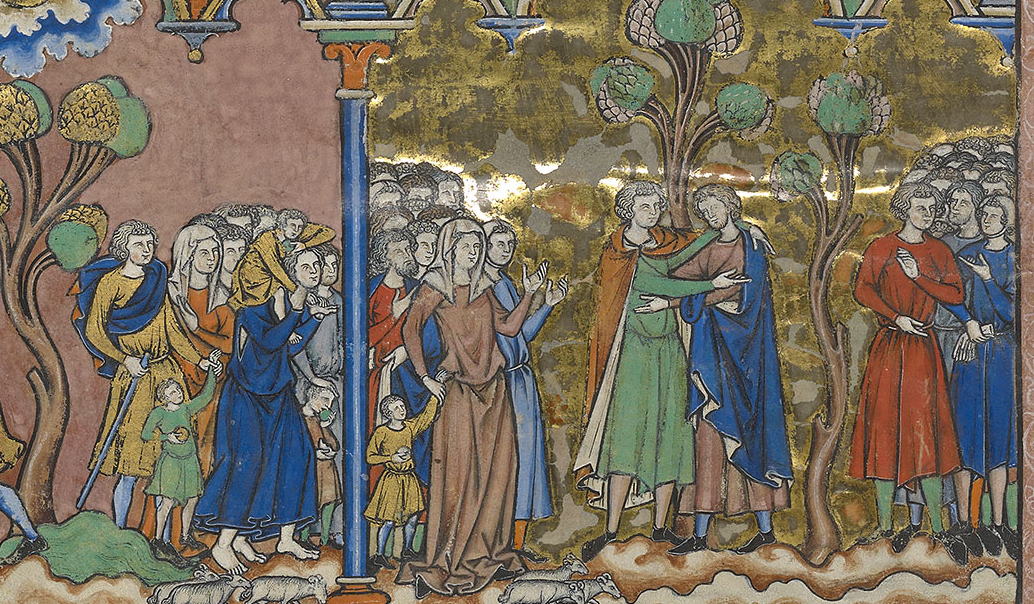
So how does this compare to medieval images? Here's one example:

Maciejowski Bible, The Morgan MS M.638, fol. 4v. See it in full size here: https://www.themorgan.org/collection/crusader-bible/8

On the men's tunics, the folds go straight down. On the women's dresses, the folds run towards the middle. At least that is how it looks to me - and yes, I will say again: the difference is subtle. Similar fall of folds can be seen on the other folios of the Maciejowski. (I'd like to go and hunt for more similar things in other manuscripts now, but unfortunately I'm running out of time for today.)

On many of the images that we have, it's not possible to tell how the folds run, or if there is a distinct difference between the male and female dress. Female dresses are often tucked up into the belt (not just drawn up, but a side fold of the dress taken up and stuffed in), and that will severely change how the fabric drapes and hide any "natural" front folds. Quite often, some mantle or cloak also hide what goes on in the front, for both men and women.

So in conclusion... I would not call what I see on the images as hard evidence, but to me, this impression of a subtle difference between how the women's dresses fall and drape, and how the men's tunics, especially those longer than knee-length fall and drape, is a very strong hint towards a different cut, and I would interpret that as the middle gore for the men's garments and no middle gore for the women.

What's your impression? Can you see a difference?

0
APR.
04
2

Ah, Vienna.

I'm back from the Vienna trip, and it was wonderful - giving a presentation in front of actual living, breathing human beings just is different from giving an online-only presentation. Though I am certainly delighted that the presentation was hybrid, that made it possible for a good number of other people to join in.

There were questions afterwards, and then there was the "Post-Kolloquium" which is the official moniker for "have a meal and some drinks together". It's been forever since I've been at a social like that and that, too, was wonderful.

On the next day, I got to meet up with some colleagues to have a look at a spectacular Bronze Age gold textile, or what's left of it, which is only the gold threads. Interesting debates were had about it, and I got to play a little with some of the testing textiles and give some input, and then there was time for a museum visit before we met up again for dinner.

Some more sightseeing was added in before we went home (the Most Patient Husband went along for the ride), there was bouldering at a Viennese gym (which sort of counts as sightseeing as well), way too much coffee, lots of delicious foods of all kinds, and a lot of rides on diverse public transport vehicles. I'm especially enamored with the Viennese Underground, as there are some sections where it goes overground, with very nice views, and even nicer stations designed by Otto Wagner, a famous architect. These stations are part of the cultural heritage and still in use, so you get to ride modern trains to historical buildings, built in a style that I like very much.

Using public transport this weekend had an added benefit: the vehicles are all heated. It got very cold in Vienna over the weekend, especially on Saturday and Sunday - there was even snow, and not just a few flakes, but enough for it to stay on rooftops and trees. Brrrr!

Now it's back to the desk for the more mundane everyday tasks... though there is the next presentation to prepare, for a workshop coming up towards the end of April. 

I'm still feeling a bit queasy about travelling, and meeting up with a lot of people within a short period of time; it's so different from the pandemically mostly secluded life that we have here, and that I've gotten so (maybe too) used to in the last two years. So I hope we haven't caught anything on our trip, and we plan to get a test today and in a few days again. 

As a side note regarding the pandemic: Rules in Austria are similar to those in Germany, which means that you will be allowed to take off your mask when in a restaurant and seated at the table. Which means that for the presentation, in the larger room with more air volume and lots of space for each person, everyone wore a mask... while those going to the post-colloqium were then seated at a small table, with little space between individuals, and in a much smaller room, not wearing a mask. I do get the rules, and I completely understand how these situations occur, but it's still sort of weird and makes the rules seem sort of haphazard...

0
APR.
01
0

Riding Slits, Part 2.

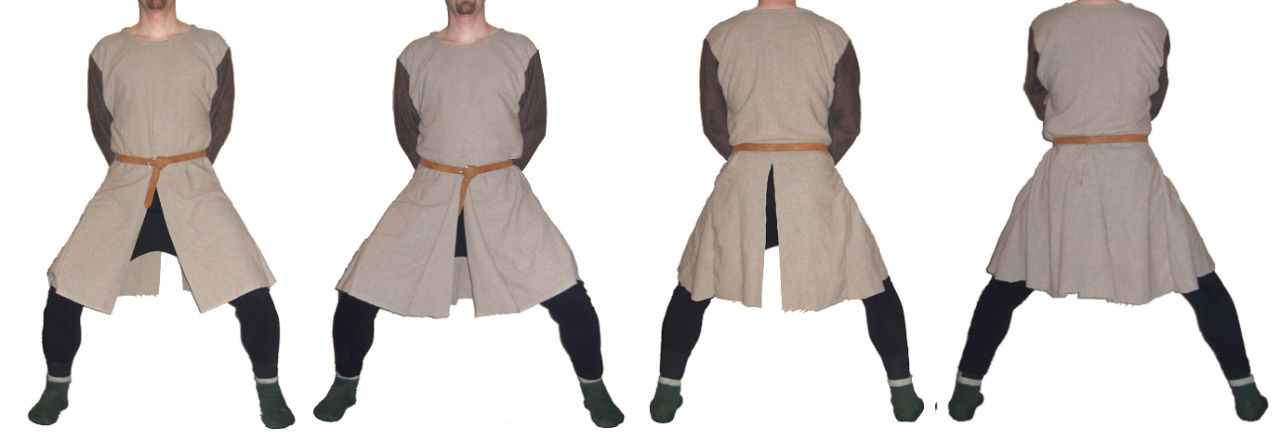
Here's a comparison of a mockup tunic with slits cut in, with and without middle gores around those slits: 

Simple tunic with riding slit cut in, from left to right: front view without middle gore, with middle gore, back view without middle gore, with middle gore.

Well, the horse is missing from those images (due to lack of handy horses around here), but you can see that the slit functions, of course, in both instances - with and without a middle gore. However, the version with gores remains much more "closed" even in the riding position. Especially noticeable in the view on the back, where the slit is not visible even in this leg position.

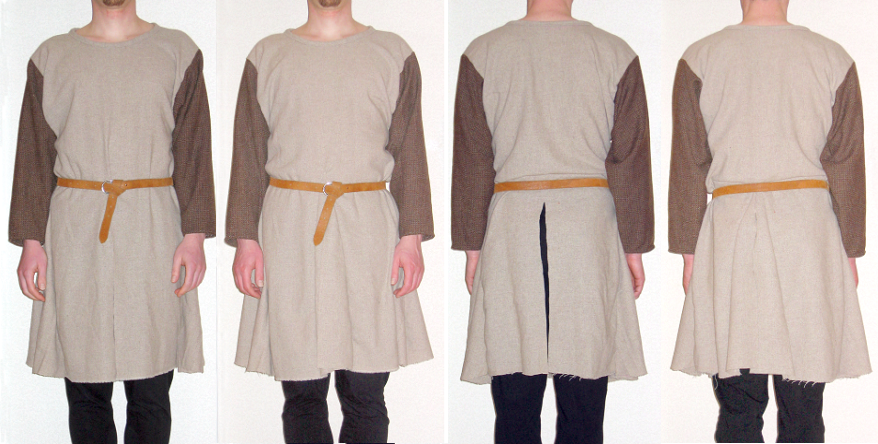
The whole issue gets properly interesting, though, when you are standing normally:

From left to right: front view without gore, with gore, back view without gore, with gore.

As you can see, the tunic does not close properly at the back if there's no middle gore inserted. This is standing position; the slit issue gets worse, and more noticeable, once the wearer starts to move - when walking or running, the slit will gap open, unless you insert the middle gore.

So that's something you'd definitely want to do for your coverage. Not only to avoid flashing your undies, but also because the slit, staying open, will make things rather drafty in cooler weather!

What you can also see in those standing position pictures is that the fall of the tunic changes with the insertion of the gores. This is significant because riding slits are closely related to riding, which means horses, which is an expensive and status-y thing to have not just today, but also in the Middle Ages. Owning a horse that is used for riding is not something everyone can afford.

Consequently, if you're wearing a tunic with riding slits, that indicates that you have a certain amount of wealth, being a horse-rider. If that changes the fall of your tunic... it's not a big thing to insert a middle gore, with or without slit, leading to the same fall of the tunic regardless of being a horse-rider or not. So that could be an explanation for the middle gore to be found in men's tunics, whether slitted or not, but not in women's dresses. 

From the archaeological record, I know of no garment that is certainly associated with a woman with middle gores set in. There's piecings for panels in some of the later dresses (like the Golden Gown of Queen Margaret) that sit in the center front, but they do not change the fall and drape of the garment away from the straighter, more slender silhouette in the front. The fall-changing middle gore is never present. There's also no example of a slit tunic without a middle gore. 

To me, this makes perfect sense - you do not need a riding slit in a woman's dress (the bunch-up problem is solved differently, if the woman does ride a horse), but you want the slender look that is easier to achieve with a straight front and back panel in your dress. In men's garments, if you cut in a slit, you definitely need the gore to cover up the unmentionables; that changes the tunic to give it a different fall and drape. That, in turn, may have been associated with a "manly" look, or with higher status, or both, and said associations probably led to the universal adoption of the middle gore in men's garments.

2

By accepting you will be accessing a service provided by a third-party external to https://www.pallia.net/

Kontakt