Latest Comments

Guest - Aislinn Dyestuff Citizen Science.
09. Oktober 2026
This is a great project. I look forward to the results. Thanks for letting us know.
Guest - Aislinn Time for...
09. Oktober 2026
Looks delicious!
Guest - Katrin Sprang Discussion
18. September 2026
Hi Rachel, I have looked for more photos of you, but that was not very successful. I found a link on...
Guest - Beatrix Sprang Discussion
15. September 2026
That lozenge pattern element is not a photograph, but a scan. So it should be to scale. But I pinned...
Guest - Katrin Sprang Discussion
15. September 2026
I was not referring to Rachel's reconstruction (is the reconstruction you refer to the one photograp...
JUNI
16
0

Oh The Colours!

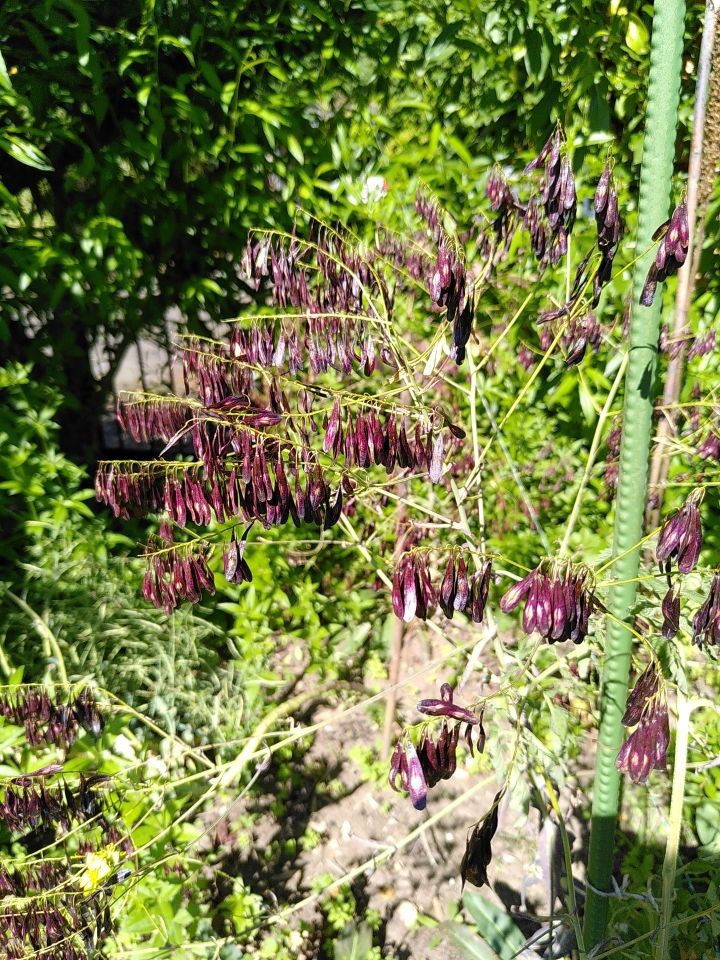
Today's a public holiday here, so instead of a proper post, you're getting this picture of ripening woad seeds: 

I really love the colours of these seeds at that stage - they stay beautiful, but the deep purple changes to something more of a brown or blackish colour as they ripen.  

0
JUNI
15
5

Loop Stitching.

Sometimes, when chatting about work in historical/medieval/prehistoric times, especially the very time-consuming textile work, somebody says "ah, well, but they did have more time back then". 

Did they, though? 

My usual answer to this comment is that back in history, days also only had 24 hours each. Not all of these hours were light, and there was less artificial lighting available than we're used to today, both in quality and in quantity. Some of the dark hours were, of course, spent sleeping - so let's just say, for simplicity's sake, that after 8 hours of sleep, there's 16 hours of time left to do things.

To do... all kinds of things. Especially those that were directly connected to sustaining yourself in some way, either by farming directly or by doing some other work to earn money to buy the things you'd need, or a mixture of both. Sounds familiar? Because that is, basically, what we're still doing today.

So depending on what your work is and how long it takes, you might have resources left over to spend on luxury goods in the wider sense, or you might not. That, again, is something that remains the same no matter what era we're in. There's people who have more resources and people who have less, and those with more resources can invest them in stuff that serves as status symbol, and those who don't... they have to make choices.

Time-consuming manufacture of things means that you either have the surplus time yourself and can spend it on making something fancy, or you have the money (or bartering means) to buy somebody else's time. If the rest of your social environment knows the worth of the item made, it can serve as a status symbol. (That won't work if you get something very pricey and fancy but nobody can appreciate it, because it's not common knowledge. A very fine hand-knit sweater would take a lot of time, but most people won't realise that when you pass them on the street - something like a fancy designer hand-bag, though, would be more widely recognisable.)

I am a firm believer that "back then", people did not have so much more time than we do have now. They'd also have had distractions, and days when things did not go as planned, and they'd have hung out with friends and family in their leisure time and not worked all the time on something. (Well, not more than modern people do.) That is also what I try to explain when the comment comes up.

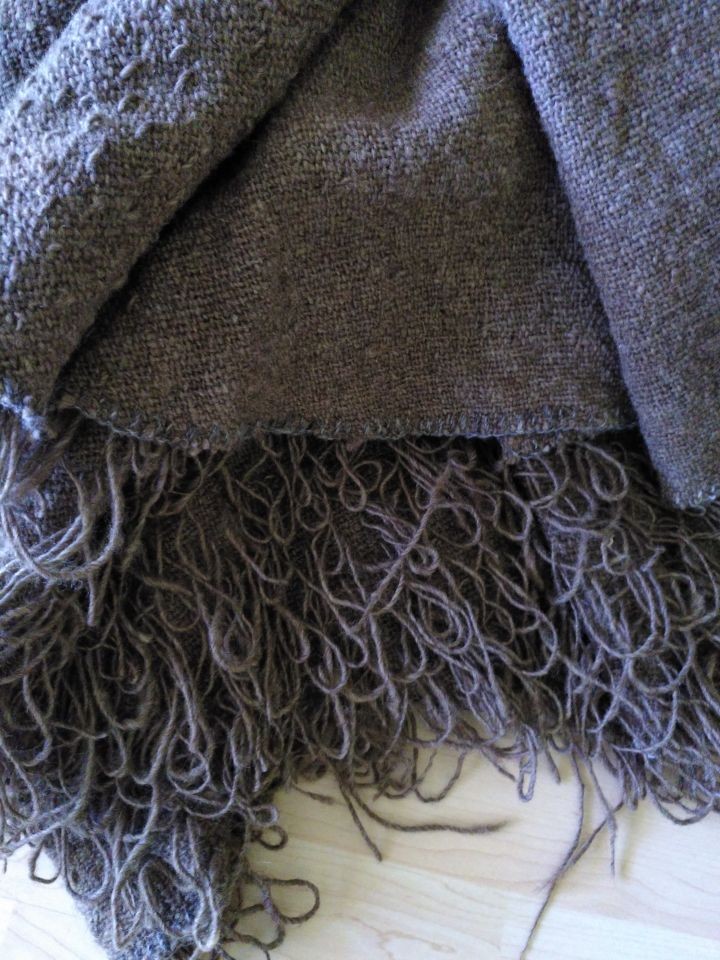
Sometimes, though, I feel like going "oh my goodness, someone had waaaay too much time", too. Like now, when I am doing the stitching for the pile on the reconstruction of the Trindhøj cloak.

That is a lot of stitching. A LOT. 

Don't get me wrong, it's a quite nice task, and each single stitch goes rather quickly, but a lot of quick actions will still take a long time. I also hope that the yarn I spun will be enough, and I won't run out before I finish the loops.

Maybe it helps to work faster? So I'm finished before the yarn realises that it's not enough?  

1
JUNI
14
0

Linkapalooza!

It's time for some links again - here you go:

Alex Makin has new things up on her blog about (mostly) Early Medieval Textiles. This time, the textiles are (mostly) a bit later - Milena Bravermanová, Helena Březinová and Jana Bureš Víchová present textiles found in the tomb of St Wenceslaus in Prague Castle. Do check them out - they are fabulous fabrics!

If you're into Medieval cookery, you might want to check out this recipe book in the OpenLibrary - it's the edition and translation of a late medieval recipe book from Naples, dated to the end of the 15th century.

If you're up for a fight, or maybe just up for reading about military mobility equipment, there's a nice article about chariots and related wagon-like things here.

Prefer more friendly things? There's an investigation into fragmented ring ornaments used in the 4th millenium BC in Finland, which may have been something resembling "friendship pendants" - rings that were made, then intentionally broken and used or worn by two people. The article is open access.

I hope there's something for you in that selection!

0
JUNI
13
0

The Joy of a New Wheel.

We are, as you might know, cyclists. Erlangen is a place where there's a lot of cycling going on, and in most cases, it's the quickest way to get from A to B within the city (just like in so, so many places). You can park right where you want to go and don't have to find a parking space, get the ticket, put it into the car, and then walk to wherever you planned to be.

Apart from that, it's healthy (at least healthier than sitting in a car), more quiet, and more sustainable. Also it's fun, especially with a nice bike that is easy to ride.

If we are going somewhere together, we're taking the tandem, if it's at all possible. We've also spent a few holidays on the bike... so it has seen a few replacements over the years, pieces that were worn out, pieces that got upgraded, pieces that broke.

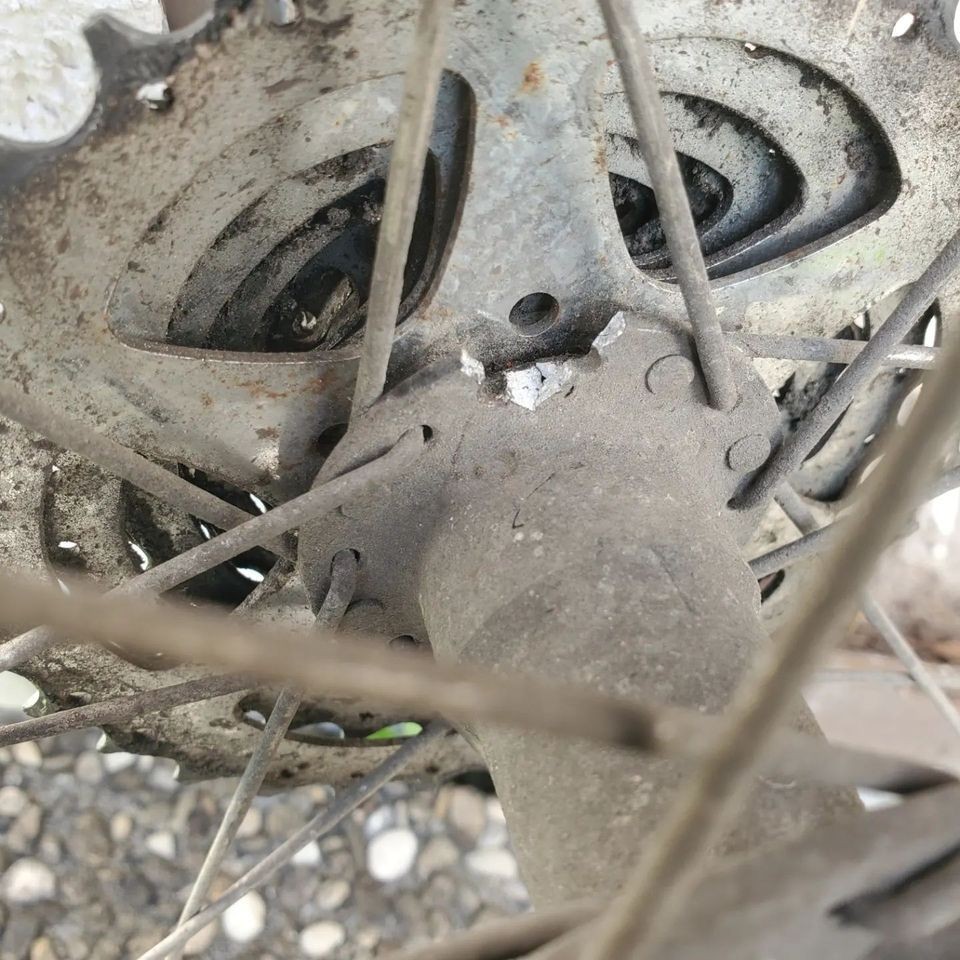
The latest piece that broke? The flange on our rear wheel hub. On one trip, we heard a "ping" sound like when a spoke breaks - and yes, two spokes were loose. But not because they themselves had broken. A part of the flange had taken exception to staying with us and went its merry way somewhere into the bushes.

Ouch. That is not how a wheel hub should look like.

Fortunately, it was still possible to use the bike, though with a bit of caution. And last Friday, the replacement wheel arrived. We now have a shiny new wheel, and the Most Patient Husband of Them All also replaced the chains, and there's a new sprocket cassette, and now the whole thing is running like new again. Plus the freewheel of the new wheel is really, really quiet - in fact, you can only hear it in some instances, and the sounds of the chains running when we pedal are actually louder than the freewheel sound. 

The last hub lasted about 33.000 kilometers. So now we can work on wearing the new one out...

0
JUNI
10
0

Should you? Or not?

Sometimes you hear about an event just in time - that happened to me with a paper on a (hybrid) conference yesterday. I read about said conference about half an hour before the thing started, and an hour before the paper that was of special interest to me - and luckily, I got sent the link for the login really quickly, and was able to join in.

At said conference, there was mention of a TED talk about whether you should kiss with lipstick... or not.

Since it is, sort of, well, related to historical dyeing, here you go:

0
JUNI
09
0

More Images!

Well, not here, but on this site called "Medieval Wall Painting in the English Parish Church: A Developing Catalogue".  I'm not sure about how up-do-date the "developing" is, since the copyright notice says "-2018", but it is a very nice collection of murals in churches. 

I've stumbled across it looking for Genesis scenes, which are a premium source for images of Eve spinning. (I've learned, though, that it's not always the spinning woman in those scenes, sometimes she has other occupations.) I hope you enjoy having a look at the paintings.


0
JUNI
08
2

More Spinning Stuff - Évangiles de Quenouilles

If you're on Facebook, and interested in distaff spinning, there's a lovely group there called Evangelical Church of Distaff Spinning. Not too much traffic, lovely people, and from time to time someone turns up a gem. So thanks to that group, I can now point you to the Évangiles de Quenouilles on the BnF site. If you click on the small image, you can read the original version - if you can read Old French, that is. (The script is, to my eyes, not too hard to read, which is nice - I find it superhard to try and read something in a hard-to-decipher script and in a language I do not know well.)

Apparently there's an English edition to these Évangiles, too (available as an ebook). Here's a review (mostly behind a paywall) of the book.* My quick search via google Scholar has not turned up much more - there's a Dutch version that you can access online, with the text from a 1910 edition/transcription. 

The contents are advice - the "gospels" that are passed on between women as they meet for spinning. A lot of them are medical or concerning health. You can read a bit more about the medical advice in this paper.


* I do wonder about this passage in the review: 

"The 'distaff' of the title is the rod – or 'staff' – from which yarn is wound onto a spindle. In figurative terms, it is the mechanism by which the thread of the oral narrative – a collection of folk wisdom (or 'gospels') told by a group of peasant women (the evangelists of the title) – is spun into a written text by the male narrator, an unidentified cleric." 

Weird mis-explanations of distaff function, or distaff use, or how spinning is done pop up again and again. This, to me, is really irksome and I do wonder - are other techniques and their tools mis-explained just as badly and frequently as spinning and its tools, and it's just an awareness bias that I have, or is spinning really more of a victim than other techniques?


0

By accepting you will be accessing a service provided by a third-party external to https://www.pallia.net/

Kontakt