Latest Comments

Guest - Aislinn Dyestuff Citizen Science.
09. Oktober 2026
This is a great project. I look forward to the results. Thanks for letting us know.
Guest - Aislinn Time for...
09. Oktober 2026
Looks delicious!
Guest - Katrin Sprang Discussion
18. September 2026
Hi Rachel, I have looked for more photos of you, but that was not very successful. I found a link on...
Guest - Beatrix Sprang Discussion
15. September 2026
That lozenge pattern element is not a photograph, but a scan. So it should be to scale. But I pinned...
Guest - Katrin Sprang Discussion
15. September 2026
I was not referring to Rachel's reconstruction (is the reconstruction you refer to the one photograp...
SEP.
08
1

Still On The Hunt.

I'm still on the hunt for a replacement for my photo database programme. If I had ten Euros for every programme I installed for testing... ah well.

So far, there's three prospective candidates; the first of them is almost out, as there's considerable trouble still to import the metadata from the text file; the second seems to be a bit more promising, but jury's still out on how feasible the import will actually be; and the third one has only just entered the testing phase (import seems possible, but a bit tricky, as it involves several steps and a first quick try did not result in anything helpful).

All three are pay-for-a-license types, which suits me well - one programme was right out of the list as it's a per-month thing, and I'm really not into that. At all.

Well, the testing and installing and trying, that ate a few evenings, while other stuff - like Textile Forum prep - was going on during the daytime. More Forum-related emailing now, and then some writing work to be done. Some day I'll be caught up! (Probably that Some Day is, as the Germans say, Sankt-Nimmerleins-Tag...)

0
SEP.
06
0

The Season of Madness is Approaching.

Autumn is coming, and with it the Textile Forum is drawing nearer, and that always marks my own personal Season of Madness - as things are getting sorted out and planned and organised. 

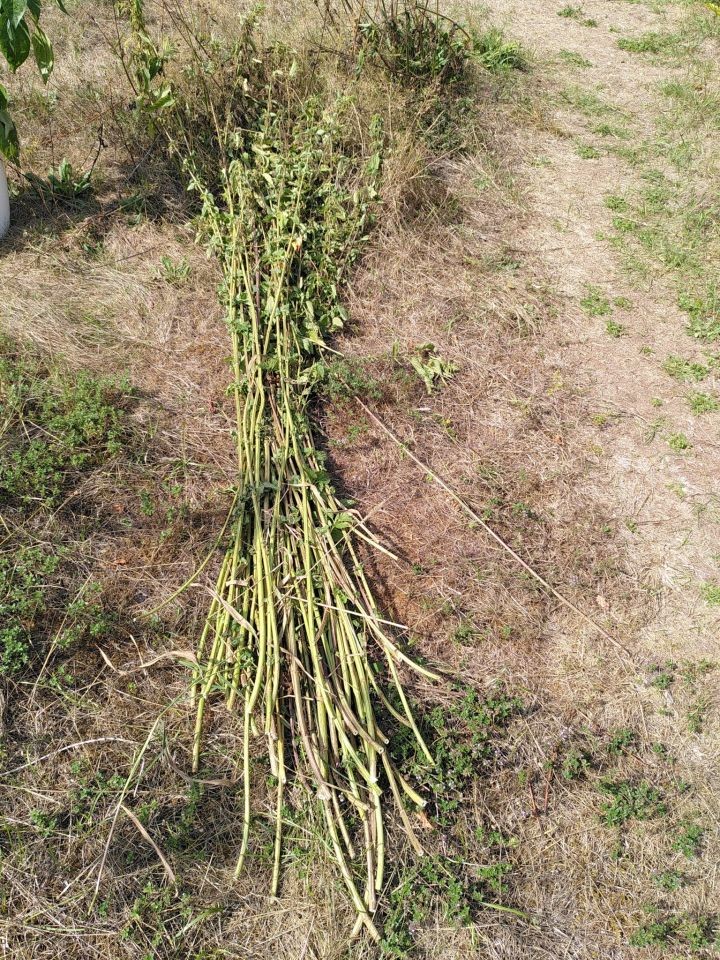
There's long lists of stuff to check, or pack, or look into - and since this year's focus topic is "making threads" which includes splicing technique, there was a little bit of nettle harvesting today:

These grew on public ground, and quite obviously on a piece of public ground that they found pretty nice, as some of the stalks are more than my height in length. Now I'll have to figure out what best to do with them until we need them in November. Ret them? Let them dry? Freeze them? Hm... 

0
SEP.
05
1

Tomato Seeds.

I've been saving seeds for next year, like I always do, and I was thinking about putting something about the fermentation of tomato seeds here just in case someone is interested, and while looking for some instructions I stumbled across the Garden Myths blog.

Which says, here, that a test of different tomato seed prep methods did not result in any difference in germination rate. 

Well... I do remember reading something, a good while ago, about different methods of preparing tomato seeds. That was some scientific research thingie, geared more towards industrial production, and there were differences in seed viability... so I think I'll stick with my method.

Which is: Take a ripe tomato that tastes well (obviously!), take out some of the seeds (maybe all, if it's a small tomato or has few seeds) and put them into a small glass. Add a pinch of sugar and some water, swirl around. Let stand for long enough, usually between 2 and 3 days, depending on temperature and general conditions. The way I decide whether it's time to get them out or not is swirling the contents around in the glass; when the seeds sink quickly to the bottom of the glass, they are ready. I then put them into a small sieve, wash the gunk off (gently rubbing with the fingers), put them onto a paper towel, and let them dry. 

Worked very well for me these past years, the seeds don't stick together, and they have stayed viable for at least several years. (Might take them longer to sprout if they are older, though.)

Do you save your own seeds? Do you treat the seeds in any way?

0
SEP.
02
0

Flax Processing

Fibre processing and spinning always takes a long time - and it can be done with simple tools, as a rule. A Czech Centre for Traditional Technology has a very nice video on Youtube showing several steps from the dried flax plant to winding a shuttle bobbin for weaving - with a delightful mix of old and new items (watch out for the modern plastic-handled scissors!) 

The video is in Czech with English subtitles, and I hope you enjoy it as much as I did. 

0
SEP.
01
0

Whoops, where did that day go?

A chunk of it was eaten by some more research into the photo database problem; then there was a bit of writing; there was a bit of textile work; some organising; there was lunch at some point inbetween, and woosh, the day was gone.

Speaking of time, just a few days ago I was chatting with a friend about wages, and pay, and freelance employment. A few years ago, I had found an online calculating tool that helped in calculating a sensible rate for freelance work, with a list covering expenses and taxes and all these things, but that has long since gone the way of the Dodo Website.

A quick search, though, found a page called, very fittingly: The Freelance Rate Calculator.  Clicking the link there sends you to a google spreadsheet that you can download and fill in, to find out what you will need per hour to earn the money you need. It does, very handily, remind you that you might want to have some savings too... so a very smart thing.

In case you consider going freelance: Check out this sheet, or something similar. You definitely want to find out if you can turn whatever you are planning to make your main job into a business that will sustain you... before you take the plunge.

0
AUG.
31
0

Survey on Gender Equality in Research

The L'Oréal and Ipsos Foundation are running a survey on gender equality in research, available in 6 different languages (German is not among them, but English is). It is asking scientists for their experiences in their careers and work, and according to the survey intro, it takes about 10 minutes to complete. (It took me a bit longer.)

It is especially interesting if you are working in an academic environment or a company also doing research - it's definitely not tailored towards special cases like me, who are working as self-employed people with a research part to their job. But even if I could not contribute to quite a few of the questions, I can at least spread the word further!

The survey is online until September 9, so if you plan to do it, or plan to pass the info on to someone else, you should do it before then.

0
AUG.
30
0

Duck Resurrection!

Years ago, we got a "Dampfente" - which is a small hand-held steam cleaner that has, more or less, the shape of a duck. It's not large, and it has been used occasionally through the years, mostly related somehow with textile work.

For instance, I used it to set the twist in spun yarns when I was pressed on time; steam once, let cool and dry off (which will not take as long as letting a thoroughly wetted skein dry out) and then repeat the process. Voilà, almost instantly dead yarns. 

An added benefit of that process was that I realised how much movement and wiggling happens when the twist is set. There was a lot of wiggling of the threads, even though they were all stretched on a skein winder.

From the past tense used in this past text, you can probably guess that at one point, the little duck broke down. It would still heat up, the pump would still try to do its work (audibly, but not horribly so), but no steam was coming out.

Yesterday I finally took out a screwdriver and some ambition and took the whole thing apart. I got joined in my duck dissection by The Most Patient Husband of Them All in the evening, and using four hands (which is very much to recommend, since the hot parts have to be kept away from the possibly-melting parts, and the water from things that should keep dry, and you have to test all the stuff somehow) we found the culprit: The filter was clogged.

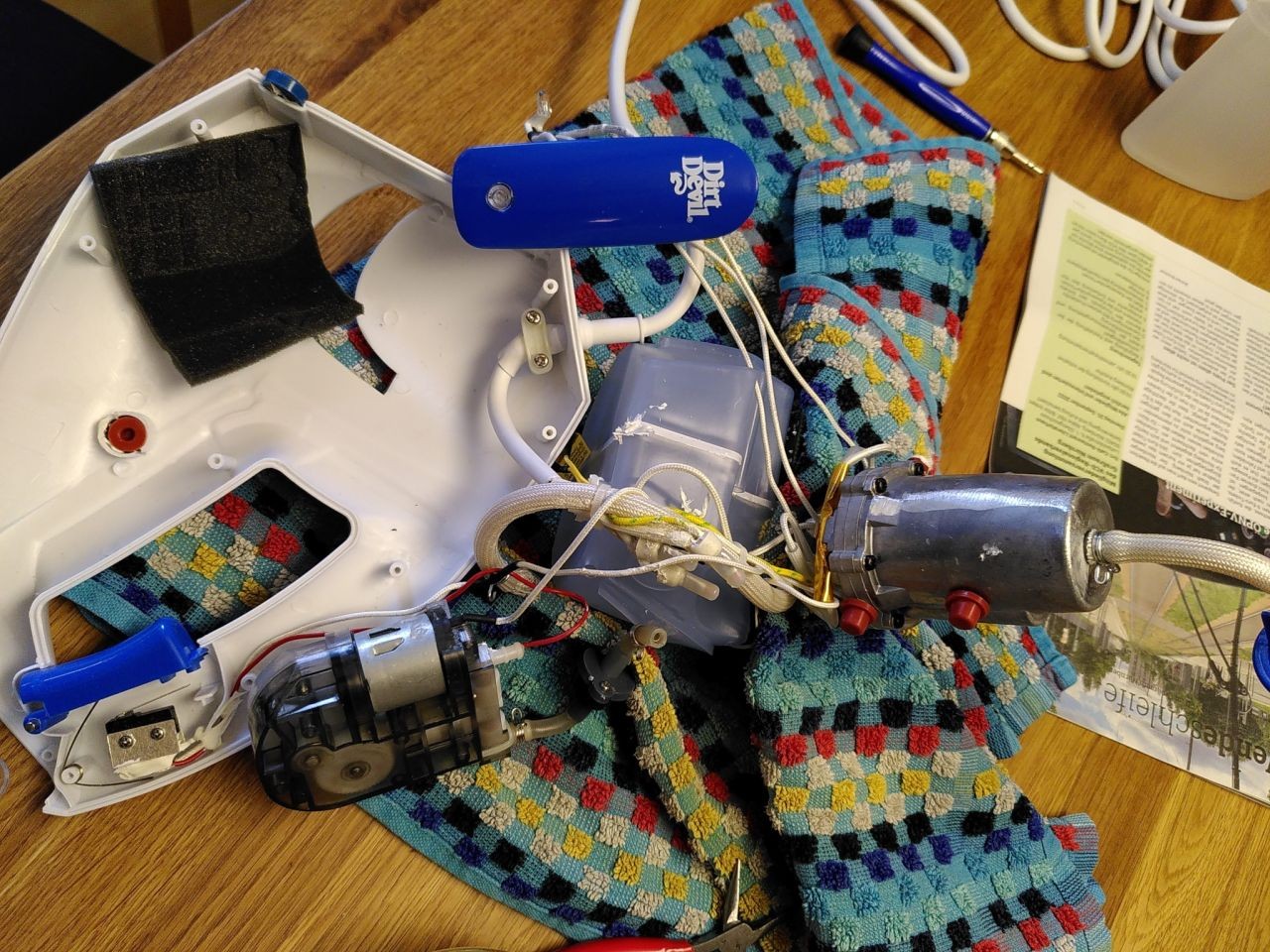
The operating table - things are fixed already, and at that stage, we're waiting for the heating block to cool off enough to reassemble the whole thing.

I had expected some limescale issue to be the cause, but no, there was nothing. Instead it looked like enough fine fibres and dust particles had accumulated in the fine filter mesh to stop water from coming through. Filter cleaned, set back in, then a longish session trying to fit everything back inside into its proper place and screw the thing shut again. 

The fibres in the filter probably came from not cleaning the little can that was provided to fill the duck with water well enough before using it - so fibres and dust from the bottom of the little water can got into the tank, and from there into the filter, and there you go. Clogging, after a while. Which means in the future the water can will get cleaned before use (with normal water) and just to prevent any chalk issues, distilled water will be used.

I'm very pleased now - both that it functions again (it will come in handy at the Textile Forum, I'm sure) and that it was possible to repair it!

0

By accepting you will be accessing a service provided by a third-party external to https://www.pallia.net/

Kontakt