Latest Comments

Guest - Aislinn Dyestuff Citizen Science.
09. Oktober 2026
This is a great project. I look forward to the results. Thanks for letting us know.
Guest - Aislinn Time for...
09. Oktober 2026
Looks delicious!
Guest - Katrin Sprang Discussion
18. September 2026
Hi Rachel, I have looked for more photos of you, but that was not very successful. I found a link on...
Guest - Beatrix Sprang Discussion
15. September 2026
That lozenge pattern element is not a photograph, but a scan. So it should be to scale. But I pinned...
Guest - Katrin Sprang Discussion
15. September 2026
I was not referring to Rachel's reconstruction (is the reconstruction you refer to the one photograp...
AUG.
29
0

Photo Database.

Things going on behind the scenes, here? The search for a new database programme for my images.

As you may guess, I've accumulated a lot of images over the years - photos, drawings, scans from books, videos, you name it. There's a few private and personal ones, but most of them are work-related. They've been handled by a wonderful programme called FotoTime ever since I discovered that, ages ago.

Unfortunately, the company lost their servers in an accident back in March 2021, and has ceased operation due to that. Some of their users lost all their pictures and data (never, never place something important in just one place, file-wise!). Fortunately, for me, that is not the case, but at some point in the future, the programme will probably be too old to work with the current version of Windows... so I thought it might be a smart thing to look into a replacement.

The really nice thing about FotoTime was that you could place your images in a folder structure on your computer that was unrelated to the "album" folder structure in the programme. You could set a date, and keywords, and a copyright notice, and an image description... and all those, of course, I'd like to have transferred to a new programme. Preferably also one that keeps my folder structure.

Some possible databases have already been ruled out, but the one I'm looking at currently is digiKam. It's free and open source, and my test installation seems to at least conserve all the things that were in the old database - and maybe I'll be able to migrate the old database into the new one once I've gotten an idea of how they are structured, and how they work.

If you have a good image database for organising your photos, do let me know what you are using!
0
AUG.
26
0

Holiday Travel Souvenirs.

Holiday travels are wonderful - seeing new places, meeting new people, eating new and different foods, talking different languages (or at least trying to). Then you arrive home again, eventually, bringing with you... well, what do you bring with you from holiday trips? Memories, of course - which may or may not fade over time. I'm not a diary person, but when we are on holidays, I write a little travel diary. That is something my mum always did, and because memories may fade, or it could be handy to look up where one stayed a few years ago, or some highlight of a trip, I also made this a habit. 

Then, of course, there's photographs. When I was a teenager and in my early twenties, I really enjoyed taking pictures during holidays, but somehow, that enjoyment got less and less over the years. Maybe it has something to do with me taking the camera mostly for work purposes, more and more so as time progressed. Mostly, though, the reason is that when I'm taking photos, some part of my brain gets obsessed with looking at things only in "will that make a good picture"-mode, and that distracts me from actually enjoying things, or looking at stuff just so. Fortunately, the Most Patient Husband of Them All does not have a similarly weird brain, and he takes a picture here and there and now and then, so we go home with a few images for our collection and to keep memories alive and to show them to friends and family.

Sometimes there's also something that we buy to take home with us. I have blind-baking ceramic "beans" that we bought on one of our England journeys years ago, and when I take them out to use them, I remember that trip. 

There's only so much you need for a household, though, and only so much stuff you want to buy and lug home from travelling. So my most favourite type of holiday souvenir is... a recipe.

I'm fond of good food, and I very much enjoy eating "foreign" things when abroad, and trying stuff that is a regional speciality. And sometimes, something is delicious enough for me to look up the recipe (or several of them, since, you know, Internet recipe search) and integrate it into our portfolio of things to cook here. Which means that I both get new ideas on what to cook or bake, and I have something reminding me of glorious times in other places, and it's something that does not need storage space (apart from the bit of space in my cook book).

Cinnamon rolls remind me of trips to the North - Scandinavia or Finland. Scones are, of course, England and Ireland. Just like pies, which I make way too rarely. There's Sächsische Quarkkeulchen, from our hiking through the Sachsenforst, there's Crostata reminding me of the Embroidery School in Muro Leccese this spring, and most recently there's Pressgurka, from our stop in Sweden on the way back home this summer.

Definitely my favourite kind of holiday souvenir, these recipes!

0
AUG.
25
2

Hands, Looks, and Expectations.

Social media is, if you ask me, both a blessing and a curse. It's a wonderful way to keep in contact with others, or to get into contact and discover new people and new things or possibilities. However, it also has a tendency to eat up inordinate amounts of time.

It also has a tendency, or an inherent danger, to foster unrealistic expectations. That came up a while ago in a chat with a friend and colleague, who told me about another colleague being the aim of harsh criticism regarding the look of her hands - which she had happened to post on social media.

Years ago, I remember seeing a gold ring for offer on etsy. The artisan himself had taken the photographs, and one of the images showed him holding the (very well-made, really beautiful) ring. Now... goldsmiths are metalworkers. Metalworking is not a job that has a reputation for being kind on your hands, or skin. The photo, consequently, showed a worker's hand, and you could see a bit of grime and a lot of abrasion and the nicks and cuts and scars that years of working metal had left.

To me, that was a very impressive picture, and beautiful in its own way, as it showed both the product and the most important tool to make it. The hand was not "pretty" or "beautiful" in the sense of someone being a hand model, but to me, the contrast between the shiny clean ring and the battered hand also made it clear that this piece was hard work to make, and had a cost beyond the materials and the time invested.

Someone of the potential customers actually complained about the "ugly" picture, and that it would be offensive to post dirty, ugly hands like that. To which the artisan replied that these are his hands, they look ugly like this because that's the cost of making beautiful things, and she's welcome to do her shopping elsewhere. (Or something roughly along these lines. It's been a long time ago.)

My own hands also tend to look a little battered. This is normally nothing that I much care about - unless it's something that gets in my way when working, such as exceptionally rough skin that silks will snag on, or something that causes pain. Other traces? My hands are tools, and tools will sport traces of their use after a while, even if used correctly and treated properly and with care. When they do so, to me, they have their own very special kind of beauty, So, to me, have a dyer's hands stained bright blue or red, or a shoemaker's hands with its calluses and short nails, or a goldsmith's hands with calluses and scars and metal dust caught in the cracks of skin.

If you ask me, hands that bear the traces of work should never be something to be ashamed of. On the contrary! 


0
AUG.
24
0

Oil Spill Threatening.

Off the coast of Yemen, there's an old oil supertanker that has been used as a storage facility and loading bay for crude oil. It's still hanging out there, slowly decaying. Or quickly decaying, these days, since maintenance has been called off because of the war.

Which means that the tanker, with four times the amount of oil that was spilled during the Exxon Valdez disaster, is a catastrophy scheduled to happen any old day now. 

There's a plan by the UNO to pump off the oil from the tanker, bringing it to a safer storage place, but they lack the funds to start work on the rescue mission. They lack a few millions, actually - and they're getting desperate enough to have started a crowdfunding, back in June. Up to today, though, there's not enough money been raised for this.

If you can spare some money, you can donate for this cause, either directly at the UNO website or via SumOfUs (German site here, there's no way I could find to link you to the English version.) You can also help by spreading word about this issue, and the UNO crowdfunding.

0
AUG.
23
2

Home Again!

I'm home again after the absolutely wonderful weekend at the Archäotechnica. It was lovely to have a museum event again after such a long pause due to the pandemic. I got to meet old friends and get to know new people, and realised how much I missed all this.

My work space was in the cloister, where I had very good light, but not too much of it - at least most of the time; on Sunday around noon, I had a bit of direct sun, and it was very hot and very bright and hard to see what I was doing.

I also realised that I have a very, very hard time stitching and speaking at the same time. So even though there were very few and very short breaks only, the amount of stitching that got done was... well, let's say that there was no danger at all that I'd run out of embroidery work.

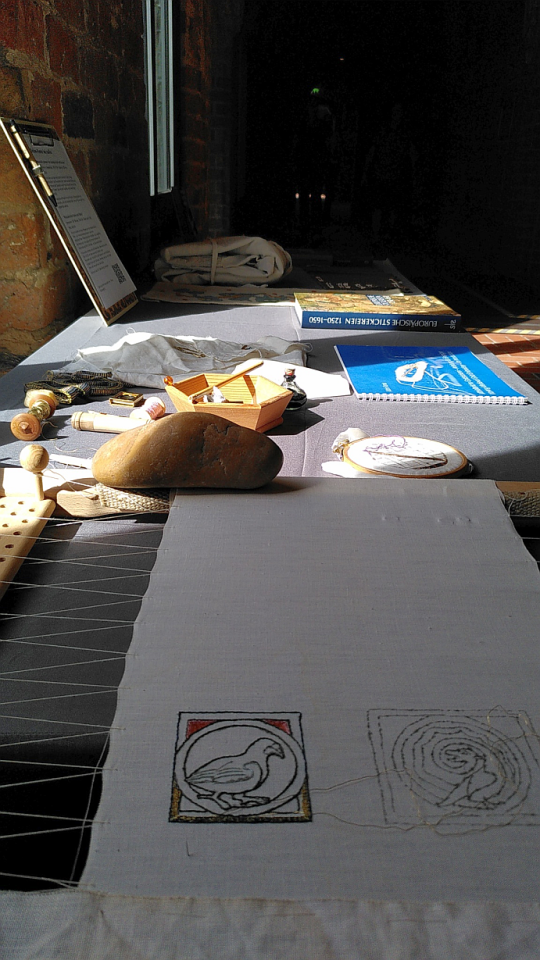
The gold in the picture is the result at the end of 7 hours of demonstration time - not at all to be confused as the result of 7 hours of embroidery time! 

A demo situation is always different from a proper work situation, even if the technique you demonstrate is one that needs very little attention. Your main focus, as a good demonstrator, will always be on the people coming and asking questions, or watching, and not on your work piece. So you stop things to explain, you work slower if necessary, you demonstrate mistakes or point out possible problems (in some cases making them happen on purpose), and your main aim is explaining things and not having a perfect piece at the end. (The gold embroidery quality is also not what I'd reasonably expect from myself as the result of a normal stitching session.)

Even when I'm doing a very low-demand technique such as combing wool, or spinning, I can feel a difference in how the work goes that I'm doing on a demo as opposed to doing it as work. (It's fascinating, really.) In my experience, there's techniques and things that need little or no brain, and little or no attention, and they are best suited for demonstration purposes. With these techniques, I can look at the people passing by, make eye contact, and talk to them without interrupting the work. Spinning would be one of these; netting also works very well in my experience. 

Techniques that need no brain, but focus on the work and attention are the other group of techniques where a demo is possible. These, which include anything involving stitching, are more difficult - as soon as you look like you are concentrating on something, quite a lot of people have qualms to ask something. I've had a lot of "may I ask you something" questions this weekend, and I am actually considering putting up a sign next time that says some thing like "do ask me things, that's what I am here for". I do try to stop and look up at my surroundings when I am demo-ing a high-focus technique, but it takes more effort from my end to demo this successfully and with similar amounts of interaction than a low-focus technique. 

The third group are techniques that need attention and focus as well as brain power. These are right out for demo purposes in my opinion. I just cannot give a proper impression of how something demanding is done and concentrate on getting the hows and whys across to visitors at the same time. So I'd never do a demo on complicated tablet-woven patterns, for instance. That requires all my attention, and I'd either not talk to people or weave with lots of errors and very badly.

This is also something that I explain to museums and event organisers when we're discussing possibilities for demonstrations. Usually we then find a technique that fits the event and that is suitable for a good demo. After all, a demo of the coolest and most astonishingly complicated technique serves nobody if it's just not working properly for the public.

Have you done demonstrations? Are your experiences similar?

0
AUG.
18
0

Update - Backups and Virus Scanner

Things are progressing here - albeit slowly. Of course my email programme was on the dead drive (one of the very, very few programmes not on the newer C: partition on a different physical drive), so that had to be re-installed and the data backup restored. This happened successfully (yay!) so I can now access my email archive again, and, even more importantly, work on the mails properly and not just in emergency mode over the mobile phone. 

There's a solid chance that the new HDD will arrive today, and then I can power down the machine here, put the new one in, and do a proper restore of everything that lived on the old place. Well, apart from the D: drive, which was not included in any backup (causing the issues with the mail programme, for instance) and I sincerely hope that there was nothing important stored on that drive, because it's dead as a doorknob.

On the upside - I have found out what caused the excruciating slowness and proneness to errors with my backup.It was an overenthusiastic Antivirus programme, which decided that since the RAID that the backups are stored on are not an internal drive, everything on them might be dangerous and contain a virus and thus has to be checked very, very thoroughly. Which, obviously, will take time...

So from now on I will try remember that, and if something concernes an external drive and then takes ages, I'll look for the antivirus as a possible culprit. If you're running into a similar problem on your computer, you can either turn off the antivir or, if using the Windows Defender antivirus (which, according to reports, is about as good in getting the bad guys as the free versions of standalones are) there's the possibility to exclude folders from getting scanned.

Oh, and because it bears repeating: if you haven't made your backup yet... well, you know. There's a lot of free and even more affordable programmes for backups out there; some external HDDs come with backup software pre-installed, so you should be able to find a solution without too much trouble. In case you don't want to look about that much at all and already have a drive of five lying around that you can store stuff on, I've used SyncBack Free for a long time and can recommend it.

I will be off travelling north tomorrow, and will return on Monday, so there will be blog silence until Tuesday... when I will hopefully also be able to work from a restored drive.

0
AUG.
17
0

Slow Going.

It's slow going here. Slow going part one: The resurrection of my data. The backups lie on a RAID, to make extra sure that everything is safe - but unfortunately I'm having connection troubles to said RAID, which means every copying action takes ages and then some. That is annoying, and slow going, and sometimes the connection trouble leads to the interruption of the copying process which means that some stuff is there, and some isn't, and I can't tell what is and what isn't. So things will take more time than expected. Which, to be frank, was to be expected, because just as the X never marks the spot, when has anything computer trouble related ever taken only as much time as expected?

(And just in case you are not thinking about that anyways right now: Do yourself a favour and check your backup solution. Make sure that it is current, and that everything important is covered, and that you can recover and restore your data if something dire happens. If you've been following this blog for a while, you've read me go on about this before, but, well, obviously it bears repeating. In the case you don't have a backup solution and regular backup plan yet... well. Do yourself a favour and change that.)

Slow going part two: Getting sorted (and packed) for the weekend in Brandenburg. That, though, was actually not as slow as I had feared! I have sorted my bits and bobs and odd ends of dyed embroidery silk and re-wound most of them onto better suited cores (reed cores, which I absolutely love). The gold thread is also sorted and packed, and now I am in the stage where I ponder what else I could need and put it all on the giant heap on the bed, from where it will be transferred into my rolling suitcase and, if necessary, an additional bag.

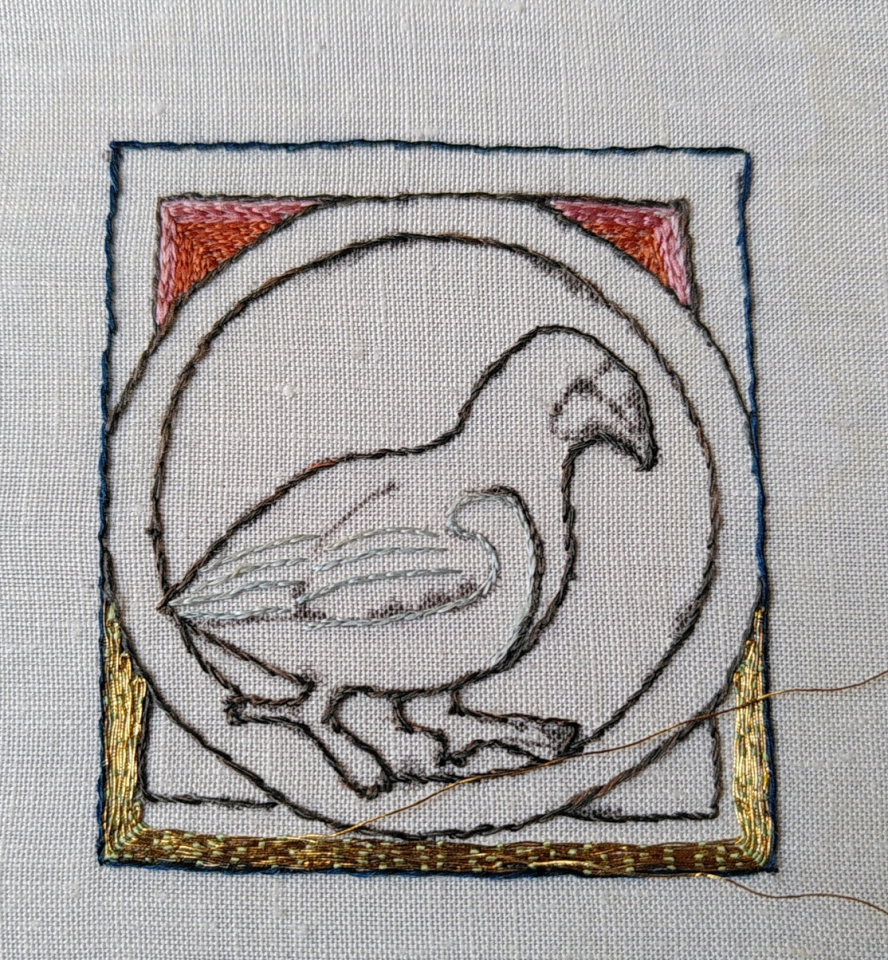
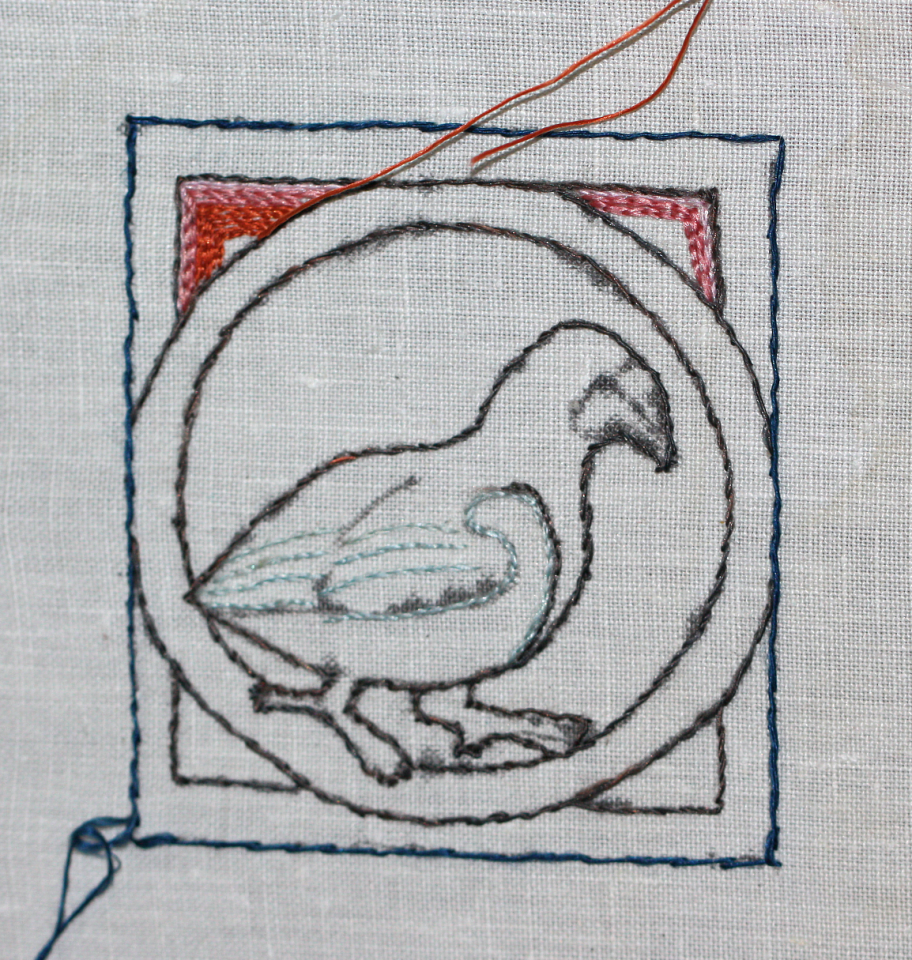
The main part of the preparation, though (and what I had expected to be slower and more gruesome) was making sure I can go ahead with gold embroidery right from Saturday morning. That meant inking my motif and doing the contour stitching as a minimum. Because gold and silk would be paired in such an embroidery, and because I wanted to be able to show at least a little bit of the silk part as well, I had planned to also do some split stitching.

This is stitched on fabric with about 20 threads per centimeter, which means that the stitches are fairly small. As you can see, there's a start made on the crow's wing feathers, and one of the corners of the frame is almost filled completely.  I'll do the last few missing stitches before the event starts, and this will give an impression of how the colour parts will look. The appropriate silks will also travel north with me so I can show that part of the work, too, if people are interested - just like I'll take some extra linen and the things to make pre-drawings or ink in motifs.

Because the thread is thin and the stitches are small, it does take a bit to get one of the corners filled, but it was enormously pleasant work - and in contrast to the computer stuff, progress was noticeable and there was no constant apprehension that there would be an error message.

Enter your text here ...

0

By accepting you will be accessing a service provided by a third-party external to https://www.pallia.net/

Kontakt