Latest Comments

Guest - Aislinn Dyestuff Citizen Science.
09. Oktober 2026
This is a great project. I look forward to the results. Thanks for letting us know.
Guest - Aislinn Time for...
09. Oktober 2026
Looks delicious!
Guest - Katrin Sprang Discussion
18. September 2026
Hi Rachel, I have looked for more photos of you, but that was not very successful. I found a link on...
Guest - Beatrix Sprang Discussion
15. September 2026
That lozenge pattern element is not a photograph, but a scan. So it should be to scale. But I pinned...
Guest - Katrin Sprang Discussion
15. September 2026
I was not referring to Rachel's reconstruction (is the reconstruction you refer to the one photograp...
DEZ.
01
0

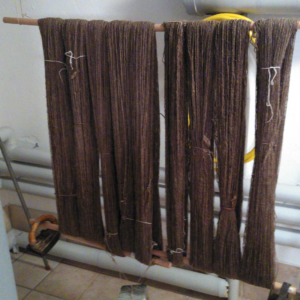
Drying!

A bunch of skeins is hanging out in the cellar, where it's nice and warm, and they are all drying. Actually they are almost dry - but I prefer to be really sure and leave them a little longer, if I can, than take them off sooner.


This is a little more than 2.5 km of yarn. I'm wet-finishing the skeins - soaking them in hot tap water (which has about 60° C here) for about 20 minutes, then stretching each skein, then hanging them to dry with a bit of weight to keep the yarn slightly stretched. It's not a lot of tension they are under, just enough to hold the yarns more or less straight.

I've marked each skein with a number, corresponding to the sequence they were spun in - and I'm very, very curious now to find out if the yardage has changed with the wet finish. Soon. As soon as they are completely dry...
0
NOV.
30
2

Argh Windows.

I've semi-recently switched to Win10 from my old trusty Win7, and now I have this very helpful update thingummy that deems it a very good idea to restart my computer over night, when I'm not looking. Argh.

Yes, I'm guilty of not restarting the machine very often - in fact, I only do it if I must, because some installation needs it, for instance. That has a reason, though - I like to have the things I'm currently working on open. Yes, I do save the files before leaving the computer (at least I usually do) but that does not mean I want to come back and find the programmes closed. I especially do not care to have my mail programme shut down by the system, because then said mail programme insists on doing a very long, leisurely database check... while I'm waiting for it to finish so I can get to my mail. Argh again.

Back in the old version it was possible to switch updating, including possibly necessary restarts, to manual only. Win10 does not allow for that without a little bit of twisting its guts, which I now have done, gleefully. If you're suffering from the automatic restart issue as well, here's one of the many tutorials on how to make it stop. I did the registry editing, by the way.

Oh, and now I have to restart the machine to make the change take hold...
0
NOV.
29
0

Like an Arrow!

There's a quite interesting article online about arrow wounds found on human remains in a site in Exeter - where, due to the fracture patterns and spalling it was even possible to see the probable turn direction of the arrow causing one wound.

Arrows usually spin, due to the slight curve of the feathers used as fletching; that stabilises the arrow while it's flying through the air. Depending on the curve of the feathers used, it will either turn clockwise or counterclockwise, and the curve of the feathers in turn depends on whether it was a left or a right wing feather.

It would be very interesting to know if one arrow-maker would prefer to do all arrows fletched in the same direction... or not. Or if they used tools or gadgets to get the fletching as consistent, and as accurate, as possible (like modern people do, when shooting with bow and arrow has become a sport, and precision is important) or if they just did it by eye. Back when I was having a bit of a go at shooting with bow and arrow, I tried both - my latest set of arrows had one feather taken from a bird of prey and two goose feathers each. They were rather soft, and made a quite distinct noise when flying through the air, and they were not stuck on in the precise 120° angle that more modern fletching is done in, and they were a little irregular anyways - but my shooting precision was never on a level where I'd feel that the irregularity made any difference. (Read: I had a lot of fun, but was quite bad at it.)

Modern feather fletching, by the way, is made from turkey feathers, and you can get them in all kinds of colours and patterns, pre-cut with a die so they are all exactly alike... and that makes the arrows look very different from ones done with less standardised, more natural fletching. They will all fly, though. And they will all make quite a bit of an impact!
0
NOV.
26
0

Very Wordy.

In case you're interested in German, or in Middle High German, and you don't know it yet, let me introduce you to the Wörterbuchnetz. This is a webpage that gives you access (and a search function) to a large number of German dictionaries and the Middle High German Word Database (MHDBDB is the German acronym) plus a few encyclopaedias. It is a wonderful resource if you're looking for meanings of words in the past - there, one of the Sources with capital S is the Grimm'sches Wörterbuch, and it's all in there as well.

An unexpected treasure trove is the Rechtswörterbuch, too - there's laws and regulations cited in there which also include medieval texts, and you can search for the names of jobs, for instance. There's a lot in there about the Schneider (tailor); the Färber (dyer) is only mentioned as a dialect term for a crook. So it's not complete, and not perfect, but if you like these things, it might still keep you entertained for a good while!
0
NOV.
25
0

Spinning Speed Ponderings.

Sometimes I have days (or is it still nights?) when I wake up way too early and cannot get back to sleep... so I usually get up and try to do something useful. Such as... work.

Today was one of those days - which means that it's now mid-afternoon and I'm feeling a bit more tired than I'd like to be, but there's still a stack of office work to be handled. (If you're wondering what I did the rest of the day, the answer is simple: For most of the time, I turned fluffy stuff into yarn.) It's no huge help that the cat is curled up on the sofa, napping and looking very cute and cuddle-able. There's visible progress, though. Yarn is happening! Not quite as quickly as I'd like it to, but hey, that's life.

Spinning speeds are something weird anyways. When I'm spinning for a project, I record all the time I spend on it, and I try to split time-keeping and -recording into the individual tasks to have a better overview in the end. So I will make notes for the time spent spinning, skeining, and wet-finishing the yarns. I did this for past projects as well, and I found that spinning speeds are not completely consistent. That is partly due to current form, partly depends on the kind of yarn to be spun and the fibre (and fibre prep), but there's also another factor: It's quite easy to fall into a slow, relaxed, dreamy pace even though I can draft faster. That will lead to slower spinning speed, of course, thank you Captain Obvious.

I'm not quite sure where that comes from - when I still only had my little wheel, the limiting factor was not the drafting speed, but the treadling speed. (There's only so fast that you can pedal.) With the hand-spindle, flicking speed and spindle turning speed is one limiting factor, the other is winding up speed. Winding up takes a lot of time, even if it's done quickly and efficiently. With the e-spinner, neither of these is there - so I can spin just as fast as I can draft.

In theory, that is quite, quite fast. I've done short test runs to find out how fast I can go, and it was significantly faster than with the spindle or treadle wheel - I think it was in the 140 m per hour range, or even a little higher. There are, however, limits to a sustainable drafting speed. I've learned that while I am able to go as fast for a short time, I'll fall into a slower rhythm when I am working for longer stretches of time. Which is okay - no sprinter is going to hold their speed for a marathon distance. The really evil trap, though, is when things start to feel so meditative and calming that spinning speed goes down some more, and more.

So when I'm production spinning now, I'm not only checking regularly for thickness, twist angle, overall okay-looking-ness of the yarn, progress on the bobbin and whether I have to move to the next bit of bobbin, and status of my tea cup (which includes heat and fill levels of tea), but also remind myself to keep up the good speed, and not start dawdling. I'm also wondering if people back in history had the same issues when spinning, and how they handled things. Did the medieval housewife care about whether she could be faster, or not? Was there more of a "it takes time, and will be done when it's done" mindset than we have today? I could well imagine that - but, of course, that is wild conjecture.

What do you think about the need for speed in medieval crafts, and medieval production? Is that a modern thing only? Did it depend? If so, on what? And if you're a spinner, are you leisure spinning, or production spinning? Do you have different spinning speeds? Have you ever tried to spin as fast as possible for a longer time? I'd love to hear about your experiences...
0
NOV.
24
0

...three more are done...

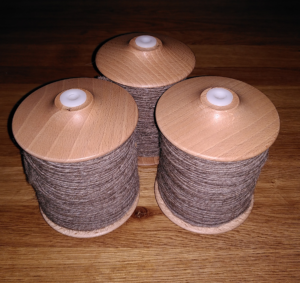
Here I am, with some more spinning done, and another three bobbins full.


Well, by now they have been emptied and partially re-filled. I also found out that my estimate of how much needs to be spun was a considerable amount lower than the final estimate is, after doing a test weave sample. It's the Law of Reconstructions and Reproductions, it seems, that if one mis-estimates anything, it's always a mis-estimate towards lower, quicker, easier, or cheaper than it turns out to be in the end.

Soon there will be a stack of skeins large enough that it will be time to draw a hot bath for them, and give them their settling soak. I've marked every skein with its number in the spinning sequence, so I can label them once they are dried - with the length in metres, the weight and grist. That will hopefully help to see how consistent the yarn is.

I'm also thinking about doing at least a partly re-skeining after washing and drying the yarn, to see if there's shrinkage. If so, I'd need to adjust the amount of yarn spun so it doesn't run out before the fabric is finished...
0
NOV.
23
0

Circular, Black, Madness.

You're probably also getting them: Loads and loads of advertisements and promises of deep discounts and insane deals, coming up on Friday, or the weekend, or all this week, even.

I think I posted a similar rant last year, and I'm kinda tired of doing it again, but... but. I will still write about this.

Black Friday is the day after Thanksgiving (the US food coma holiday), and it's been made a retail and shopping madness day at some point years back. It has since spread over about all the world, and now people are getting loads and loads of ads and discounts and whatnots to tempt them into buying stuff and more stuff.

Now... I totally get the desire to have nice things, and new things. I'm not adverse to having something pretty, and having stuff is, for most of us humans, a quite basic desire. Stuff like food is a necessity, as is clothing appropriate to the time of year and climate. Then there's the social component, stuff that shows one's taste and preferences and social status. There's stuff that we need for work, stuff that we want for comfort, stuff we buy to make others happy. Stuff we get to repair other stuff. Stuff we get for future use (stash acquisition, anyone?) and stuff we get for future use though we strongly suspect while getting it that we will never actually use it.

I am, overall, fine with that. For myself, I try to stop and think before buying something new whether I will really use it, and do so in time. Do I really need this? Will it be useful? Am I sure about this? Then there's some secondary considerations, like how is it packaged? How much energy does it use? How long will it last? Can it be repaired? Does it have a fair price, and where does the money land that I pay for it - where the work has been done, or somewhere else?

Altogether, these things lead to shopping decisions that I'm usually happy with, not just after buying, but years and sometimes decades later. My thermos cup felt really expensive back when I bought it, back in 2012. I'm still very happy about the decision to get it anyways every time I pull it out of my bag to have a coffee on the road. It looks quite battered by now, but it's still working very well. Deals limited to a short amount of time, intending to put pressure on people to buy right now this instance or the opportunity will be gone make me deeply suspicious, though. As do deep discounts - because, well, if the sticker price can be discounted that far, either the seller loses money with the deep discount (which is not a smart business move), or the sticker price is way higher than it would need to be for the seller to make a decent profit. But if there's still money made with the deeply discounted price... how cheap is the item, actually, when they buy it? I'd really love to know the calculations behind these deals...

For now, though, I'll stick with not buying stuff this Friday. Just like most Fridays. Like most days, actually. And that's something I'm totally fine with.
0

By accepting you will be accessing a service provided by a third-party external to https://www.pallia.net/

Kontakt