Latest Comments

Guest - Aislinn Dyestuff Citizen Science.
09. Oktober 2026
This is a great project. I look forward to the results. Thanks for letting us know.
Guest - Aislinn Time for...
09. Oktober 2026
Looks delicious!
Guest - Katrin Sprang Discussion
18. September 2026
Hi Rachel, I have looked for more photos of you, but that was not very successful. I found a link on...
Guest - Beatrix Sprang Discussion
15. September 2026
That lozenge pattern element is not a photograph, but a scan. So it should be to scale. But I pinned...
Guest - Katrin Sprang Discussion
15. September 2026
I was not referring to Rachel's reconstruction (is the reconstruction you refer to the one photograp...
APR.
09
0

Exhibition!

I've actually managed not to blog about this yet?

The exhibition about experimental archaeology, for which I've also provided some things, has opened: "Experimental Archaeology" at the MAMUZ at Schloß Asparn/Zaya.

It is, of course, currently closed (hellooo lockdown!) but since it runs until November 2021, there should be time to see the exhibition it if you're planning to do so. I've been at the MAMUZ before, and it is definitely a lovely place to visit!
0
APR.
08
0

For your delectation.

Resources! Stuff to read and watch!

I always enjoy stumbling across repositories or book lists where you can download fresh, juicy research. (Admittedly, I do download more than I actually read. I'm trying to get everything sorted into my library database, at least, though I'm eternally not caught up with that. The reason? See above - stumbling across repositories... resulting in a little search-and-download splurge.)

My newest discovery is the DiVA portal. That's short for Digital Vetenskapliga Arkivet, a Scandinavian site where you can search for theses and papers from 49 university and research institutions. It looks like it's very well tagged in English, too - searching for "textiles" and either "history" or "medieval" yields a number of results, some of them in English, most in Swedish. Also nice: you can limit the search results to things with full-text available.

Many of these are student papers, so it's research that you don't get to so easily otherwise - delightful to have the possibility to see these via the portal. And if you don't read Swedish (or Norwegian), most should have an abstract in English. Plus you can look at images in any language.

Definitely in English is the upcoming series of the British Library in their Food Season, where there's a number of online events about different aspects of modern and historical food and food culture. If you're a foodie, it's definitely worth checking out.
0
APR.
07
0

Easter Cake, Continued.

It seems that the shapely Easter Lamb/Bunny cake is actually not a global phenomenon... so here's a bit more about it.

Baking shaped cakes is in the tradition of the "Gebildbrot" (image-y bread; link takes you to German Wikipedia, which has some images), and that reaches back a bit. It also seems to be a German-Austrian thing, though specially shaped baked goods do occur in other countries.

[caption id="attachment_5964" align="alignnone" width="300"] If you eat the antlers first, it looks much more lamb-like...
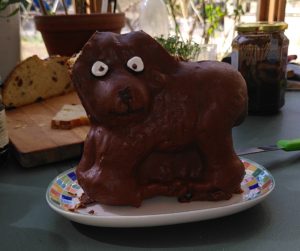

We have the Easter bunnies and lambs, though. There's also yeast dough bunnies and lambs. Plus, in the wintertime, there are gingerbread men, and other gingerbread shapes. There's the Stollen, too, which is supposed to remind, with its form and white sugar covering, of the swaddled child. And even the very common find-it-at-every-bakery-every-day pretzel is a form of Gebildbrot. Then there's the Plätzchen, with their many shapes and forms, that get baked for Christmas (and, to a lesser extent, for Easter).

Anyways... back to the lamb. Traditionally, the way I know it and grew up with, the cake made in lamb-shape is a very simple one, nothing fancy: flour, eggs, sugar, baking powder, a bit of lemon peel grated in and maybe a dash of lemon juice. That's also the kind you would get at a bakery. When I was small, our church also gave out a lamb as a present to each of the helpers with the festive service. (Everyone who attended got an egg, coloured, of course, that had been blessed.)

The moulds are usually considerably smaller than normal cake tins, so my mum always made additional small cakes to use up the batter. The cake she made in the bunny mould was usually a marble cake, one of the usual suspects to be made in our home (with lots of dark and little light dough, because everyone liked it better that way). I made an eggnogg cake for the elk, because of eggnogg being there, and anything with eggs is considered quite easterly, so it sort of fit. (Delicious, too, by the way.)

Baking in these shaped moulds is quite fun, but you do need to grease them thoroughly and then powder them with crumbs, or ground nuts if you like nuts, so the cake will not stick. My elk has an anti-stick coating, which does help, but it still needs the assistance. The older bunny mould my mum has really, really needs the buttering and crumb-coating, else you'll have bunny crumbs only. Also I tend to fill in too much dough, and there's always some left over anyways, which means it's a good idea to have an extra small cake tin or some muffin thingies handy. Unless you like to eat lots of raw cake batter, of course...
0
APR.
06
5

Easter Cake.

I hope you had a nice long holiday weekend - here it was wonderful weather on Saturday and Sunday, and quite cool on Monday. Then it actually started snowing on Monday evening, and has been snowing on and off all day today. That's true and typical April weather!

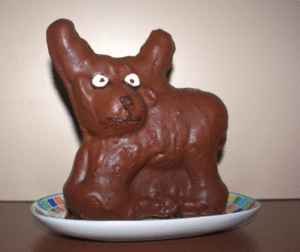
Speaking of typical - one of the typical things for Easter in Germany is cake. Special, shapely cake. This year, I had the strong desire to follow this Easter... and this is what ours looked like:


Admittedly, this is not the entirely traditional cake. That, of course, is in form of a sheep or an Easter bunny. You can either buy a special baking mould and bake them yourself, or buy a ready-baked sheep at about every single local bakery that exists. (The reason for the elk? I own neither a sheep- nor a bunny-shaped mould. My mom has a bunny... but in our household, there's only the elk, which we got as a wedding present and use far too rarely anyways. Also, if you cut off the antlers and eat them, it looks much more lamb-like already.)

And now I'm curious - do you have Easter cakes like that in your spot in the world? Or is that entirely unknown where you are?
0
APR.
01
0

Happy Holidays!

Today, it's actually technically correct for the Thursday to feel like Friday... as tomorrow's a holiday.

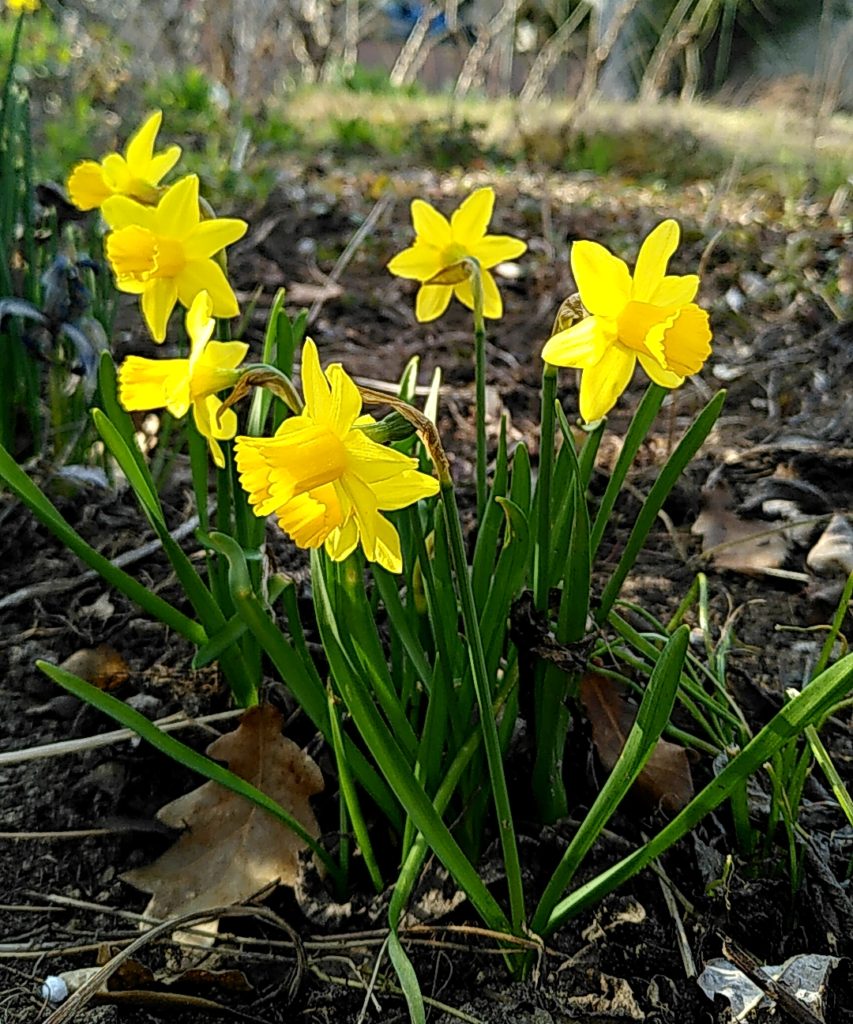
So, with these timely Easter flowers blooming in our garden, I wish you a good Easter time, with the appropriate amount of eggs (chocolate or other) and hopefully some wonderful weather:


I'll be back on the blog on Tuesday!
0
MäRZ
31
0

Gold on the Move

If you're interested in medieval gold threads, there's a zoom talk at/from Yale University on Friday, April 2:

Department of the History of Art, Yale University, Medieval-Renaissance Forum: Gold on the Move. The Mongol Impact on 13th and 14th century Asian and Mediterranean Textiles.

It's at 12:00 pm Yale time, and if I did my time conversion correctly, that corresponds to 18:00 h German time. Which is a very reasonable time to listen to a talk!
0
MäRZ
30
0

New Wool!

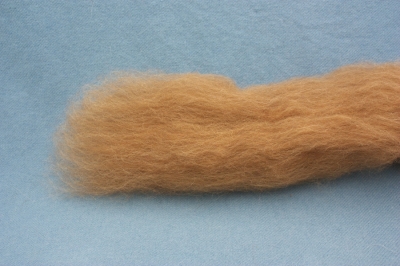
There's not only new spindle whorls in the shop, there's also new wool - from a rare sheep breed.

The Manx Loaghan sheep is a small, hardy breed that can be found on the Isle of Man. The sheep are a four-horned breed; some of them even have six horns. You can read a bit more about it on the Wikipedia page, with links there for more.

It's mostly kept for its meat, but the wool is also really beautiful: a warm, brown colour that reminds me of honeydew or chestnut honey.


The wool arrived just in time to make it into the shop in time for the March newsletter... which will go out tomorrow in the English version, and has been sent already in the German version. Hooray!

 
0

By accepting you will be accessing a service provided by a third-party external to https://www.pallia.net/

Kontakt