Latest Comments

Guest - Aislinn Dyestuff Citizen Science.
09. Oktober 2026
This is a great project. I look forward to the results. Thanks for letting us know.
Guest - Aislinn Time for...
09. Oktober 2026
Looks delicious!
Guest - Katrin Sprang Discussion
18. September 2026
Hi Rachel, I have looked for more photos of you, but that was not very successful. I found a link on...
Guest - Beatrix Sprang Discussion
15. September 2026
That lozenge pattern element is not a photograph, but a scan. So it should be to scale. But I pinned...
Guest - Katrin Sprang Discussion
15. September 2026
I was not referring to Rachel's reconstruction (is the reconstruction you refer to the one photograp...
MäRZ
18
0

Close-Up Altar.

I've been doing some more sniffing around on the 'Net for a work project, and I've come across this very nice project: The Rode Project, featuring two altars by the late-medieval artist Hermen Rode. One of them is in Lübeck, the other in Tallinn, and both are absolutely spectacular - and you can have a really close look at them in the Rode Project.

Both are from the late 15th century, and you can virtually open them to enjoy the altars in all their aspects - plus see the paintings in infra-red or in normal light. And, of course, marvel at the wonderful things that all the people are wearing!
0
MäRZ
17
0

Free Books!

I've done a little research work these past days, and I've stumbled across, the title might be a hint, free books!

The University Publisher of Kassel University offers books (dissertations, but other types as well) both as printed volumes and as pdf downloads, the latter being entirely free. You can see the whole programme of the publisher here.

Two books that I came across that may be interesting for you, too, are Presche, Christian: Kassel im Mittelalter and Wolkewitz, Ursula: Die gravierten Messinggrabplatten des 13. und 14.Jahrhunderts im Bereich der norddeutschen Hanse - ihre Herkunft und ihre Bedeutung.

There might be more, but unfortunately there is no good search function for the catalogue, and I have not had the time (nor the inclination or patience) to click my way through the long list. In case you find something interesting, too, please let the rest of us know in the comments!
0
MäRZ
16
0

I think she got it.

I was sort of more or less planning to write another ranty post today, because of all the Corona-related stupidity happening here in Germany right now, but I'll postpone it. Because guess who used the cat stairs today, with only minimal prompting?

Madam obviously wanted to hop up onto the desk, but she's having a non-jump day. So she only suggested a slight hop (not like yesterday, when she tried to jump but didn't get high enough, so she dropped down from having her front paws on the desk, but not more). So I petted her and tapped my finger on the stairs to get her to look at them, and maybe consider using them in her little cat brain... and she actually did look at them. And used them.

Minimal prompting, I'd say. Quite possibly next time, she'll need no prompting at all anymore! Of course she was properly praised and petted upon arrival here upstairs, and after some cuddling on my arm, she's now happily installed on her office cat bed, snoozing peacefully.

 
0
MäRZ
15
0

Innocence?

I'm currently having a lot of fun with an Instagram photo challenge, initiated by ig14.at - there's a topic for every day as a prompt, and the challenge is to post a living history photo for it.

Some of the topics are really easy, but others I find quite hard. Not because I don't have associations, or haven't had the situation (like "cold"... who hasn't frozen half-solid at some event or other), but because I usually don't have a picture for it, at least not one showing me in that situation.

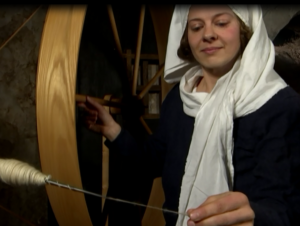
One of those prompts was "innocence". After a while of thinking, I ended up with this picture:


Why? Well, let me take you around the three corners that brought me here:

Sleeping Beauty is a story, more or less, about innocence lost. (It's actually not a very female-friendly story, as unless you read the cleaned-up version, it's not just kissing that happens when the man finds her. She loses her innocence to him, in some versions without having a say in it, as she's still asleep.)

Sleeping Beauty pricks her finger while spinning, or so the tale says. Well, as I have told a lot of people posing that question on events, that did definitely not happen on a normal handspindle, and also not on a modern treadled spinning wheel. While the early Great Wheel does have a pointy spindle, it does not need to be really sharp. With enough enthusiasm or clumsiness, though, yes, you could hurt yourself on the tip of the spindle rod (mine is about as sharp as the tip of a modern dessert fork). A late medieval version of the tale from France sees Sleeping Beauty ram a wooden splinter left from bad flax processing under her fingernail - which I guess is at least as probable as ramming her hand into the spindle of a wool wheel.

If you'd like to read more about this, I've written a bit about the Sleeping Beauty Question here - and if you are curious about the other things on the challenge that I posted, you can have a look at my Instagram feed here.
0
MäRZ
12
0

Nobody Tells You.

One of the things I've learned running my own business: Nobody Tells You Things.

I always thought that information about things changing that would affect a shop or business would be coming to said shops and businesses. Say, for instance, that there's a change in VAT rate - the tax you have to charge for every sale.

If you have a business in Germany, you're listed and registered. At the very least, your home town has your registration as a business. You might also be registered in some other institutions or thingummies, but let's leave that aside - one registration, which is in your town and thus an official state registration, that's enough.

So in theory, since you are registered and the state should sort of have an interest in having you comply with rules and regulations... I'd have expected some letter or email or notice about that change in VAT rules to come to each business. Not necessarily a long explanation or precise instructions, mind. Just something like a heads-up, as in "there'll be a change, please check if that applies to your business and inform yourself".

Just in case you're also in the Fluffy Bunny Wonderland of Imagination and Incredible Optimism, like I was about this once upon a time, let me burst your bubble: This is not so. Nobody official from the town, or from the state, or from the EU, or from any other stately place, ever tells you anything about upcoming rules or changes. Ever. EVER. You have to miraculously find out about things yourself... or fail to do so, and then maybe eventually fail to comply with rules. The most you can hope for then is an admonishment if your failure to comply comes out somehow, and maybe you'll have to pay a fine then, too.

The long-time readers of you will remember the issue with VAT-MOSS (or VAT-MESS) some 5 years back, when VAT rules for digital goods sales across borders were changed, and caught a lot of vendors unaware. Back then, already, it was hinted that similar rules should be introduced for physical goods as well. This is now going to happen; it was planned to start in January 2021, but has been postponed to July because of the pandemic. I accidentally learned about that this morning... which meant I spent half the morning reading up on stuff to find out what I'll have to do come July.

The good news is: looks like I'll have to do exactly... nothing. My business, and thus my export volume, is small enough to fall under the annual export threshold, which, thank goodness, has been set into place right from the start (as opposed to when the digital sales VAT changed). As a side effect, I've also found out that a similar threshold has been put into place for sales of digital goods, which is fantastic as I'll be able to sell digital instructions and knitting patterns from my shop again. (That threshold introduction happened at sometime back between 2015 and now, and I totally missed it.)

So. Phew. A burst of adrenaline, and then good news - that's an okay outcome of this. And I confess, should you now all conspire to order so many things outside of Germany but within the EU to lift me over the threshold, I'd be totally cool to register for the One-Stop-Shop for my taxes and do the fancy changes to the shop system that would be necessary. (If you want to know, it would mean to look up the tax rates for each of the 27 member states and what they apply to, as books and other printed goods are sometimes taxed with a reduced rate and sometimes not at all, then enter those taxes in the shop system accordingly for each country. Then test all that to make sure it functions properly. That is probably a workday, if it's going badly, more.)

After this little intermezzo... I can now tackle my overly long list of things again. Hooray!
0
MäRZ
11
0

17th Century Braids.

Just in case you totally need to look at a 17th century manuscript today, which has examples for braids and instructions on how to make them, here you go:

V&A Unknown Manuscript with nine pages, vellum, c 1625-1650.
Ah, they look pretty. Preeeeetty.
0
MäRZ
10
2

Virtual Unfolding.

Back when I was writing my thesis, I hung out a lot with physicists working with a small detector - so I got a glimpse, occasionally, of small things being scanned and imaged in incredible detail. It made me aware of the fact that with modern technology, a lot of really mind-boggling things are possible.

Something along the same lines of "really cool things that are now possible" is the virtual unfolding of old letters. Over the centuries, quite a lot of letters were never delivered, due to some reason or other, and most of them still hang out somewhere. Now, before the advent of the modern envelope, those letters were folded and sealed, and the folding was sometimes very intricate. In order to read the letters, though, this means that they have to be opened... and apparently that is not always easy, and usually leads to some damage to the letter.

Enter modern technology. Or, to be more precise, X-ray microtomography, which makes it possible to scan the many layers of the letterlocked letters, then reconstruct the whole thing in a 3D-simulation, and finally to unfold the whole thing virtually so it can actually be read. Isn't that incredible?

You can read more about this in this article on nature.com titled "Unlocking history through automated virtual unfolding of sealed documents imaged by X-ray microtomography", or, if you prefer to read German, there's also an article here on Spiegel.de.

And now I want to learn at least one of these cool folding methods...
0

By accepting you will be accessing a service provided by a third-party external to https://www.pallia.net/

Kontakt