Latest Comments

Guest - Aislinn Dyestuff Citizen Science.
09. Oktober 2026
This is a great project. I look forward to the results. Thanks for letting us know.
Guest - Aislinn Time for...
09. Oktober 2026
Looks delicious!
Guest - Katrin Sprang Discussion
18. September 2026
Hi Rachel, I have looked for more photos of you, but that was not very successful. I found a link on...
Guest - Beatrix Sprang Discussion
15. September 2026
That lozenge pattern element is not a photograph, but a scan. So it should be to scale. But I pinned...
Guest - Katrin Sprang Discussion
15. September 2026
I was not referring to Rachel's reconstruction (is the reconstruction you refer to the one photograp...
FEB.
08
0

Braiding, Hair and Other Stuff.

Braiding is a fascinating technique - there's so many different braids that can be made, just by passing strands over each other, and there's a good number of different ways to go at it as well.

That starts from using just your fingers to hold the individual strands, which are fixed at one end, continues with the use of loops held on the fingers or the hands, and ends at the use of more elaborate tools such as braiding stands or braiding tables, weights, and weighted spools for the individual elements. The last is used, among other things, in kumihimo (the Japanese art of braiding), but was also employed in Europe for braiding hair.

In case you're not familiar with that, there was a time in the 19th century when it was totally en vogue to have jewellery or artwork done with human hair, as a keepsake and especially as a remembrance item for deceased loved ones or family members. You can read a bit more about this topic here, and the book referenced whenever hairwork is mentioned, "Self-Instructor in the Art of Hair Work", is freely available on the 'Net, for instance here at archive.org or via googlebooks or Project Gutenberg (if you're not in Germany, that is - Project Gutenberg is blocked off for German IPs, because, ah, stupidity.)

I've thought about trying to do some hair work with my own hair now and then, basically whenever I stumbled across this topic, but I've never actually put together all the necessary things and actually tried it. Maybe some day I will, before my hair gets too short (age is having an effect here - my braid used to be quite a bit longer five or ten years ago!).

Anyway - there is a distinct similarity between this technique used for hair work, with weights attached to the many individual elements and braiding with the help of a stand, and kumihimo. In case you're interested in the latter, the American Kumihimo Society is running a virtual meet-up with several workshops on March 20&21. Registration is possible for both members and non-members; you can learn more about the virtual meet and the workshops here.
0
FEB.
05
4

Willow Harvest Time!

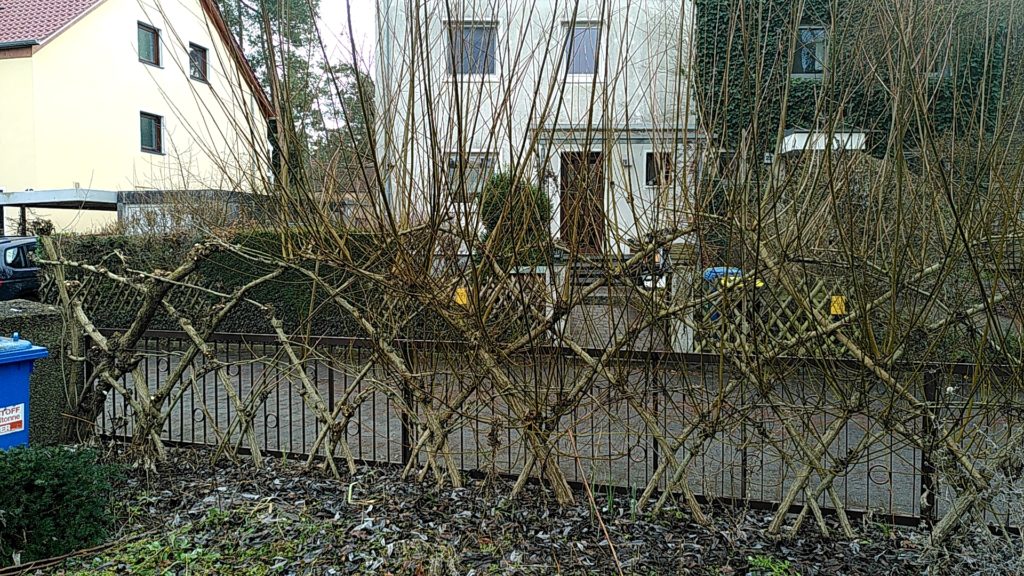
It's the time of year again - our willow fence has to be pruned. Willow harvest!

I find it absolutely amazing each year to see how much biomass this fence pushes out; and each year there's more of the really thick ones. I'd say withies, but they are more like little trees themselves!

We got started with the cutting yesterday, and as usual, it will take us a while and a few sessions to get through the whole fence. There is definitely a difference visible already, though:


You can see where we got started on the left side. We're always cutting the fence in several (many!) sessions, as there are still some places where the basic structure is not established completely, and it takes some concentration to not cut the wrong bits off. Especially the lower arches are prone to losses, and it's very easy to cut off all possible replacement shoots before realising that one would have been needed to close the gap... It's also still rather nippy in February, and cold hands do not work so well.

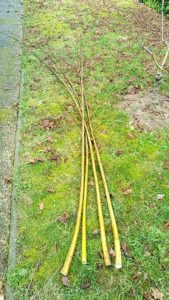
When we planted the fence, we made sure to choose a willow variant that is suitable for basketry, but some of them are also used for willowing wool (as in beating it to fluffiness) - and some will become distaffs. Such as these nice, straight, rather sturdy ones:


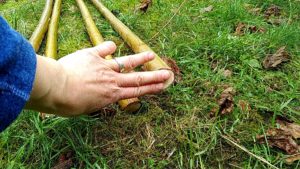
They are really long - and rather thick at the bottom end, as you can see here with my trusty measurement fingers:


My index and middle finger side by side are exactly 3 cm wide. That has come in handy so many times!

On that note: If you are ever in the need of figuring out how long or wide something is - and who isn't - it is totally worth it to play around with a ruler and figure out how wide your fingers in various combinations are. I get 3, 5, and approximately 1 cm with my fingers, plus an approximately 20 cm with my hand fully spanned out, and there's a lot of measurement questions that can be covered with these units.
0
FEB.
04
0

More Mini Painting.

There's been some more mini painting - it's definitely fun to put colour on those little cubes, with each of them being quite different from the others regarding colour schemes and general feel.

Some of them have their first (glossy) layer of varnish now, such as this one, called "Pinky Schweets":


You can tell why this mini has this name, not only from the sweets stuck into the pink fur here and there - it's also holding a bag of the name-giving items in one hand:


The amount of sculpted detail is quite different from cube to cube, and sometimes there's a significant difference between what is drawn on the player board and what the mini shows. I've tried to match the look of the mini on the player board as closely as possible - though in some cases, my colours are a little off.

Like in the back hollow of this figure, where the little animal should be a tad more brownish instead of grey.


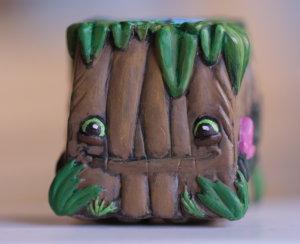
I've decided to leave it as is, though - otherwise I'd have to do the eyes, nose, and tail stripes again, and it's not so far away from the artwork to be a real issue in recognising what side of the cube it is. The face of this guy looks like this, by the way:


and it's also almost ready for its first layer of varnish now!

 
0
FEB.
03
0

More goldwork.

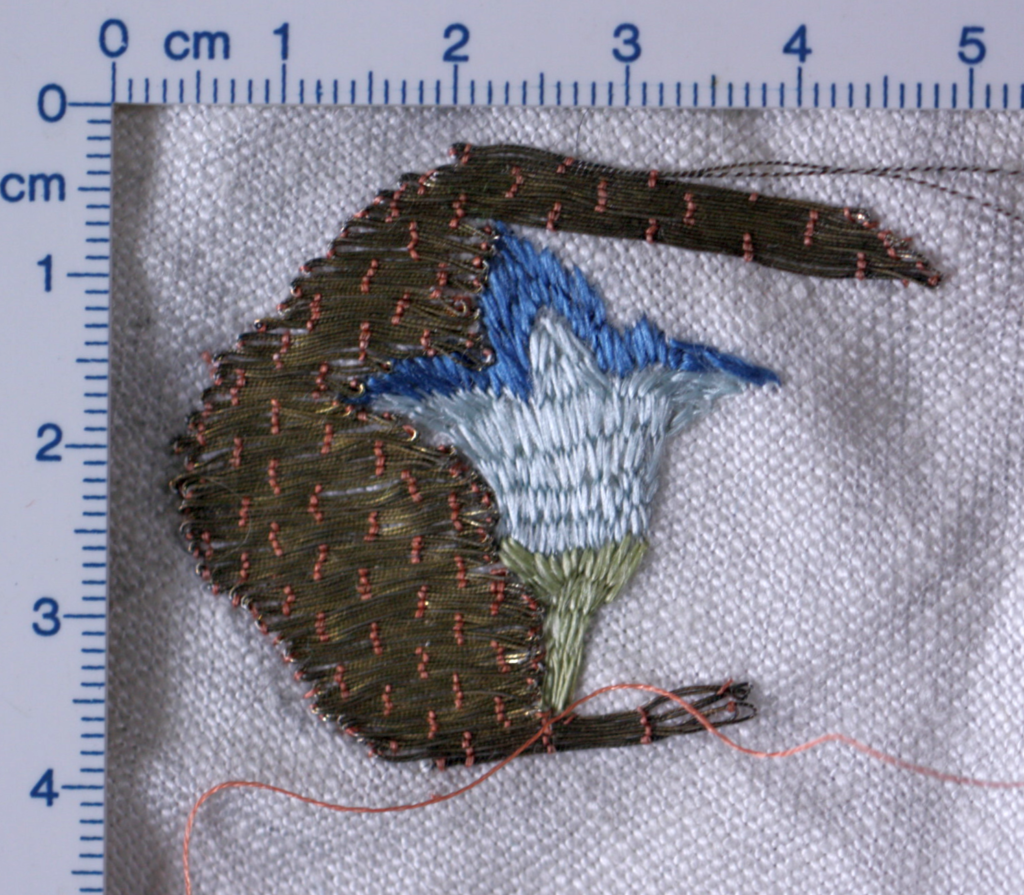
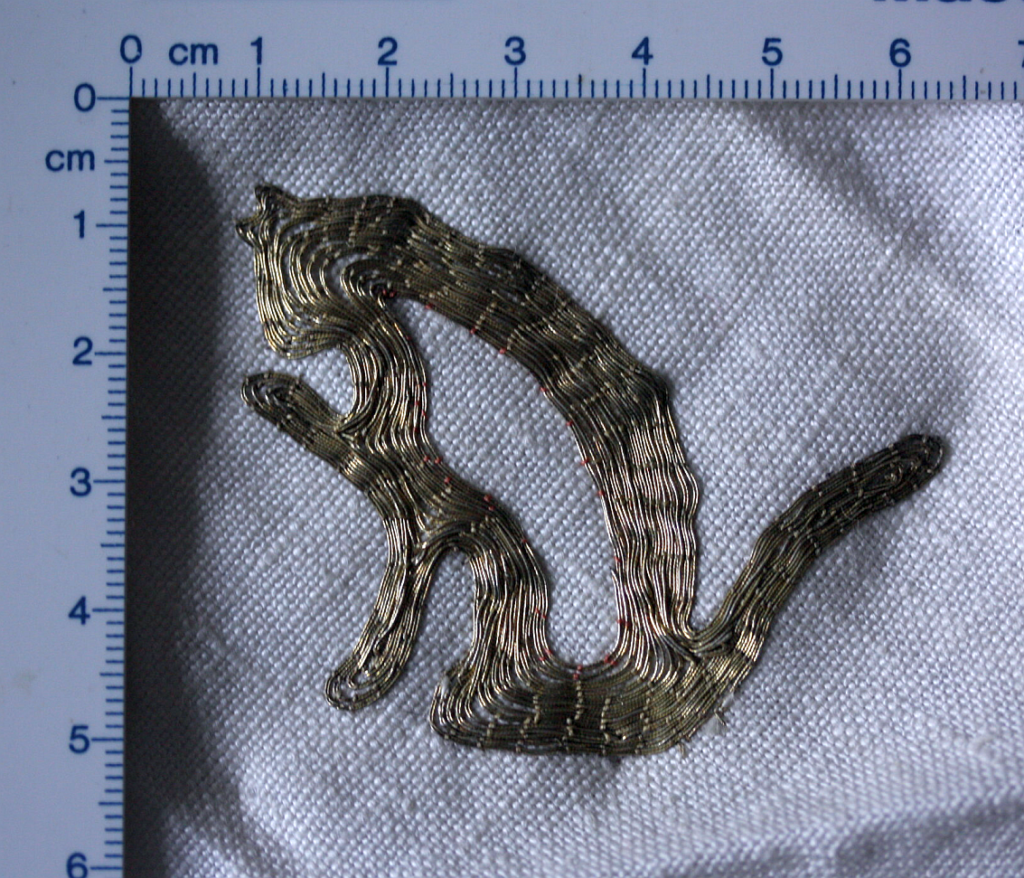
Here's another picture of embroidery featuring gold - this is the sample (unfinished, of course) where I did the counting of how many threads were lying side to side:


The silk parts are worked in split stitch, the gold is couched down with a red silk thread in the same thickness. As you can see, I was not very good at this kind of stitching when I made the sample - which was quite a few years ago! I did this bit mostly to show how the silk and gold would look together, and how split stitch can be used to cover an area. So it was stitched on a rough charcoal drawing as a template, and the gold patch also only outlined with coal, still faintly visible and not very rounded or symmetrical.

Like most of my sample bits, this has been dragged around and stuffed into baskets and boxes and taken out and fingered and then stuffed back in wherever it came from. I've also cleaned (gently washed) all my samples at least once by now. The gold has developed a little bit of a patina due to all this, but it's still pretty and shiny when light falls on it. So - it does hold up quite well!
0
FEB.
02
0

Gold Embroidery Maths.

I've been asked recently about how much gold thread to calculate for covering a given area - so I've taken out my samples and took a look, and did some maths, and maybe that's interesting for you, too.

The gold thread that I have in the shop is about 0,2 mm in diameter - so if we assume that it will be couched down perfectly, one thread right beside the next, and there's no significant gap between threads, 50 threads next to each other are needed to cover a width of one centimeter. For a stripe one centimeter wide and ten centimeters long, accordingly 5 metres of thread are needed - plus a little more, since it's necessary to have a little bit of thread to pull to the back of the fabric.

When I had my gold embroidery starter kit fairly new, I found a volunteer to test it for me, and these are the results of stitching with 5 m of gold thread:

[caption id="attachment_5805" align="alignnone" width="640"] This is how much ground you can cover with 5 m of gold thread.


That's roughly in the area of the 10 x 1 cm stripe. As you can see in the picture (hopefully - it's really hard to take a good photo of gold embroideries!) there are areas where the threads overlap a little, and areas where there are narrow gaps, and that can even itself out or, if you tend more towards one or the other, it will reduce or extend your covered area slightly.

As to the number of threads lying beside each other, I did some counting on a piece where I had threads couched all in parallel, and I got about 21 to 23 threads on 5 mm - so about 42 to 46 per centimeter. Which is close to the theoretical 50, but not quite there, just like I would have expected.

For calculating thread needs, thus, 50 cm of thread per square centimeter seems to be a good ballpark number - it should give you enough wiggle room to anchor your thread ends and safely cover that area, even if you have a little bit of overlap here or there.
0
FEB.
01
2

Looking for Celebration Excuses?

Just in case your February has started like mine - with grey soggy weather and a stack of unexpected bills to pay - and you need something to smile about: there's a calendar that lists probably not every National Day of Whatever You Can Think Of, but at least an astounding number of them. (And a good number of international ones, too.)

So in case you're looking for an excuse to eat cabbage, cream-filled chocolates, chili, or chocolate soufflé - that calendar has you covered. Actually, that calendar could even serve as an inspiration on what to have for lunch, as a lot of the "National Day of" topics are certain foods. Maybe kahlua for lunch is not such a good idea, though... but I could totally live with chocolate soufflé as main meal!
0
JAN.
29
0

Nothing new here.

It's Friday (hooray!) and apart from that, there's nothing much new going on here. I'm still working on the things that are due, among them the January newsletter (which just went out) and yes, still the tax stuff. I can totally see the necessity of bookkeeping, but I'm not ever going to be a fan of doing it.

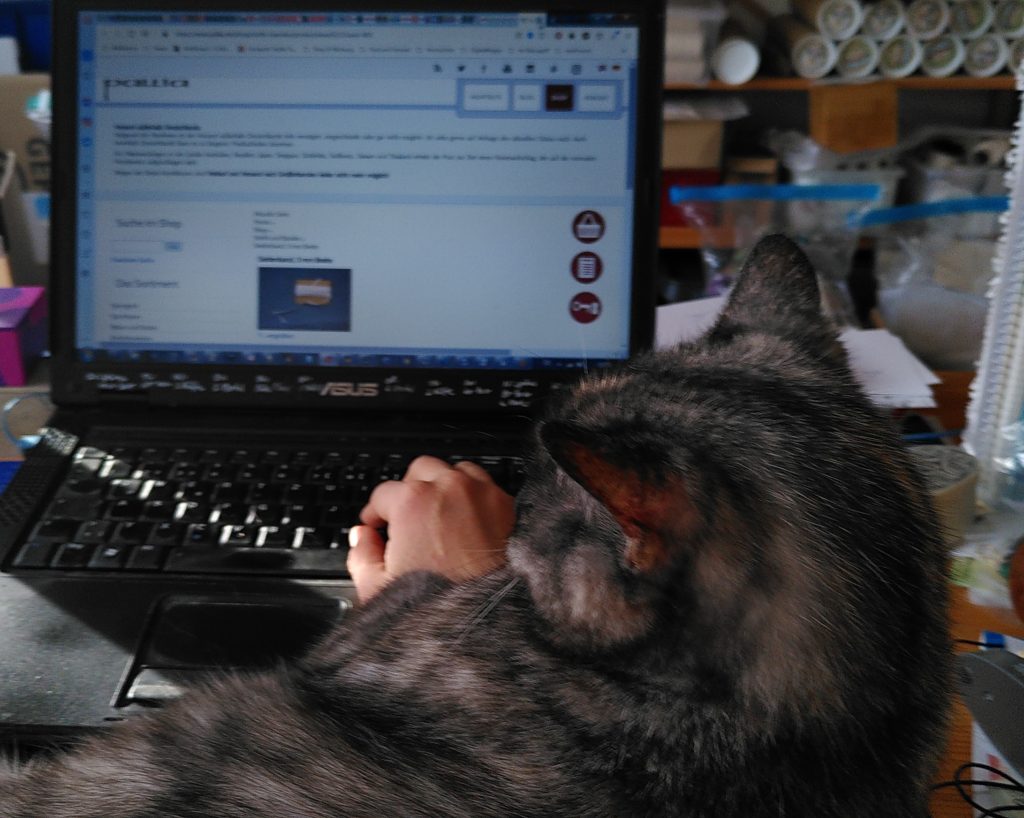
The little cat complains about the weather (which has been way too wet for her taste for several days now) and prefers to hang around inside. She also prefers to use the litter box inside, instead of going outside and wetting the ground even more.

[caption id="attachment_5797" align="alignnone" width="640"] Nothing makes work go better than some furry help - at least according to Madam the Cat...


At least I've managed to get a little bit of research time in, puzzling about a few different loop-braided bands - it's nice to have some brain-bending once in a while!
0

By accepting you will be accessing a service provided by a third-party external to https://www.pallia.net/

Kontakt