Latest Comments

Guest - Aislinn Dyestuff Citizen Science.
09. Oktober 2026
This is a great project. I look forward to the results. Thanks for letting us know.
Guest - Aislinn Time for...
09. Oktober 2026
Looks delicious!
Guest - Katrin Sprang Discussion
18. September 2026
Hi Rachel, I have looked for more photos of you, but that was not very successful. I found a link on...
Guest - Beatrix Sprang Discussion
15. September 2026
That lozenge pattern element is not a photograph, but a scan. So it should be to scale. But I pinned...
Guest - Katrin Sprang Discussion
15. September 2026
I was not referring to Rachel's reconstruction (is the reconstruction you refer to the one photograp...
DEZ.
18
1

Winter Break!

It's time for the winter break!

Like every year, I'm taking a bit of time off. Even though this year, I won't be able to spend it with the group of friends, playing board games, cooking, and having fun (and way too much coffee), we're both taking the time off work to chill and relax. Boardgames may be on the list of things we'll do as well, and some long walks or short hikes, even if it would be more fun to do that together with the others instead of just the two of us.

I'll be back on the blog and shop on January 10 - until then, I wish you good times during the holidays, and a good start into 2021. Thank you for reading here, and commenting, and visiting the shop, and I'm looking forward to seeing you again on the flip side.


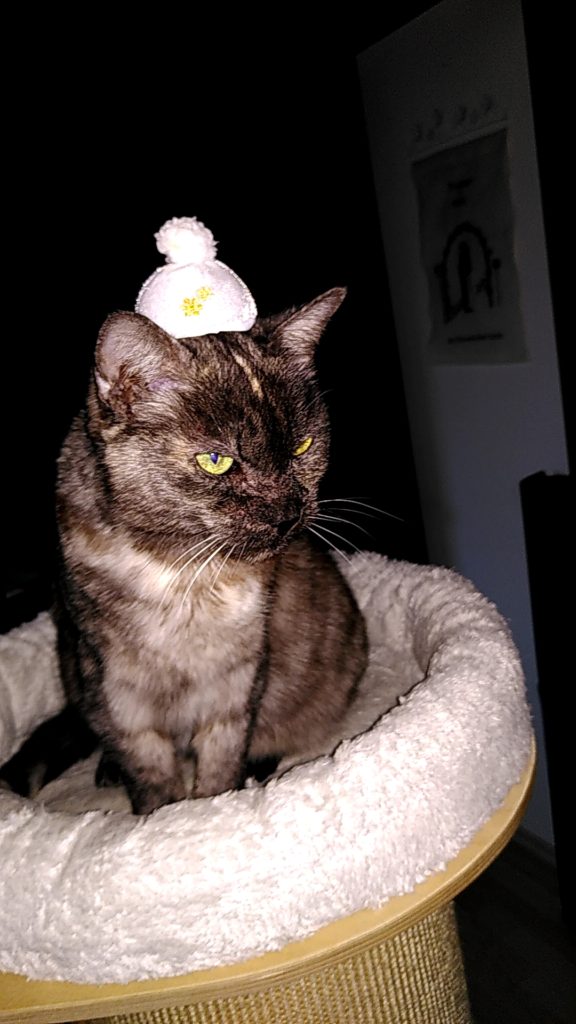
P.S.: The little cat wishes to remind you that this year, images of festive hats placed on slightly irritated felines might be even more important than in other years. We can probably all use a bit of extra silliness these days, after all.
0
DEZ.
16
0

"Bake" Mosaic Knitting Pattern

Naomi Parkhurst is making knitting stitch patterns (which sometimes include mosaic patterns) out of words, using a special encoding technique. Fittingly for this time of year, she's encoded the word "bake", and I think it looks really pretty. You can take a look at it here.

Speaking of baking - we're done with all the "necessary" seasonal baking. Though there's some egg white left that needs to be taken care of, and I'm intrigued by a Finnish seasonal thing called Joulutorttu. So there might be something in the near future still!
0
DEZ.
15
2

Taking a close look... at linen threads.

You might not guess it, but I have a thing for threads. Which, obviously, includes linen sewing threads.

Linen is a wonderful fibre, and good linen threads are very strong - at least strong in the sense of "can hold a lot of tension". Linen is never strong against abrasion, which is one of the reasons to give the thread a rub with beeswax before using it for sewing.

The best, strongest, and nicest linen threads are those that are wet-spun from long-line flax. Linen fibres are rather smooth, and longer fibres together with appropriate amounts of twist make for stronger yarn than when it's spun from shorter fibre bits. Linen yarns also tend to have a few slubs here and there - much more so than cotton. These can be annoying when using the thread, and having few and relatively small slubs is also a sign of good quality.

The slight variation within a yarn regarding its thickness is also a reason why three-ply sewing threads are more common these days: They have a rounder cross-section, and the probability of the thickness variation cancelling itself out in a mix of three yarns is higher than with two yarns. That means it's more pleasant and more easy to work with.

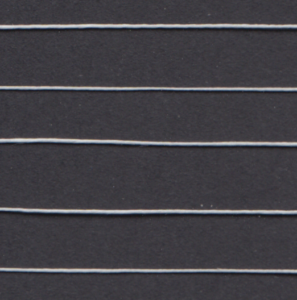
Here you can see the difference:

 
[caption id="attachment_5723" align="aligncenter" width="297"] Three-ply linen yarn - that is my extra fine linen sewing thread.

[caption id="attachment_5725" align="aligncenter" width="300"] Two-ply linen yarn, about the same thickness - that is my 60/2 linen sewing thread.
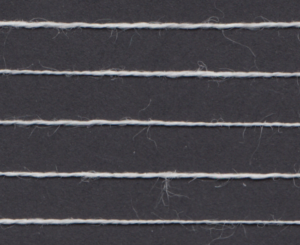

The two-ply also looks more frizzy - that is also an effect of the tighter spinning and the tighter plying the three-ply yarn has.

So what is the better thread for your project? As so often, the answer is: That depends.

If you want to go as historically correct as possible, the two-ply is definitely the way to go, as anything with more plies than two is a HUGE exception for medieval and early modern times.

Why? If you're spinning by hand, it makes quite a difference whether you are making a two-ply yarn or a three-ply yarn: You have to spin the whole length of necessary yarn a third time for the three-ply. Historically, two-ply sewing threads thus were the rule. Only in extremely rare cases can we find a three-ply yarn somewhere before the rise of mechanical spinning and plying - a two-ply will bring all the stability needed for sewing or other techniques where you work with open ends or twist, and is the quickest and easiest ply to make.

Today, though, machine-spinning allows for setting one size of yarn thickness and then easily using a higher number of plies to make a thicker end product. And with three-ply or four-ply yarns having the advantages described above, these kinds are now the rule. Consequently, it is rather hard to find two-ply linen yarns suitable for sewing these days. Which is also the reason why I'm carrying a three-ply thread in my shop, this is stock from the days when I had not found a source for the two-ply yarns yet.

If you're not a total stickler for details, or want to have the bit more smoothness and stability that the three-ply will give you, then you can well go for the more modern thread. And with the fineness this thread has, it will take most people a close look, a magnifying glass and the possibility to un-twist a bit of the thread to be able to tell it's a modern three-ply!
0
DEZ.
14
0

Janet Arnold Awards - Application Deadline Jan 15

I've stumbled across a mention of an upcoming deadline for the Janet Arnold Awards - that is a grant given out by the Society of Antiquaries of London. The current awards will focus on dress in colonialism and its legacy; deadline for award applications are in January 2021.

If you think that might be interesting for you, or if you know someone with a project that might be given a grant by the foundation, check out their info page about the awards. And in case you apply: Best of luck!
0
DEZ.
11
3

The State of Things.

Here's the current state of things:

I have a newsletter to write (the English version, the German one went out yesterday); the weather outside is mostly grey and hardly pleasing; there's a chunk of yeast in my fridge that waits for inspired baking (suggestions welcome!); I have a video for an exhibition to cut and edit; the cat is lying on my right forearm, and since that moves when I type, she wobbles along on it.

I'm also feeling fairly rant-y about the German politicians draaaaaaaaaaaagging their feet when it comes to decisions. They took a sweet long time to decide that something should be done back in October, when they might have acted in September; they waited for six weeks now, probably hoping that a cluster of half-hearted restrictions that clearly revealed that they were not enough after two weeks would miraculously be plenty with even higher numbers (and so worse circumstances) after three, four, five, or six weeks. Now there's a new all-time high of infections within 24 hours, we're nearing 600 dead per day, clinics are on the brink of overload, and there's still a debate about whether one should maybe think about closing schools and shops a bit before Christmas, or, as has been planned in the last week or so, after Christmas only. I just don't get it.

It's not that the second wave came unexpected. Or that one could not know the numbers would rise more if things were not taken more seriously. There was lots of downplaying in September, when numbers started to rise - which is not the smart thing to do when you want the public to take stuff seriously and see the danger. And yes, a lot of shops and a lot of restaurants and a lot of schools and a lot of sports places are not the super-spready places. But they can all play a part (and will!) in spreading the virus once numbers are over a certain threshold, as the probability to have infectuous people there will be high. How can that be so difficult to see?

As for us, we'll be going into (even more) of social seclusion for a bit now, in order to be able to safely see my parents at Christmas. Not that there's very much real-life social stuff to cut, mind you; we've had real-life contacts of more than a few minutes at a time with just a handful of people for the last few months anyways.

It's not nice, folks. So - sorry for the rant, and for bringing up that unpleasant topic again, but it's unfortunately quite at the top of my mind right now. I do hope things are better where you are - and if they are not, that you can cope.

Stay safe, and sane, and keep your distance. We'll make it out of all this somehow.
0
DEZ.
10
0

Online Market again - Saturday December 19!

I'll be taking part in the last Mittelaltermarkt Online this year, on Saturday, December 19, from 16:00 h onwards.

There will be next to no Christmas Markets in Germany this year, and I'm a bit sad about this, even though I'm not a big drinker of mulled wine. But I've always enjoyed a stroll through the market in cold weather, looking at baubles and cookie cutters and stalls selling soap and spices and furry indoor shoes. And, of course and traditional for me, eating Currywurst mit Pommes (curry sausage and fries)! No Currywurst this year, is how it looks.

But there will be at least this online market, and one where there's no need to keep a metre of distance (you can push your nose as close to your screen as you like), or where you are going to have very cold fingers and toes after a while (unless you have a very cold space to sit with your computer) and you can have all the mulled wine that you want (having heated it in your own kitchen). So - stop by on Saturday the 19th, have a look around at all the stalls, and feel free to drop by and have a chat with me at my "stall"!
0
DEZ.
09
0

Baking Hacks.

I'm slowly running out of new seasonal cookie recipes to post... which is not really a surprise, since I'm making mostly the same types of cookies each year, with only a little new stuff thrown in, and I've been posting recipes for a while now.

So this year, I'll just share a few general "baking life hacks" that you will hopefully find useful!
  • Silicon baking sheets. I have four of these, and using them has brought down cookie breakage from significant to about zero for me. Even now that I have newer non-stick baking sheets, I still use them. Additional benefit: The silicone sheet can be placed on the counter and filled with cookies, then you carefully pull the sheet onto the baking sheet or the grid.
    I also use the sheets if a recipe tells me to roll dough out between layers of clingfilm, or other single-use plastic sheets, as I refuse to use single-use plastics for that (and have done so for years, even before the most recent quest to ban more plastics from our life). If you do that, and it gets harder to roll it out, it helps to remove the sheet from time to time, so the dough can spread again.
  • Peeling almonds. Some of my recipes call for peeled/blanched almonds. I've always bought the whole things and done any grinding myself, and that means peeling also has to be done. Usually, instructions tell you to pour boiling water over the almonds, wait a bit and then pull off the skins. I've often struggled with that... until one day, I forgot to peel them right away and the water had gone too cool. So I poured off the cold water then poured fresh boiling water over them again. They were amazingly easy to peel afterwards! I've done it similarly ever since: Steep in boiling water for a few minutes, pour off the water, add fresh boiling water, wait a little, then peel while still hot.
  • Grinding nuts - I've always used an old-fashioned grinding thingie, which would yield medium-sized to rather coarse bits. I've recently discovered the trick to get the finely ground nuts or almonds, like those you can buy ready-made: Use a meat grinder with a fine disc.
  • While we're talking of chopping up things, another new discovery for me: A food processor can be used to help prepare cookie dough. I've found out about that trick on American recipe sites. Fill flour, cold butter cut into thin slices, and possibly some or all of the sugar into the food processor and blitz until the butter has been transformed into small bits, covered by the flour. Then tip onto the table, add eggs and other ingredients as called for by your recipe, and knead together. This saves the cutting and crumbling up stage to mix the butter and the flour together.
  • Choose cookie cutters wisely. For years, we bought a new cutter every advent, because... well, no real reason needed, right? (Actually, it was just a nice little thing to buy at a Christmas market.) However, the cutters had to pass the test - in the shop or at the market stall, we'd take several of the same cutter and try to stack them together as closely as possible. If their forms meant large spaces between the individual cutters, they'd stay right where they were. Cookie cutters with a form that will fit itself well means little space between cookies, and thus little leftover dough after each run, and thus better dough quality until the end (because you don't have to roll it out again so often, and that means less flour uptake).
  • Speaking of rolling out and flour uptake: I roll my dough out on a clean cotton tea towel that gets lightly sprinkled with flour. Due to some reason, that constellation means less flour is needed. For the basic cookies that I make and that get rolled out thinly, there's the additional thickness control built in: They are thin enough when the checkered-pattern stripes of the towel start to be visible through the sheet of dough.
  • Four times is about the limit of how often I roll out pastry dough. Initially, I divide the dough into pieces of suitable size for rolling out. Leftovers from the first goes are collected, all kneaded together and rolled out again. After that, depending on how much dough is left, it gets rolled out either once or twice more. At the stage where there is only a small circle of dough after rolling out, a few cookies are cut from the sheet with plenty of space inbetween, and the rest baked as it is (or maybe cut with a knife into handle-able parts). That will get you an ugly cookie or more, which are just as tasty as the nicely-shaped ones, and include the perfect excuse to eat them whenever you wish. Because obviously, ugly cookies cannot be served to others, right?
  • I use the butter wrapping papers to grease sheets and forms. Once the butter has been unpacked, I fold them once or twice and stick them into the freezer compartment of our fridge. When something needs to be greased, I take one out, let it thaw for a few seconds, unfold it and rub the something with the buttery side. No greasy fingers, quick, easy, and no waste of the butter film always clinging to the wrapper no matter what.
  • Leftovers after decorating? For my reindeer cookies, I make a glaze from orange juice and confectioner's sugar, plus very finely ground off orange peel. The latter is the secret to having a proper, strong enough orange taste to the glaze. Anything left of that after glazing the proper cookies goes onto the ugly cookies, making them even tastier.
    Leftover chocolate from covering cookies, or other things? This can be mixed up with cornflakes to make choco crossies, chopped nuts to make nut clusters, or crumbled up cookies can be mixed in. Be creative. Bonus: The outcome can probably be classified as "ugly".
  • For quite liquid glazes like the orange sugar glaze, I use a brush. For everything else that needs to be applied to a surface, such as jam or molten chocolate, I use a pastry fork - for me, that works much better and is less messy than a brush. The fork is also very convenient to stirring up the jam to make it smooth enough for application. I've tried heating it up once, but that seemed to make only a very small difference, if one at all, in the end product, so I've gone back to using the cold jam, stirring it up and applying it.
Happy baking, I hope you find something useful among these tricks!

If you're looking for proper recipes for baking, the seasonal recipes that I blogged in the past are:
1

By accepting you will be accessing a service provided by a third-party external to https://www.pallia.net/

Kontakt