Latest Comments

Guest - Aislinn Dyestuff Citizen Science.
09. Oktober 2026
This is a great project. I look forward to the results. Thanks for letting us know.
Guest - Aislinn Time for...
09. Oktober 2026
Looks delicious!
Guest - Katrin Sprang Discussion
18. September 2026
Hi Rachel, I have looked for more photos of you, but that was not very successful. I found a link on...
Guest - Beatrix Sprang Discussion
15. September 2026
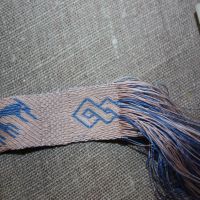
That lozenge pattern element is not a photograph, but a scan. So it should be to scale. But I pinned...
Guest - Katrin Sprang Discussion
15. September 2026
I was not referring to Rachel's reconstruction (is the reconstruction you refer to the one photograp...
OKT.
29
0

Bryggen Papers PDFs online!

This seems to be the week of happy discoveries: The Bryggen Papers are available for free, online, as pdf files. These volumes include (you may have guessed that from my enthusiasm) the one about textile equipment and its working environment!

There's a bunch of other interesting topics as well, such as children's games, fishing tackle, ropes and cordage, and locks and keys. Go have a look at the Bryggen Papers Archives!
0
OKT.
28
1

Manuscripts as Textile Sources.

Textiles sometimes survive in the weirdest circumstances - the Viborg shirt was pulled from a posthole, where it had carbonised (thus the linen fabric has survived). There's textiles that were used as tarring brushes, textiles used as toilet "paper", or those used as wrapping for metal items; in all cases, the coating led to them being preserved better.

Even better when the fabrics are not coated or permeated with something... but are preserved in good conditions. Dry and away from light, and protected from moths and mice and other critters that might have a use for them. Like... pressed between the pages of a book. Such as manuscript curtains.

If you go "huh?" now, that is exactly what I did. A friend pointed this possible source of medieval textile knowledge out to me, as she had heard a talk on the topic in one of the (digital) conferences she attended. And here's one of the little bits of good things the pandemic brought: Because the conference was digital, the talk is available online, on Youtube, and you can get a glimpse of this fascinating practice and, even better, a glimpse of some of the preserved textiles!

0
OKT.
27
0

Building Bridges... or at least one!

Bridges are a wonderful piece of architecture. They connect two shores, they make crossing a river so much easier than having to ford the river, or to ferry across. (They also make paddling more interesting, but that is, of course, not their main use.)

They are, however, rather complicated to make - at least if the water that is to be crossed isn't just a slim bit, but has some substantial width. That means they have to have support pillars in the riverbed, and that, in turn, means... some ingenuity, and good technique, is needed for building them.

If you've ever wondered how such a bridge was made in the Middle Ages, here's a little animation video that shows the reconstructed process for building the bridge now called Charles Bridge in Prague:


Isn't that amazing?

And that bridge is huge. HUGE. I've been to Prague a few times (though by far not often enough, it's an utterly beautiful city, and I'm utterly fond of the old and very old buildings there, the amazing textiles in the castle collections, the lovely textile colleagues working there, and of course the Czech food, which brings back memories from my childhood in parts, and is just utterly delightful in the other parts.
Erm. I digress. The bridge is huge. If you have the chance to visit Prague, go see this monster of about 10 m in width and more than 500 metres in length. And maybe buy a trinket from one of the stalls set up on the bridge, like on so many bridges in medieval times, as a souvenir. (I might have done that. Who knows?)
0
OKT.
26
0

Autumn, Tea, Random Ramblings.

It's getting autumny here, with days that are partly golden and super-warm, and days that are more nippy and grey and rainy. Overall, though, it's been rather warm - which has led to the thyme in our not-lawn blooming a third time right now, and the strawberries (yes, the strawberries!) have followed suit and are now blooming. And producing fruit. (More decorative than tasty, though, so you have no reason to be jealous.) The tomatoes in the wintergarden are doing another round as well, and I will be the last person to complain about that.

Things are... strange this year. Really. Apart from the unseasonable blooming of fruit and vegetable plants, we're all in the midst of the much-mentioned and not-at-all-looked-forward-to "Second Wave" now. Well, all of us except maybe Norway and Finland, who are staunchly holding out. (Keep it up, whatever you are doing or not doing!)

Our local numbers have, by now, risen to the "red traffic lights" stage. That's the stage with more than 50 new cases per 100,000 inhabitants over the last 7 days. Measures against the virus spread are supposed to start at the "orange" phase, with 35 incidence or more. However, it looks like these measures (which are mostly contact restrictions and extension of mask wearing rules) were either not followed well enough, or they were unsuitable, or they were too late, as  in quite a few places in Germany, numbers are still rising. So much that Bavaria (hooray federal system!) has now extended the traffic lights to have a "dark red" stage that comes into play once the incidence number rises above 100. Which is the case in several places in Bavaria, and some spots in Germany even have a number above 200.

After the "lockdown" had ended and things seemed more under control, about everyone in politics said that we would be taking measures locally from now on, curbing the spread of the virus in each region. Then there was the summer holidays, and then school started, and numbers were creeping up. Still the prevailing talk was that we would definitely have no second lockdown.
Numbers were going up more, and more, in Germany's neighbouring countries and in Germany. We were nearing the numbers of new cases we had in spring, when the first wave was at its peak. However... what I read was things like "ah, no need to worry, we're testing so much more now than in spring that you cannot compare the numbers, and we're well-prepared, and we have plenty of hospital beds free". Erm... maybe that is the case, but steeply rising numbers and the dynamics of a spreading illness means that we will reach higher and higher numbers? So maybe don't downplay it, but start doing something before it gets out of hand?

But... politicians were reluctant (sort of understandably, but still not very helpful). And so it happened. Now there's suddenly talk of a new lockdown maybe becoming necessary.

It's an unpleasant situation all around; everyone is tired of the changed life, and nobody wants to go back to the restrictions we had in spring (though seeing it realistically, they were not so bad in Germany, compared to many other countries). We know a bit more about the virus now, and maybe that makes us think we're safer than we are; we also remember that the first wave did by far not have as dire consequences as we feared for a while. So how bad can it be, right?

Ah. Well. I'd say... bad? Really bad? Maybe even really really bad?

The not-wanting-to-deal-with-it-yet mindset (or non-action-set) that our politicians have shown seems to be similar in our neighbouring countries. Something very human, it appears - though I'm not entirely sure whether I find that a helpful thought, or whether it makes me doubt our collective intelligence since obviously nobody anywhere has learned anything from the first wave. Jury's still out. Maybe I'll do my judging of humankind's intelligence after the election in the US?

So we're trying to draw back into our little corner of the world for a while, being even more careful than before. We can both work from home, so we're really lucky in that regard. Any other activities are done as much as possible at times and in ways that involve as few other people as possible. It sucks, but I'd rather a bit of suck than an unknown amount of sick, or having someone else fall sick because of me.

The weather today, at least, makes it easy to stay home and curl up in a corner of the sofa - it's grey and drizzling rain. We stay home a lot. We drink tea. We meet our friends virtually (thank goodness for video chats).

So far, we cope. I hope you do, too.
0
OKT.
22
0

Online Market on Saturday!

There's a "Mittelaltermarkt Online" again on Saturday, and I'll be there!

There have been a few of these markets this year, but I was away or otherwise engaged for the last few events. This time, the stars have lined up favourably, and I'll take part again.

The market organisers have shifted the timeframe of the market, it now starts at 17:00 German time, so the Saturday (which we usually spend, at least partly, with grocery shopping, like so many others) doesn't get ripped apart by a noon-to-afternoon event. I totally approve, and am very happy with that change.

In case you missed the last ones, and don't know at all what I am talking about: The market is intended to give people a possibility to do some "medieval shopping" that they would otherwise have done on real-life markets and events. There's a stage with some entertainment, and stalls with different goods offered by different people. They are not all medieval as in historically correct, but if you don't expect that, it's quite enjoyable and fun.

Registration is necessary (but free), and then you can click yourself along the market paths (which remind me of a simple game dungeon), look at the stalls left and right, and chat with the stall owners, look at their goods, and maybe buy something. It's even possible to run a video meeting so one can video-chat with people. That is the closest online equivalent to a real market that I have yet seen, and actually allows to explain things or show something.

So: Stop by if you wish, and have a chat with me!
0
OKT.
21
0

Cat Embroidery, Done.

I just realised that I haven't posted a picture of the finished "visible mending" cat embroidery yet - so high time to remedy that lapse!

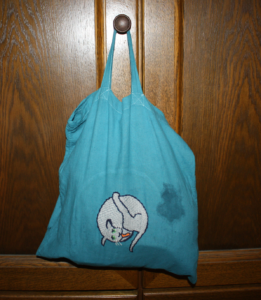
Here's the cat, in all its butt-licking glory, on the bag:


You can see that the bag has had better days, and the stain is still quite visible. There's also another small hole close to one of the side seams, and I'll eventually close that up with a few stitches. (Or, who knows, maybe with a tiny mouse?)

I'm quite happy with the bag and the cat overall, and it certainly was a lot of fun to do!
0
OKT.
20
0

The things you get used to.

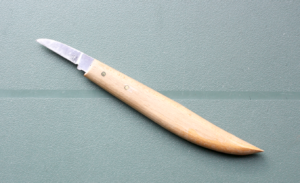
I've managed, for a little bit, to mislay one of my knives. To be more precise: The knife I use for cutting notches into spindle sticks.

This cutting is something I do periodically, whenever one of the shapes runs out. Then I stock up on all the combinations: horizontal and spiralling notches cut into beech, pearwood and maplewood sticks. There's a simple, small knife that I always use for this, and as mentioned, it was mislaid.

So I was searching for it, at the places I suspected it might have gotten to. Now, there's no dearth of knives in this household, and for the two most urgent notches, I used another knife... which worked, but felt weird, and not as nice and comfortable as I was used to.


Because with the knife I usually cut the notches with, the process is familiar, and the knife fits my hand just so, and the blade has just the right shape, and I know exactly how much pressure is needed, and what angle to hold it, and how to scrape and cut and work. I am actually not sure whether this little knife is, objectively, the perfect tool for that kind of cutting. I am sure that it is very good, but there might be a shape even better suited, so using a different tool for the two "I need these right now" notches might theoretically have brought a revelation. (It didn't. I think I'm good with the old knife.)

Things like this are what absolutely fascinates me in regards to crafting. We use tools, and we use them often, and we get so familiar with them that they start to feel, at some point, not like tools but like extensions of our hands. In some cases, they are not perfect - or not perfect anymore - but the crafter has grown so accustomed to the specific tool and its vagaries that it's not getting changed out for something else. Maybe it is not getting changed out even past the point where a new tool might make more sense than going on with the old one... but because things develop (or deteriorate) slowly, and over time, and with the crafter adapting, that point does not get noticed.

Getting a new tool for something also always means a process of familiarising oneself with the thing, getting used to it. Breaking it in, so to say. I remember being told about how construction workers go about getting a new shovel: You fit the shovel to the wooden shaft, and then you work with it a while. Once it has all settled, and you feel comfortable with your tool, then - and only then - you take a hammer, and a nail, and you fix the shovel head to the shaft. Because if you do it straight away, it might feel crooked, and then you always have this weird feeling about your tool.

The little knife has turned up again, by the way. So now, soon, I'll sit down and do some notch-cutting - and I already know that I will enjoy the process more than usual, because it will feel so nice to have the knife in my hand that fits it just so!
0

By accepting you will be accessing a service provided by a third-party external to https://www.pallia.net/

Kontakt