Latest Comments

Guest - Aislinn Dyestuff Citizen Science.
09. Oktober 2026
This is a great project. I look forward to the results. Thanks for letting us know.
Guest - Aislinn Time for...
09. Oktober 2026
Looks delicious!
Guest - Katrin Sprang Discussion
18. September 2026
Hi Rachel, I have looked for more photos of you, but that was not very successful. I found a link on...
Guest - Beatrix Sprang Discussion
15. September 2026
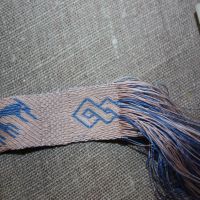
That lozenge pattern element is not a photograph, but a scan. So it should be to scale. But I pinned...
Guest - Katrin Sprang Discussion
15. September 2026
I was not referring to Rachel's reconstruction (is the reconstruction you refer to the one photograp...
SEP.
15
0

Cuthbert Maniple Interview!

Another thing that happened while I was away: The interview that Alex Makin did with me and Margit from Alte Künste went live!

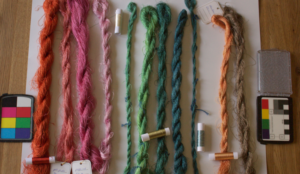
In that post, we talk about the process of finding and dyeing the threads for the Cuthbert maniple project that Alex works on, including some details on the problems and decisions made. It was a lovely, exciting, wonderful sub-project for the Maniple Project, and I'm very proud and very happy to have been part of it.

[caption id="attachment_4346" align="alignnone" width="300"] Some of the silks dyed for the project, still in skeins.


You can read the full interview (and see the pictures) here on Alex' blog Early Medieval (Mostly) Textiles. Enjoy!
0
SEP.
14
0

I'm back!

I am back from my summer break, and there are a lot of emails, of course, and some orders and other requests that will keep me busy for the next few days.

There's also a lot of things to tell - but first, because it's current, and urgent:

Moria. After the fire, there's still stalling all around; our Mr Seehofer (even though part of a party that has "Christian" in its name, and should thus have a modicum of humanity and milte) is still forbidding German communities to take in refugees. There's a lot of them who have offered to do so, and more than the utterly ridiculous 100 -150 unaccompanied youths that Mr. S. has agreed to. About everyone sane and thinking is in agreement that Moria needs to be evacuated, and should have been months ago. (Here's an article from MSF, to just list one.)

Please help increase the pressure on our politicians by writing an email (If you're in Germany, you can do so very easily via leavenoonebehind), or tweeting, or by going out on the street if there's a protest near you. There is a petition to the EU on the Campact site as well, please help by signing it. You can also help by donating, via leavenoonebehind under the link above. Every voice helps. This madness needs to end, and it needs to end now.

 
0
AUG.
14
0

Time for the Summer Break

It's time for my summer break - I'll be away from the shop and the blog from August 15 to September 13. I'm very much looking forward to taking a breather, spending time with friends, having a few days of holidays with the Most Patient Husband of Them All, and doing a bit of lazing around the house and garden (and maybe some pottering around as well). I might even get to squish some progress in on my Ink cardigan, who knows? If so, it might actually be wearable come fall...

So - I'll be back on the blog, rambling on about things, on September 14. Until then, I hope you will all have a glorious time!
0
AUG.
13
5

Supported Spinning.

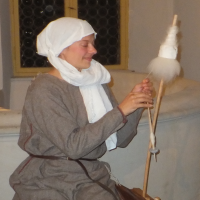
I'm not a huge fan of supported spinning, but I'm quite enjoying the technique when I get to do it. One of the things I remember wondering about when I first saw it was the use of a temporary cop - winding on the spun yarn near the tip of the spindle. It seemed weird to me to do that, as it means you have to wind off the temporary cop again and then wind on properly to the permanent cop.

This was one of the things that started to make sense a few years later, when I tried it with significantly more practice in spinning, and with more appreciation for spinning efficiency. Yes, you do wind your yarn twice with that technique - but it doesn't matter if the temporary cop is rather sloppy, so you can wind on very quickly (by twirling the spindle) and go on spinning. It also means that if you tend to add uneven amounts of twist in your makes, winding off and on again gives the twist a chance to partly redistribute and even out. One of the main pros for me, though, is the fact that winding to the temporary cop is less of a disruption in the process than winding to the permanent cop. I can wind much easier and better to the permanent cop if I take the spindle out of its bowl and place it on my leg or hold it in my hand, depending on the position of the rest of me and the spindle. Doing that is a major movement as compared to the small movements done during the spinning process. Add to that the fact that a typical make in supported spinning is much shorter than one in distaff spinning or long suspended spinning, where the winding process is already the main disruptor of the process, and it becomes quite clear that going from "spin position" to "winding position" is better done less often.

Not all variations of supported spinning use the temporary cop, though, and that is another thing I find fascinating with this type of spinning: There's a plethora of subvariations and possibilities. Like you can do a short draft as for worsted spinning, while the spindle twirls much like when you spin long suspended. This brings with it with the same necessity of having a feeling for when the spindle will stop, and twirling it again before it has come to rest completely. You can also do a kind of longdraft technique, either in the park-and-draft variation (which is easier) or in continuous spinning, and with the latter either drafting against the spindle weight, if your fibre is slippery enough to allow it, or helping with the hand close to the spindle by gripping the thread above the spindle.

If we're looking at evidence in medieval sources, supported spinning seems to be the exception, not the rule. Just like spinning with top-whorl spindles, there is a little bit of evidence for it, but not much. I know of one single picture showing a woman spinning with a spinning bowl; unfortunately, I've not made a proper note of where it is, and a quick internet search turned up the picture (yay!) but also no reference to where it's from (gnah).

I've done better with remembering the source of the image with a top-whorl spindle: it's in an English manuscript in the British Library, and it shows the Bearded Woman of Limerick spinning with distaff and top-whorl spindle. That's very nicely matching the fact that there are a few hooked metal spindles in the National Museum in Dublin that are very suitable for use as top-whorl spindles, possibly without an extra whorl in some cases.
0
AUG.
12
0

It's too darn hot.

It's baking here - but at least we got some rain again yesterday, when water came down in sheets to refill our rainwater barrels at last. We waited for the worst of the torrent to pass before we got on our bike to cycle home from where we were, but we got soaked through completely anyways. Something that I was happy about, as it meant water, much needed by the totally dried-out land. It was, according to our rainwater measuring gadget, about 32 litres per square metre, and enough to fill both of our reservoirs to the brim.

Which is very good, because it means I can keep on watering our plants with rainwater, and finish washing my wool. Though the last bits of wool will have to wait until after the upcoming summer break... which I'm very, very much looking forward to.

Tonight I'll have the pleasure of giving a spinning lesson, this time on supported spinning; then I'll have tomorrow and Friday to wrap things up here, and then it's summer break from Saturday on. With the current heatwave, that is more than welcome, I feel like my brain wants to go on heat-induced standby in these temperatures.
0
AUG.
11
1

Grow-your-own, Distaff Edition.


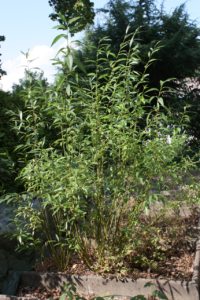
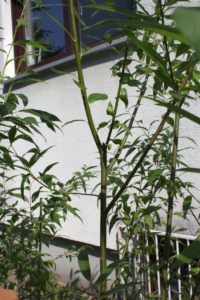
What you see on this picture is my current little bit of fun. Actually, it's not really very current - this has been going on for a while: I'm trying to grow caged distaffs.

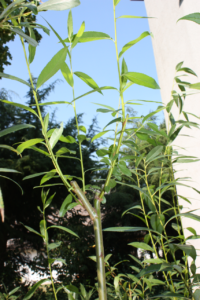
This is a willow bush, and since willow grows fairly fast and makes new branches from where it's cut, I thought that maybe it might be possible to grow shoots with enough smaller branches at the top to form a cage.


Jury's still out on whether it will work or not, and on how long it will take to grow a distaff once I know how best to do the pruning and forming, but there is some progress on some of the shoots.


Forming the top part will be the next interesting step...
0
AUG.
10
2

Slowly, slowly...

I've already told you about my chili plants, at least a few things - and now, finally, they are starting to bloom. Slowly. And with some hiccups.

There's a variety of chili breeds in my pots (moved, again, outside, but out of hare's reach, or so I thought), and some of them are unknown (as the seeds came out of my spice rack, so it's either Ecuador Purple or some unstabilised mixed breed). All of them were started rather late, with the seeds sprouting mid-April, and there have been some losses due to snails and hare bite.

Now one of the larger plants has sadly lost its head.
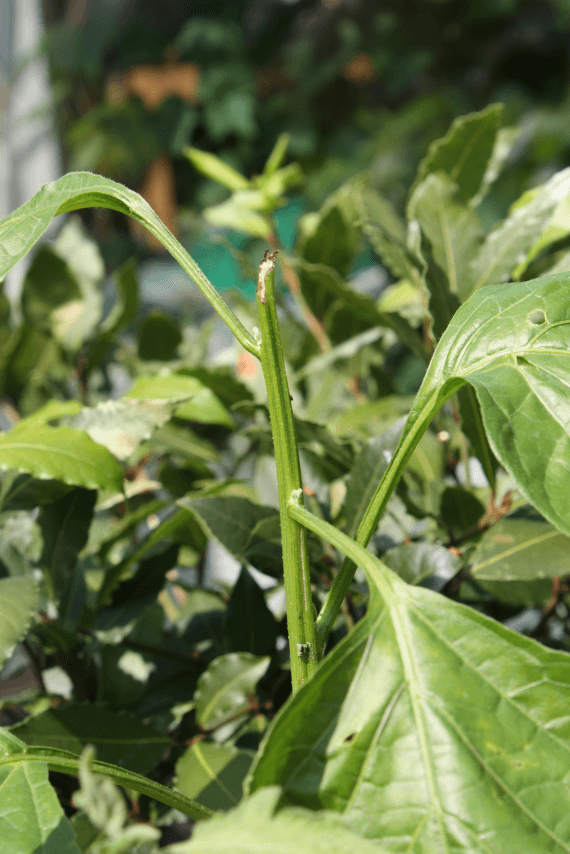


I don't really know how that happened; it was not eaten, the lost crown lay beside the plant in the pot. With all the nice little buds it had. I'm quite sad about that, especially as I have only that one so far along of the kind, but I hope it will rally itself and make a bunch of side branches with flowers.

That was one of the more vegetable-y peppers, which tend to be quicker than the chilis in my lineup here. One of them actually has produced fruits already:
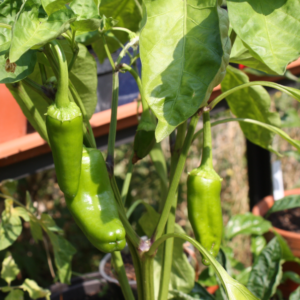


They will take a bit longer to ripen, though I'm very tempted to try how they taste still green. I like green peppers best anyways...

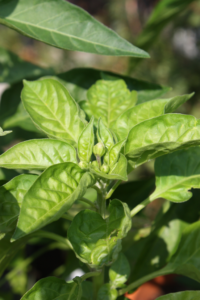
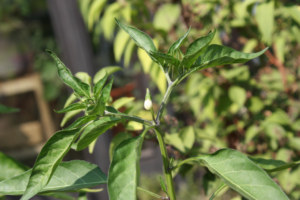
But yes, slowly, the chilis are getting ready as well. There's no open flower yet, but that is a question of days, as the buds are growing larger and larger on some:


And here's a view of Ecuador Purple buds - pleasingly purple, too:
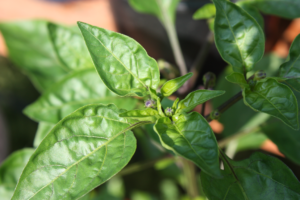


I'm quite happy about all that, I just hope there won't be more losing of heads to whatever made that one plant shorter!
0

By accepting you will be accessing a service provided by a third-party external to https://www.pallia.net/

Kontakt