Latest Comments

Guest - Aislinn Dyestuff Citizen Science.
09. Oktober 2026
This is a great project. I look forward to the results. Thanks for letting us know.
Guest - Aislinn Time for...
09. Oktober 2026
Looks delicious!
Guest - Katrin Sprang Discussion
18. September 2026
Hi Rachel, I have looked for more photos of you, but that was not very successful. I found a link on...
Guest - Beatrix Sprang Discussion
15. September 2026
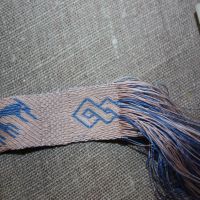
That lozenge pattern element is not a photograph, but a scan. So it should be to scale. But I pinned...
Guest - Katrin Sprang Discussion
15. September 2026
I was not referring to Rachel's reconstruction (is the reconstruction you refer to the one photograp...
AUG.
07
0

Looking for stuff to read?

In case you're looking for (research-y) summer reading stuff, you might want to check out JSTOR, who have expanded their free reading scheme from six to one hundred articles per month, to support researchers during the COVID-19 crisis. This is very nice, and very generous!

You need to register with them for access (which is free), and then you can read up to 100 paywalled articles; there is also a number of open-access articles on their page.

Happy reading!
0
AUG.
06
0

Peacock Feathered Fabric!

If you're reading Middle High German texts, there's occasionally the mention of peacock feathers in clothing - quite often it's a "peacock hat", but sometimes there's also a reference to other garments in a kind of peacock-y style.

Nobody really knows what this kind of fabric was (or if there's several variations)... but I have now actually stumbled across a real piece of extant fabric that includes peacock feathers!

It was found in a relic case in St. Rumbold Cathedral, Mechelen, Belgium. The fabric has been radiocarbon dated to the 13th century, and it is a red cut velvet (silk pile on linen ground weave); applied across it, in a kind of cross-hatch pattern, are peacock feathers and gold threads (gilt silver around a silk core). Unfortunately the text doesn't say how exactly they were attached - but I'm utterly thrilled anyways.

It has been published in an article aptly named "A Box Full of Surprises" (available on academia.edu).

This is... way cool!
0
AUG.
05
0

EXARC Finally Friday!

If you're looking for something to look forward to this Friday, I might have a helpful hint for you:

Alexandra Makin (who does the Cuthbert Embroidery project, in which me and Margit have been involved regarding the embroidery threads) and Ronja Lau (who is working about band-woven finds, and who I've had the chance of meeting during a Forum) will be the guests on EXARC's Finally Friday this week.

The title of their discussion is "Sew much to do, sew little time", and I'm sure it will be a very interesting one! If you'd like to tune in, check out the EXARC link. The event starts on August 7, at 17:00 Amsterdam time; it will be streamed via Discord, so you will need to have a discord login (free) and register yourself on the EXARC server; the link is on their Finally Friday page.

In the meantime, you can check out Alex' website to read a bit about Ronja's research (who has recently been interviewed there) and the Cuthbert Maniple project. I hope you have fun!
0
AUG.
04
0

Grow your own...

There's, obviously, a lot of stuff you can grow yourself. Weld. Madder. Tomatoes. Your own hair. Kombucha leather, which a designer couple from the US has used to make transparent face masks... you can read more about that here, and the article includes a link to instructions on how you can do it yourself.

It would be a very good thing to have biodegradable, sustainable masks. It would be a very good thing, actually, to have a lot more things biodegradable and sustainable, and maybe that bacteria-grown cellulose is a good solution for it? I can imagine having sheets of that for wrapping stuff as well.

At the moment, all the Covid19-precautions are leading to much more single-use stuff, and much more trash and landfill. Our favourite bakery doesn't accept any customer-brought bags or containers at the moment, so if we buy something there, it's always a paper bag or two. We see thrown-away masks everywhere outside these days. To protect from the virus, single-use cups are much more frequent again... and while the spread of corona is very much at the front of our attention these days (though if you look at some images from holiday places, or at other images, probably not as much anymore as it should be), if we're not acting quickly and decisively enough to stop our climate change, we'll be screwed even more by our planet heating up.

So here we are. Rock. Hard place. I do hope we'll be able to find a way that will let humankind have a future on this planet, because we quite obviously won't be able to find a new one (and a way to get there) quickly enough to save our asses. Seeing how much the common effort to keep everyone safe from the virus is going down, though, after only six months, and even though numbers everywhere are going up again? I somehow doubt it will be done.
0
AUG.
03
0

Monday!

Today is one of those days where I have a list of things I planned to do, and then end up doing completely different stuff. Ah, well, as long as something gets done... which, in today's case, was some bookkeeping (and that is always a nice thing to have dealt with).

So while I'm not-quite-procrastinating, here's a link for you in case you read German: Cattle (highland cattle, to be precise) are grazing in Augsburg to keep larger vegetation away from the archaeological evidence buried under their meadow - because their roots would do damage to the things buried below.

Now that's a very good way of keeping the area clear!
0
JULI
31
1

Need some wool?

There's not many traditional sheep flocks left in Germany, wandering around to graze here and there. Rules, regulations (sometimes really stupid ones, especially concerning herd protection dogs), the intensive agriculture in Germany, the many streets and roadways, and last but not at all least the very low price for wool are all making it hard for this way of keeping sheep to be economically viable. Yet sheep grazing is the thing that keeps some of the iconic landscapes of Germany what they are, and wandering flocks like that are the only way to preserve them.

One of the last flocks that remain is now trying to change the "no money for the wool" dilemma, to make things better. The shepherd (who is also active on twitter) started a Startnext campaign to sell their wool directly. It has been funded already, then met its second funding goal, but there are a few more days left to support it, and there's also (most importantly) some knitting yarn, carded wool, and other wooly product stuff left to get.

I think it's a wonderful project. Supporting the project means a reasonable price for wool, making sure traditionally-kept wandering flocks like Sven's flock can keep going, and helps to protect the very special environment in German regions that have been grazed on, and formed by this, for many years. Plus you get knitting or spinning fodder!

You can check out the project under "Paulas Wolle" at startnext, and support it there. Text is German only, but they do send their wool outside of Germany within the EU (sorry Great-Britain, you're out).
0
JULI
30
3

Link Post.

Status of things here: The cat is lounging on my arms (and half on the keyboard) again, and if I have not cuddled her for too long, I get admonished that her ear needs kneading, or her belly needs rubbing, or that she generally needs some more attention. There's a package waiting to be packed and brought to the post office together with the already-packed one (which will happen very soon), the usual stack of emails to be answered and taken care of, and there are way too many tabs open in my browser. Which, as you well know, means:

Time for a link post!

If you like to look at weird design choices for... stuff, check out the Instagram account "uglydesign". It's curated by two designers who are trying to find the ugliest thing there is (just like the name hints) - but obviously, beauty and ugliness are in the eye of the beholder, and I find some of the things not predominantly ugly, but more "cool in a weird way". (Some are utterly horrible to my personal aesthetic sense, though.)

EXARC has a new section about textiles, with a collection of interesting articles that will be extended with new ones as they come up. I especially appreciate that someone else also writes about the "it depends" thing, something that has come up again and again in my personal research and crafting, and that I think is very important when discussing time needed to do something (which, in turn, is a frequent topic both in Experimental Archaeology and in explaining aspects of medieval or historical craft to the wider public).

Now some bits in German:
Here's an interesting article about how much food gets thrown away in Germany, and how much of that would be avoidable. Especially bread, one of the staples, and considered a Very German Thing Indeed, gets binned in a horribly high percentage. Altogether, a third of the food produced ends up in the trash. A THIRD!!!
We've recently had some more trouble than usual with bread getting mouldy, reasons as yet unknown (different types of bread, or the weather, or contamination of our bread box, or a mix of things, or something else, possibly), and it always makes me really sad to have to throw it away. I have a general tendency of seeing food going bad as a personal failure, and I consider throwing away still-edible things as a kind of disrespect towards all the people who have worked on making this food.
This is a combination that you might call... interesting. On the down side, it leads to much chagrin for every bit I have to bin because it's really not edible anymore, which includes those where there was no way of avoiding the outcome (such as fruit that was damaged during transport and instantly changes from "unripe" to "covered with greenish fur"). It also includes me eating dodgy stuff, or things I don't really enjoy anymore because they have to be used, on occasion. On the up side, it means that relatively few food gets thrown away here, and that I have a good amount of creative approaches to leftover foods and their use.

On to something more positive: A medieval shipwreck was found in a German river, the Lippe. The wreck was found by chance by a hobby diver, and now gets checked out by archaeologists. It's about ten metres long and probably about 1000 years old; whether and how it will be excavated is still being evaluated.

And a last German link - there's an Interessengemeinschaft Zugpferde! I didn't know that until a while ago, when I stumbled across it via an article about sustainability in field- and forestwork. For small fields and in some circumstances, it makes more sense to invest in draft animals instead of trying to go "all western, all modern" and get a tractor, or other machinery. The IG Zugpferde tries to keep the draught horse and draught cattle use alive and offers all kinds of stuff around this - from competitions to workshops and courses to learn how to care for and use draught animals. I'm utterly delighted - and I hope there will be more draught animals in use in the future!
0

By accepting you will be accessing a service provided by a third-party external to https://www.pallia.net/

Kontakt