Latest Comments

Guest - Aislinn Dyestuff Citizen Science.
09. Oktober 2026
This is a great project. I look forward to the results. Thanks for letting us know.
Guest - Aislinn Time for...
09. Oktober 2026
Looks delicious!
Guest - Katrin Sprang Discussion
18. September 2026
Hi Rachel, I have looked for more photos of you, but that was not very successful. I found a link on...
Guest - Beatrix Sprang Discussion
15. September 2026
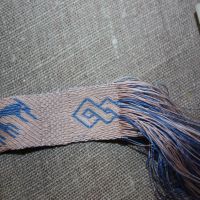
That lozenge pattern element is not a photograph, but a scan. So it should be to scale. But I pinned...
Guest - Katrin Sprang Discussion
15. September 2026
I was not referring to Rachel's reconstruction (is the reconstruction you refer to the one photograp...
JULI
29
0

Make it... scary.

Plans are something you make... and then revise according to circumstances. We had planned to go for a bit of a hike last Sunday, but then it rained (finally! though by far not enough)... which meant we spent it at home, doing diverse small tasks.

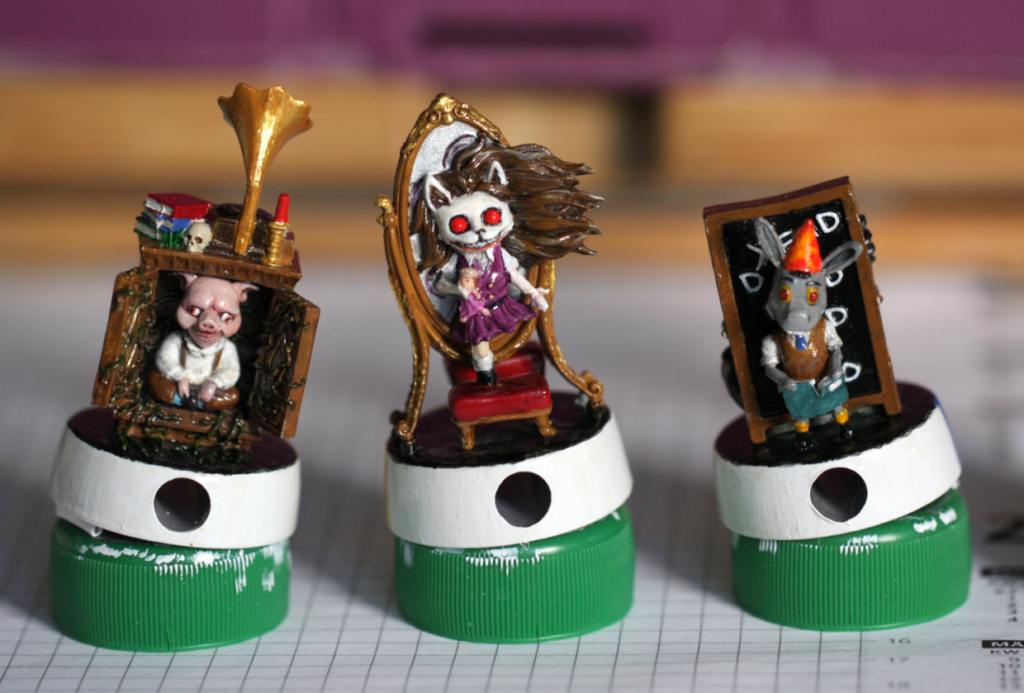
One of them was varnishing a batch of painted miniatures - four of them for the game "Faceless". As always, those minis look a huge lot better painted than they did unpainted, and much scarier as well (which is the intention, of course).


They are still sitting on their painting supports, and they are very shiny right now, having been treated with glossy varnish. As soon as weather conditions and our schedules permit, they and the other finished minis will get the second coat, matte varnish, and then they are finally good to play with.

We do the two coats because the glossy varnish is said to be more resilient, but doesn't look as good on minis as the matte one. Plus, with the two layers, you know that you should reapply varnish if glossy spots appear on the minis, but because there's still the glossy coat once the matte one has worn down (if it actually does from handling), the paintjob itself will not suffer. Not that our minis get such super-heavy use, but then, you never know...
0
JULI
28
2

Tomatoes.

I am quite, quite fond of tomatoes - though I remember that as a child and even teenager, I didn't really like them. These days, I do grow them myself, with varying success though unwavering fun. I find it especially fun to have a variety of different breeds, and I do take seeds myself to grow them again the following year (though admittedly I don't take too much care to prevent cross-pollination, so things may deteriorate over time...)

Here's some of the current crop, most of them still working on getting ripe:

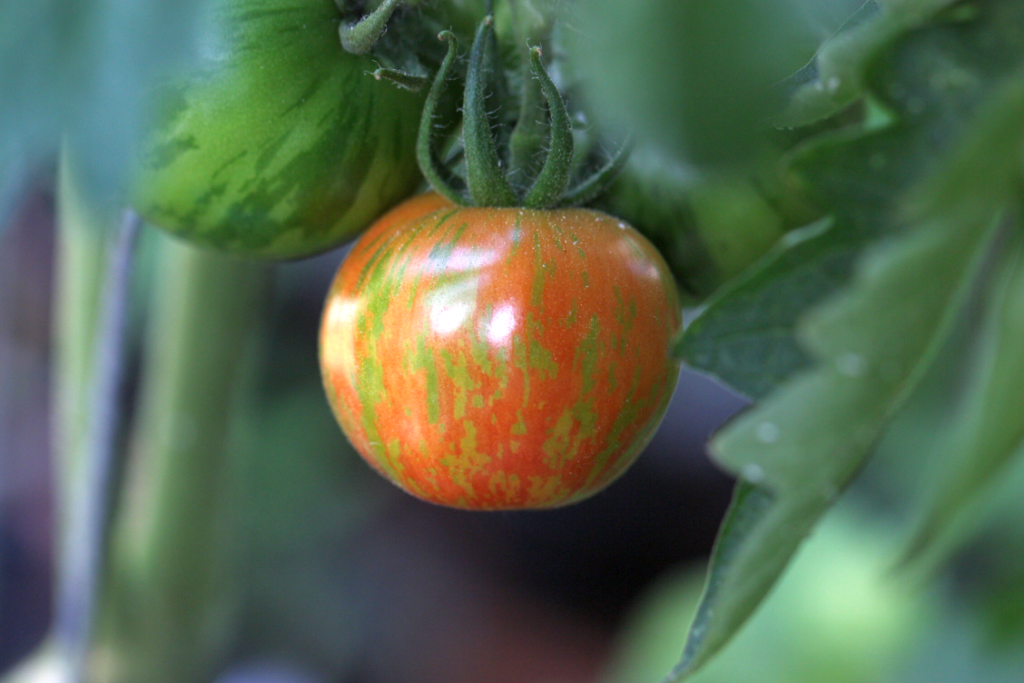
[caption id="attachment_5480" align="alignnone" width="640"] This one's a Tigerella - with fancy tiger stripes. Not completely ripe yet, but definitely working on it!


I got the Tigerella seeds a few years back as a present from a friend who's mostly out of touch now - so having these tomatoes also holds some pleasant memories for me.

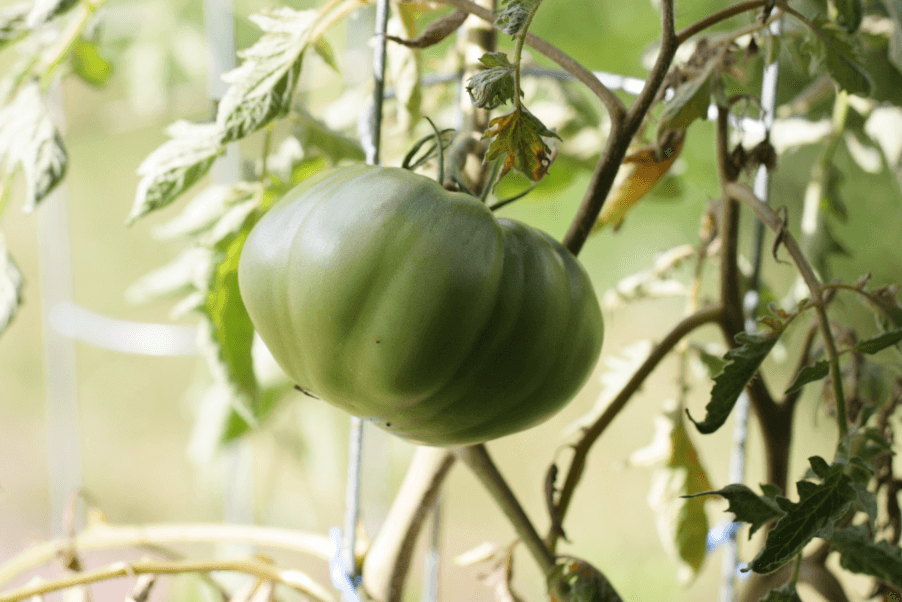
The next one is a "Sibirische Fleischtomate", literally "Siberian beef tomato". At least that is the name it was sold under when I took one of these from our grocery box, also a few years ago. The plants make just few, but rather large fruits:

[caption id="attachment_5482" align="alignnone" width="902"] Sibirische Fleischtomate!


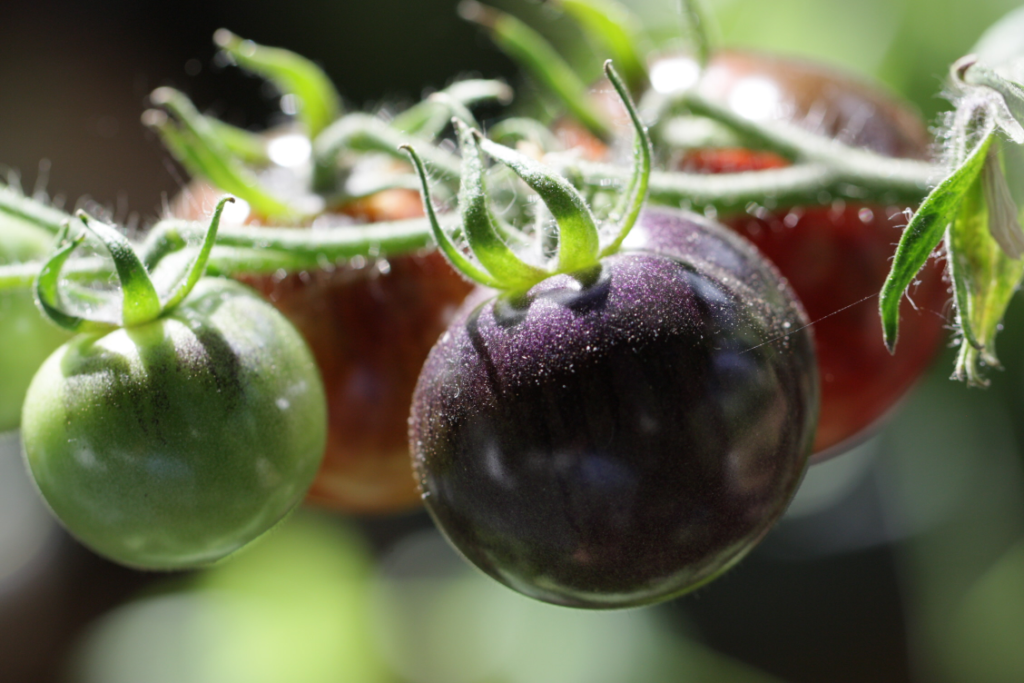
And finally, a souvenir tomato - I brought back a few packets of different seeds from our last summer holidays, among them one kind of tomato called "Indigo Rose". They are blue on top and ripen to a red-blue mix; tasty both raw and cooked:


Depending on the plant and on how much sun they are getting, the blue part is smaller or larger, and might even go towards a black colour. Definitely also a fun tomato, and looking at them brings back fond memories of hot summer days spent paddling...
0
JULI
27
4

Very British.

While discussing things about tea and coffee (and their availability, in specific types, in both Germany and England), a friend sent me a link to a company making real British tea. As in... tea grown in Britain.

Tregothnan grows tea bushes in Cornwall and sells tea (different kinds) as well as tea bushes (in case someone wants to grow their own tea). The prices for the "homegrown" tea might be a tad higher than the price for tea in your common supermarket, though.

Now if I didn't have all available spaces filled up with the current experiments growing chili peppers (most being surprise seeds from a random crossing, so nobody knows what kind of peppers they will grow), the Coffee Plantation (down to a more manageable ten or so plants now, as I've gifted a bunch to other people) and the Passionfruit Plethora (because flowers! and passionfruit!), I'd be tempted to get a tea bush...
0
JULI
24
0

Almost weekend!

It's almost weekend, and it promises to be another sunny one. Which is nice, but I'm actually waiting and hoping for some rain these days. We have had warm and dry weather for so long now that our rainwater barrels are almost empty - and I need the water both for watering the plants in the wintergarden (lovingly called "the jungle") and for washing the rest of my dirty wool from this year's shearing. As it currently stands, we're down to using the garden hose for watering the plants in the garden that absolutely need it (the not-lawn is not getting watered, but there's tomatoes and fruit trees that do need, and get, some care) and using tap or hose water for the wintergarden residents.

Washing wool takes a lot of water even if you try to use it as sparingly as possible... which means I have enough for about one more batch at the moment, maybe even two depending on how dirty the fleeces are, and then that's it. I'm not using tap water for wool washing, due to two reasons - it would need lots of tap water, which I think is too precious to spend on processing wool, when rain water will do just as well; and secondly, but just as importantly, I'm getting better results with rain water, as our tap water here is very hard.

So here I am, enjoying the sun yet hoping for rain. Preferably a nice, good, substantial and slow-starting rainfall during the night!
0
JULI
23
4

Wool Combs.

So... let's return to the wool prep proper, and in particular: Wool combs!

Here's the basis on wool comb using: You have a pair of them, used together. Wool is placed on the tines of one of the combs, then gets transferred onto the second one, straightening and aligning the fibre in the process. Dust, debris and short cuts either fall out during the process as well or can be removed relatively easily. Once everything is aligned nicely, the wool can be drawn off, ready to be used.

There are several different ways that can be used to transfer the fibre from one comb to the other; most of them involve holding the combs so the tines are perpendicular. While it is possible to work with one comb held in each hand, most images also show one comb as fixed somewhere, and only one held in the hands to work with.

Modern wool combs are used in a similar way; usually, there's some combing station or pad included with them (unless it's very small ones) or available to go with them. One comb is held in that station, and the other is used to work, held in the hand(s). If you look on youtube, there's (of course!) a number of combing videos and tutorials. (Note, also, that modern wool combs may have several rows of tines, and very frequently have two; the medieval ones I know of have only one row of tines.)

This medieval-style version can be seen on a number of images, showing the process in more or less detail, and a more or less, hm, trustworthy way. For instance, the British Library manuscript pic here has a woman combing in a setup that has one comb looking like it's held by, as we in Germany would say, "Siemens Lufthaken" - an invisible device holding anything at any place. (Hard to get, unfortunately. Let me know if you have a source.)

Much more detailed, and looking a good bit closer to actual life, are two images from the Hausbuch der Mendelschen Zwölfbrüderstiftung - one here, and the second one here. The images date from the 15th century.

In both cases, one of the combs is held in the hands of the worker, while the other is fixed in some contraption: A stool-like support for the t-bar holding the tines, and an upright pole coming out of the floor or fixed to the floor, a bit further away, forming a brace for the end of the handle. This far, we're still in sort of a similar vein as modern combing. Both modern and medieval images show the worker in front of the fixed comb's tines, the handle pointing away from the worker.
However... modern combs are fixed in a way that allows the worker to stand or sit in front of the tines of the fixed comb, yet work towards oneself. The wool is pulled through the tines on the far side of the handle (close to the worker), towards the worker. This only works when the comb is fixed very firmly, though, and in a way that will bear the force of combing (which is not to be underestimated!).

Logically, and very obviously with the medieval setup, that work direction will not work - the comb could slide away from its brace and support towards the worker. Maybe there is some additional way to help the comb sit properly on its support - but it might not be necessary as the work direction is quite clearly adapted to the bracing construction: Both workers in the Hausbuch images use the hand-held comb on the far side of the tines, the handle side. Which obviously means they work away from themselves, not towards themselves.

This... is intriguing. I haven't gotten around to try this setup properly yet, but I can definitely tell you it feels very different from the "modern" wool combing, where you have full freedom downwards with your working comb, as the fixed one is clamped to the front of its support. This might mean some other technique for medieval-style combing is necessary. It will definitely be very quick and easy to switch the fixed and the handheld comb with such a construction, though.

If you know of more combing pictures, I'd love to hear about them. And of course if you have wool combs and try this out, please do let me know about your results!

 
0
JULI
22
0

Wool Prep Rambling Thoughts.

One of the things in textile production that are underestimated, as a rule, is wool preparation. Quite often, spinning is the first task that people think of. There is, however, the tiny little fact that fibre preparation has a rather large influence on how spinning goes, and is thus important. It's also time-consuming, as everyone who has ever hand-processed some fibre for spinning will know quite, quite well.

Wool fibre prep starts with shearing the sheep or with the shorn fleece, depending on how you see it. The dirty fleece needs to be cleaned at some point, and the fibres sorted and prepared for spinning.

It is technically possible to spin the fleece just as it comes off the sheep, with all the dirt in. This will be easier if it's a good-quality fleece that is not too dirty (or if the sheep has been washed before shearing, which is an option as well). I've spun dirty fleece, and I confess that I'm not thrilled by it.

Whether your wool is clean already or not, you can prep the fibres by teasing them apart with the fingers as the most low-tech, low-time option. Next step up is aligning the fibres in some way, which can be done today using either combs or cards. As far as I can tell from historical sources, the Middle Ages used the wool comb only until the Great Wheel starts to turn up, which is when we also get evidence for cards. There's some textile tools found at Hallstatt-Dammwiese in Austria and Liptovska Mara in Slovakia, dating to the Late Iron Age; they were flat wooden boards with holes, and thorns were placed in those holes. Whether they were used for roughing up fabrics, preparing flax (hackling boards) or for preparing wool is unknown, though. (Pics and references can be found in Grömer, Karina. The Art of Prehistoric Textile Making. Wien: Naturhistorisches Museum Wien, 2016, p. 72f.) Combs were found in prehistoric context as well, and it's relatively safe to assume that they were used for fibre/wool preparation.

Wool combs, as they are shown on medieval pictures, are something that can be expected to only rarely turn up in archaeological evidence, due to the usual two reasons: They are made from perishable materials (wood and iron are both not very talented at surviving burial), and they are rather nondescript if falling apart. Added bonus: For something to be findable in publications, it has to be a) identified and b) published (where b usually requires a). So if some weird little piece of wood with a row of holes in it gets found, and there's no or little trace of iron in the holes, it might not get identified as a wool comb fragment, and thus not get mentioned anywhere.

This, by the way, is a problem not limited to textile tools; it's a general problem in archeology. Me writing this is also not intended as criticism towards my digging and publishing colleagues - I do know that they are all taking a lot of care, and trying hard, to identify as much of the weird bits and pieces that are found. Archaeologists working on a find complex look at lots and lots of images and lots and lots of publications of other sites, searching for comparable objects (also for dating purposes). There's also the option of asking colleagues, of course, something that is done as well - and showing mysterious things at conferences.

This general problem is a phenomenon of there being so many, many, many things in daily use and daily life that it is impossible to know them all. Just take a look around your home, or a look around a workshop of some craft that you are not familiar with, and try to imagine how hard it would be to identify things that are broken in half, or where there's only a fragment left.

And now I've rambled off on a tangent... we'll return to wool combs tomorrow.
0
JULI
21
0

Hiking.

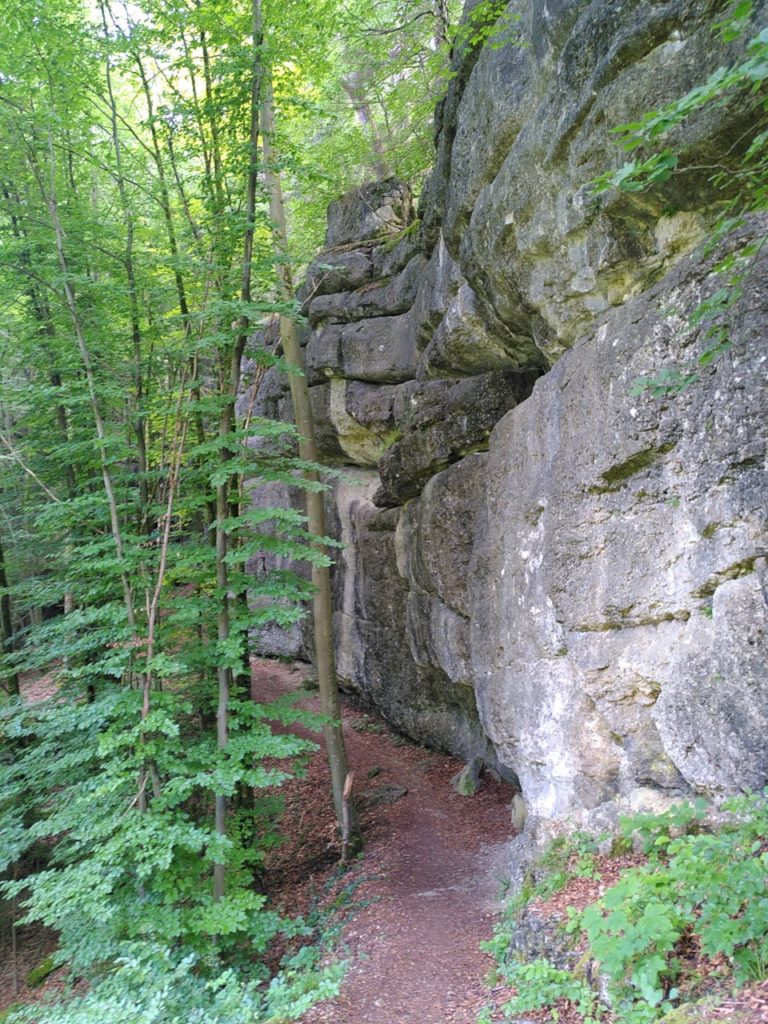
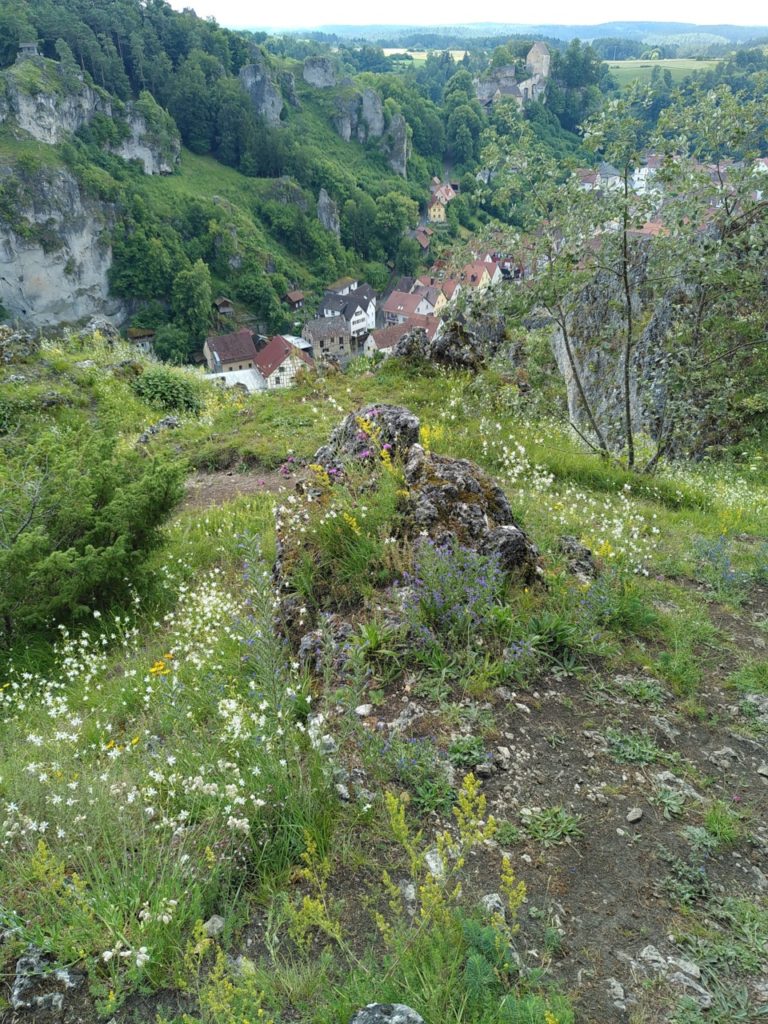
We finally managed this weekend to go on a "more-than-one-day" hiking trip - more or less right outside our front door, less than 50 km away as the crow flies. There were spectacular rocks and lots and lots of flowers in full bloom (which meant that the walking was periodically paused, and time was spent admiring the flowers, and the scenery).


To our great delight, we also saw a few rare flowers - Türkenbund and Waldvögelein - as well as lots of (rather common) fish. One Anguis fragilis crossed our path, and there were many butterflies, some of which we hadn't seen for so long that we both didn't remember their names (like the "Kaisermantel", literally "Emperor's Cloak", Argynnis paphia). There were also a few fields lying fallow or, rather, planted with cover crops - these cover crops being bee-friendly flowers, and blooming abundantly. In the non-fallow fields, there were more flowers growing than a decade or two ago, pointing to the use of less herbicides these days. All in all, it did make me feel that there still might be hope for our world and its wildlife. On our last evening, we also spied some signal crayfish (unfortunately not proper European crayfish, but the invasive North American species).


I didn't take many photos, so you've now seen most of the actual good ones that I did take. I'm not very good with using the phone camera; in fact, I'm not very good with a lot of cameras, my "proper" one being the exception. It's rather large and heavy, especially with my favourite macro lens, though, so I'm only taking it along when I plan to actually focus on taking pictures, and not on most holiday ventures.

I've also found out that I look at things differently when planning to photograph, and that I have a different mindset as well. I like taking photos in general, and I do enjoy hunting for good motifs, and good angles, and getting lovely pictures. Especially macro and portrait photography do tempt me, and I've hade a lot of fun with both. However, when on holidays, I have found that both the way of looking at things to evaluate their picture-worthiness and the corresponding mindset are, for me, at odds with winding down and enjoying the scenery. This is the main reason why I have stopped to take a lot of photos when on holiday trips. Occasionally I will pull out the phone, or take our (small) camera and snap some pictures, but it's mostly the Most Patient Husband of Them All who does the holiday photography, and I'm very content with that.

 
0

By accepting you will be accessing a service provided by a third-party external to https://www.pallia.net/

Kontakt