







Latest Comments

Guest - Aislinn Dyestuff Citizen Science.
09. Oktober 2026
This is a great project. I look forward to the results. Thanks for letting us know.
Guest - Aislinn Time for...
09. Oktober 2026
Looks delicious!
Guest - Katrin Sprang Discussion
18. September 2026
Hi Rachel, I have looked for more photos of you, but that was not very successful. I found a link on...
Guest - Beatrix Sprang Discussion
15. September 2026
That lozenge pattern element is not a photograph, but a scan. So it should be to scale. But I pinned...
Guest - Katrin Sprang Discussion
15. September 2026
I was not referring to Rachel's reconstruction (is the reconstruction you refer to the one photograp...
JAN.
07
0

Nesat 11 has a place to be!

First of all, sorry for the unannounced blog silence yesterday - the 6th of January is a holiday in Germany (and I think in several other countries as well), and I got sucked into that holiday spirit so much that I totally forgot to either tell you on the 5th or holiday-blog on the 6th. (Holiday spirit, in this case, means sleeping a little longer, then working on the still-lots-of-unpacked-stuff-situation, with some cake and some knitting sprinkled in.)

Regarding non-knitting, still-textile news, the homepage of NESAT has been updated - NESAT 11 will take place in 2011 in Esslingen, Germany. There is no more info up yet, though - so it's still suspense time!

In case you do not know NESAT (though if you read this blog, chances are you have heard of it), the name is an acronym for "North European Symposium for Archaeological Textiles". The first conference was very small and took place back in the Eighties, and "North European" has since developed to include most of Europe - not only the North. The conferences take place every three years, in a different place, and include about all the big names and lots of juicy, brand-new archaeological textiles science. The publications are absolutely wonderful, and I have spent delightful hours with each and every one from the series (which is listed here).

Last time was the 10th NESAT conference, and it was the first time that the event was "opened up" and participants not giving a paper were allowed in. Before, it was always just a small circle of people, and there was no public call for papers. I think that taking this conference more public was a brilliant move, and it seems that lots of others thought so too - we were over one hundred conference participants. And I hope that NESAT 11 will be as wonderful, exciting and fun as the last one was (and I'll do my very best to be part of the fun).
0
NOV.
03
0

Connecting Grad Students

Through a mail from my old Uni, I have just stumbled upon "Gradnet", an association that wants to make life a little easier for grad students by hosting an interdisciplinary and international conference, an opportunity for productive and critical exchange.

I haven't heard about them before (that's a small wonder and has much to do with both my topic and my work style, and little to do with them), but the programme of the next conference is online, and it looks quite large and quite nice.

The next conference takes place in Erlangen, from 20 to 22 November - so pretty soon - and you can check out their programme on the Gradnet website www.gradnet.de.

I probably won't be able to hop over there due to the move coming up on the next weekend, but I'd love to hear about it, so should you go there, please drop me a comment!
0
OKT.
12
2

Back from wonderful adventures...

I'm back home again, up and running - and blogging (even if it's slightly later than usual due to a much-needed battle against sleep deficiencies). So what have I been up to in these last two weeks?

First, there was Tannenberg. The traditional season's end market and, like Freienfels, usually resembling something like a fair to see different craftspeople and sellers of medieval tools and paraphernalia. This year, however, Tannenberg was rather subdued in atmosphere and with much less participants than the years before. We all wondered why - maybe all the fear-mongering about bad times and recession, combined with real-life struggling of craftspeople and participants, have finally had their impact on the modern middle ages as well. Still, we had a very nice time in Tannenberg, with quite good weather - only one day of rain and drizzle, and not much muddyness at all - and met and chatted with many of our friends and colleagues.

After return on Monday, it was unpacking, drying, sorting out of things and then, for me, preparing for Hungary straight away. Since I had to finish the presentation too, Tuesday was quite short for that - but everything got packed up in time, clothes stuffed into a bag, the trusty laptop bundled up, and off I went to a wonderful and truly memorable conference in Százhalombatta, a town some thirty km from Budapest. The conference was both the EXARC meeting and the last meeting of liveARCH, a project connecting eight archaeological open air museums from eight different countries. It was wonderfully organised by the Matrica Museum and archaeological park of Százhalombatta, including lodgings and transfer from and to the airport (what luxury not to book anything beyond the flight). It was everything I wish for in a conference: lots of people with different experiences and points of view meeting for good, interesting and sometimes thought-provoking presentations, many academic discussions, common meals, excursions to both stretch the legs and see something else for a while (including something typical for the country and/or region), enough coffee breaks with sweets (yes, the local sweets are actually something I enjoy maybe too much on a conference) and more long, varied discussions. Because everything except, of course, the excursions, took place at the hotel and meals were also organised by the conference team, everyone was kept closely together, and there was no scattering to different watering holes for meals and during free time. And that is another thing that makes a successful conference, to me: Keeping everyone together so that networking, chatting, joking and discussing is made easy, because all the others are quite within reach.

And because during liveARCH it became very clear to everybody that there is one single key to good cooperation and to success with networking, perfectly summarised during one of the lectures as "communication, communication, communication", every evening the "liveARCH Social Club" was opened for having a drink and a chat or five between friends. And every evening I got to bed later and later... explaining the sleep deficiencies and, thus, the lateness of today's blog post.
0
SEP.
21
0

Early Textiles Study Group conference

I have received a call for papers (on the usual labyrinthine ways these things take) for next year's Early Textiles Study Group conference that will be held in the UK. The theme will be colour and the organisers are aiming for an even contribution of technical and sartorial papers.

So since the organiser in her original mail asked to pass this on to interested parties, for all the dyers and colour people out there, you can find the full CfP as a .pdf behind this link.
0
JUNI
08
1

Feeling lonely?

It's been ages since I last posted about the Textilforum, so it's high time. And I have a reason, too: We have extended the deadline for registration to June 30. There are still some spaces left for participants at the museum, so if your occupation includes historical textile crafts - research, reconstruction, analysis, conservation, replicating - you are welcome to join us at the Forum. We also need a few more handspinners (handspindle only) to make the required twenty that we need for the spinning experiment. If you are a handspinner and able to spin an even thread for two hours, you could be part of this nifty bit of science!

If you don't know what I'm talking about: The Textilforum is intended to get people working with historical textile crafts into contact with each other - because it can be a very lonely affair. So we would like to link both professionals and amateurs (like living history folks) in this Forum, where there will be ample time to work, chat, and exchange hints and tips with each other. There will be some programme provided - presentations about research or projects in the evenings - and we'll run an archaeological experiment, the spinning experiment, during the mornings. The rest of time is free; think "gigantic enormous conference coffee break".

You can read more about the Forum on our website, www.textilforum.org, and you can also register there: Go to Call for Papers site, and on the bottom, you will find the link for registration. See you in Eindhoven!

Oh, and you can read me here again next week - I'm off for a few days' vacation, before summer work stress really hits...
0
MAI
12
2

Spinning Experiment Calculations

In preparation for the spinning experiment on the Textilforum, I need to figure out how much fibres to calculate for each participant. And to get a first impression, I spun with the carded and combed wool I have at hand - one hour in my normal thickness, and another hour as thick as I could manage.

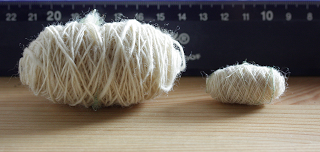
Now I'm one of those people who have a very limited range of thickness when spinning. And (unfortunately for this purpose) it is rather on the fine side. So I ended up with two very different-sized balls of yarn; I wound them off today and weighed them with my letter scales.

The "Thick Yarn" weighs in at about 8 g for one hour's spinning time. It is pretty uneven, in spite of my trying oh-so-hard to spin a decently smooth and even yarn. Thick stuff is just not for me. Here you see the sorry results of my thick-spinning:


Beside the huge (haha), bulky and uneven ball of thick yarn, you can see what I spun as my normal thin yarn. The weight? Somewhere between one and two grammes. Both yarns spun with the same wool on the same spindle (which was about double the weight of the reference whorl for the experiment, and fitted with a rather heavy wooden spindle stick). When wound onto a ruler, the thick wool gives about 20 threads per inch, the thin one about 12 threads per quarter-inch.

So now I've outed myself as a thin-spinning freak, can any spinners of thick yarn out there give me a rough estimate of how much fiber in grammes they hand-spindle away in one hour? Just to check against my calculations? I'd be very grateful...
0
MäRZ
30
0

There's no place like home!

I'm back from my little trip abroad - I went to Ireland for a little more than a week, going to the Borderlines XIII conference and then having a few days more in Dublin.

The conference was neither as international nor as interdisciplinary as I had hoped, but good fun and very informative, as I now know a gazillion more Middle English than before (gone straight up from "none at all" to "I can understand some simple words"); learnt that the same differences between archaeologists' and literature-ists' papers exist in Germany and in Ireland; found that there is so much still to learn; got the distinct impression that I should really try to read some Chaucer one of these days; discovered that Irish saga background is really different from Middle European background; learnt where the Liffey and the Puddle flowed together in the old town of Dublin; finally understood why my "Celtic-style knotwork" always ended up with one crossing out of pattern and a few more odds and ends. Sadly, I was not really fit as with an appalling bout of bad timing, I caught a head-cold straight before leaving for Ireland and thus felt like I had cotton wadding inside my skull instead of a brain for the first one and a half days.

After the conference, I got to see the book of Kells, the Georgian Town House Museum(Number 29), the National Museum, the Collin's Barracks (second part of the National Museum), Phoenix Park, the Botanical Gardens, and the innards of several bookstores and supermarkets. I ended up with a few photos (though sadly, most of the Irish museums seem to have a strict no-photo policy), a few bars of Cadbury's chocolate, some other odds and ends and a few books, both work and non-work.

Alltogether, I'd say the trip was well worth it (even though Ireland seems exceedingly expensive to me) - the visit to the National Museum alone was so good that in retrospect, I'd have travelled for that. Should you get the chance, go see the wonderful hairnets they have, made of silk thread so thin that you'd think it is one single fine human hair; or the small bit of gold brocade tabletweave from Viking Dublin; or the wonderful bog garments, dating to the 17th century but showing stunning parallels to diverse medieval garments. And I should also add that the museum staff I met were all extremely nice and extremely helpful, and the visit to the museum is free (though the cakes in the museum café are enormously expensive).

It was, in short, a wonderful trip, but I'm thoroughly happy to be back home again now. Not least because I really missed the home-cooked food and the fresh fruit out of our grocery box - somehow, even a freshly-made sandwich just can't keep up with, say, a pie with turkey breast, fresh carrots, onions, sprouts and a cream sauce with fresh parsley. And an apple for dessert.
0

By accepting you will be accessing a service provided by a third-party external to https://www.pallia.net/

Kontakt