

Latest Comments

Guest - Aislinn Dyestuff Citizen Science.
09. Oktober 2026
This is a great project. I look forward to the results. Thanks for letting us know.
Guest - Aislinn Time for...
09. Oktober 2026
Looks delicious!
Guest - Katrin Sprang Discussion
18. September 2026
Hi Rachel, I have looked for more photos of you, but that was not very successful. I found a link on...
Guest - Beatrix Sprang Discussion
15. September 2026
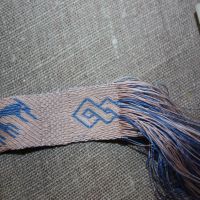
That lozenge pattern element is not a photograph, but a scan. So it should be to scale. But I pinned...
Guest - Katrin Sprang Discussion
15. September 2026
I was not referring to Rachel's reconstruction (is the reconstruction you refer to the one photograp...
FEB.
19
7

Warp Weighted Loom Thoughts.

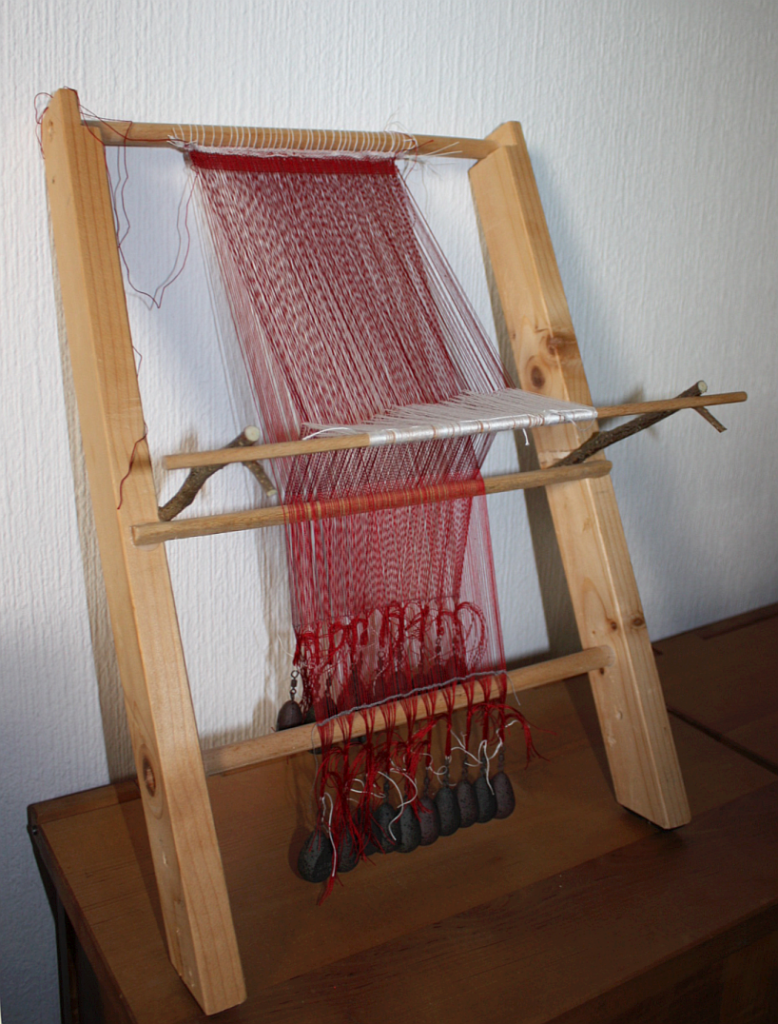
A long, long time ago, I made this little model of a warp-weighted loom, and after a few more years, I set it up again properly, trying to scale things down as well as possible.


The model has come in handy for a lot of occasions now - it's the perfect way to very quickly explain how a warp-weighted loom works, and much easier to transport than a full-size one. For weaving purposes, though... it is obviously not the most suitable thing.

For actual weaving on a warp-weighted loom, you need a full sized version. And due to some people putting a flea into my ear, I've been pondering the question of how to organise a loom-weaving workshop, in logistical terms. Because you'd obviously need a loom for every weaver...

Now, in my personal opinion, the weaving itself is not the crux in learning how to work with a warp-weighted loom. Yes, you can of course muck up things wielding the shuttle and beater - but according to my experience, the stage where the main decision happens on whether you will end up with thread salad or a proper fabric is the setting up of the loom. Which also happens to have a lot more steps, and a lot more varied tasks, than the actual weaving itself (which is, basically, change shed, beat, insert weft, repeat). So to learn the how-to, I would actually aim to teach setting up... followed by a bit of weaving.

Whether the one or the other, though, you still need a loom for every weaver. Preferably one that is a good, efficient tool which would be suitable for production weaving. Also relatively cheap and easy to make (even without a woodworking workshop and lots of tools), suitable for normal-sized women (a plus would be easy adaptability for body size), and with the option of making it free-standing (in case the workshop area does not have enough wall space). It should be possible to take it completely apart for storage or transport, preferably with no single piece longer than 2.2 m.

The most important measurement for me, at the moment, is a suitable and sensible depth of the natural and artificial shed. How deep does the shed have to be, in order to weave comfortably? At one point, it will be too shallow to pass the shuttle (or weft ball, or whatever) through. (Obviously, the wider the fabric, the more fiddly this might get.) Making the shed deeper than necessary, though, means that you have to pull your heddle stick out further than necessary each time, and that is not very efficient.

Mathematics say that the depth of shed and height of loom will dictate the angle of the loom, and thus how far its bottom will stick out from the wall, and thus how far forward you will have to lean to pull the heddle stick, and how long the rests will have to be for the artificial shed - so, basically, everything.

Which means that construction-wise, deciding on a smart depth of shed is the most important thing... which also means that if any weavers with experience on a warp-weighted loom are among you, please let me know about your thoughts - and your experiences with shed depths!
0
FEB.
18
0

Why I love warp spreaders.

When it comes to tablet weaving, I am a little... um... peculiar. If you've taken a workshop with me, you will know exactly what I mean - I will insist on certain things being done just so.
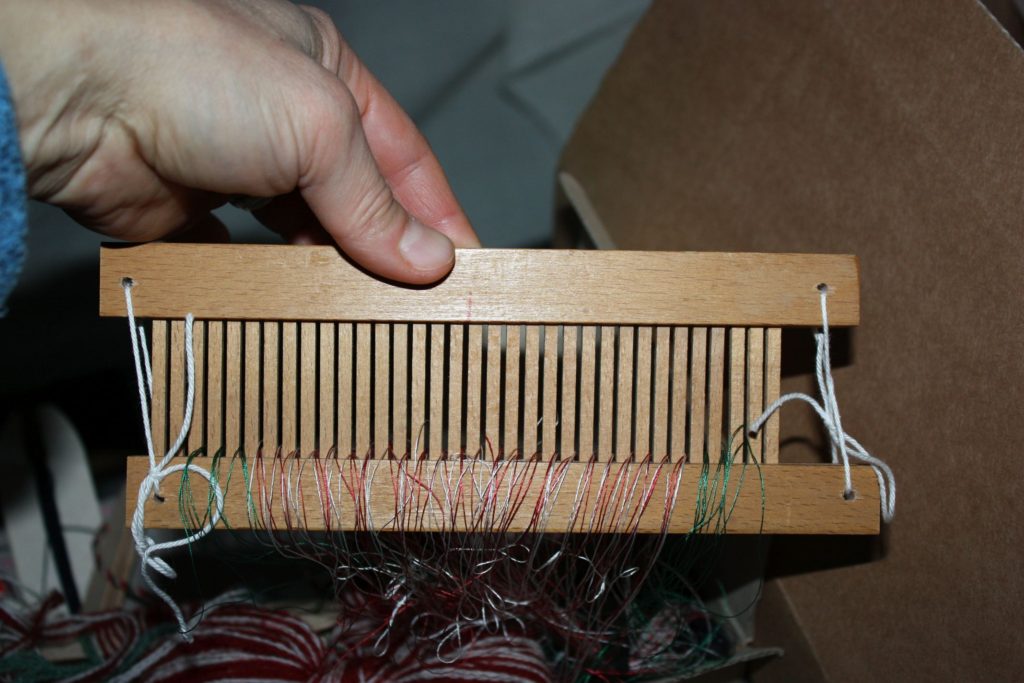
There's also a stack of things I will not insist on, but will strongly recommend - such as weaving with as little tension as possible, or leaving a loop when you are inserting the current weft, or warping with a cross and inserting either a cross (two sticks tied together, like the cross in loom weaving) or a warp spreader. In its simplest version, this is a stick with holes in it, through which you pull the individual tablet threads (all from one tablet through one hole). There's also the comb-style version, which can be filled easier, and without cutting up a continuous warp:

[caption id="attachment_5051" align="alignnone" width="640"] Warp spreader made from a broken piece of weaving reed - the top can come off to fill it with threads.


The warp spreader will, as its name implies, spread out your warp - so by adjusting its distance from the tablets, you can make turning the tablets easier, and fine-tune how easy it will be to keep your weaving the perfect width. That is its main function, and for that alone, it is very much worth installing one.

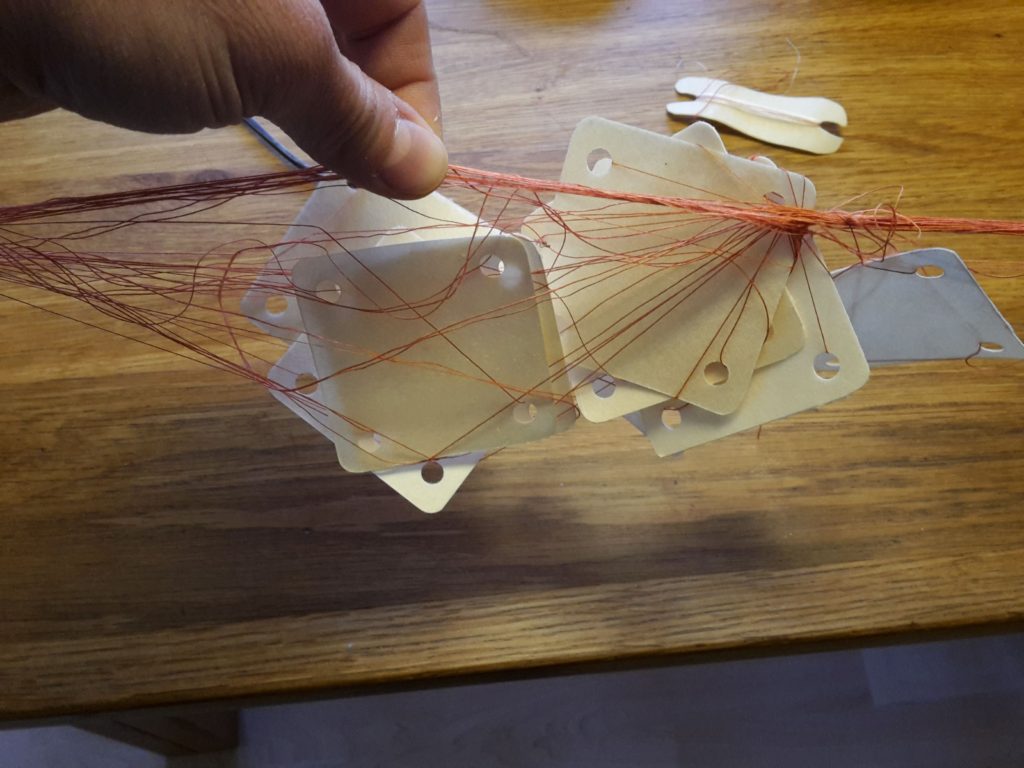
However... there's this secondary thing where it comes in really, really handy. Imagine, for a moment, that you are like me and occasionally have your five minutes of utter and complete loss of all motor skills, resulting in things dropping in the most spectacular way. (That, by the way, is the reason why I am using lightweight parchment shuttles for my weaving.) Or, in that case, you have a warp that was dragged around inadequately secured and in an inadequate packaging once too often (I am, generally, not kind to my warps). It might just result in something like this:


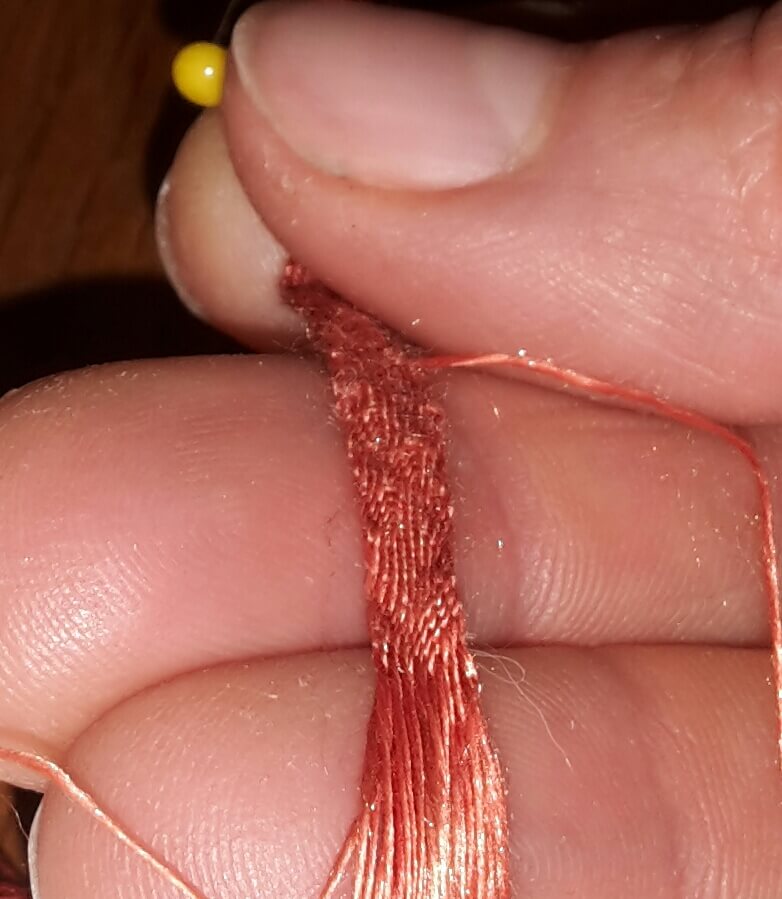
That was adequately termed "tablet salad" by someone. It's only nine tablets, but detangling something like this could be a real hassle... if not for the warp spreader. With that in place, all you need to do is go through the cords going through the spreader, one after the other, gently extract the corresponding tablet from the salad, and place it to the side to form the stack of tablets that is supposed to be there.

And then, a little while later, you can go back to weaving.


In this case, it was only nine tablets, so it was done very quickly. I once dropped my playband with 42 tablets - that took a bit longer, but still was not too bad, thanks to the cross that was in place there, too.

So... do you use warp spreaders? If not, do give it a try - it is worth it!
0
FEB.
17
0

Random Curious Things.

Pantone decides on a "Colour of the Year" each year, and for 2020, their choice is "classic blue". As a blue-loving person, I do approve... though I like all kinds of blue, not only classic.

Science has a little news article about what our modern civilisation will leave behind for future archaeologists. (Or alien xeno-archaeologists, if humans go extinct.)

This link will bring you to an image of a tablet-weaving frame in a medieval manuscript. Just because.

The Museum of London has a post about pointed shoes (and sodomy!).
0
FEB.
14
0

Medieval Mittens.

I've recently looked into medieval mittens for a bit, and one rather nice one can be found in the Museum of London, on permanent display in the exhibition. It's interpreted to be a work glove and dated to the 15th century.

If you're very fond of this thing, you could actually buy a print of it from the MoL (or buy a print of a number of other find pictures).

There's more photos online, taken privately and stashed in a forum archive - you can find the photo list with full-size images via this link. Images 184-195 show the leather mitten. (I found some of the images via larsdatter.com. I then found the list thanks to knowledge from days long gone past, when I wrote html in a text editor and learned about the structure of web addresses... shows again that you never know when some weird knowledge may come in handy.)
0
FEB.
13
0

Breakfast Delights.

There's people who eat breakfast, and people who don't, and I've been in both groups at different times in my life. I've never been someone to skip a special occasion breakfast, though - you can always get me with a good breakfast buffet, which means that staying at a hotel with breakfast, for whatever reason, always feels like an extra-special treat for me.

Recently, I've been introduced to Bircher Muesli (by my brother-in-law, from Switzerland, fittingly) - and it has become one of my weekday breakfast delights since. I've never been really fond of the typical German Müsli, which is rolled oats and other grains together with dried fruits, plus some flakes or pops; you pour milk over this and eat it. The grains are rather hard, which I don't find too pleasant, and the flakes and pops go soggy quickly, which I also don't find pleasant, and the dried fruit is just... eh. Especially if it's raisins. (It's usually raisins.)

Bircher Muesli, however, is basically overnight oats, only invented way before they became the current In Thing. The original version is a bit of oats with a good amount of apple and some hazelnuts; the oats are soaked overnight, the apple is added fresh, as are the ground or chopped nuts.

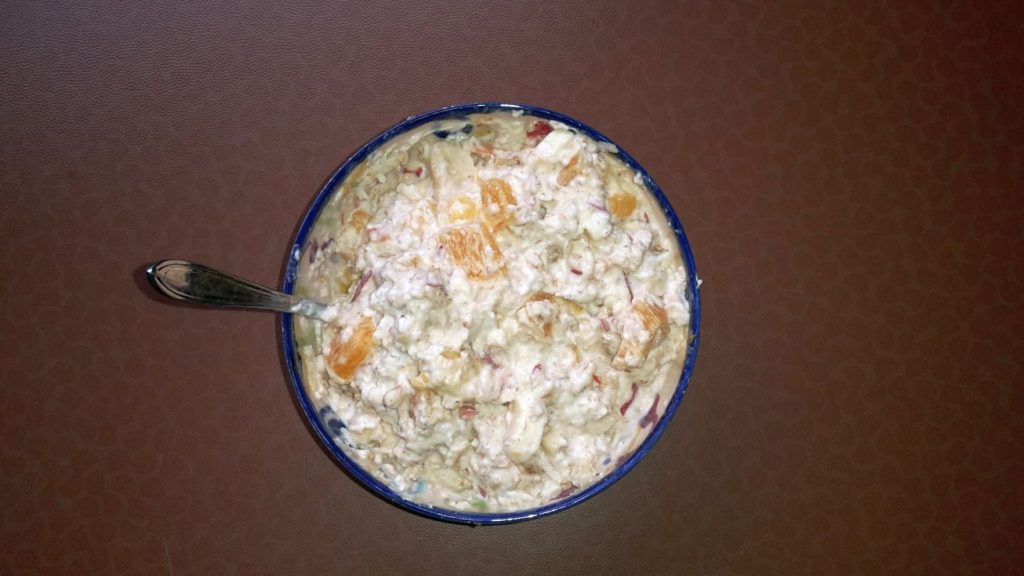
Obviously, there's a gazillion of variations (this Guardian article gives you some); I soak my oats in low-fat yoghurt and a bit of water, add a small apple (about 120 g), coarsely grated, to 60 g of oats and about 120 g of yoghurt, leave out the hazelnuts and put in a dash of lemon juice, plus some additional fruit such as a bit of sliced banana and diced orange. That makes for two servings - half of it just goes back into the fridge and is just fine the day after.


The oats are nice and soft and squishy, the yoghurt and lemon plus a tart apple add some tang, and the grated apple makes the consistency somehow fluffy, which I really like. The extra fruit adds some interest and variation plus sweetness, and if not enough of the latter, a little bit of honey drizzled on top does the job nicely.

So in case you're looking for a breakfast idea - give it a try, you might be surprised!
0
FEB.
12
0

Sort of random links.

Time for some link stuff again!

First of all, in case you're looking for a plane, or if you are plain curious to know how much is in the air at a given moment: planefinder.net shows planes in real time, plus their flight path and information about both the plane and the distance, height, and so on. It's rather chilling to see how many airplanes are over Europe...

It looks like there might be a way to increase how well humans can see in the dark - though at the moment, it's mostly documented as a side effect of a specific cancer treatment, which is obviously not the thing one would want.

The bibliothèque numérique de Lyon has 55 digitised manuscripts in its collection, dating to the 5th to 10th century, as well as a large number of miniatures from manuscripts of the 5th to 16th century. And because they are wonderful people, the images are open licence, so you are free to use them however you want.

Not medieval at all, but still interesting: Here is a map of the different types of moccasins in North America, with linked instructions on how to make center-seam type shoes of that kind. And I instantly felt transported back to my teenage years, when I had a phase (a rather long one, actually) of being totally into Native American stuff, and tried to make my own shoes and clothes and stuff.
0
FEB.
11
0

Storm Sabine has passed...

Storm Sabine has passed, and here in our spot, she was quite gentle - there was wind, yes, but I've seen stronger winds, and more rain, so altogether there was much less of a storm than the warnings and predictions had indicated. There even were bouts of sunshine inbetween - it was a little like April on speed.

I spent the past two days mostly indoors, which I would have done storm or no storm - I had a nice sunny quarter of an hour for my trip to the bakery yesterday, and today was mostly nice again, with one shower of snow in the morning. Altogether there was actually more sun during these storm days than on many of the previous days this winter; enough sun to heat the main part of our living space via the wintergarden. Go figure.

There might be more stormy weather coming up during the next days - we'll see what happens, and I hope it won't be too bad...
0

By accepting you will be accessing a service provided by a third-party external to https://www.pallia.net/

Kontakt