Latest Comments

Guest - Aislinn Dyestuff Citizen Science.
09. Oktober 2026
This is a great project. I look forward to the results. Thanks for letting us know.
Guest - Aislinn Time for...
09. Oktober 2026
Looks delicious!
Guest - Katrin Sprang Discussion
18. September 2026
Hi Rachel, I have looked for more photos of you, but that was not very successful. I found a link on...
Guest - Beatrix Sprang Discussion
15. September 2026
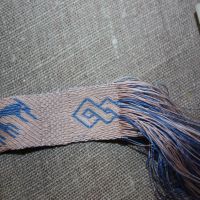
That lozenge pattern element is not a photograph, but a scan. So it should be to scale. But I pinned...
Guest - Katrin Sprang Discussion
15. September 2026
I was not referring to Rachel's reconstruction (is the reconstruction you refer to the one photograp...
JAN.
20
0

Things Recently Discovered.

Three things I've recently discovered:

There's a project called Thefbo, looking at the textile crafts from prehistory at Lake Constance and Upper Swabia. They even have a blog, in German and English, so you can have a look at what they are up to (which included some retting of linden bast fibres last year).

Also having a blog: Stadtarchäologie Wien (Vienna City Archaeology) - this one's only in German, though. Clicking the link will bring you directly to an article about a woven band (with metal threads).

Third thing, having nothing to do with textiles: There's a website called toogoodtogo.com, and the people behind it would like to reduce the food waste that happens, on a very regular basis, in restaurants, bakeries, and food shops. Basically, you can sign up and then buy a packet of leftover food using the corresponding app for your phone; you pay a small amount of money (which means this reduces the loss the business makes) and get food that is too good to go to waste for rather little money. I've not tested this (yet!), but find it a brilliant idea. After all, this way, everybody wins - the environment, because there's less waste; the business, as they make less loss; and the customer, as they get a surprise food package for a good price. Toogoodtogo is available in several countries; you can check out if yours is among them on their website.
0
JAN.
17
2

Nails. Lots of nails.

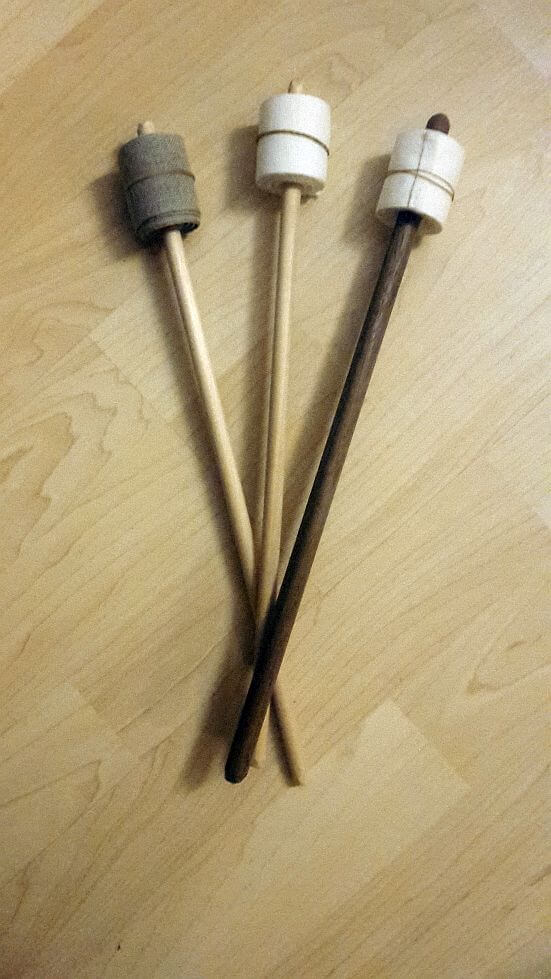
Today was spent doing re-stocking actions - among them: fixing bands to both distaff sticks and embroidery frames. As the distaffs in question were hand distaffs, though, the first step was to saw the dowels to the correct length and then round off both ends of each dowel.


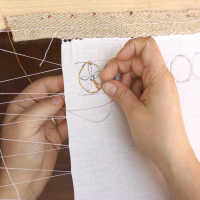
The distaffs were, after that, rather quick to finish in comparison to the embroidery frames, which have a lot more of the small copper nails holding the bands in place. And of course these nails need to sit at the proper place, and they have to go into pre-made holes so they will go in properly and not bend instead... and no, don't ask me how many bent nails it took me to finally learn that!

The first few nails are always a bit extra exciting, and fun to hammer in, but it does get a little boring after a while. Even worse, the sound of hammering makes it hard to listen to podcasts while working, though otherwise, this would be the perfect mindless job to enjoy some nice stories or other interesting things to listen to.

The restocking action was rounded off by refilling my spindle whorl boxes and portioning off wool for spinning. So it was a productive day, and I even found time to spend a few minutes outside pruning our willow fence - it's that time of the year again.
0
JAN.
16
0

Rippenköper.

I've mentioned working on the fabric info thing - and one of the things I really want to include is lesser-known weaves. Well, weaves lesser known today, I should say, because back in their hey-day, things like samite and Rippenköper definitely were well-known.

Rippenköper is something that I wasn't really familiar with either; it only had a relatively short time where it was the Thing (or at least one of the things). It's a twill variation, made by changing over from 2/1 twill to 1/2 twill after a few wefts, which results in narrow stripes giving a pleated effect. Since this is a weave where you will see more of the warp or more of the weft depending on which side you're looking at, if you have warp and weft threads in different colours, it will also give you a colour stripe effect.

If you're curious about that weave now, Carolyn Priest-Dorman has written a blogpost about it a while ago, including a pretty picture of a Rippenköper she wove in the background of the page - you can go check it out here.
0
JAN.
15
0

Links for your delectation.

More of the things-going-on-here info: I am sitting here working on an overview about fabrics in the Middle Ages. This is a large topic, and a complicated one, with many facets and many aspects and rather bad sources. Fortunately I'm "only" going for a two-hour talk, so the bad sources don't matter too much, as there's too little time anyways to go into detail of such a kind that I'd need much better sources. (Though, of course, things would be easier with better source material, which means a) more textile finds that are b) published in an easily accessible way...)

At the moment, I'm still in assembly mode. I usually start presentation outlines with a more or less rough idea of the things I want to cover, then gather all the necessary info for this, stick in a lot of pictures, think of even more things that are definitely relevant, thus stick in more stuff, then do a test run and discover I have to cut things down by about two thirds... which I then do and manage more or less, only to find things during that process that have to be added in for things to make sense, which usually makes things interesting again.

Right now, though, more things get added, and a bit later, I'll do a run-through where I babble to myself to find out how long the monster will take, to consequently enter the next stage. While I am working on that, here are two potentially time-consuming links for you - enjoy!

The Archaeological Textiles Newsletter (now the Archaeological Textiles Review) has been around for quite a while, and they have published a lot of very interesting articles, most of them short but informative.
Because the ATR people are very nice indeed, you can download the back issues up to issue 59 (which is from 2017) from their website, for free. Of course you can also subscribe to the Review, which will then bring you the more recent ones.

If that's not enough to keep you occupied, you can head over to the website of the Bamberger Staatsbibliothek and leaf your way through the digitised Bamberger Apokalypse, dating to the early 11th century. (If you're in the area, there will also be an exhibition, starting soon, about the manuscript.)

 
0
JAN.
14
0

Things happening here.

There's a stack of things happening here, though almost all of them are boring-type background things. There are some minor issues with the website, including some updates and some other small nuisances that I'd like to fix, but still haven't. In some cases, I'm not good enough at programming or understanding how the website innards work, and I just can't find where to tweak stuff so it works as intended. Most of these things are also not crucial, so I tend to have a go at them when they catch my eye, which they do once in a while, and after an hour or two of fuddling around, I put them to rest again. Sometimes I change a small thing only to find out (days or weeks later, if things go badly) that my things-look-better-now tweak actually was a things-look-better-here-now-but-shittier-everywhere-else thing. Sigh.

The most current problem was a deluge of spam coming via my contact form. It seems to have been solved now, at least mostly - I'll see if what I did was enough in the next few days. There's a plugin installed now that should keep bots from posting while doing nothing (and adding no extra steps) for regular, living and breathing human beings. If that will not stop the spamming, I'll have to add one of those wonderful "please answer this simple maths question" thingies - something I did want very much to avoid. But if the alternative is to get about 200 spam emails each day, plus the same amount in "Undelivered Mail Returned To  Sender" messages, that decision does get a lot easier.

There's also some more maintenance and ordering of things going on with the computer. Most of the transferred programmes seem to work fine on the newly setup machine, but there's a new backup procedure to be implemented, and it's a good opportunity to do some additional housekeeping, so that's also going on, and - as usual - it takes a long time and is a little annoying.

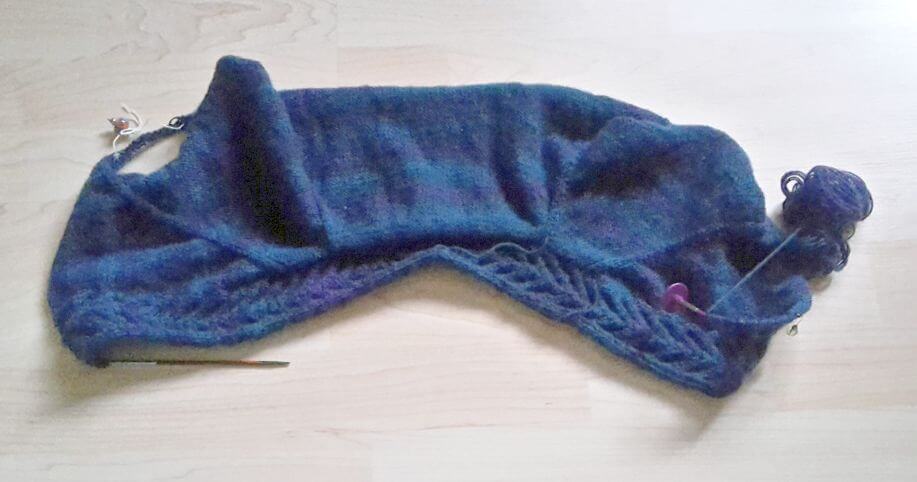
In other, more happy news: There's been some progress on the Ink cardigan, as can be proved by this very bad, very blurry photo:


I've progressed past the raglan increases and into the main body. Next step will be knitting the sleeves. I've found out with my first knit-it-all-in-one-piece piece that I absolutely hate knitting the sleeves as the last bit. There's just too much finished object to turn around with each round of the sleeve to make it comfortable... which means I'll do the sleeve-knitting right now, at the earliest possible part. That way I can also see if things fit, or if I have to go back a bit and adjust stuff.

 
0
JAN.
13
0

Low-CO2 travelling...

While we're at the subject of travelling: Here's a post about travel by cargo ship instead of using the plane. I could totally imagine travelling that way at some point - though at the moment, my personal desire to go into the US is about zero.

One of the big things about planes is that they are fast. Slow travel, though, holds its own charms. Less jetlag, for instance. Travelling overseas used to be a big thing, much bigger than in our modern, fast-paced age, where it's possible to go to about anywhere for just a few days. Maybe that will come back in our future, if more people decide to forego air travel. (Or maybe we'll get airships back. That would be a really cool thing...)
0
JAN.
10
0

Travels in 2019.

At the start of last year, I realised it would be a really interesting thing to keep track of what means of transport I'd use how much over the course of a year. So we hung up a sheet of paper on which we'd jot down train rides, public transport rides, and, in my case, the two flights I've taken. Bike kilometres were tracked via the odometers, and the car, of course, has its own odometer, with the start-of-year number duly noted anyways due to tax reasons.

So here's the full rundown of my travelled distances for 2019.

Winner, by far, is the long-distance train, with a sound 7845 km done. Longest individual train rides were the one to London for the MEDATS study day (about 1000 km one way) and my train ride to Leiden, where I had to take a detour to catch the sleeper train in Passau - this, together, amounted to about 1126 km to get there. Back was only 672 km, without the detour.

https://www.instagram.com/p/B4UK2Suojta/

Public transport trains in our vicinity add another 630 km to the train bill - so altogether with these, my train distance is 8475 km. (I calculated the train kilometres through brouter.de, which is a routing/distance calculator website based on the Open StreetMap, using the train option. I did not make sure that this was the exact route that I did take with the trains apart from the one very interesting one to Leiden, so numbers may have been a bit different in reality - it should work out about correctly overall, though.)

Second in line is the car - with 6621 km travelled. This is both the distances done for job reasons (3803 km) and those for private reasons (2818 km). When travelling for job purposes, I'm usually alone in the car, but it is full of stuff; when travelling for personal reasons, we're usually at least two people in the car, and we do try to fill up the car if possible.

Third in the list is the bicycle - though this is my main daily means of transport (together with just walking for the very short distances). It's only shorter distances, though, usually between 3 and 10 km one way, so it does not sum up as quickly as the things done by train or car. (If it's a longer distance, we often do a combination of public transport and bicycle, which is at least as fast as the car in many cases, and usually cheaper.) I rode my recumbent for 422 km last year, and did 2408 km on the tandem together with the Most Patient Husband of Them All - so 2830 km. (Probably a few more, since I sometimes forget the odometer, or it doesn't register things at first because the spoke magnet has been turned out of position.)

2341 km were done by plane - that was my WorldCon trip to Dublin and back. (Probably a bit more, since that is the direct distance between start and end points, but I could not find any way to calculate the actual flight path distances. It will have to do.) Travelling there by other means would have added about 5 to 6 days to that venture, and that was not possible time-wise for me, so I did opt for the plane.

Here's the list again, in short:

8475 km - trains (long-distance and public transport trains)
6621 km - car (both work-related and private)
2830 km - bicycle
2341 km - plane

So I did 1.7 times the distance using train and bike than I did with the car, and more kilometres per bike than with the plane. There's still some room for improvement, obviously - but I'm quite happy with the train quota for work stuff that I managed this year, considering that I do usually have to haul quite a bit of things when travelling for work.

I can say that apart from being really interesting, jotting down the kilometres done via public transport actually made me try a little harder to go by train if possible. The part where I think would be the most wiggle room for some improvement are the distances done in the car for private reasons; maybe that can be a little less in 2020. There's currently no flight planned for the coming year, too, but a long and adventurous train ride, so I'm already looking forward to find out how the numbers will stand at the end of this year.

So - would you like to join me in the project? I'd be curious to hear about your numbers in 12 months!
0

By accepting you will be accessing a service provided by a third-party external to https://www.pallia.net/

Kontakt