Latest Comments

Guest - Aislinn Dyestuff Citizen Science.
09. Oktober 2026
This is a great project. I look forward to the results. Thanks for letting us know.
Guest - Aislinn Time for...
09. Oktober 2026
Looks delicious!
Guest - Katrin Sprang Discussion
18. September 2026
Hi Rachel, I have looked for more photos of you, but that was not very successful. I found a link on...
Guest - Beatrix Sprang Discussion
15. September 2026
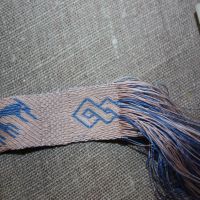
That lozenge pattern element is not a photograph, but a scan. So it should be to scale. But I pinned...
Guest - Katrin Sprang Discussion
15. September 2026
I was not referring to Rachel's reconstruction (is the reconstruction you refer to the one photograp...
NOV.
22
0

Random Link Friday.

It's time for some random links for you again (in hopes of getting my huge number of browser tabs diminished into something remotely sensible looking) - so here you go:

A new method for baking bread in minutes - researchers in Vienna are baking bread by sending electricity directly through the dough, which is looking especially good for things like gluten-free breads. You can read more about it here (in German).

If you put things on the Internet, chances are that someone else will see them and maybe feel inspired by them. Or... "inspired". There's also a chance that the idea might be taken and something entirely different made from it. Like in this case:
Bernadette Banner has made a dress reconstruction for herself, and the image of this has been used as the basis for a knockoff, sold very cheaply. So she bought a knockoff of her own dress, and made a long video about this:


If you prefer to read things to watching videos, you might want to go and browse the OpenAccess books at the OApen Library - for example the archaeology section.

There's also a bit of information online about Viking Age brocaded tablet-woven bands, as the teaser to a paper being presented at NESAT 2020.

Finally, here's something about giving media interviews as a scientist. I've been interviewed a couple of times now, and it's always exciting, and a little bit scary as well - but being well-prepared, as the article also states, definitely helps a lot.
0
NOV.
21
0

Travel Adventure Stories.

There's more to tell about the Leiden trip: Travel Adventure Stories!

I'm not someone who goes on Big Damn Adventures - I've never done trips into really far-away foreign countries with really different cultures. No hiking through China or India for me, no Turkey or Russia. But I'm fond of the little adventures. The small things that are still exciting, but there's nothing that can go desastrously wrong - and I am utterly happy when things do not go wrong, or the stories have a happy end after all.

Little adventures like travelling via the train with an interesting itinerary. In order to get to Leiden in time to have a look at the Stockings exhibition, the solution was to leave early in the evening of Thursday to catch a train in the "wrong" direction, to board the night train in Passau and then wake up in Düsseldorf. From there, it's easily possible to arrive in Leiden at noon.

I had booked one bed in an all-female compartment, which is always interesting as you never know whom you will end up sharing with. (In this case, there was only one other lady in the 3-person compartment, from Vienna, and she was very nice.) We only chatted for a very short time in the morning, as she left the train one stop earlier than I did.

The ticket for the sleeper included the bed space plus a goodie bag with some snacks, a small bottle of sparkling wine, a pair of house slippers (yes, really), a pen (to fill out the breakfast order), a pair of earplugs, a small muffin, a bottle of water, and a towel (sealed in a plastic bag) with NightJet design.

I was amazed to hear from the conductor during breakfast that these were all intended for the passengers to take away with them, and that whatever was not taken would not be re-packed, but thrown away. So I packed my towel. And the snacks (I would have taken those anyways), and the slippers, and the remainder of the goodie bag contents of my compartmentmate, who was already off the train.

Fast forward to the way back from Leiden, where I took an early train back to get home by afternoon. I had packed some food for the way, leftovers from Chinese takeout shared with friends on Saturday evening, and the bag with the food sat in the front flap pocket of my backpack. Which, in the train, went on to the shelf for luggage... until I changed trains in Duisburg (to get into the next train early, as they were predicted to be very full, and I was very much hoping to get a seat for the ride).

I did manage to get a seat in the next ICE which was not reserved... and there I discovered that the bag with food had quietly and sneakily fallen out of the backpack front, and thus still sat in the other train. Which made me sad for three reasons at once: I was without the lunch I had been really looking forward to (as yesterday's food was delicious with a capital D); I was without my trusty and very convenient re-usable silicone doggy bag, which would probably be thrown away by some train worker at the train's end station; and the food would also be wasted.

So I thought about trying to get it back via the lost-and-found service of DB... only to find out that a) they usually don't care for things worth less than 15 €, b) they do charge for their services, and c) they also charge for calling their service phone number (almost 2 € per minute from my mobile). Sigh.

And then I remembered that one of my friends lives in Karlsruhe, which is the end point of said train. Thanks to the magic of modern communication, I reached him in time (facebook can actually be useful once in a while), and he had, indeed, not any plans for lunch yet...

To my utter delight, he did manage to rescue the bag with food from the train, and I hope he enjoyed the meal! Also, this means we'll have to meet some day, for me to get the bag back, and to celebrate the successful rescue action. This shows that it's a good thing to know people at all places in the world...

It was also a good thing that the night train had supplied me with the snacks, and that my friends had handed me some fruit and extra cookies to take along on my trip back when I packed the lunch - because these had not been in the front pocket of the backpack. They were safely stored in the main compartment, and saved me from getting really hungry on the train. Hooray for friends!


0
NOV.
20
0

Dear Volunteers... Thank You.

I got to meet a lot of old friends at the Texel Stockings conference, and I also got to know (or know better) a bunch more people. Among them some of the absolutely and utterly amazing volunteer knitters who knitted an entire stocking reconstruction.

An entire one. It's not a sock, mind you. It is a stocking - more than knee-high. We're talking about a piece knit from fine silk, with about 200 stitches to cast on, and about 83 stitches per 10 cm. It took the volunteers between 170 and 350 hours to knit one stocking... no wonder these things were precious. My full and utter respect, and admiration, to the group of volunteers that, up to yesterday, handed in twentyseven complete stockings for the project.

You are heroes for science. Truly. Thank you so, so much for giving such an enormous amount of your time, your skill, and your love to a science project that could not have been done without you. People like you make the world of textile archaeology a better place, and I know from my own personal experience that all of the academics involved in the project will carry you forever in their hearts - like I do my volunteers from the Spinning Experiment that I did ten years ago.

Words are not enough to express how important your work is. Your contribution. Archaeology, especially experimental archaeology and textile archaeology both, are low-budget disciplines. Researchers often work all on their own, trying hard to make projects happen, and there's a constant struggle to source the correct and fitting information, workspace, tools, and materials. If you are very lucky, you can get financial support from an organisation, but a lot of archaeology projects are just fund-your-own research ventures.

Sometimes, this means you are working all on your own for a long while. It feels lonely, and it can be hard. Not only because you feel like there is so much to do, so much to find out, and so little time - but sometimes, as you muddle along crunching data and looking for pictures and written evidence and try to find solutions, it happens that you wonder if your work is interesting or important to anyone else.

Your volunteer support is not only helping us do science. It is also showing us that we are not writing for a dusty stack of paper, to be forgotten in some corner of a neglected library somewhere. It tells us, not only with words but with your actions, that what we are doing is interesting. It is relevant. It helps us find out things about the past, about textiles, about human work and human crafts and human lives - and you, too, are interested in this, and in the connection we today still have. In how our lives are similar, or different. Maybe also in how we can make the world a better place tomorrow, learning from yesterday's techniques, from yesterday's successes, from yesterday's mistakes.

Thank you so, so much. You are wonderful, and I am honoured to have seen, touched, and even tried on some of your hard, meticulous work. I hope you are proud of your work for the project, and that it will continue to warm your heart as it has warmed mine, and that of so many of my colleagues involved in the project.
0
NOV.
19
0

Knitting Symposium Leiden

So, as promised, stories from my past weeks - let's start with the first of my two conferences, the one I only attended (as opposed to organising it).

When I heard about the symposium held by the TRC together with the Knitting History Forum (which you should totally check out, and maybe join, if you are interested in knitting history), to bring the Texel Stocking Project to its culmination and end, I had this inkling that it would be a wonderful conference.

And it was. It was... glorious. Like all the best conferences, it was full of interesting papers looking at the stockings, knitting in general, silk stockings in particular, and Citizen Science. There were things to look at, including (but not limited to) the exhibition about Socks and Stockings at the TRC. We got to meet the TRC collection's curator Lies van de Wege, who came in especially for our group and even let us poke at things in the depot, which was amazing.

There was coffee in abundance (necessary, too, to keep the brain awake), and there were cookies (lovely, buttery, crunchy Dutch cookies), and in coffee breaks and after the conference there was time for socialising (though, of course, there is never enough time to talk to all the people you want to chat with about all the things you could chat about).

Chrystel Brandenburgh did a wonderful job in organising all this, and putting together an amazing programme, which included a look at dyes, at the knitting process, at written data about hand knitters, and at the possibilities and challenges of Citizen Science projects. We were also lucky in that Leiden had a big special market just on the Saturday of the conference, which meant there were even more things to pick from for our lunch, and ample opportunities to sample local delicacies. (The Dutch know how to do delicious food, and delicious cakes.)

I did learn a lot at the conference - amongst the most important bits, for me, was hearing that it had been much easier for most of the knitters to use gummy silk (with the sericin still in it) to knit; after the stocking had been finished, it was then de-gummed and in some cases dyed. There were a lot of interesting conversations with colleagues around that topic, and it made me itchy to find out more about partial de-gumming, and how silk like that might feel, and how easy it would be to work with, and how well it would take dye, and how well that would wear.

Leiden was beautiful, too, and after Friday, even the weather was nice enough to have a little stroll through the city. Saturday evening was spent with a group that had formed after the conference, having dinner together, and I got the opportunity to try on a pair of the stockings (one of the two pairs used for wear-testing). They were amazing. Unfortunately, I was not allowed to take them home, but I am now thinking about making myself some socks from similar silk, and based on the pattern of the original stockings (which, by the way, is available as a Ravelry download, for a little under 9 Euro, and buying it will support the TRC).

So I was going back from the conference having heard a lot, learned so much, with lots of new impressions of all kinds, lots of new connections formed; having drunk entirely too much coffee and having eaten way too much of the local delicacies, and with about a million new questions and a hundred ideas for things that would be good to look at. Or do. (Which includes, by the way, thinking about stocking some gummy silk in the shop, in case someone wants that to knit or weave with.) And with some stroopwafels and chocolate in my pack. Obviously.

To put it shortly: In exactly the state you are in after a perfect conference!
0
NOV.
18
0

I am back.

I'm back home, and I am trying to catch up - there's a long list of homework I have brought from the Textile Forum (as always), plus the usual things that are on the list, so it won't get boring here soon.

The Forum was amazing - we had weaving, and tablet weaving, and there were tours of both the monastery grounds and the Lauresham Open Air laboratory; there was a museum visit; there was incredibly delicious poppy seed cake, and of course there was chocolate and coffee, coffee, coffee. My gran kindly lent me her large coffee-machine, so I could make four to five litres of coffee in the morning - enough to tide the group over until about lunchtime.

It was actually the tenth European Textile Forum. The tenth - our first one was back in September 2009, when I ran the Spinning Experiment. I have a hard time believing that it's been that long, and that often. We only had one single gap year since 2009, and that was in 2011, the year before we found our longtime home at the LEA in Mayen. It does look like we did not completely misbehave in Lorsch, as we've been offered to come back - which might be a smart thing to do for topics where we need looms for our Forum explorations.

Speaking of looms - one of the things I found out during that week: I can do a decent starting border, but I am not very good at tying loom weights securely to their threads; while I am comfortable making the warp crossings needed to weave tapestry inserts, my actual weaving of the ground fabric was not looking good (and I quickly stopped, so I wouldn't ruin the beautiful work that Tracy and Florian had done). So I'm probably a good minion to have in the workshop for the related works, but I'd need some training to be an actual weaver. It was great fun to minion, though, and I did learn a lot about warp-weighted loom work.

I'll tell more stories from my adventures, both at the Knitting Symposium in Leiden and from the Forum, during the next days...
0
OKT.
28
0

Time for Time Off.

You've probably been half expecting this after Monday's post - it's time for me to take some time off the blog, because of... things. Exciting things. Conference-y things.

I'll be travelling to the Knitting Symposium at the TRC in Leiden, where I am utterly delighted to be part of the panel discussion. Once I am back here, I will go straight on to the European Textile Forum, and after that, experience tells me, I will be totally knackered and will need a few days to recuperate, and then there's my Gran's Birthday coming up (she is turning ninety-eight!) and I will be home for that.

So... expect blog silence here until Monday, November 18.
0
OKT.
25
2

More Stranded Knitting.

For those of you who are now intrigued by the stranded knitting thing and holding yarns thing, here's a youtube video demonstrating several ways of how you can handle your yarns when knitting with two colours:


It's rather long, but it also includes some information on how to do colour changes. The maker of this video, Suzanne Bryan, also has instructions on how to catch yarns over long floats:


Also very interesting because she looks at dominant colours and the difference between stitches made with the yarn in the left hand and stitches made with the yarn in the right hand.

(I have made a little documentary video of my learning how to do purl stitching with one yarn held in each hand, by the way. So if you want to see about five minutes' worth of awkward needle movements - let me know!)
0

By accepting you will be accessing a service provided by a third-party external to https://www.pallia.net/

Kontakt