Latest Comments

Guest - Aislinn Dyestuff Citizen Science.
09. Oktober 2026
This is a great project. I look forward to the results. Thanks for letting us know.
Guest - Aislinn Time for...
09. Oktober 2026
Looks delicious!
Guest - Katrin Sprang Discussion
18. September 2026
Hi Rachel, I have looked for more photos of you, but that was not very successful. I found a link on...
Guest - Beatrix Sprang Discussion
15. September 2026
That lozenge pattern element is not a photograph, but a scan. So it should be to scale. But I pinned...
Guest - Katrin Sprang Discussion
15. September 2026
I was not referring to Rachel's reconstruction (is the reconstruction you refer to the one photograp...
JULI
10
1

Birka Literature.

Birka is a rather well-known find place for quite a few textiles, including tablet-woven bands, and a frequently cited resource. The publications are not the newest, and in this case, it's in our favour - they are old enough to be offered as pdf files, for free, on the site of Historiska.se, the Swedish history museum.

You can find the Birka publications here, and if you have a bit of time, also check out their English homepage - which even features a test where you can find out which character from the Norse mythology you might be. (It tells me I'm Skadi... and something about me not minding deadlines, because I'm already done when they approach. Ah, if only.)
0
JULI
07
4

Workshop Planning - final stage: done.

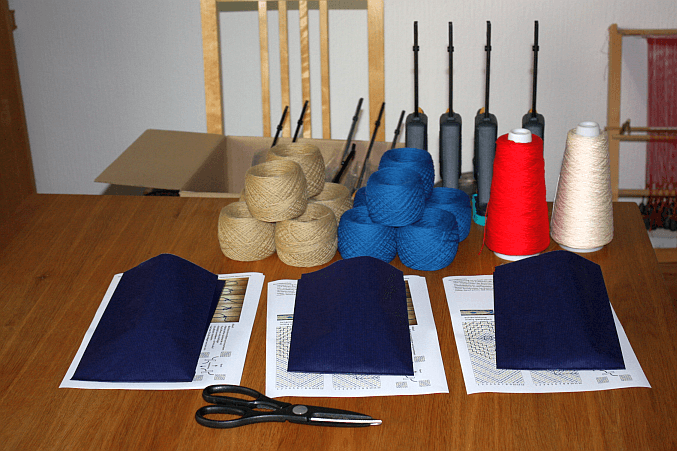
The workshop planning for the tablet-weaving is finally, finally finished. I've done a testrun on Wednesday, with three lovely ladies volunteering to be my guinea pigs for trying out the concept and the materials - and it was a good thing, and a fun afternoon to boot.

[caption id="attachment_3229" align="alignnone" width="677"]All ready for the testrun! All ready for the testrun!


The good news (for me, at least): the materials, setup things, and general concept are all sound, and they all did work as I had hoped them to. The timeframe of about 4 hours, a little more if necessary, also works.

Of course, though, there were a few issues. "No battle plan survives contact with the enemy", right? They were, however, mostly small, and to my relief, all of them can be fixed easily. One of the small issues was a sort of back-firing effect from handing out pattern sheets - they were intended to help with visualising the patterns, and as a reminder on how they are done for after the course at home. They turned out to be rather distracting, as they were either not understood easily or, in one case, were understood well enough to be used to tick off the wefts that were already done. Which is, of course, a perfectly valid method to approach one's tablet weaving - getting or writing a pattern, then following it - but exactly the opposite of what I want to teach, which is knowing what kind of pattern you want to do, looking at the band, and then seeing what needs to be done in order to get the pattern you want. This, admittedly, is a bit more of a brain exercise than reading a written pattern and following it step by step - but it does give you the possibility to weave without a pattern, and the flexibility to change things on the go without getting (too) confused.

Well, this is easy to remedy - I just won't hand out patterns. Saves paper, too...

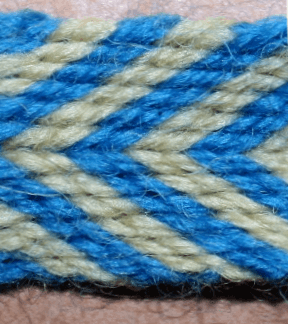
The biggest issue was my intended approach to teaching the 3/1 twill structure. Tabletwoven twill is basically a doubleface with staggered colour sequence - when you turn all tablets into the same direction, you get diagonal stripes. When I learned how to twill, I got taught with the band set up to make a chevron pattern when all tablets turn forward, so you get V-shaped stripes.

[caption id="attachment_3230" align="alignnone" width="218"]Band with chevron stripes. This will still be done in the workshop - but not as the basic setup for the twill part. Band with chevron stripes. This will still be done in the workshop - but not as the basic setup for the twill part.


This has the advantage of having a mirror-image in your band, so if you mess up on one side, the other side can help you in correcting your mistake. The problem for teaching a group with this method? You need a broader than feasible band in order to clearly see the twill structure, and get into the twill rhythm. When I did my concept and test-weaving, this didn't occur to me - I've done enough of the twill stuff to see the pattern emerge almost instantly, and with it the rhythm. With time, it becomes totally natural how the tablets move, and what you expect from them - and that is good and necessary, as twill patternwork will tend to twist your brain, so everything that is automatically done following a strict rule is one thing you don't need to pay attention to. (This is also why I have firm procedures when weaving and firm rules in how to set up the band - I need to know what direction of turning gets which diagonal, or my brain busts.) For the course, though, and beginners in twill, the areas worked in twill and in regular structure in this setup are too small, and things are following too closely on each other, and thus it gets too confusing.

Fortunately, this is also easy to remedy - with a different setup, and slightly different explanation with a different emphasis on what to look for. Which, with a few small changes to the handout, settles all my remaining problems with the course concept. Yay!

So now my script is updated, the handout has been changed, my list has been checked and amended with a few details, and the course is ready to take off. First instance, according to current plans, will be at the Nähtreffen (there's still spaces left, if you'd like to join us). And then - who knows? With about 4 hours, the course is fairly long to offer it at events like the Ravelry Meetup, but it's not completely out of question. And of course, it's always possible to book the course for a group of like-minded folks, either taking place here or where the group is based.
0
JULI
06
3

Oh the joys of construction work.

We're having construction work being done (the heating system in our house needs to be replaced), and I find that I'm all out of practice ignoring construction work sounds. That used to be much, much better in the days I was digging more, with all the construction site noise right beside you day in, day out, so you'd get used to tuning it out.

Though admittedly it's something else again when it is in the same building, as it's not only the noise, but also the vibrations and the workers going in and out the door. Which is visible from my workspace and adds to the distractions. Usually there's not much traffic down our garden path, or much noise here in the quarter, so it really helps me to appreciate even more the circumstances I can normally enjoy!

Speaking of enjoyable things - I finally got on top of my email pile again, and things feel more or less caught up, though the next deadlines, I'm sure, are already conspiring to creep up on me. While I have more of an opportunity to take care of long-overdue things, I'm quite happy to do so. And in the course of this I finally found a programme that will do the angle measurements I need for my spinning documentation in the way that I want them: several of them permanently shown in the picture, with a label with the angle beside it. And it's even possible to lock in the angle tool so I don't have to select it again for every single measurement, plus there's a list of measurements and the automatic calculation of the average. Yay!

The programme is called Digimizer, and like so many good and helpful research tools, it is completely free. (ImageJ will also measure angles and label them, but I haven't been able to trick it into keeping the first angle when doing the second one. Just now, while doing this post, I find that there's a new version of the programme, ImageJ2, as well as an offspin called Fiji - and I might check them out for other analysis purposes.)
0
JULI
05
0

Links Lumped Together.

Here's, for a change, a selection of semi-random links:

Ask the Past tells us about coffee and how to substitute the real stuff with... other stuff.

There's a kickstarter running for bras for asymmetrical breasts; for the start, there'll just be a one-cup difference between left and right breast, but their plan is to offer more variety and bras with larger cup differences in the future. This is a brilliant idea!

2017 is the bicetennary of Jane Austen's death, and the Literary Hub has a long article about the woman herself and the many ways we are wrong about Jane Austen - who is surprisingly hard to get hold of.

And finally, the reason why there are no more unicorns:

 
0
JULI
04
2

Crocheted snails, knitting spies.

Textile craft stuff just is so versatile, and here's two examples of it. First of all, a really nice article about knitting spies and knitted secret messages - though I'm rather convinced it's not a dropped stitch that actually happened, but something like a yarnover.

Knitting codes is definitely fun - the most patient husband of them all knit yoga socks that morse code spell out "Yoga socks", and he had a lot of fun with that. I've yet to do something similarly geeky, but it is on my list. (Though not very far up the list, I'll admit.)

The second link is not knitting, but crocheting: the clinic in Hannover is giving hand-crafted cuddly snails to children getting cochlea implants (German site). These children are born deaf, and they are getting the implant operation at a very young age - usually still a little less than a year old - which is of course quite exciting and frightening for them and their parents. So the staff of the clinic in Hannover has started a project back in 2015 where each of the about 100 children getting the implant each year gets a hand-crocheted snail to cuddle. It's intended not only as an emotional uplifter for the children, but also as a token of appreciation for this very big step in their lives.

In case you have itchy fingers now, the (German) pdf instructions on how to crochet the snails are linked from their site. And if you love the idea of the snails getting handed to children - all snails are crocheted by volunteers, and the clinic is always looking for snail donations, which are much appreciated.
0
JULI
03
0

The Textile Orchard

I've been pointed to a map/collection thing called The Textile Orchard, where you can find artisans, textile researchers, museums, dye and fabric producers, and historical sites related to textiles.

It's always a nice thing to have collections of resources, and I'm happy to now be part of the growing Orchard, as you can see from the small blue star in the south of Germany:


The red star across to the left is my friend and colleague Margit from Alte Künste, by the way.

If you are a textile person yourself, or have a place or museum to add, you can quickly and easily do so with this questionnaire. You can also follow the Textile Orchard on twitter via @textileorchard.
0
JUNI
30
2

Course Prepping.

I had a lot of fun yesterday preparing for a tablet weaving workshop testrun - which, unsurprisingly, proves to be a lot of work. I last posted about this almost one and a half years ago, so it's been stewing for a really, really long time now. That is mostly due to logistics problems. One of the large stumbling blocks for me were the questions "How do you enable up to eight people to warp simultaneously?" and "How do you get the warps tensioned?"

The answer to both, in my case: F-clamps. I love those things, especially those single-hand F-clamps, and I've used two tiny ones for years now. I should probably say "abused", though, because, well, they are not intended to be clamped down onto something upside down and then get stuff attached to the stem sticking upwards. There's high-quality ones that will withstand this kind of abuse, though, and cheap ones that will eventually give up and come loose with rather little tension on their stem. Which means the sensible thing is to go for the higher quality tool... with the higher price.

Unfortunately, regarding my two questions, "F-clamps" is not the full answer. The full answer is "a shitload of F-clamps", and it has taken me a while to get to terms with that, bite the bullet, and invest. But I have found a good clamp, they have arrived, and I'm now working on finalising my teaching script, getting the handout (which will be a how-to-make-your-pattern cheat sheet) all done and lined up, and then there will be three nice guinea pig ladies coming over next week to try their hand and my teaching ideas.

It's all quite, quite exciting - and if it all works as planned, the course will cover warping in the "endless" method, the basic system and mechanics underlying all tablet weaving, how to read and write patterns, and how to do 3/1 twill on tablets, including how to work (and design) patterns in this method.

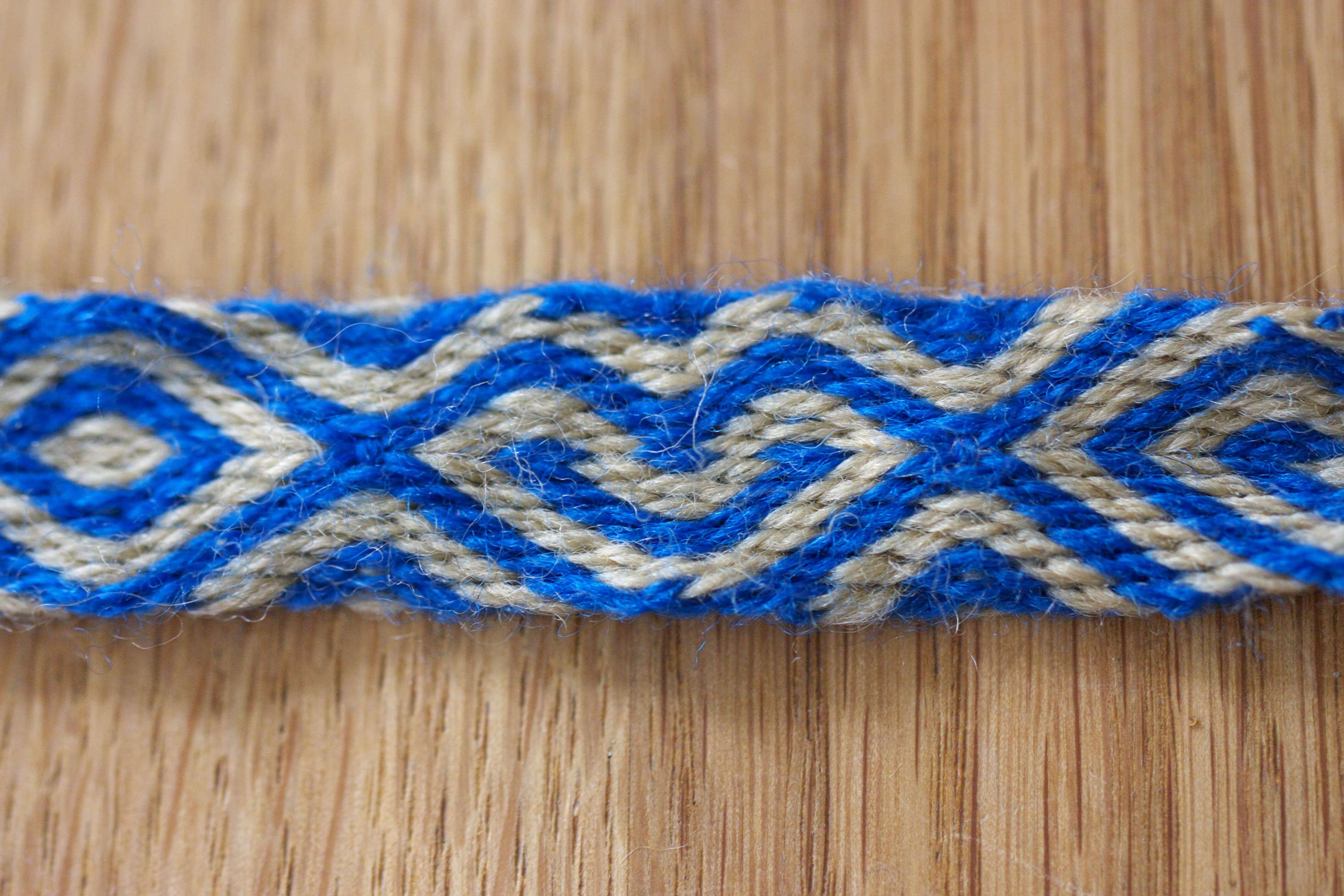
[caption id="attachment_3213" align="alignnone" width="4272"]One of the possible pattern bits that will be part of the workshop - and part of learning how to design swirls and stuff. One of the possible pattern bits that will be part of the workshop - and part of learning how to design swirls and stuff.


The course will then have its first proper appearance at the Nähtreff in October - which right now seems rather far in the future, but with the way time is flying, it will probably be happening before I know it!
0

By accepting you will be accessing a service provided by a third-party external to https://www.pallia.net/

Kontakt