Latest Comments

Guest - Aislinn Dyestuff Citizen Science.
09. Oktober 2026
This is a great project. I look forward to the results. Thanks for letting us know.
Guest - Aislinn Time for...
09. Oktober 2026
Looks delicious!
Guest - Katrin Sprang Discussion
18. September 2026
Hi Rachel, I have looked for more photos of you, but that was not very successful. I found a link on...
Guest - Beatrix Sprang Discussion
15. September 2026
That lozenge pattern element is not a photograph, but a scan. So it should be to scale. But I pinned...
Guest - Katrin Sprang Discussion
15. September 2026
I was not referring to Rachel's reconstruction (is the reconstruction you refer to the one photograp...
MäRZ
03
0

Calls for Papers! Date for NESAT!

There are two Calls for Papers open currently that have come to my attention (which usually happens through an email in my inbox). The first one is for Assemblage, Sheffield's peer-reviewed graduate journal of archaeology. Assemblage is currently seeking submissions for its 15th issue. Since 1996, assemblage has been run by postgraduate students at the University of Sheffield, and publishes articles and features on a wide array of topics related to the field of archaeology.

The publishers invite postgraduates and early career researchers to email articles between 3,000 and 5,000 words to Diese E-Mail-Adresse ist vor Spambots geschützt! Zur Anzeige muss JavaScript eingeschaltet sein. by 1 April, 2016.

You can access previous issues and view submission guidelines at http://www.assemblage.group.shef.ac.uk/.

The second CfP is really exciting, at least to me - as it's for NESAT! The next conference now has not only a place (Liberec in the Czech Republic), but also a date (May 22-26). The CfP is also open and will remain so until May 31. The organisers encourage papers that present lesser-known or recently excavated textiles, techniques and iconography that will generate discussion and exchange of information among conference attendees. In addition, this conference will include a poster session. Posters can be focused on any topic related to
archaeological textiles, but should be primarily visual.

You can find the schedule for the conference preparation here on the NESAT website, and the first entry also links to the full call as a pdf file.
0
MäRZ
02
6

Spindles, detachable whorls, and why they might fall off.

Yesterday I received an email, asking about spindle whorls slipping off the spindle stick while spinning - and I suddenly realised that this issue is not that uncommon, and that I should maybe write a little info thingie to go with the spindle sticks and whorls. So here you are - it's coming to the blog first, so please feel free to comment and ask further questions!

Medieval-style spindles, as opposed to modern spindles, don't have the whorl attached permanently. Instead, the shape of the two pieces makes it possible to attach the whorl to the tapering stick by just pushing it on. This means easier storage of the spindles plus more flexibility, as you can use one whorl with several sticks, or exchange the whorl for a lighter one to account for more weight of the yarn on a partly-filled spindle stick. You could also use the filled spindle stick directly as a shuttle for weaving on a warp-weighted loom, if you were so inclined.

This method of fitting the whorl onto the spindle stick relies on enough friction between the two parts. To avoid the whorl falling off, there are two things to take into account: Firstly, fitting it securely enough when you place it on the stick, and secondly, making sure that there is no downward pressure onto the whorl while working.

To fit the spindle whorl to the stick, I recommend sliding it up the stick as far as it will go up easily, then give a light twist to the whorl and gently pressing it upwards at the same time. Gentle pressure will suffice, and just a few millimetres of twisting of the spindle against the whorl. It should now sit quite firmly on the shaft. You can test the fit by gently tugging downward on the whorl; it should not budge.

If you have mounted the whorl like this, it should stay there throughout your spinning. If you drop the spindle, the whorl might come off - that is perfectly normal, just put it back into place as before, and carry on.

If the whorl falls off even though you have not dropped the spindle, there are two possible reasons for this.

If you have used the spindle stick a lot with the same whorl over and over, there might be a compressed spot where the whorl grips the wood. This is especially an issue with spindle sticks made from soft wood (such as pine or fir, for example). If that is the issue, you can usually see a ridge where the top of the whorl usually sits. The compressed part of the spindle can't provide enough friction with the whorl anymore, and the whorl cannot slide further upwards over the ridge, so it will not sit securely anymore. Should that ever be a problem, you can revive the stick by placing it in water; the compressed wood fibres will soak up the liquid and swell back into place. Let it dry thoroughly before you use it again.

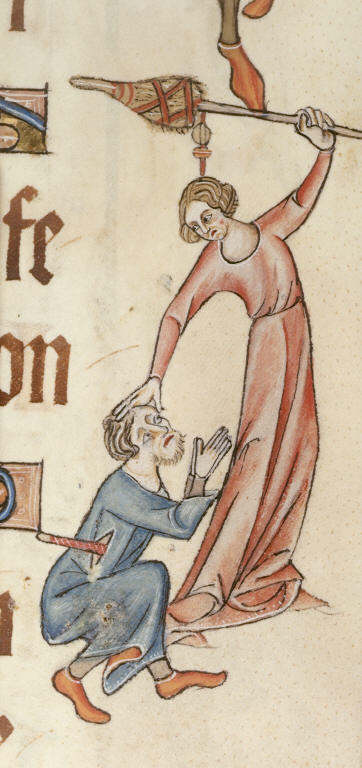
Most times, however, the spindle whorl slips off because the cop of yarn is pressing against it. If you look at medieval images of spindles, you can see that the yarn is in a sort of rugby-ball-shape or spindle-shape, and it is usually quite clearly wound onto the middle of the spindle stick, with a distance to the whorl. (Sometimes there is no whorl discernible at all, especially when the spindle looks like it's quite full already, but the cop is always this rugby-ball-shape or spindle-shape.)

[caption id="attachment_2257" align="alignnone" width="362"]British Library MS Additional 42130, f.60. A woman striking a man with her distaff. Note the very round cop of yarn on the spindle - it is keeping its distance from the whorl. British Library MS Additional 42130, f.60. A woman striking a man with her distaff. Note the very round cop of yarn on the spindle - it is keeping its careful distance from the whorl.


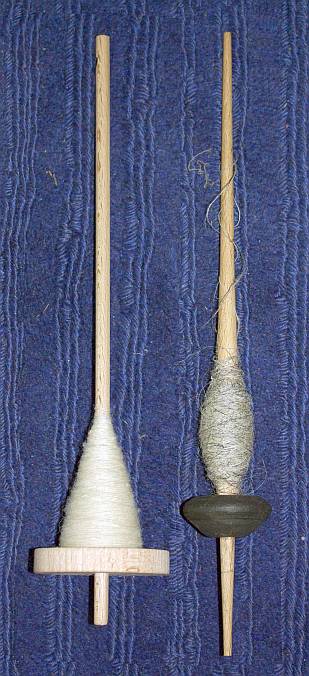
Many modern spinners are used to whorls that are glued onto their spindle, and there's a habit of winding in a sort of cone that rests against the whorl. This cone can put a surprising amount of pressure onto the whorl, so if you wind in this modern way with a medieval spindle, it will definitely press the whorl off the shaft at some point.

[caption id="attachment_2254" align="alignnone" width="309"]Modern-style winding on the left, medieval-style winding on the right. The modern, cone-shaped cop rests against the (permanently fixed) whorl. Modern-style winding on the left, medieval-style winding on the right. The modern, cone-shaped cop rests against the (permanently fixed) whorl.


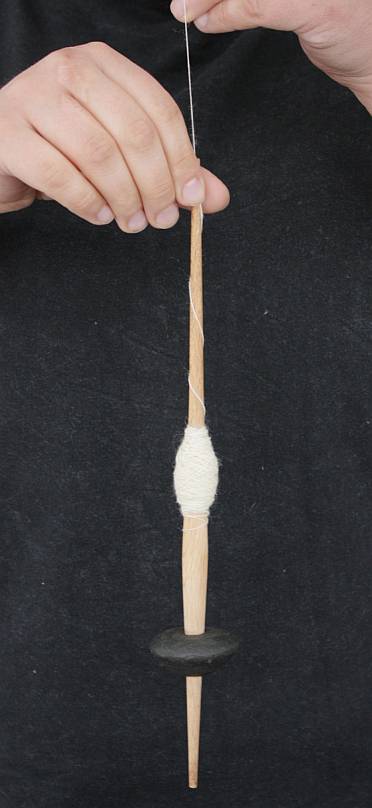
So you need to build a yarn cop that is stable enough not to need support by a whorl. You can achieve this by winding in a criss-cross fashion, instead of winding in a right angle around the spindle shaft with the windings parallel to each other. Start your yarn cop at a good distance to the whorl; this makes sure that you will have enough space to build up a sizeable cop before running into the whorl.

[caption id="attachment_2253" align="alignnone" width="372"]Starting the yarn cop in the middle of the spindle stick leaves lots of space to build it up. Starting the yarn cop in the middle of the spindle stick leaves lots of space to build it up.


You can alternate winding parallel and criss-crossing the yarn over the cop; winding the yarn in these two fashions lets you build a stable and dense cop.

[caption id="attachment_2255" align="alignnone" width="371"] You can see the parallel winding on top of a criss-crossed layer here: At the top of the cop, the criss-cross structure is still visible, but the middle part is wrapped over in parallel.
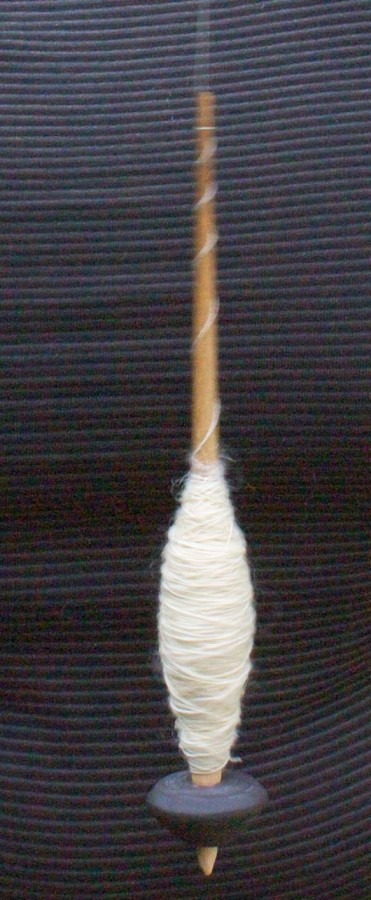

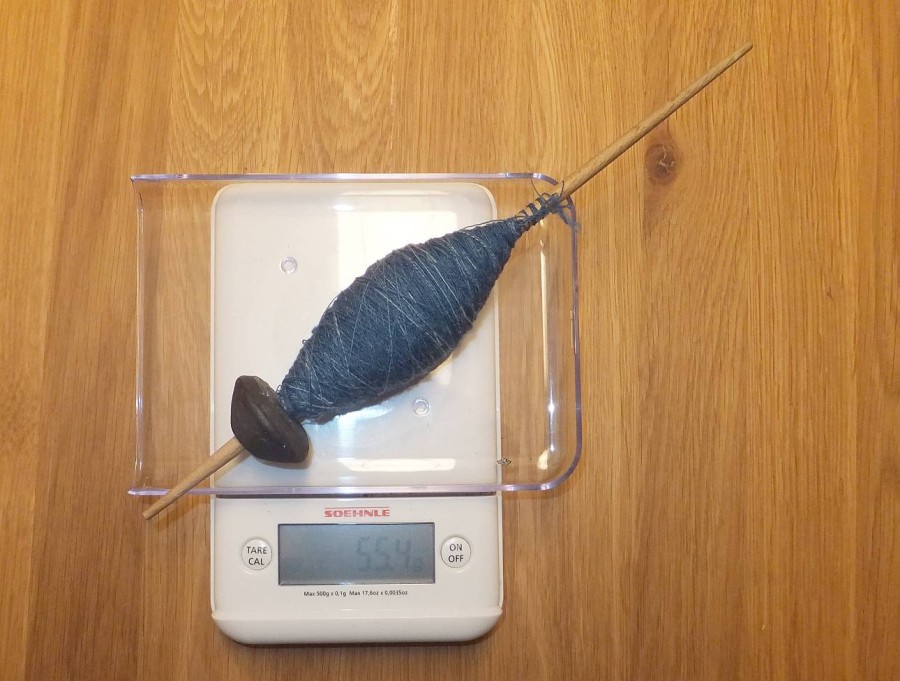
Eventually, your yarn will start to touch the whorl. You can then go on spinning until the yarn pushes the whorl off the spindle; you might be able to fill it even further if you try to wind more towards the top of the cop than towards the bottom.

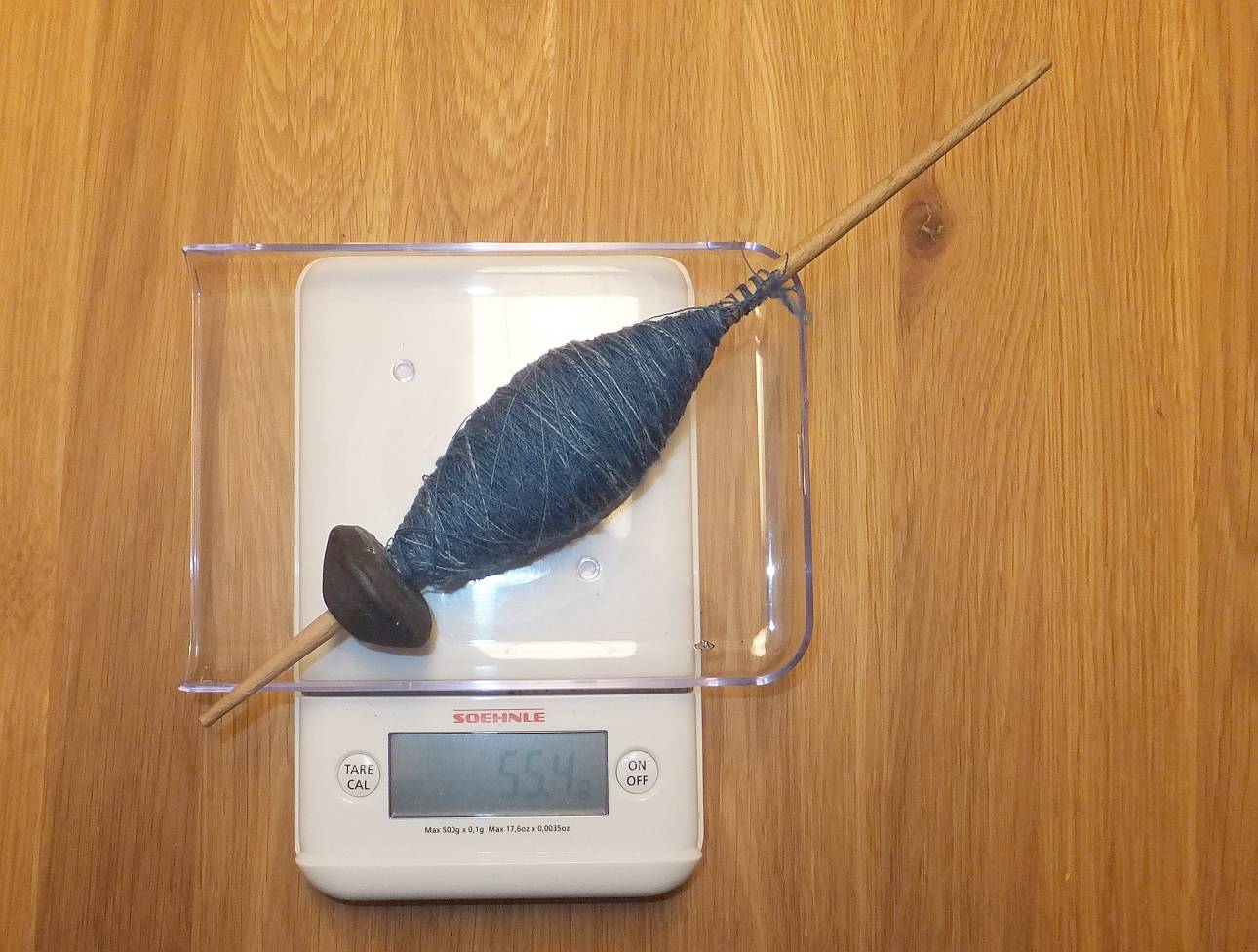
[caption id="attachment_2256" align="alignnone" width="640"]The yarn cop has grown so much that it now touches the whorl. Empty weight of the spindle was 35.4 g, so there's about 20 g very finely spun yarn on this spindle. The yarn cop has grown so much that it now touches the whorl, though there is still no pressure onto the whorl, and the cop could be built up more towards the top of the spindle. (Empty weight of the spindle was 35.4 g, by the way, so that's 20 g very finely spun yarn.)


In any case, once your whorl comes off, you can either declare the spindle as full, or you can leave the whorl off and continue spinning either with a (typically lighter) whorl that sits further down the spindle shaft, or without any whorl at all.

Happy spinning, and happy winding!
0
MäRZ
01
1

New technology shows old Roman roads.

In the UK, the Environment Agency has used lidar, a modern laser-based surveying technique, to generate 3D maps. Altogether, the data collected covers about 72% of the land surface, and it amounts to about 11 TB. That is a huge amount of data.

While the Environment Agency used it to track coastlines and do planning of things like flood defenses, they've put it online last summer, so you can find it on their survey Open Data site now.

Of course, this is a wonderful tool for archaeologists as well, as the lidar scans can reveal buried structures. Among the archaeologists who have already used the scan data successfully is David Ratledge, who finally found the "missing" Roman road that connected Ribchester and Lancaster.

I always love it when new technology does wonderful stuff for archaeological research!
0
FEB.
29
0

Recent Textile Stuff.

Here's some textile-related stuff (finally, as promised) that has popped up during the last few days. Enjoy!

Tracy Hudson has an article up in the EXARC digital journal, looking at spinning experiments and how much they can tell us.

Another exciting thing, right at my doorstep: The Kaisermäntel ("emperor's cloaks) in Bamberg are getting some quality research time, and it already looks like the researchers will find exciting things, such as remains of pre-drawings on the fabric (link goes to a German article). There are six pieces counted as Kaisergewänder, and they are the oldest extant textiles of European rulers, dating back mostly to the 11th century. Only mostly, as the fine gold embroidery was cut out from the original ground cloth and transferred to new silk ground fabrics.

It was assumed until now that the original placement of the embroideries was preserved during that transfer, but current research will look into that. Art historian Dr. Tanja Kohwagner-Nikolai, who is working on these wonderful textiles, is doubting that the original arrangement has been preserved especially regarding the Sternenmantel, which is a cloak with embroideries of constellations. She suspects that the embroideries were purposefully arranged differently, with the intention of supporting a cult around the rulers Heinrich and Kunigunde.

The project will run for the next four years, looking into different questions around the pieces and their history from the 11th to the 15th century, up to their last conservation and restauration in mid-20th century. Research will be interdisciplinary, with material and technological analyses, historical and art historical methods combined.

This is a very exciting project - I do hope they will get a lot of good results from the analyses! If you'd like more information, here is the (German) page of Uni Bamberg about the project. If you are in the area, you can visit the Diözesanmuseum and see the garments for yourself (the museum is open Tue-Sun 10-17 o'clock).

Sarah Bendall has posted the next chapter on her effigy bodies reconstruction: Boning and Binding.

Finally, rather unrelated, but really interesting: Barbie dolls dressed up with hijabs.
0
FEB.
26
2

Please beware.

(I had planned a different post for today - but due to something I found in my inbox just this morning, I'll be pushing the post about textile stuff to Monday instead. It will come, though!)

Recently, there's been a new virus called "Locky" that comes in Word files. When opened, they contain a macro that sets the virus free on your computer; it then encrypts your files, and you are supposed to pay money (probably a lot of it) to get the key to decrypt your data again. Ransomware like that has been around for a while, but "Locky" spread quite furiously, since it took a while for antivirus software to be able to detect it.

(So - don't open word files that come from sources you don't know. And make sure your word security settings regarding macros are set to "high". That is the default setting; if you're not sure, here are instructions on how to change macro security settings.)

Everyone, though, should know by now that opening email attachments from unknown sources, especially if they are not a .pdf, is a bad idea. What I personally find really disturbing is not the stable-ish number of sketchy attachments arriving in my inbox, however. It's the quality of the most recent phishing emails that I've been getting.

Just this morning, I got a "payment confirmation" from "Paypal". Which told me that I have successfully transferred money for a one-month membership to a porn site. Helloooo? What?

The mail looks almost exactly like legit payment confirmations from Paypal. It uses the original images from the PP server, and layout and design are very similar.

The differences are very subtle: there's a reference number in the top right corner that looks like a link but is not (it is in the legit version). Same with the item description. In the mail I received, there was also a question mark in front of every number.

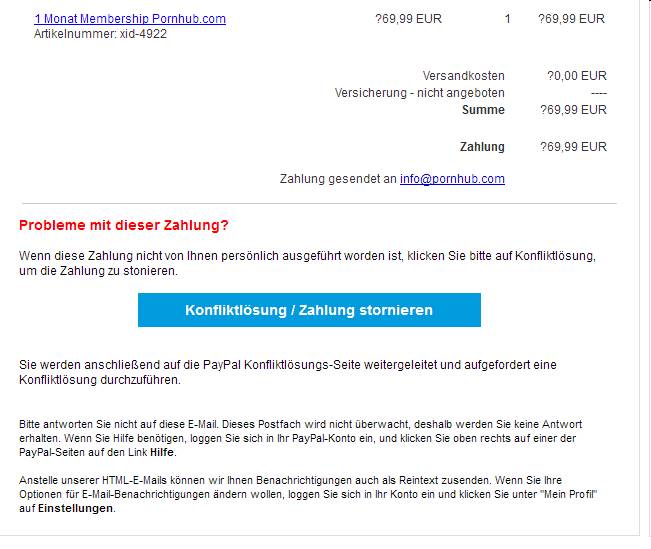
The scam is also missing the imprint data that PP includes at the end of the mails. The biggest (and most important) difference, however, is the inclusion of a nice, big, friendly button to cancel the payment.

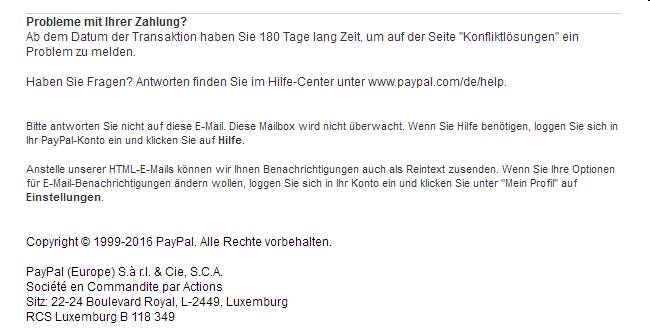
Here's how the lower part of a legit payment confirmation looks:

[caption id="attachment_2244" align="alignnone" width="650"]This is only the bottom part of a legit payment confirmation, received just this morning (I had to buy postage). There's an invoice number just above the light grey line on the top of the picture, which I'm not showing due to privacy reasons. This is only the bottom part of a legit payment confirmation, received just this morning (I had to buy postage). There's an invoice number just above the light grey line on the top of the picture, which I'm not showing due to privacy reasons.


In comparison, this is how the scam/phishing email looks:

[caption id="attachment_2243" align="alignnone" width="651"]paypal_scam You can see that the invoice number is missing. The "problems?" thing is in red, to make sure you see it... and then that nice, friendly, ohsohelpful button (which, you guessed it, will not lead to Paypal proper, but somewhere else).
In case you get something like that, from Paypal or from any other banking/finances site (I received one about a credit card a while ago, if I remember correctly), take a deep breath, open your browser and go directly to Paypal or to your bank. Log in and check - you will find that nothing has actually happened on your account.

You can then report the scam - there's various ways to report various scams, but it's always a good idea to forward the scammy mail to the actual company that it is spoofing.

These scams have gotten much, much better over the course of the last few months, and they really do look a lot like official stuff. With so much of commerce and invoices going through the 'net these days, I guess that they are a very good strategy to making money by fraud. So please beware, double-check, and be safe. Have a backup or two. Never click links in sketchy emails, open dubious attachments, and don't believe everything a random email tells you.

 
0
FEB.
25
0

So many issues.

While the sun is shining outside and the flowers are getting ready for spring bloom, other stuff is blooming, too - but not in a nice way, unfortunately.

One of the issues is, again, harassment at conventions. I believe the current wave of discussion was sparked by Mark Oshiro's post about how he was treated when he was Guest of Honor at ConQuesT 46. Jim Hines has a post about the importance of not only having a harassment policy at a con, but also enforcing it, with more links to issues. Rachel Caine, in the wake of this, is declaring to act accordingly in the future, and I wouldn't be surprised if more will join her. We can hope for changes, right?

Another issue, of a less geeky nature, is the nightmare of the EU VAT madness still going on. It is having an impact not only on the tiny firms, though - Ghost (a UK digital platform) will be closing down its business in the UK and reincorporate in Singapore to avoid the VATMESS. Advice and guidance for small businesses has been, and still is, conflicting - it's not gotten any better. As far as I know, the plan to expand this madness to all goods, including physical ones, is still alive (though it has not been pushed through this last January, as was planned previously) even though the problems with the current digital tax have not been solved.

Even more bad news (not an issue, however) - Peter Lustig died yesterday, aged 78 (link to a German page). He was one of my childhood's TV stars, explaining things, researching and tinkering, first in the TV show "Löwenzahn" (dandelion) and later in a show called "Mittendrin" (in the middle/in the thick of things) (though I'd almost outgrown the format by then).

Huh. Sometimes I wonder how bad things can get, for us as a society or as a culture, and for humankind overall, especially looking at how we ruin our environment, and how hard it is to keep one's footprint small. However, ignoring problems or bad things usually tends to make them worse, not better...

I promise more upbeat things on the blog tomorrow...
0
FEB.
24
0

More hat pics!

Remember when I said there would be a hat in my future? The future, it has come, and the hat is finished!

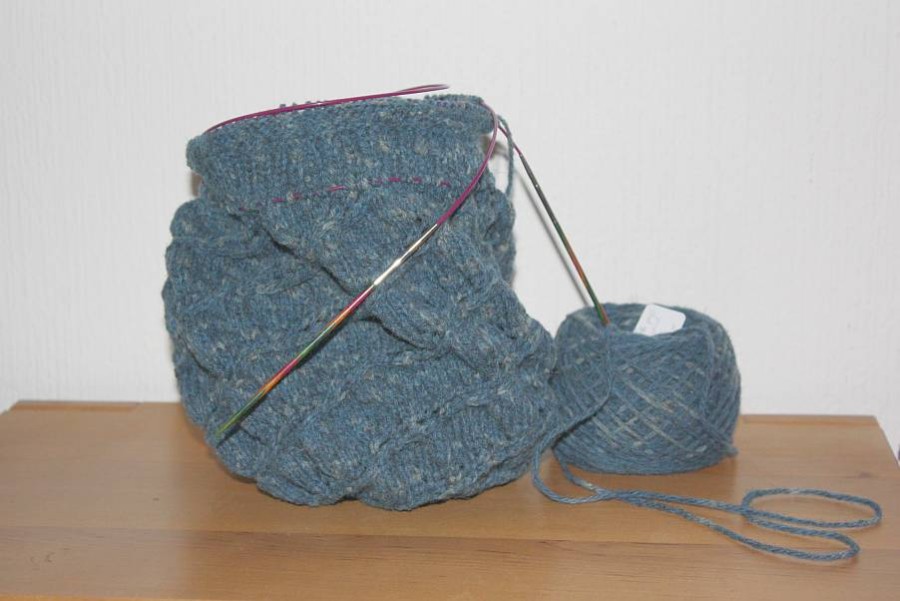
I spent a while knitting up the sides, finally reaching the next interesting part - the brim...

[caption id="attachment_2231" align="alignnone" width="640"]Knitting the double-layered brim... Knitting the double-layered brim...


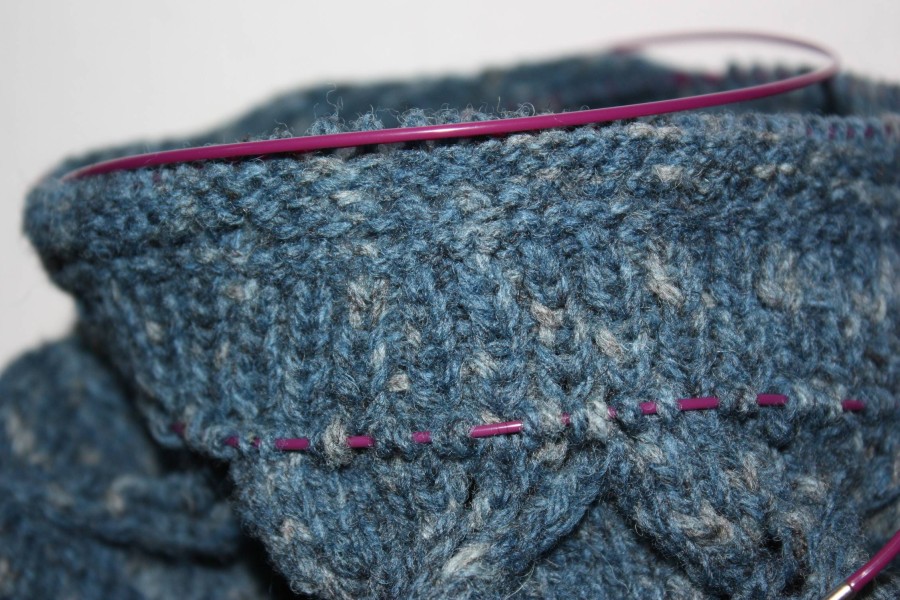
which is folded over and then cast off to make the double layer, using a three-needle bind-off.

[caption id="attachment_2230" align="alignnone" width="640"]Closeup of the brim in progress. The really interesting part is not yet started, though! Closeup of the brim in progress. The really interesting part is not yet started, though!
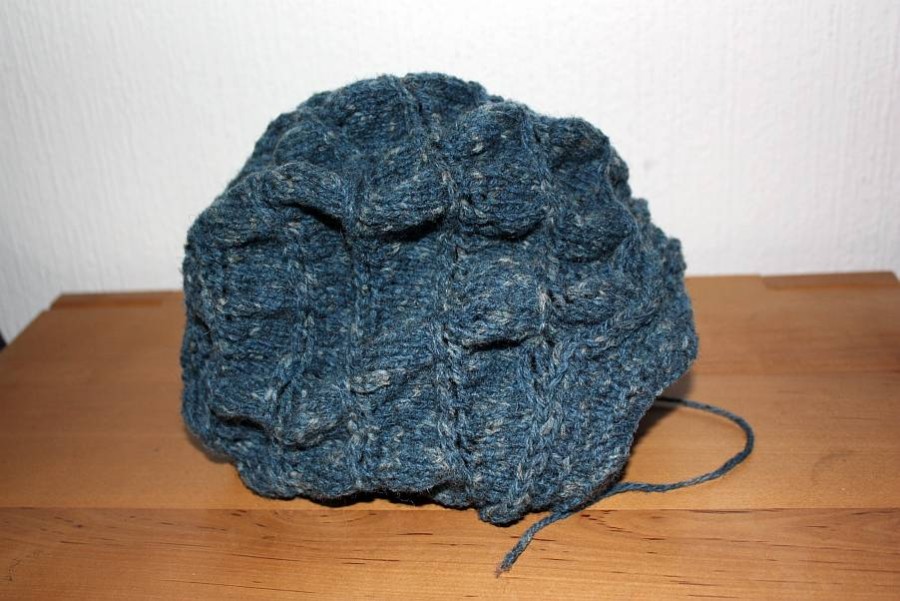

Binding off, for me, is always a little weird. I'm sort of feeling three things at the same time - happiness that the item is finally finished (or almost finished, with the end very much in sight), a little bit of sadness that it's over and I don't get to knit longer or more with the lovely yarn, and annoyance because binding off always takes a good long while (or at least it feels that way to me).Then the hat was finished... and looking very blobby.

[caption id="attachment_2229" align="alignnone" width="640"]It's finally finished! Though still looking very unspectacularly and blob-like. It's finally finished! Though still looking very unspectacularly and blob-like.
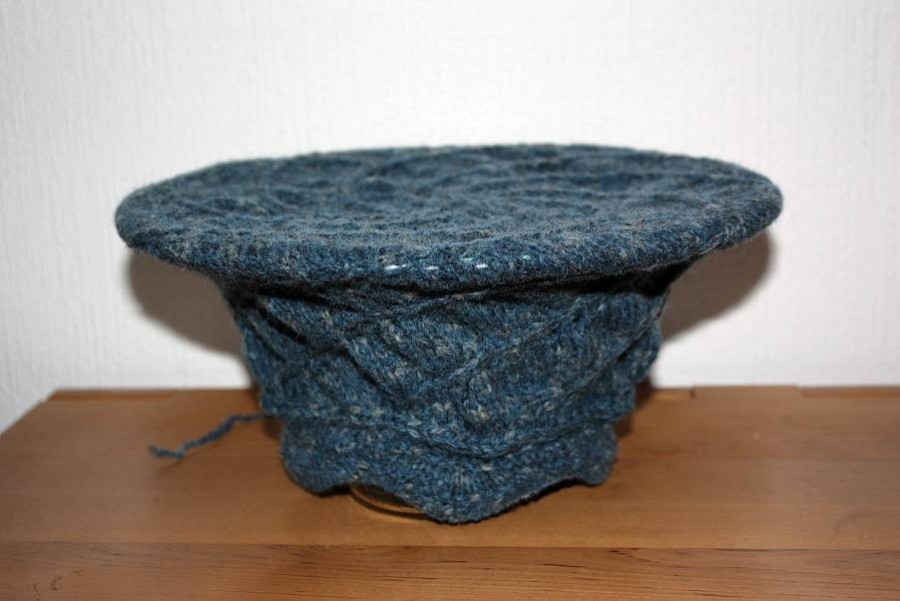

So it went off to take a little bath, and afterwards it became great friends with a dinner plate, and the two got very close and hung out together.

[caption id="attachment_2228" align="alignnone" width="640"]blocking_hat Cute couple, the hat and the plate, right? (The plate is standing on a glass jar, by the way.)
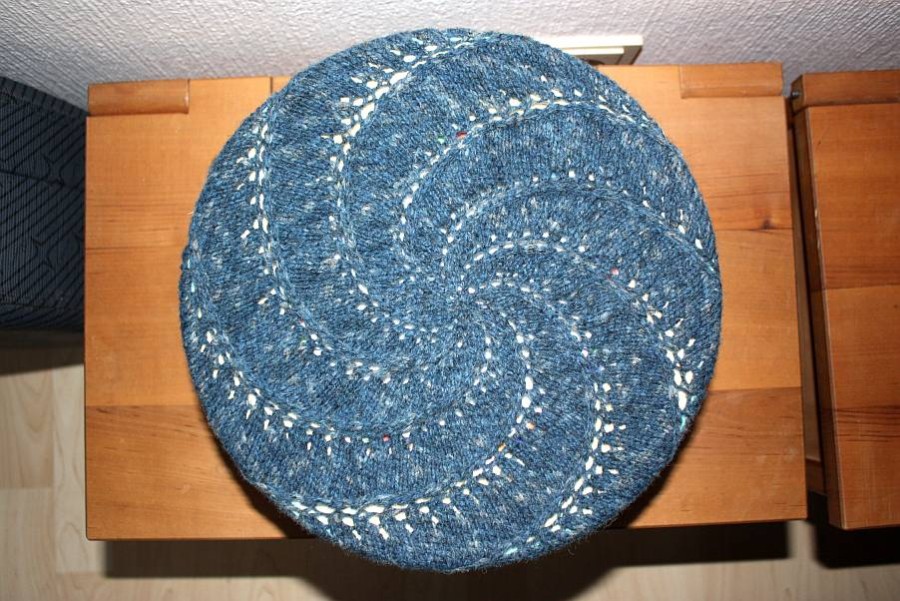

[caption id="attachment_2227" align="alignnone" width="640"]The hat on the plate, seen from the top. I really love these spiral patterns! The hat on the plate, seen from the top. I really love these spiral patterns!


And now it's dry... so yay, new hat! And it is still cold enough outside to wear it!

 
0

By accepting you will be accessing a service provided by a third-party external to https://www.pallia.net/

Kontakt