
Latest Comments

Guest - Aislinn Dyestuff Citizen Science.
09. Oktober 2026
This is a great project. I look forward to the results. Thanks for letting us know.
Guest - Aislinn Time for...
09. Oktober 2026
Looks delicious!
Guest - Katrin Sprang Discussion
18. September 2026
Hi Rachel, I have looked for more photos of you, but that was not very successful. I found a link on...
Guest - Beatrix Sprang Discussion
15. September 2026
That lozenge pattern element is not a photograph, but a scan. So it should be to scale. But I pinned...
Guest - Katrin Sprang Discussion
15. September 2026
I was not referring to Rachel's reconstruction (is the reconstruction you refer to the one photograp...
FEB.
23
2

Course Planning.

A while ago - last autumn, to be precise - I was asked about a workshop or course on tablet weaving. This has been on my agenda for a while, and I have taught tablet weaving before, but not just the course I really want to teach.

Said course, as I plan it, will be suitable for beginners as well as for people who already know a bit about tablet weaving. It will be teaching solid basics, with a strong emphasis on the underlying mechanics - so after the course, you will have an understanding of what happens when and why. With that understanding, reading and making (writing and designing) your own patterns will be possible. And if you feel so inclined, you will also have the tools necessary to work 3/1 broken twill patterns.

This is, admittedly, a stiff programme. Which means it needs careful developing (what will I introduce when? For the many elements of tablet weaving that are linked together, how can I best structure them?) and also time-management (which includes deciding on whether I will teach how to setup the warp or not, and whether to prepare warps for the participants or not).

There's also the problem of logistics. There's a difference in necessary equipment between teaching a simple introduction and teaching the course I have in mind. I have space, but I will also need either a lot of table space or a lot of (simple, medieval-style) tablet-weaving frames. I also need tablets that are both suitable for the weaving that we'll do (as in large enough) and affordable, plus suitable yarn in at least two colours and enough length.

So all this has been stewing in the background for a good while now, and yesterday I finally solved the yarn-and-tablets problem. Which means two things: a lower price alternative to the parchment tablets will turn up in the shop very soon, and I can finally do a test-run for the weaving course plan that I have!
0
FEB.
22
0

Honey Knowledge.

About a year ago, I sort of decided that keeping bees would be a nice thing to do, as there are too few bees around hereabouts, and it can never hurt to have some more. Bees are wonderful, astounding and fascinating creatures - they not only produce honey (which I don't eat so much of, but I still like it quite a bit), wax (one of the main reasons why they were cultivated in the Middle Ages - there's much less wax to be harvested from a hive than honey) and propolis (I always have a bottle of propolis dissolved in alcohol in my travelling kit), they are also the reason why we get to eat fruits and vegetables. Many, many edible things would not be there if it weren't for the bees...

However, before taking the lives and well-being of several thousand creatures (like 30-50.000) into my hands, I'd like to have some proper grounding in knowledge and experience. So I spent this Saturday learning about the many things that can befall bees and make them suffer, or even die.

One of the things every beekeeper these days has to cope with, and be on the lookout for, is the varroa mite. That is a parasite originally living off Asian honey bees, but it has spread to almost everywhere worldwide these days. The other bees, though, have never developed coping mechanisms for this parasite - so without treatment, the mites will suck on the bee brood and the adults, shortening their lifespan by about one third. Which means that without treatment, the winter worker bees will not survive until April, and die about at the end of January or in February instead. With a lot of the workers dead, the hive cannot generate enough warmth anymore, and there are not enough bees to get the colony going again in spring - so the whole hive will die off.

Another thing, that I will hopefully never have to see myself when keeping bees, is American Foulbrood. This is a bacterial infection that targets the bee brood, and the younger brood is very vulnerable to the bacteria - as little as a single one is enough to infect a one-day old larva. The honey from a hive with this disease is still safe for human consumption, and in some countries it is acceptable practice to keep the symptoms down with antibiotic treatment. However, this means that the honey you buy might contain spores of the bacterium - completely safe to consume for you, but dangerous to bees. If bees eat that honey, they carry the bacteria back to their hive, and there the nasty little buggers can wreak havoc. A hive that is infested with AFB has to be killed off, and the hive box and equipment has to be either burned to destroy it or disinfected completely. If you have AFB in Germany, you have to inform the authorities, there will be an off-limits area established around the stricken hive, and all hives inside the area will have to be tested for AFB as well. This disease? It's really, really nasty. And it can be spread by honey that is perfectly fine and healthy for humans to eat.

Which means... please don't spill honey outside, or leave honey for insects to find and eat. Make sure any honey containers are rinsed, or closed properly (or both) before tossing them. Your honey spills could kill off a bee hive - or even several.
0
FEB.
19
0

World's Oldest Dress

A dress find from Egypt, called the Tarkhan Dress and housed in the Petrie Museum of Egyptian Archaeology in London, has been radiocarbon-dated - and the result: it's the oldest garment we know of, about 5000 years old. This makes the piece the oldest piece of evidence for something that was tailored from woven fabric - and with a V-neck, decorative pleats in the yoke area and long sleeves, this is definitely and beautifully tailored.

The National Geographic has a short article about this garment, and there's also a more in-depth article about the dating in Antiquity.

This is a really exciting garment, and it does show again how old clothing is - and how important it was for mankind...
0
FEB.
18
0

Lots of Links.

I have a stack of diverse links for you again - hope you'll enjoy them!

First of all, for those of you who understand German, here's a nice video about archaeological excavations of a Villa Rustica (a Roman villa):


Shit Academics Say has a really interesting article about quitting one's PhD study over at the blog - if you're struggling with your PhD and are not feeling happy with the thought of spending x more months doing this work, I'd definitely recommend it.

Historian Sasha Handley is just starting out with a blog about the history of sleep - go check out the very first post on the blog, if human sleep in Early Modern Age is of interest to you.

On an unrelated note: Edible Spoons! (Looks like the spoon-baking thingummy is just a prototype yet, though, and thus not really available.)

And finally, if you're non-white and an SFF fan, you can request assistance to be able to attend a con via Con or Bust. Including WorldCon 75 - application is possible until February 25. Helsinki! I'll be there too!
0
FEB.
17
0

Here's what I did yesterday evening...

... apart from some knitting, that is:

I went for a little walk with the most patient of all husbands, entered a building, handed a card over to an elderly lady, and received a sheet of paper with lots of boxes to tick in return.

Boxes were ticked. Then I brought the sheet into another room and handed it over to a guy in a white coat, who stuck something into my ear, asked me a few questions, scribbled some notes on the paper and signed it.

I carried it into yet another room, where yet another guy pricked my ear and did some stamping on the paper and the card, and a third one handed me an aluminum box with a few plastic items in it. And the sheet of paper, joined by a second and third one.

In yet another room (I carried the box there), I lay down on a comfy recliner, told some lady my name and date of birth (while she was looking at the papers), got handed one of the three sheets, and then she stuck a needle into my arm.

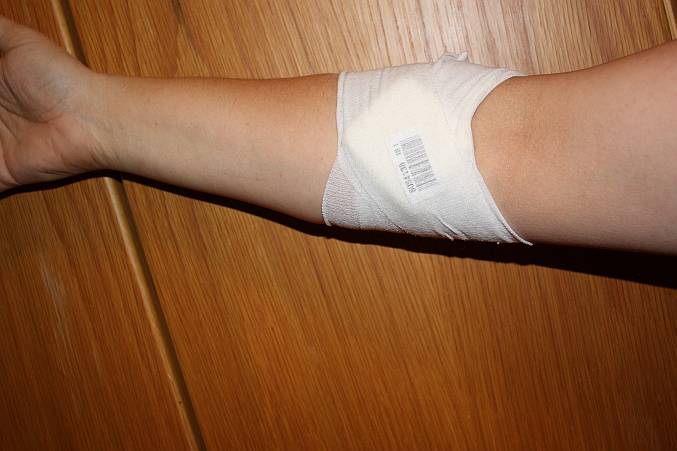
About ten minutes later, my right arm looked like this:

[caption id="attachment_2213" align="alignnone" width="677"]blutspendeverband The barcode in the wrap matches the barcode on my paperwork and the bag plus the test tubes that my blood went in. It's more or less just decorative on the arm, though!


And you've probably figured it out by now - we went to donate blood. I've been doing this since I turned eighteen, with a few years of hiatus inbetween, and it's a really nice thing to do. We usually team up with a friend or two, which makes this a nice and social evening for us. It's a good feeling to be able to help somebody else (plus you get your blood checked, and will be informed in case there's anything really amiss with you), there's lots of nice and friendly people there, and after the donation you get coffee and a bite to eat. Donating blood also has some health benefits for the donor, so it's an allround win-win situation. Yay!
0
FEB.
16
0

Tell Them Of Us.

I posted a while ago about the exhibition on knitwear used during WWI, but I didn't mention in that short blogpost how the exhibition idea originated. The reason for this knitting project was a film about two young men going off to war. The film is based on a true story of one family.

The film has been all finished now, and it's available through vimeo, where you can either rent or buy it. There's also a trailer (free to watch, of course) that is already featuring quite a few bits and pieces of beautiful knitting.

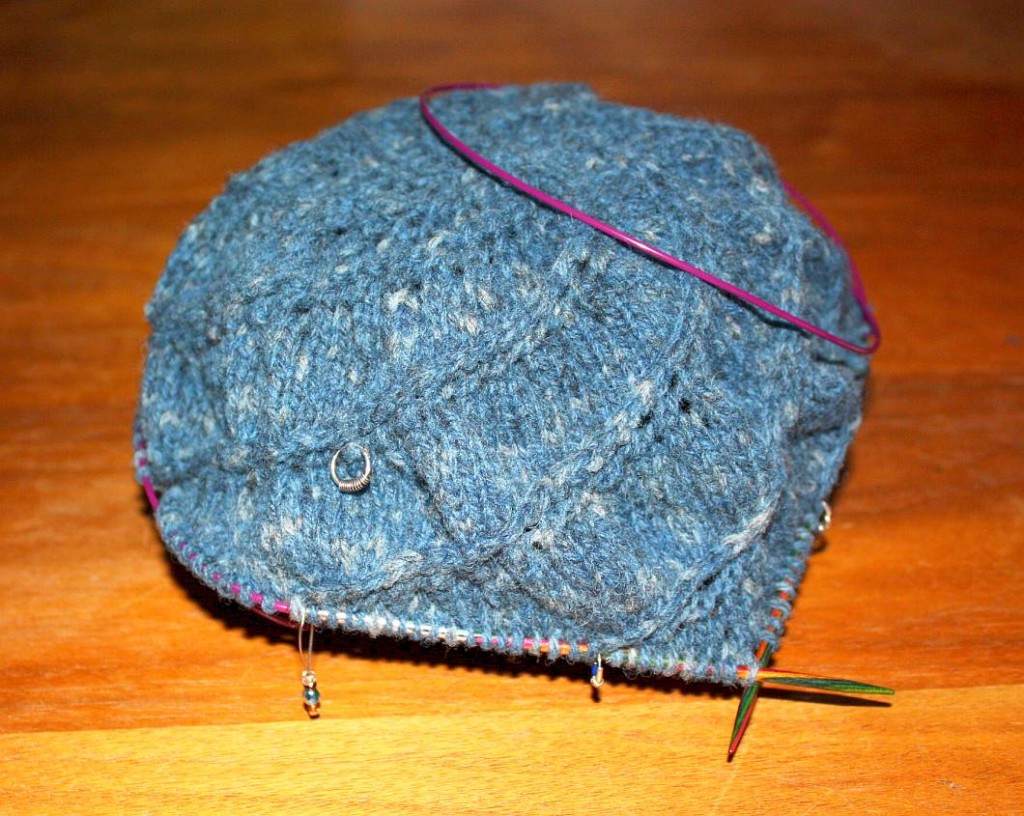
Speaking of knitting - my own hat knitting has only progressed very little over the weekend. I'm working on the sides of the hat now, and there's still a good bit (about 12 cm or so) to go before I can get started on the brim (which is the most fun part of the whole pattern).

[caption id="attachment_2210" align="alignnone" width="640"]The hat in progress. Sloow progress... as it's often the case for me. The hat in progress. Sloow progress... as it's often the case for me.


The one single earring in the knitting marks the edge of the flat crown and start of the cylindrical part, the other ones are my usual stitch markers. I really like to use earrings (the small hoop type) as stitch markers - they are small, they are pretty, they are available in different designs so you can mark different spots, they can be opened and all that gives me a perfect excuse to buy some from time to time. (I like the look of them. I even had my ears pierced ages ago, but I'm not a wear-earrings-daily type of person, and wearing them occasionally only always led to pain and infection... so I stopped wearing them altogether, and now I'm getting the earring-fix through knitting.)
0
FEB.
15
0

Videos and Stitches.

Let me start this week by giving you two links to spend lots of time looking at stuff!

Firstly, Doug has posted a number of videos from Scotland's Community Heritage Conference in 2015. Topics range from community projects and landscape projects to surveying, and there's even a "minute of madness" short video.

Non-moving pictures, but lots of them, and lovely ones of sewing work are in Sarah A Bendall's post about her reconstruction of the Elizabeth I effigy bodies - cutting and sewing. If you like to look at hand-sewing, or are interested in early modern stays, or both, you should not miss that post!
0

By accepting you will be accessing a service provided by a third-party external to https://www.pallia.net/

Kontakt