I've debated with myself for several days now whether to write this post, or not. It's a very personal topic, and one that has just very recently become a topic I can at all approach - and that is my weight issues.
However, I'm so happy about this recent development, all triggered by reading a book (my Book of the Year! That was an easy choice!), that I really want to share - maybe it helps someone else out there, too. So here you go. Be warned that it will be very long, and more rambling than usual, and quite personal. If you prefer not to read stuff like that, I can understand, and I can promise you this will not turn into a weight loss or diet blog - depending on how much interest this post will generate, I might do a few more posts about the topic, but then we'll return to the usual mix of things.
That all being said...
I'm carrying too much weight for my relatively small frame, and I've done so for years. It got more and more weight gradually, and I was trying to reconcile myself with the fact that I'd be overweight for all my life, as my family... well, almost all of them are, too. You're surely familiar with that stuff about weight being hereditary, right? About the body having a set point for its weight? Also that dieting makes you just heavier if you're unlucky, and that it breaks your metabolism? And that diets don't work for long-term reduction of weight?
These things also had a cozy place in the fact-storing area of my brain, and they made me silently and quietly despair about weight gains while suggesting to me there was nothing I could do against it, and trying would only make it worse. So I did what a lot of other overweight people do - I tried to come to terms with the inevitable and see it as positively as possible, or to at least ignore it as much as possible.
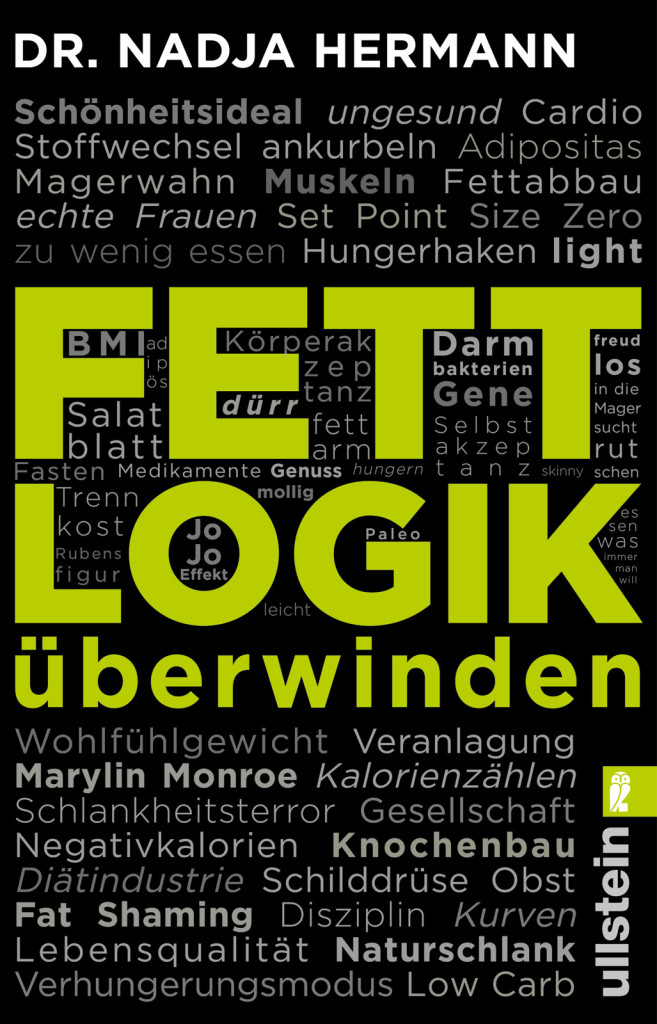
Until little more than a week ago, when, via a friend, I found out about a new book called "
Fettlogik überwinden" (German for "Overcome Fat Logic"), written by a lady who went from 150 kg to her normal weight of 63 kg. She writes from her own experiences, and the book is very nice to read and never shaming, or insulting, or pressuring in any way (because,
as she aptly puts it in her blog, nobody makes bad decisions on purpose - everyone tries to make the best decision possible from the things they know as facts). She just gives you better facts. Proper, scientifically grounded facts. Lots of them. Plus hilarious stick-figure comics that help to take apart even the last bit of fat logic possibly remaining after a chapter. There's also the
blog accompanying the book (in German as well). The book will come out in print on February 12 and is already available as a Kindle ebook.
So. Those things that I had accepted as facts about weight and weight loss, heard about from everywhere and everybody, all the time, and thus known for all my life? The very "facts" that led me to believe I was doomed to being overweight and I could do nothing against it because my body has a weight set point, because diets break your metabolism, because there is starvation mode that the body enters at once when you eat much less, because calorie counting does not work, because [insert common knowledge of your choice about dieting here]? The book takes all of them, and it takes them all apart using actually
reliable scientific studies. It also takes apart those studies that are based on people self-observing and self-reporting - because, as it turns out, these self-reports are
not reliable at all. Let me repeat that for you, because it makes such a difference.
Diet studies that are based on people self-reporting are not reliable at all. (The reason, in short? Human beings are really, really bad at estimating food and activity correctly. They are, on the other hand, really, really good at lying and denying, to themselves as well as towards others. So if you have a study, unless everything consumed by the subjects has been measured, weighed, and logged by a scientist... toss that study.)
And suddenly, my brain was free from all those bullshitty myths and fat logics. I have no "fat genes" - the only thing my genes might have to do with weight gain is more of a propensity to mis-estimate calorie needs and more of an appetite for high-cal foods. They'll not stand behind me with a loaded gun, though, forcing me to cram another bar of chocolate into my mouth. (Cultural and social surroundings are much the same - they might nudge towards consumption of high-cal foods, large amounts, or both, but there's never someone forcing that stuff down my throat.)
There's also no "weight set-point" - yes, if you regularly consume 16oo kcal while you only need 1500, you will eventually arrive at a stable weight, because larger bodies have a higher Basal Metabolic Rate (BMR), but you could just cut down to 1500 and stay at the lower weight. There's no way to break a metabolism by fasting, and eating again. As long as you keep eating within the limits of what you burn, you will keep your weight - any weight you have. If you eat more, you'll gain. If you eat less, you'll lose. And that's it. Oh, and metabolic differences between "fast" and "slow" are actually rather small - a hundred or so calories up or down. That's about a large apple, or two medium-sized squares of dark chocolate.
Words cannot tell you how much of a relief that was for me. For the first time in my life, I can accept that I weigh way too much, because I also, finally, know that this is something I can change. I'm not
condemned to be fat, not by genetics, not by food intolerances, not by anything or anyone. I'm not condemned to a life with too much weight and all the resulting health risks and impediments - because yes, being overweight is not healthy, and it does make things harder, and less accessible, and less fun. It weighs you down body, mind and soul, gradually and slowly - just as weight tends to climb gradually and slowly. As the human being is incredibly adaptive, this also means that you'll forget what "normal" once was and felt like - making it even easier to accept the slow loss of quality of life all around, and easier to deny all the bad side effects to yourself. It's a survival strategy of a kind, this denial and "think positive" attitude - it's just not a very healthy one in this case.
This point was driven home to me even more in the past few days by realising how much of a difference those first few kilograms I've already shed are making. What's more, and making me even more positive about my future health and happiness: I have realised what attitudes and patterns have led to the weight gains and occasional "mysterious" weight losses (though small and infrequent) that I had over the years.
Again, words cannot tell you how wonderful that feels to me, and how miraculous, and how stupid I now feel about having bought into all these diet "facts". I felt awful at times when I could not ignore my weight anymore, but still felt - was so, so convinced! - that I had no real chance at all to do anything against it. When I went more-or-less-paleo because of the food intolerances, I lost a bit of weight at first, making me rejoice inwardly and hope that I had finally found the Miracle Cure - but it crept on again, furthering my conviction that I would be destined to be fat. I now know that I just fell back into a few patterns that meant I was eating more than my body used up per day. Part of that might be genetic disposition, but a lot of it (as I now know) was also triggered by cultural crap, such as the "bigger/more is better" mentality, and "finish what you paid for", or "it's not worth putting that little bit into the fridge for storing".
So, when I suddenly got rid of all that bullshit that is touted everywhere, losing weight became dead simple: I just have to eat less calories than my body consumes. Every body has a basal metabolic rate (BMR) that can be calculated, and there are lots of calculators online. While this can fluctuate a little and even decrease a bit when fasting or eating very little, there's a baseline (which is above 1000 kcal/day) that cannot be undercut even by a small woman doing nothing all day but lying in bed. So it boils down to simple maths: the less you eat, the more stored energy will be used up by your body.
But what about the quality of food, you might say? Well. For gaining or losing weight, a calorie is a calorie is a calorie, no matter whether it's from sugar, whole wheat, meat or fish or veggies or butter or whatnot. Yes, of course it's a difference for your overall well-being if you are subsisting entirely on choc chip cookies or on a diet with meat, fish, fruit and veggies - but you can lose weight by restricting yourself to 200 grammes of chocolate per day and no other calories from anything else. It won't be the healthiest way, but you will shed weight - because you're only consuming about 1000 kcal. For your calorie balance, it's also completely irrelevant whether you eat the choc in the morning, or noon, or evening; whether you distribute it over the day or eat it all in one fell binge. It would even be irrelevant for the calorie balance if you ate a kilo of choc every five days and nothing inbetween, instead of 200 g a day. (Mind you, that's only the calorie balance - we're not talking about quality of life, or health, or sanity, here.)
Now comes the tricky bit. I've already hinted, above, that human beings (even those working professionally in the diet/nutrition/fitness business) are notoriously bad at estimating activity levels, portion sizes and calorie counts. We're also very good at forgetting how much we ate, or drank, especially small bits here and there (Germans have a saying "gefressen und vergessen", which translates to "gobbled down and forgotten"). This effect of mis-estimation gets even worse when people are overweight. So just estimating foods (and drinks!) will, as a rule, not work, especially not for those already overweight.
Fortunately there's an easy way around this problem. It consists of some adequate kitchen scales and a calorie database (in German, a good one would be
fddb, for the English world, I've heard good stuff about
myfitnesspal). Put in your basic data (most accurate is to say "no sport at all" and track your activities manually) and weigh and log everything you consume before you stick it into your mouth. Everything. Every little bite, every sip of drink.
You're now getting numbers. If calories in < calories out, you're losing weight. The human body is built to use the fat stored inside to tide you over lean times, and it will do just that.
If you want to optimise the whole thing to best conserve your muscle mass and health, and to avoid side effects from deficiencies, you should make sure to have enough protein intake per day (minimum 0.8 grammes per kg of the normal body weight for your size, and if you do sports, try to go for more - up to 2 g per kilo). Having too little protein can hinder you from keeping, repairing or even building up muscle mass, and make you feel de-energised and bad. You should also make sure to get enough vitamins and minerals; the more you restrict calories and thus the amount of stuff you eat, the less of these are delivered via your food, so supplements might be a good idea. And finally - as you lose weight, your body needs fewer muscle mass to support its weight, and it will get rid of the excess muscle, so you might want to do strength training (with or without weights, whatever works for you) - this tells the body that the muscles are needed, and it should actually keep them for further use.
That was the TL;DR super-mega-ultra-condensed version of the book, muddled together with my own thoughts and experiences. For those of you who want to know more about it, if you read German, go to Nadja's
Fettlogik blog or pre-order the book (that should be possible in any bookstore of your choice), or do both. For those of you who can't do this because you have no German, Nadja has graciously allowed me to give you short English TL;DR versions of individual chapters (each of them tackling a single "Well-Known Dieting Fact™"). So if there's a thing that you would like to hear more about, please tell me so in the comments, and I'll look it up and give you a slightly longer TL;DR version in English.





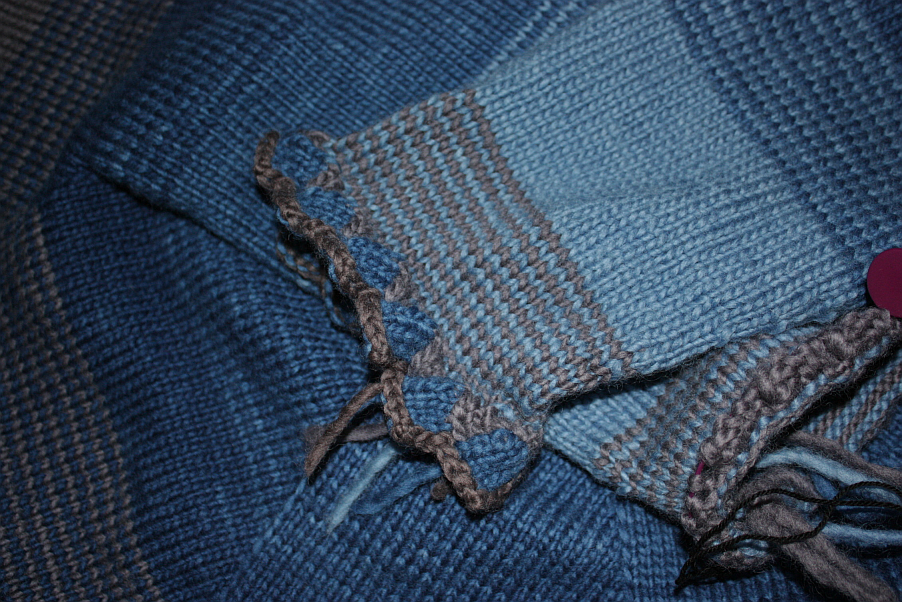 Sleeve finished with a tiny bit of entrelac-like knitting.
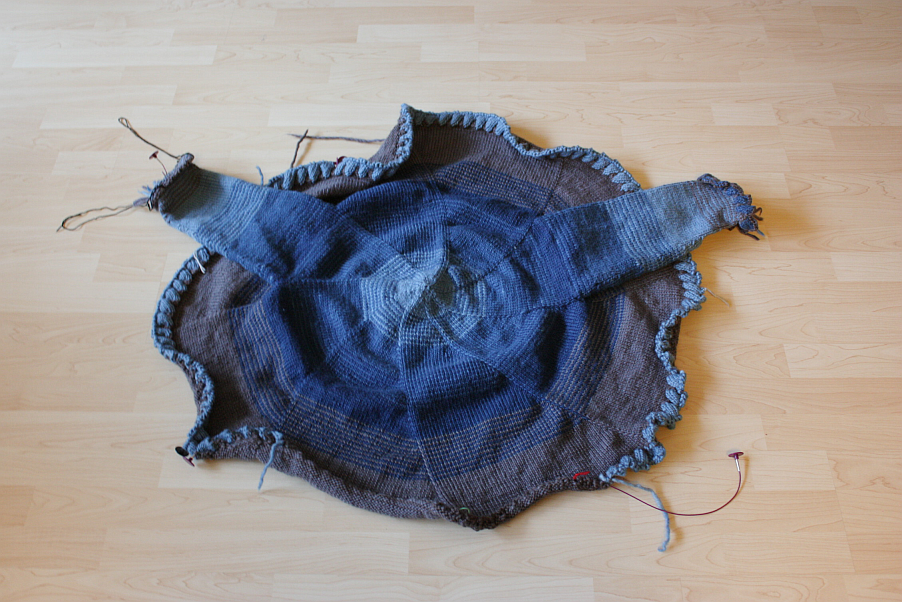
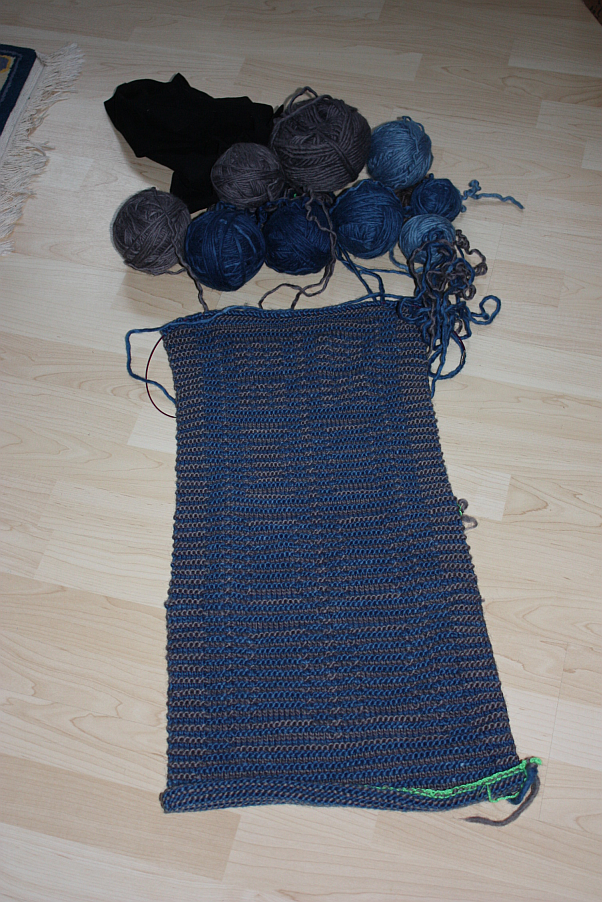 The Tardis knit, seen from above...
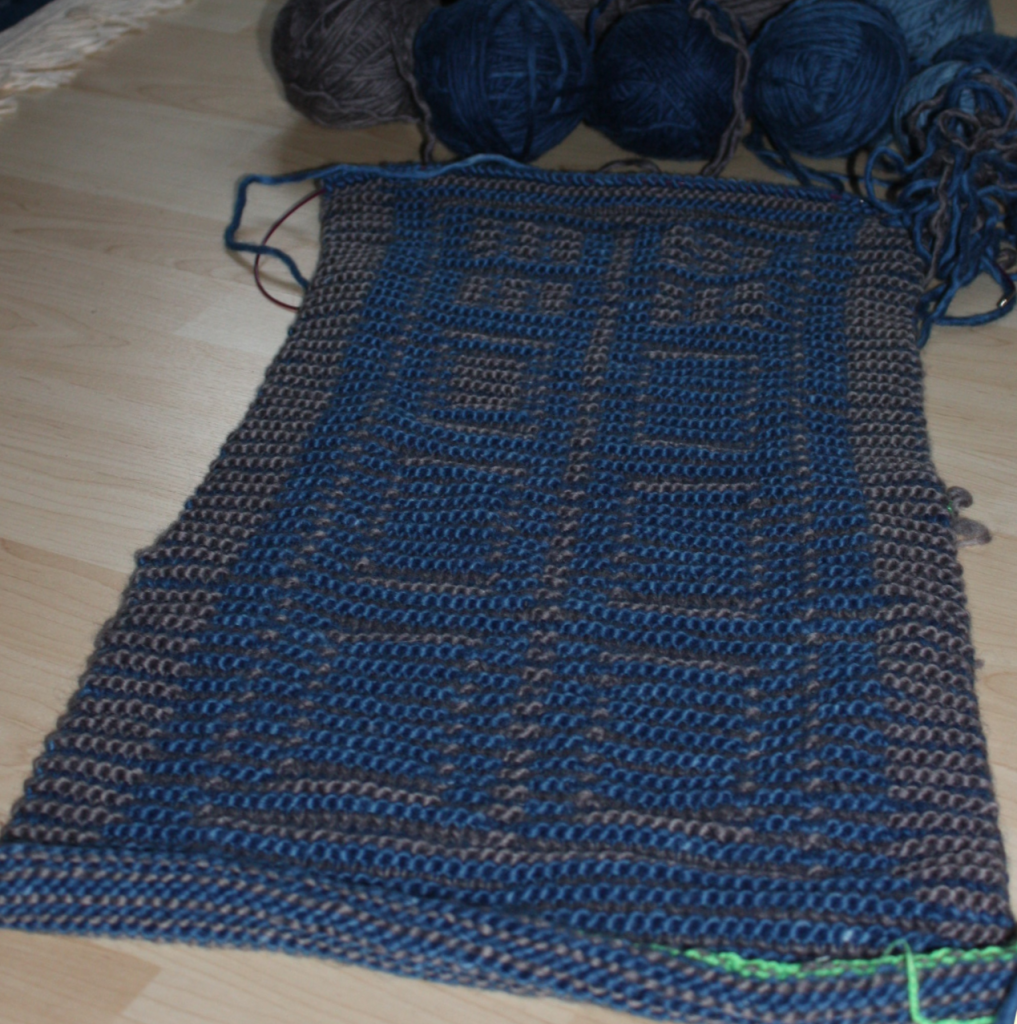 ... and at an angle. It really looks Tardis-y!
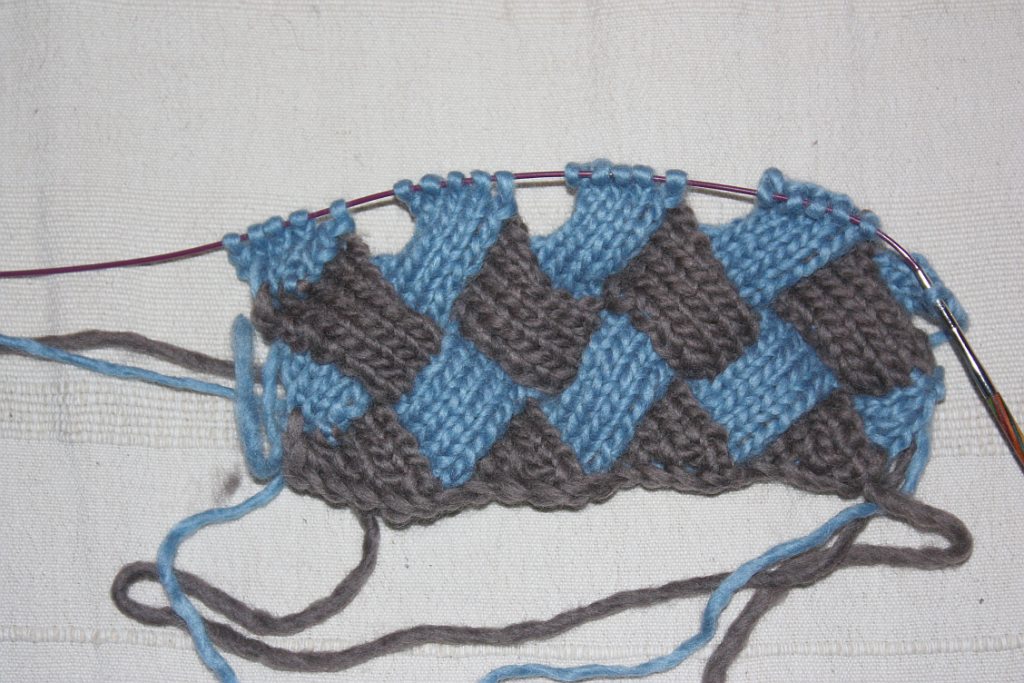 Entrelac knit with the same kind of wool. I think this will be the thing.