Latest Comments

Guest - Aislinn Dyestuff Citizen Science.
09. Oktober 2026
This is a great project. I look forward to the results. Thanks for letting us know.
Guest - Aislinn Time for...
09. Oktober 2026
Looks delicious!
Guest - Katrin Sprang Discussion
18. September 2026
Hi Rachel, I have looked for more photos of you, but that was not very successful. I found a link on...
Guest - Beatrix Sprang Discussion
15. September 2026
That lozenge pattern element is not a photograph, but a scan. So it should be to scale. But I pinned...
Guest - Katrin Sprang Discussion
15. September 2026
I was not referring to Rachel's reconstruction (is the reconstruction you refer to the one photograp...
JAN.
17
0

To-do list, revisited.

It's been almost a year now since I discovered HabitRPG, which I posted about back in February 2013. (For those of you who missed that first post and are too lazy to click the link, it's a to-do list with integrated life gamification. You have a little avatar that gains gold and experience for every task you do, whether one-off or recurring, and can die if you miss too many recurring tasks. Like a roleplaying character, it will level up when there's enough experience amassed, and the gold can be used to buy either in-game rewards like equipment, or buy permission to treat yourself to some real-life rewards, like the book you wanted, or having coffee with friends, or whatever you set for yourself at whatever gold price suits you.)

That was not the first planning gadget I had tried, but contrary to my expectations, I did actually stick with it and did not drop out after a week or two, or even half a year. My to-do list is still quite long, and some items stay on it nauseatingly long, but I do have the feeling that I am getting more done overall.

Habit is especially useful, for me, in keeping track of recurring tasks such as book-keeping (and you faithful readers will know exactly how much I love that task), but also small everyday things that tend to get forgotten. The to-do list can get a bit unwieldy if it becomes too long (if? it's always way too long), and tends to make me sigh because I have still not gotten around to doing this or that, but that is not a problem of the programme, but of my too-ambitious planning.

There are plenty of small things to keep you motivated, too - special gear turning up from time to time, a chance of finding something such as a pet or pet food, and recently implemented are "boss quests" where you have to fight a special monster by doing all your daily tasks, for example. You can also join friends in a party, or join a guild of like-minded folks. For long-term positive reinforcement of getting things done, there's the real-life reward opportunity, which also works nicely for me (and is the main reason why my little avatar does not have that much equipment - I preferred having coffee or lunch with friends, or saving up to buy that yoga mat, or a book).

When I started using Habit, it was still very much in development, and quite... buggy. That has much improved now, though it's still being developed and gets add-ons periodically, such as the long-awaited checklist option. More gamification is possible now than in the first months, with a class system and more complex stats (that you can also ignore if you want).

Sometimes the documentation and explanation on what things do is a little... vague, and there are still plenty of bugs being had, but the developing team (which sports many, many volunteers) is doing a really good job of tackling them. So while there's the occasional glitch, overall I don't mind that much. I really like using Habit, and it actually has made a difference for me. If you like RPGs (or even if you are just curious about that thing), go and check it out. If you need help or want to read some more about it first, here's the wiki for Habit... but I'd actually recommend you to jump right in and give it a try with a few tasks and a few recurring tasks, and see if it suits you. It just might.
0
JAN.
16
2

More Distaff Questions.


As requested in one of yesterday's comments, here is a follow-up post with a little more stuff about the distaff... for the basic explanation about the reconstructed medieval spinning, see also this post.
I am guessing that one takes fibre from the distaff and somehow moves it to the spindle, but I can't tell from this part if you are taking it randomly from any part of cousin It, or if you intend to take it sequentially, in the same order it was placed on the band, or what...
You draft from the distaff, and the flow more or less occurs naturally. I try to work my way along around the distaff, turning it a bit from time to time, so that I don't use up all the fibre on one side first. Otherwise, I don't much care where my fibre supply flows from, as long as it flows easily and evenly.

I am also curious to know how much time this distaff dressing process takes, and how much spinning time one gets from it. I gather from other posts of yours that it used to be that "everyone" used a distaff, but for modern spinners it is not so common to use one (though becoming more common again as more historical reenactors experiment with them?)
I can tell you exactly how long it took me for dressing this one: I snapped the first blurry pic at 13:56 and finished with the Portrait of Cousin Itt at 14:04. That's eight minutes, and I guess that at least three of these minutes were photo time. So in textile work terms, dressing a distaff this way does not take any time at all.
The spinning time you get from it, on the other hand, totally depends on how fast you are spinning and how much fibre you are using up per make (i.e. how thick you are spinning), so I can't tell you. Me, I go a long way with 42 g of fibre.

Modern spinners don't use a distaff, for the most part, because their spinning technique does not technically require them to do so. For the medieval style, however, the distaff is essential and you cannot physically spin without it.
Is there a savings in total time when using a distaff? (e.g. while dressing the distaff takes time, the spinning part goes enough faster as a result of having done so to make it worth it) Is there an improvement in the quality of the spinning (I am guessing "yes", since I imagine that it would be easier to be consistent as to how much fiber is added per second to the spun yarn).
Since spinning in the reconstructed style is not possible otherwise, you might argue that yes, yarn quality is improved ; )
Joking aside, what really does take time and has a big influence on yarn quality and ease of spinning is the fibre preparation. The five minutes (even if it were fifteen minutes, same applies) for dressing a distaff are really next to nothing compared to the time needed for spinning a substantial amount of medium-fine to fine yarn, and preparing the fibre to accommodate this. Spinning quality hangs on the quality of the fibre prep and the spinner's skill. If you muck up in dressing the distaff by wrapping it too firmly, for example, or too loosely, this is easily and quickly remedied, and there is quite a bit of leeway in how it needs to be; you just need enough friction between the held fibres to make drafting possible.
If you had mucked up in prepping your fibre, though, not the best distaff-dressing in the world will make that better.


The distaff is, essentially, your third hand for spinning - the one holding your fibre and helping you draft. And just like a real hand, if it holds only crap... it will give you that same stuff it holds. You have a say in how firmly it holds on to its stuff, though, depending how you dress it.

Any more distaff-related questions, folks?
0
JAN.
15
9

How I dress my distaff.

The following is a photo report (wow, this word makes me think of my youth and those crappy romance photo stories in teen mags) of how I dress my distaff. Please be aware that this is a work in progress and a technique still in development, and that there are probably fifteen gazillion other methods that are at least as suitable as mine, if not better.

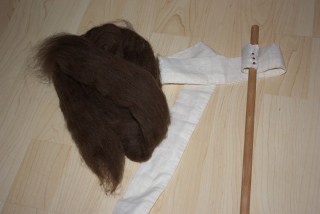
I start off with my distaff, which is a stick with a few notches cut in at the top to reduce slippage. The notches are a horizontal cut at the bottom, then a sloping cut downwards to meet the notch, resulting in something like a tiny shelf. Attached to the stick is a linen band about 1.5 m long (I used small copper nails to attach it). The band helps to secure the fibre evenly and give the necessary little friction.
I start by placing the distaff somewhere suitably flat; a table or the floor will do. I've chosen mixed brown wool for this, about 42 g of it.

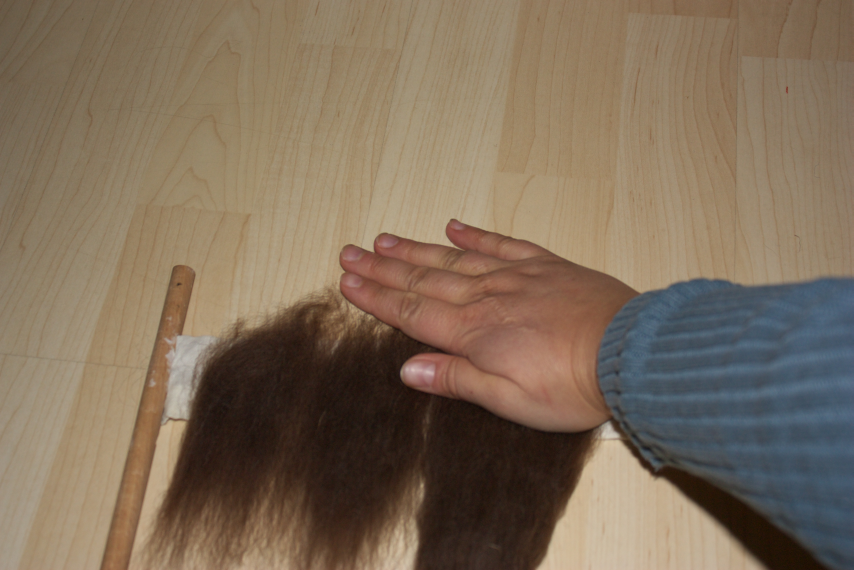
In my experience, you can use the fibre that sticks out from the bottom of each band and the fibre still touching the band, but usually not the fibre sticking out above the top. So I position my wool accordingly: I place the end of my top at the upper edge of the band, put my hand down on the band and pull the top away, leaving a bit of fibre on the band.
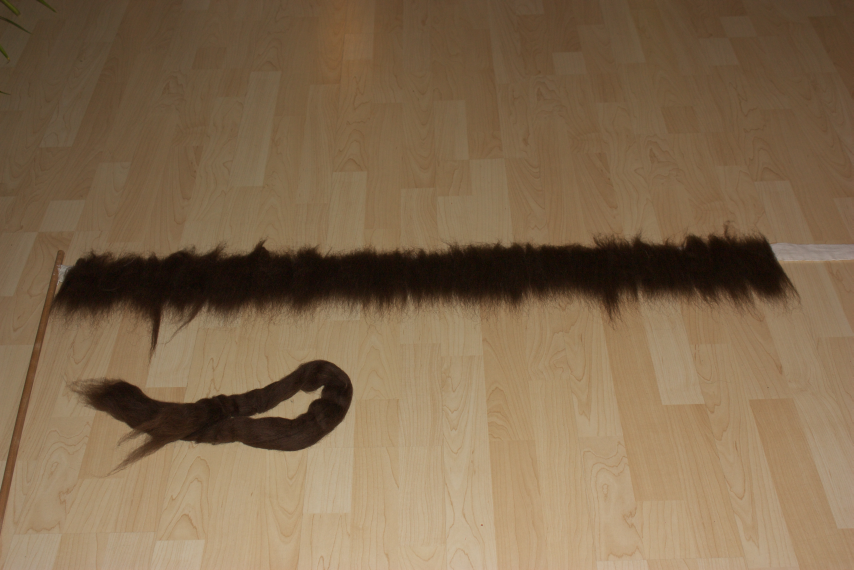
I work myself along the band in this way with a first layer of fibre.
I then go back and forth, evenly layering the fibre into the thinner spots, not going too thick with the layers. (I have not gathered enough experience yet to know how much you can load on without it getting awkward.)
I leave the last hand width worth of the band without fibre
and then I start rolling up the distaff.
Rolling is done with only the gentlest pressure, and without tensioning the band (at most, I put on enough tension to just keep it properly straight). You can roll up with tension, but that may prevent you from drafting out easily - I've had more success with going easy on the distaff when rolling it.
Roll until you can roll no more, resulting in something like Cousin Itt with a nice headband, and secure the end of the band (I used a modern pin for it here).
That's it. You can go spin now. The band may shift with spinning, developing into a spiral that sort of droops down the distaff. Thus, after a while of spinning, it might be necessary to adjust the distaff - I do that by gently unrolling and re-rolling the band.

If you try this method or a similar one, I'd be delighted to hear about your experience!
0
JAN.
14
0

Who needs bridges, anyway?

I have managed to empty out my distaff yesterday, so I was actually planning to go and take photographs of the dressing this morning. Then, however, I read some blogs. And was stunned.

Imagine you have a bridge that was built in the 13th century. There were repairs, sure, and major restauration after the war, and one of the three arches was then re-built with a larger opening for better passing of ships. Still... it's a piece of history.

There's such a bridge in Tournai, and it's in danger of being torn down to make way for a new bridge with even larger openings, in preparation of a channel whose realisation is not even a sure thing yet.

Luckily, we live in the Age of the Internet, and there's a petition against the demolition. (For those of you not reading French, "je signe" means "I sign", so that's the button you want.) The person who started the petition has also written up some info about the bridge and the project, and that's in English.

The usual remains to say - please sign, share, and nag your friends with it...
0
JAN.
13
4

Spinning like "back then".

A good week ago, I received a nice email from somewhere in the US, asking me this:

I do living history demonstrations, and since I am learning to spin, I will be adding spinning to what I demo. I've seen the pictures of the long double tapered spindles with distaff, it looks like there was either no spindle whorl, or it was a bottom whorl.

 My problem is trying to learn how they actually spun the wool on the spindles.  Do you know where I can get enough information on how the spinning was done so I can demonstrate it correctly?


First of all, I am thrilled that demonstrators pause and think about what tools were used, and how exactly they were used. Thrilled! Because (as I have learned, and to my great chagrin much too recently) that modern-style spinning, even with a distaff, is a long way removed from how medieval spinning pictures look.

So how do you spin medieval-style? First of all, the caveat: This is the attempt to reconstruct a spinning style from, basically, pictures and a few surviving tools. Spinning is, at its core, a very basic thing (adding twist to fibres) and this thing can be achieved with a myriad of tools, and a myriad of techniques; there is no guarantee that everybody in the MA spun alike, and there's no guarantee that we as modern people trying to reconstruct it actually hit the correct version(s). Even if it works really, really well, it's no proof. (It is a strong indication that it may be right or close, though.) If I'm talking about "medieval spinning" in the following text, it may refer to pictures and other sources or the reconstructed technique, so please read accordingly.

Typical modern spinning is drop-spindle spinning, where the spindle travels down, hanging freely from the hands and wandering towards the floor; the hands stay close to the fibre supply. Drafting takes place between the two hands. The spindle is flicked periodically with one hand (which leaves its normal drafting place for this).

In contrast to that, medieval spinning always keeps one hand close to the spindle tip and one hand close to the fibre supply. Drafting takes place between the top hand (drafting hand) and the distaff, which is indispensable for this kind of spinning; the other hand keeps the spindle in motion.
The spindle can either be kept in the hand and turned between the fingers or suspended right below the twisting hand from the thread already spun. In both cases, there is an almost continual twisting action done with the twisting hand.

And because you will probably be all confused now, here's a video of me spinning in that technique.


I am indebted to Cathelina from the 15thcenturyspinning blog, who has done a lot of research on the reconstructed technique. She also has some videos on her blog, most of them showing the in-hand spinning, not the close-to-the-hand-suspending that I prefer. Especially this slo-mo one is worth watching.
If you want an overview on spinning pictures, I can also recommend her pinterest board.

With this technique for spinning, you can use a spindle with a whorl (giving a little more heft to the spindle and making for a better twist when spun suspended) or without a whorl (in my experience, nice to do when the spindle is already quite full, or when you are spinning long fibres such as linen). You do definitely need a distaff, either a free-standing one or one that you tuck into your belt, or place beside you.

You try to draft an equal amount of fibres from the distaff, letting the twist enter these fibres as fast as needed (the twist travels upwards from the spindle). As every style of spinning, it takes practice - but it's a lovely and quite fast style in my experience. The well-dressed distaff with well-prepared fibres is crucial for this. I'll try to do a blog post on how I dress my distaff one of the next days, since it's different from Cathelyne's version.

For now, though, I hope this helps to shed some light on medieval spinning!

1
JAN.
10
0

Random thoughts.

I've barely started on the current big project, and first complications have already arisen, hooray - there is an issue with the fabrics I had planned to order. If I am lucky, I can get very similar replacements for them. If not... well. We shall see. At least it starts out quite, quite interesting.

There are bits and pieces I can get started on, though, and I am firmly planning to do so today, with just one single other point on my agenda.

(Sorry for the vagueness - if things work out, I'm planning to de-vague it soon, and you will be along for the ride.)

So while I'm feeling a little torn about how things will work, here are some scattered random links for you.

The Yarn Harlot writes about a baby sweater, and how only love could buy it. Yes. This. (Fits right in with the Fair Prices stuff that I blatantly plugged again yesterday.)

If you read German, Archaeologik posts about an excavation of a modern ceramic firing pit (pit was courtesy of a school project). If you don't read German, there's piccies.

Random fact of the day: I'm still doing yoga. My standard go-to site is doyogawithme.com, which I still highly recommend. There are pay-for sites that are by far not as nice as that one. And online yoga is a business with quite a bit of money to be made, as noticed by a company called YogaGlo... who have, apparently, patented a certain layout of the room for video classes.
This has led to hubbub and kerfluffle with the other yoga class sites, among them Yoga International. How is that interesting for you, you ask? Go read their open letter - and then you might want to enjoy their offer of all their classes for free (offer stands with undisclosed end time, but probably not forever).
0
JAN.
09
1

Blogging Archaeology Carnival January

Dear Doug, thank you so much for your January question. This was a welcome excuse to go waste a lot of time finally catch up on my blog statistics again. Though I confess that I am a slight bit confused by them...

To keep those of you not checking into Doug's summary up to date, January’s questions are:
What are your best (or if you want your worst) post(s) and why? Compare and contrast your different bests/worsts.
I leave it up to you to define what best is. We bloggers have all sorts of different stats available to us.
(Doug then gives a list of suggestions on what could be defining best and worst.)

So naturally, the first thing I did was look at stats. As all bloggers, I have the blogger stats available to me, plus I have an extra statcounter installed. Both are somewhat... lacking, to my taste, in giving a good and complete overview - the blogger one tells me that some of my early posts (from back in 2010 and 2009) have never received a single visit, which I find hard to believe. This one here, for example - which is admittedly not one of my most brilliant posts ever. However, at least the most patient husband of them all usually reads my blog every day, so it should have at least one view, right?

According to blogger stats, most of my relatively current posts get hits somewhere between the high twenties and low sixties, with outliers (often linky posts that get handed on by others) that are solidly in the one- to twohundred hit range. This is probably not counting any rss feeds, though I am not sure how many of you get this via feed.

The most viewed post of all time (9485 views) is actually a link post - this one here, linking on to instructions for unwinding a small skein of yarn. Follow-up with 6586 hits is my own post about how to untangle a skein of yarn, which has been popping up as the most viewed one consistently since I wrote it back in November 2009. I still like it, too - it's long and tries to be a little humorous as well. So that's probably what I would consider one of my best posts, in terms of effort spent to views gained, and possibly also helpfulness (at least I hope so).

Much lower in the hitcount lists are other posts that were a more than average effort to write, like the Skjoldehamn neck flap one (2775 hits). Pictures from this, however, have been turning up across the 'net (and not always with acknowledgement).
On a more positive note for me, posts about the Textile Forum (and there's many of them) are consistently getting higher hit counts than my normal posts, too - and since that conference project is one very close to my heart, this makes me very happy. They are not always what I'd consider a splendid piece of writing, though.

And some of my favourite posts in the blog are the ones about fair prices for crafts - all tagged under "fair prices for crafts campaign". They did get a good share of love (and hits), ranging somewhere between almost 500 and 1340 hits for the posts in the main series (the one also linked to on the sidebar).

That's about what I would consider the best posts of my blog. I won't go into the worst ones, though - with trying hard to post weekdaily all year around, there are bound to be plenty of non-brilliant posts just telling you that I ran out of ideas, or giving a random link and two lines of uninspired writing. I am sorry for those, and I feel a little bad about it every time I post such a one, but really - it can't be helped, and putting on pressure to be totes brill all the time... just won't work.

If you will tell me about your favourite post (or your least favourite one!) on this blog in the comments, though, I'd greatly appreciate that!
0

By accepting you will be accessing a service provided by a third-party external to https://www.pallia.net/

Kontakt