Latest Comments

Guest - Aislinn Dyestuff Citizen Science.
09. Oktober 2026
This is a great project. I look forward to the results. Thanks for letting us know.
Guest - Aislinn Time for...
09. Oktober 2026
Looks delicious!
Guest - Katrin Sprang Discussion
18. September 2026
Hi Rachel, I have looked for more photos of you, but that was not very successful. I found a link on...
Guest - Beatrix Sprang Discussion
15. September 2026
That lozenge pattern element is not a photograph, but a scan. So it should be to scale. But I pinned...
Guest - Katrin Sprang Discussion
15. September 2026
I was not referring to Rachel's reconstruction (is the reconstruction you refer to the one photograp...
DEZ.
04
3

New stuff in the shop!

We are nearing the end of the year, and before 2014 starts, I am widening my range of goods. You can now find more new things in my shop - linen bands.

Modern fabrics are usually woven to the standard width of about 140 or 150 cm. While this is not wider than some medieval fabrics were, and very practical to work with if you are tailoring something or trying to calculate your fabric needs for a specific garment, there are times when the standard width just won't cut the mustard.

Luckily, there are a few small companies left that have looms suitable for narrow wares. And while most of these produce modern-style patterned bands from cotton or viscose or other more modern materials, I have managed to find one that does pure linen weaves.

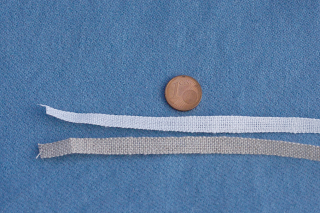
So now I can offer linen tape in 8 mm width, in bleached or unbleached,

as well as 3 and 5 cm wide tape.

There's a lot of uses I can imagine for bands like that - fixing fibre on a distaff, for example. The fabric has an even threadcount in warp and weft, so you can also use it as basis for late medieval counted-stitch embroidery, in case you are looking for clothing embellishment. (It's on the coarser side for medieval embroidery, though.) The 5 cm would also be a good width for a barbette, saving the need to hem a strip of cut cloth, with the added bulk at the edges that hemming brings.
 
And speaking of fabric for headwear:  In case you are looking for material for a veil or kerchief and would actually prefer to have the selvedge of the fabric along the long edges (both of them!) of your piece, here's something for you:


transparent headwear linen, woven to a width of 50 cm - which is wide enough, according to my own experience, for headwear pieces. It's really light and airy, amazingly so, and it saves you the hassle of having to hem at least one long edge.

The headwear linen is also available in a non-transparent version, with a weave density similar to that of the 3 and 5 cm wide bands. I'm offering all those pieces not per metre, but per 10 cm, so you can buy exactly the amount you need, no more, no less.

There's also a very small number of bronze pins, and it looks like the netting needles will be back in stock soon too. And in case you are a spinner and looking for some nice, non-merino top to spin, I have Coburg Fox sheep, German Eiderwolle and a naturally brown mixed German wool for you.

Finally, I have new spindle whorls coming in - here's a sneak preview picture:
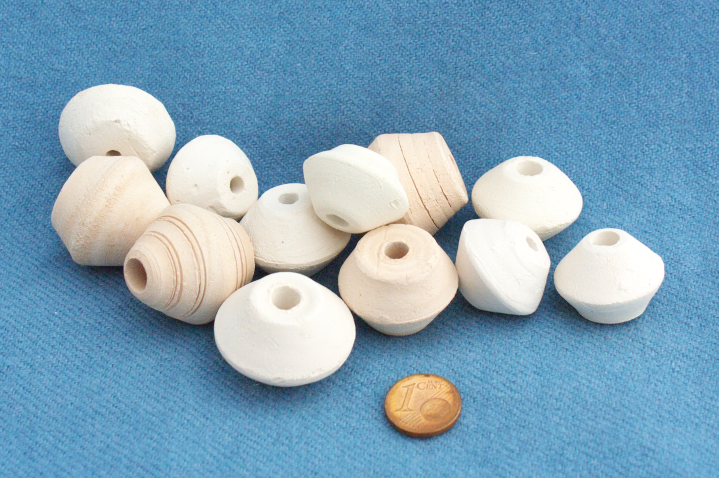

If you want to see more of the shop (or buy some of the stuff, even), here's a friendly link to take you there. I hope you enjoy all these things as much as I do!
0
DEZ.
03
0

Rethinking stuff.

The last workshop I gave turned out a little differently than planned - a little smaller due to some illnesses, and a little more open-themed, partly as a consequence of that.

The result of this change toward more openness, and more diverse topics, pleased all of us no end. So much, in fact, that I have decided to rethink my workshop/course structure in general. Since one of the issues for workshops is to get enough people interested in the course topic together, on that one specific date, having an open-topic workshop takes out this major issue, so it's easier for me to have a workshop. An added benefit? Participants can have a look at what the other participants do, and maybe widen their interest.

So while I will keep up the offer of courses catering to a specific topic - especially for groups or museums that want to have a course or workshop tailored to their topic of choice - I will also offer small, open-topic workshops hereabouts.

These will be small because it's not possible to run multiple topics in a large group. A small one, however, allows for it since all the textile work is a bit of instruction, a bit of working on it by yourself. So basically, the open-themed courses are going to work like this: you book your course spot, and we will figure out what you are going to focus on during the workshop. I will then prepare your topic accordingly, and you can work on it during the course day(s), getting the instruction you need and want, with the opportunity to soak up some extra knowledge from what other participants focus on. (Or even switch focus, if you want that.)

I'm currently sorting out dates for the next three workshops of this type and am writing up the info text for the shop... so it will be online soon. And I'm already looking forward to the first of these workshops - since the last one was such a nice experience!
0
DEZ.
02
0

The Hunt.

These days, I get the feeling that in the middle of all the seasonal preparations, I am hunting for some elusive stuff all the time. Elusive stuff as in "that's how it was in the Middle Ages".

So high on today's list of things to do: counting threads from fabric samples and trying to decide if some of them will do as 14th century fabric replicas.

This is weird, and exhilarating, and interesting in a way that fabric samples probably should not be. Out comes the little USB microscope now. Threads, I will count on you!

Not all of the current hunts are as difficult, though - there has been some progress, and I hope to have suitable light for taking decent photos later today, so I can share my findings with you.

Until then, here is a truly breathtaking video that has nothing to do with historical textiles - but a lot with going for what you want to go for, and never mind conventions and naysayers.


This video left me totally boggled. It's... wow. Just... wow.
0
NOV.
29
0

More Manesse, and barbette-and-fillet thoughts.

Yesterday's post brought up a question in the comments regarding whether the fillet with the pie-crust edge was closed on top or not... good question.

Personally, I tend to see all of the fillets as open on top unless I can clearly see otherwise. That is possibly due just to a personal quirk, but my reasoning is: You don't really need it closed on top for stability (stiff linen holds up just fine even without an inlay of leather, or felt, or whatnot), and it's easier to adjust in size if you don't close it. So you can have a strip of linen that you tack together or even just hold together with a needle in the back, and if your hair changes or your hairstyle changes or you have a thicker barbette... adjusting the size is no big deal. Also it saves material.

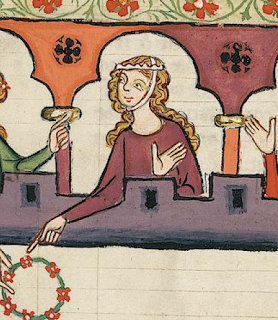
There is one non-typical fillet in the codex Manesse that shows, very clearly, a non-closed version:

(fol. 11v, or page 18)

I have also tended to see the little darker area on top of this fillet as the top of the head peeking through:

(fol. 32v)

The only closed headdress find I know is one from Villach-Judendorf; that one has, however, no pie crust and consists instead of gold-brocaded narrow ware. Beautiful - but quite different from the Manesse versions.

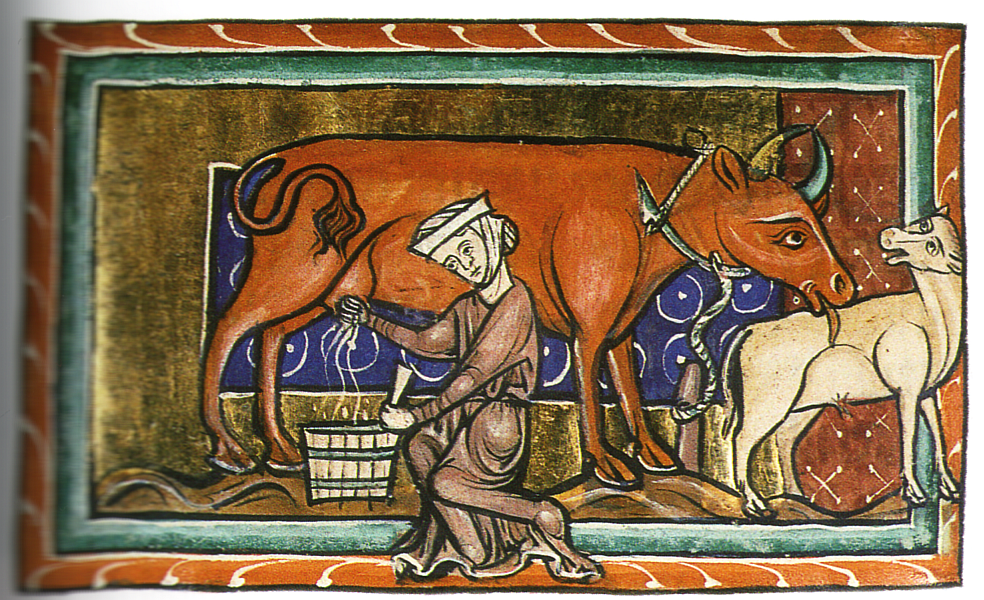
Finally, while there is no picture of b-and-f in the Manesse clearly showing the top of the head peeking through, there is also none clearly showing a fabric top. And there are quite a few pictures clearly showing the fillet as just a strip, such as this one:

(pic out of HÄGERMANN, D. (Ed.) (2001) Das Mittelalter. Die Welt der Bauern, Bürger, Ritter und Mönche., RM Buch und Medien.; late 13th c, England).


That's my thoughts about the question hat or band as fillet - I'd be happy to hear your opinion, and the reasons for your arriving there!
0
NOV.
28
0

Conferences and stuff.

It's winter time, the time for planning, or so it seems. Also the time for registering at conferences. For example the Experimental Archaeology conference in Oxford:

Dear Colleagues,
 
Registrations are now open for the 8th UK Experimental Archaeology Conference that will take place in Oxford on 10 & 11 January 2014.
 
The registration fee is £55 for both days if you register before 1 December 2013. For more details and if you would like to have a look at the provisional program, feel free to visit our website: http://experimentalarchaeology.org.uk/
 
To register, follow this link:
 
It doesn't look like I will be able to make it there this year, but the last one I was at was really nice.

I've also been sent a CfP per email, with the request to forward it - so if you are interesting in the following, email me and I will forward it to you:

Breda's Museum in the Netherlands is organizing an international conference on Costume and Textile Preservation in Museum, Theatre and Fashion. This is part of a meeting of the Costume Design Group (CDG) of OISTAT <www.oistat.org>. In the first place this is a call for papers for the international conference in Breda, but interested attendants may want to choose for the complete CDG activities or just for the conference in Breda.
The preliminary programme includes a lot of visits to workshops and exhibitions, so it sounds really fascinating. Now if only I were a conservator....
0
NOV.
27
3

The Manesse thing.

If you have looked at late-medieval pictures from Germany, chances are high that you have seen some from the Manesse Codex (completely online here, courtesy of Uni Heidelberg).

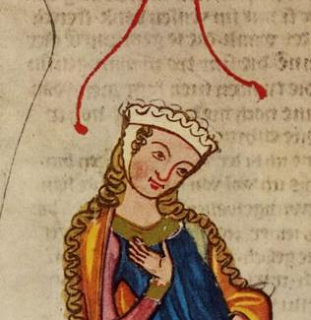
There's an iconic version of the female headdress of the barbette-and-fillet type in there, showing a wavy upper part. Like this:

(That's from fol. 32 v. Lots more to be found in the manuscript.)

I have heard about many different ways for a possible reconstruction of this wavy upper edge, and have seen a lot of interpretations - ranging from textiles woven with a ruffled edge, sewn-on ruches and ruffles to bands folded down and pleated, to an attached cord. It's perfectly possible that all these kinds of achieving a wavy edge were in use back then, but personally I have never seen a version that really convinced me.

Recently, I have added another interpretation to the mix - this one:


It's all linen (though it would be possible to make it with a stiff enough silk fabric), and the ruffled edge is made from the same fabric as the main part of the fillet. I think it might be possible to tickle it into even more similarity with the Manesse depiction, but for now, I am not unhappy with the visual impression...
0
NOV.
26
3

This is... (drumroll) Post Number One Thousand!

It's hard to believe, but this post is actually number 1000 in this blog. Time for a celebration!

I have no pic of fireworks, but this one is a blooming Chili, and it will have to do as a celebratory pic:


It's amazing, really. One thousand posts...

Thank you for reading this blog - and here's to the next one thousand posts.

0

By accepting you will be accessing a service provided by a third-party external to https://www.pallia.net/

Kontakt