Latest Comments

Guest - Aislinn Dyestuff Citizen Science.
09. Oktober 2026
This is a great project. I look forward to the results. Thanks for letting us know.
Guest - Aislinn Time for...
09. Oktober 2026
Looks delicious!
Guest - Katrin Sprang Discussion
18. September 2026
Hi Rachel, I have looked for more photos of you, but that was not very successful. I found a link on...
Guest - Beatrix Sprang Discussion
15. September 2026
That lozenge pattern element is not a photograph, but a scan. So it should be to scale. But I pinned...
Guest - Katrin Sprang Discussion
15. September 2026
I was not referring to Rachel's reconstruction (is the reconstruction you refer to the one photograp...
MäRZ
04
0

Stiches galore... and all the stuff for the prep work.

I'm still up to my ears in prep work for the embroidery course - I am using this as a wonderful opportunity to tackle all those embroidery-related side projects and side questions that had pestered me for quite a while, but that I never got around to occupy myself with.

And one of those eternal projects was getting the proper ink to do authentic medieval preparatory drawings. There's a nice instruction on how to do it in Cennino Cennini's handbook (the extended version; scroll down to CLXIV to read it), but getting the appropriate ink proved to be a bit harder than I had expected. And now I'm finally in the home straight for the ink project - only a few more days until I have that done and finished. Then I will be one step closer to having all the embroidery preparations covered!

(There's still plenty of steps left until that though, so no danger in my getting out of work to do in that area yet...)
0
MäRZ
03
0

Embroidery!

I'm currently spending snatches of time here and there to sit down with some embroidery, all in preparation for the workshop in April. At the moment, I'm mostly trying to figure out whether there was a typical approach to work sequence and turning corners in the counted embroidery that I have in my books. And that means... stitching and comparing.

There are a few things I have already learned (or learned even better) about medieval embroidery. One of the first things, and one of the biggest problems, is the size of that stuff (pun intended). Medieval embroidery... it's tiny. Teeny-tiny. If you buy modern ground fabric for counted work, you'll often get about 12 to 13 threads per cm as "fine quality". Medieval fabrics? 19 or 20 threads per cm. That's about a third smaller, and fabric in that fineness and even weave is not easily available nowadays. (I'm working on it, by the way.)

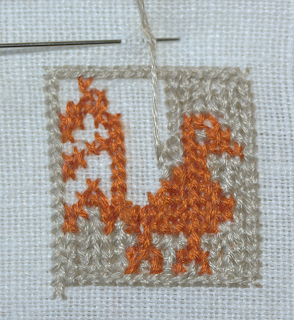
Apart from those little problems, I'm vastly enjoying myself trying out different ways to make transitions from one row to the next, with differring success. I have not settled on one "best" technique yet, and I'm not sure there will be one for me... but my sample-and-try-out-things fat chicken currently looks like this:


It is worked in "Zopfstich", a stitch giving sort of a braided appearance (Zopf = braid), and it's fun and easy to work. I did not get it totally like the original which is partly due to my being bad at counting and partly due to the different thread counts (I have to work over different counts of threads in different directions). As you can see, it's not perfect - but it does serve its purpose as a trying out slightly different techniques.

And plump chickens? I like them.
0
MäRZ
02
1

Guttbye, Mr. Copy-and-Paste!

(Politics first, textile stuff later - please scroll down if you are not interested in German politics.)

At noon yesterday, the German Minister of Defense has abdicated. I think that this is a very, very good thing - it proves that the voters do care about the integrity of their politicians, that plagiarism is still a crime and not a gentleman's crime, and that the Internet community has become an influence big enough to overthrow a person of political importance.

The abdication of her minister does not sit well with the German chancellor Merkel, though - she is actually accusing those not on Guttenberg's side of "hypocrisy and dishonesty" and says that "We do not need to have anybody explain to us what integrity and honour are in our society" ("Wir müssen uns von niemandem erklären lassen, was Anstand und Ehre in unserer Gesellschaft sind", here's the full German press article with those statements).

Well, at least as far as I'm concerned, it was not my aim to harm the CDU/CSU - but that's not how Merkel and her group see things (or state to see things). And now we can all wait and see whether the Fallen One will make a comeback or not... I hope that this time, the memory of Germany will prove to be longer than before. Because yes, I would agree that everyone deserves a second chance in life - but not a second chance to help lead a country.

On to other important things: Old rags. There seems to be a conference in London this weekend, and I'm sorry to pass this on to you on such short notice - I had not heard about it before. It went over the MEDTC-List yesterday, and I'll just repost the whole thing, since I could not find it on the Museum of London pages to link to.

Making it: Textile Technologies in Medieval Europe

Saturday 5th March 2011
Weston Lecture Theatre, Museum of London, 150 London Wall, London EC27 5HN
www.museumoflondon.org.uk

10.00: Doors open

10.30 – 10.45: Welcome: Hilary Davidson [MEDATS and Museum of London]

10.45 – 11.15: Professor Gale Owen-Crocker, University of Manchester,

 ‘Continuity and Change: an Overview of Medieval Textile Production’

11.15 – 11.45: Ruth Gilbert, Independent Scholar and Weaver, ‘Spinning technology in England in the Middle Ages (450 – 1500)’

11.45 – 12.15: Coffee, demonstrations and screening of DVD showing images of medieval cloth production from Semur-En-Auxois, in the Activity Room

12.15 – 12.45: Alan Raistrick, Independent Scholar, ‘Revelations and Calculations; developments in the spinning wheel during the Medieval Period’

12.45 – 13.15: Anna Nørgård, Weaver, author and demonstrator at the Viking Museum, Roskilde, Denmark, ‘The Early Medieval Warp-weighted Loom’

13.15 – 14.45: Lunch (not provided) and demonstrations in the Activity Room

14.45 – 15.15: Anton Reurink, Author, Historisch Openlucht Museum Eindhoven, The Netherlands, ‘The Medieval Process from Wool to ‘Lakense stof’ (Broadcloth)’

15.15 – 15.45: Kathrine Vestergård Brandstrup, Archaeologist,  ‘The Development of the Loom, 1000 – 1500’

15.45 – 16.15: Tea and demonstrations in the Activity Room

16.15 – 16.45: Dr Nat Alcock, Emeritus Reader in Chemistry, University of Warwick, and past President of the Vernacular Architecture Group, ‘Recreating the Medieval Weaver’s House and Loom’

16.45: Discussion

17.30: Close

Demonstrators - Glenys Crocker: warp-weighted loom - Ann Markwick: great wheel - Jo Wexler: tablet weaving
Speakers who will also demonstrate - Kathrine Brandstrup: naalbinding -Ruth Gilbert: drop spindle
Demonstrators Warp-weighted loom: Glenys Crocker, Vice-President of the Surrey Archaeological Society and member of the West & East Surrey Guilds of Spinners, Weavers & Dyers; great wheel: Ann Markwick, the East Sussex Guild of Spinners, Weavers, & Dyers; tablet weaving Jo Wexler, from the Cambridgeshire Guild of Spinners, Weavers,& Dyers.

The researches of some of our speakers demonstrate the contribution of practical experimentation to historical research and, in a museum context, ‘bring alive` many aspects of textile history.  Kathrine Vestergard Brandstrup is the editor, with Marie-Louise Nosch, of The Medieval Broadcloth: Changing Trends in Fashions, Manufacturing and Consumption, Oxbow Books, Oxford, 2009.  Anna Nørgård is the author, with Else Ostergard & Lilli Fransen, ofMedieval Garments Reconstructed: Norse Clothing Patterns, Aarhus University Press, 2010.

What hand tools were used, how were they made, and what practical skills were needed – as well as what changes took place – will be discussed in relation to aspects of the historical and archaeological record. There will be demonstrations of some practical spinning and weaving technologies used in north-west Europe from approximately the fifth to the fifteenth centuries.  It is hoped that a new light will be shed on the production of yarn and woollen cloth.
I would love to go there, but it's too far away and  on too short a notice (and travelling to Britain is, alas, not so utterly cheap and fast). I also don't know if there's a conference fee to be paid or who organises the whole conference, so you might want to call the museum to find out details before you travel there.

I will stay here and play some more with my embroidery, in preparation of the workshop in Vienna that I will give in April. And more about that... tomorrow.
0
MäRZ
01
0

There's really no standing still.

One of the things I enjoy about being my own boss and doing my own stuff is that I regularly get served with a nice new challenge - something to update, something to change, something to get better next time, something new to add to the stack of goods to sell.

And quite often, those little (or bigger) challenges come with a change to the better. As does the thing I'm facing now... as our Textile Forum gets a bit better known, its ranking on search machines in the 'Net gets higher. And that inevitably leads to more spam.


Last year, I was still sifting out the real entries from the non-real spammy ones by hand, but meanwhile it looks as if there will be a huge lot more spammy entries than last time - so today I have the wonderful opportunity to build an anti-spam trap into the registration questionnaire. So... I'm off to look for an instruction of how to do that!
0
FEB.
28
1

How weird is that.

It might have come to your attention that the German minister of defense, zu Guttenberg, has gotten himself in a heap of trouble because he did not actually write a doctoral thesis but copied it - he plagiarised. All of it (except maybe a few pages, it seems). Even the introduction was not written by himself, and for that copy-and-paste work, he received the best grade possible, summa cum laude.

Now you might know that in Germany, a Dr. in front of the name, that's something. There's still a nimbus of infallibility and specialness adhering to these two extra letters, and a Dr. in front of your name, spoken or written, might even provide you with preferential treatment or better customer service. (This is not something that I endorse - I'm writing this just to let those of you not knowing Germany well get a feel of what a title here might mean.) This should make it easy to understand why a phd is a good thing to have if you are going into politics, and it also explains why a German might, from time to time, find some weird advertisement letter in the mail promising a doctoral degree (and all the recognition connected with it) for next to no work (and a goodly amount of money).

A fake doctoral degree might exist more often than I wish to believe (or even think about it). And a fake title - buying something that others have worked and studied very hard for - is not a gentleman's crime. Especially not if you are a person of high political rank and should have high professional and personal integrity. Hello? Minister of Defense? Fake doctoral title? No can do.

So I, like a lot of other academics, are now waiting to see what happens. Meanwhile, since the Internet makes it easy to find plagiarisms in comparison to years ago, the community is working hard - not only making an interactive report available where you can compare the Guttenberg thesis and the original, but also with an open letter to Angela Merkel concerning the Guttenberg Affair from doctoral students (but also signable by others, both with and without an academic title). That letter has meanwhile even made it into the Tagesschau.

And then, of course, there's the jokes. Zu Googleberg, Karl Theodor Xerox, the Killer of Footnotes, Dr. ctrl.c. zu Guttenberg,... If you understand German, you might be amused by this joke collection, even including songs about him.

But there is something that should not be forgotten with all this joking: Mr. zu Guttenberg has wrought a lot of damage - damage to his ministry, to his political party, to the German science community, to the University he got the degree at, his faculty there and the professors working there, and possibly everybody else that comes from that Uni for at least a while. He is a fraud and there's no way to deny this (Statement by Prof. Lepsius from Uni Bayreuth, in German). And that fraud has done damage enough to end a few careers, not only his own.
0
FEB.
25
0

Call for Papers European Textile Forum 2011

Working in historical textile crafts can be a very lonely affair. To help remedy this, we are organising the third European Textile Forum for people working in historical textile crafts. The event will take place September 12-18 2011 in the Urgeschichtemuseum Asparn an der Zaya, Austria.

The programme consists of three parts: Free time to work, try out things and talk about textile techniques; the possibility to give little show-and-tell presentations directly on your project during daylight hours; and a series of short paper sessions in the evening hours. We would like to present current projects, reconstructions, technical problems or research work during those talks.
As focus topic this year, we have decided on linen and other vegetable fibres, a very interesting and we think also very rewarding topic. Fitting in with this focus, Sabine Ringenberg is planning to do a series of test runs for her project of reconstructing historical methods for mordanting linen for a good, reliable dyeing result.

Papers or posters about our focus topic "Linen and other vegetable fibres" are thus especially welcome, but of course we are not limited on these fibres for the Forum.

We want to give up to thirty textile experts and enthusiasts the opportunity to meet at the museum for one whole week, each with his or her project(s), and there is free time to work, chat, demonstrate and talk about textiles and textile crafts during the day. The museum is open to the public and we welcome other weavers, spinners, dyers, to come so they can also sit, work and talk with both guests and participants. With this opportunity for everybody interested in textiles, we want to help establish a better communication between professionals and non-professionals like Living History enthusiasts.

The museum is graciously offering to support the Forum with the opportunity to sleep in a bronze-age house on the museum grounds. The museum facilities are very basic, so staying at the museum means bringing your own sleeping gear (mat and sleeping bag) - think of it like you would think of a camping trip. If you prefer a room, you can of course book your own accommodation in Asparn; information about rooms can be found on the Travel and Accommodation page. Full board consists of breakfast, lunch and dinner; water to drink will be available at all times. Breakfast will be served in the museum, while the other meals will probably be served in the restaurant doing the catering for lunch and dinner, a short walk from the museum. The conference fee, including sleeping space in the bronze age house and full board during the week, is 350 Euro per person.

Asparn an der Zaya is located about 60 km north of Vienna and is served regularly by public transport. We will try to make travel as easy as possible by providing the participants with information on public transport and transport schedules; additional information on the programme, the museum and transportation will be available over the website www.textileforum.org as well. If you have any questions, you can contact us directly via Diese E-Mail-Adresse ist vor Spambots geschützt! Zur Anzeige muss JavaScript eingeschaltet sein..

For the Forum, we are looking for both paper or poster presentations and offers for show-and-tell presentations. If you can offer a workshop in connection with our Forum focus, please contact us via Diese E-Mail-Adresse ist vor Spambots geschützt! Zur Anzeige muss JavaScript eingeschaltet sein.. Workshops will be booked separately by the participants, and teachers will receive a reimbursement.

To register for the Forum with or without a poster or paper presentation, please submit your current area of research, the title and abstract of your presentation (papers not longer than 20 minutes) until May 27 via the registration form. Please also pass this Call for Papers on to others who might be interested!
For any questions left, you can contact us directly via Diese E-Mail-Adresse ist vor Spambots geschützt! Zur Anzeige muss JavaScript eingeschaltet sein..

We are looking forward to a wonderful conference with you!
0
FEB.
24
0

Textile Forum - we will be in Austria!

There is a German idiom that goes "Erstens kommt es anders und zweitens als man denkt" (literally: Firstly things will come out differently than secondly you planned), and that was a bit the case with our Textile Forum planning this year. This has lead to - you have already noticed - a bit of a delay with our Call for Papers, which we originally had wanted to post a bit earlier than now.

The good news is that we have finally got a date and a museum to host us - we will have the Textile Forum from 12-18th of September 2011 in the Urgeschichtemuseum Asparn an der Zaya, and I'm currently working on the website and CfP. You can expect the Call to go out tomorrow, and the website to be updated accordingly. And we're very much looking forward to the Forum in 2011!
0

By accepting you will be accessing a service provided by a third-party external to https://www.pallia.net/

Kontakt