







Latest Comments

Guest - Aislinn Dyestuff Citizen Science.
09. Oktober 2026
This is a great project. I look forward to the results. Thanks for letting us know.
Guest - Aislinn Time for...
09. Oktober 2026
Looks delicious!
Guest - Katrin Sprang Discussion
18. September 2026
Hi Rachel, I have looked for more photos of you, but that was not very successful. I found a link on...
Guest - Beatrix Sprang Discussion
15. September 2026
That lozenge pattern element is not a photograph, but a scan. So it should be to scale. But I pinned...
Guest - Katrin Sprang Discussion
15. September 2026
I was not referring to Rachel's reconstruction (is the reconstruction you refer to the one photograp...
FEB.
14
0

Things, randomly written here.

Firstly, for all those of you who are planning to put in a visit to the V&A before they close down the textile study room, a heads-up: I have been sent additional information by two friends who went there and found that, without any further notice, the staff closed the study room at noon.

So they recommend that
any colleagues intending to make a special visit to the collection are *strongly* advised to contact the museum first to check that the room is likely to be open : they probably won't give any promises, citing the usual weasle phrase "lack of resources", but pointing out that the room will soon be closed anyway might help.
So please phone ahead if going to the V&A to save you a disappointment.

Secondly, there are more conferences coming up: The Braid Society meeting in 2012 and the Leeds Congress 11-14th of July 2011. I have made the mistake of looking at the preliminary programme up on the website, and now I'm totally lusting to go there. If only beaming were invented already!

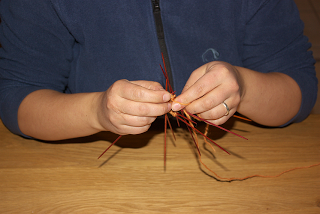
Thirdly, I spent part of the weekend having a load of fun with the new "in" sports discipline, Extreme Hedgehog Wrestling. Here's photo proof of it:


And this is the hedgehog in rest:
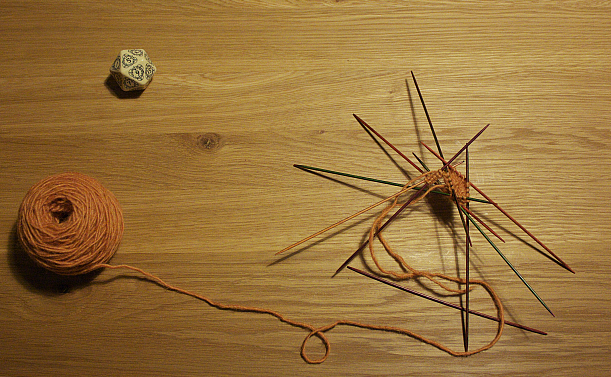


The thing lying around on the table in addition to the needles and yarn is a count-down d20* that I use for counting knitting rounds. (For those of you not enlightened by roleplaying friends sharing their dice and knowledge, countdown dice have the numbers arranged so you can easily find the next one in sequence - as opposed to normal dice where you have to hunt for the next number.)


It's a pattern that was published in Knitty a while ago**, and contrary to my usual approach, I actually did not change anything when knitting it. Well, except using dpns instead of the recommended two circs, and messing with the needle size : yarn thickness ratio to get the correct gauge. (Hint: My needles are, to a normal knitter's mind, way too small for the yarn.) After I broke one needle tip during the wrestling session start, I sort of tried to err on the side of caution in regards to the number of needles (and therefor reduced stress on the individual needle).Hedgehog Wrestling then is the natural side effect of this.

* A 20-sided die. Which is plenty for most knitting purposes and a very standard type for a lot of roleplaying games.
** I won't tell you what it is yet, because it's intended as a gift, and you never know who reads this blog. I'll show the finished thing once it's been received, though.
0
FEB.
11
1

Beating Wool

In the comments to my post about the beating frame, Iðunn asked about the procedure - I think, however, that this merits a proper blog post instead of a comment answer, so here it is. I do not have pictures of the beating process yet, but I will post them as soon as I get them.

Beating wool is something I have for a long time wanted to learn or see being done, so please keep us informed with pictures or even a video. Though I have seen those bows on medieval pictures and on a video about a German hat maker (Der Letzte seines Standes, I think it was)I'm still not quite sure how to do it.
There are three basic ways to fluff up wool: By beating it on a frame, by using a bow, or by teasing the fibres apart by hand. The first two methods use vibrations to loosen up the wool fibres, the third method is the straightforward mechanical pulling apart of the fibre staples.

A beating frame is a wooden frame strung with ropes in a lattice pattern; the (thin) ropes are under tension. The frame rests on trestles or some other support, and wool is placed on the rope lattice. By beating the wool (and the rope lattice underneath it) with a smooth, strong and flexible stick, the ropes and stick vibrate and thus start fluffing up the wool staples.

The bow method uses no frame and, according to literature, is better suited to short fibres than to very long fibres. A bow is strung and held or suspended so that its string is inside the loose heap of fibres. By hitting the string with a stick or plucking it, vibrations are induced that start fluffing up the fibres.

I have not yet worked with a bow, but the frame is a much faster way to fluff up fibres than teasing by hand - and they can get much fluffier as well. The downside? You need trestles, a large enough frame (if it is very small, you will hit the frame itself and break a lot of sticks, plus it doesn't work really well) and beating sticks.

Another thing I would like to ask you is about the distaff. I totally agree that spinners MUST use a distaff as it has been done since time immemorial. I have a distaff from Greece but somehow I can't find a proper way to hold it. When I put it in my belt it keeps falling forward. Also I'm not quite sure how to attach the wool to the distaff. I take pains to comb the tog and card the þel but when I wrap it around the d. it looks all messy. My distaff looks like sort of a trident.
I prefer rather short distaffs, and I tuck them under my left arm to hold them there. If you can't get your trident distaff to work, maybe you can try around with some different lengths to find out what suits you best? As for attaching, I just wrap my roving around the distaff-stick I use, and when I get to the end of the sliver, I tie the very end to the stick with a bit of string so that it doesn't slip off. You might try to place the end of your roving through the "fork" bit and then wrap it around the stem underneath - maybe that will help.
0
FEB.
10
0

New threads!

My new linen threads have finally arrived, and now I have a slightly different assortment than before. Instead of offering sewing thread in two colours (creamy white or fully bleached), I have reduced the colour range to one thread inbetween the two and instead now have two thicknesses of linen sewing thread.


The picture shows both linens and between them a spool of fine silk thread. As you can see, I have also started winding the thread on new spool-like objects, so now your thread rolls can happily lie around in open sight on every historical event - these babies are historically correct material. Plus you can secure your thread in the open end if you carefully crack the roll in one or two spots!

And just so you can get an approximate picture of the thicknesses we are talking about here:


These are, from left to right in the picture: Silk Gütermann 100/3 thread (for thickness comparison), the thin linen thread and then the thicker linen thread. I'm sorry the picture is a little blurry, but you should be able to compare the three thicknesses if you look at the spot right under the cent-coin.

I am very happy with these new threads: Sturdy, very high quality, very smooth and thinner than you usually get. Oh, and I have decided to do one hundred metre spools for now and see if there are requests for smaller portions, too.
0
FEB.
09
1

Tidying up.

I am theoretically all in favor of things neat and tidy (and all put away into their proper place). I have a fixed sorting and packing system, for example, for my stuff that I take to market; there's a fixed place that I get the things from, a fixed spot they take up in the car (though that does regularly undergo a slight change), a certain order in which they go into the car and out of it again. And when I pack up my stuff, I know which bit goes into which basket (and you can occasionally hear me mutter the names of the baskets while sorting). This system has been established for a while, and I really, really appreciate knowing where to go for this or that, and where to put things when packing up, since it cuts down on packup time and packup stress enormously. (That's when having to fiddle is most annoying, because all you want is get everything and yourself into the car and have the journey home over with...)

However for some reason, many of my things tend not to stay in their neat and tidy place, nor the place neat and tidy. So after postponing it often enough, I used a bit of my mostly-off-day yesterday to sort through stuff in my study cupboard and rearrange its innards so that everything has its proper place again and more fits in besides that. It was actually successful, and as usually not as bad as I always picture it. There's still a bit of rearranging and sorting to do before the season start, but at least it is a beginning.

And even more of a wonder, I have actually tackled the heap on my desk this morning and taken it down considerably. And I'm sure that all the rest of the heap will also not be so bad. Which brings me to a continuously amazing (and unfortunately a recurring) thought:

How can it be that things that are not so bad to properly stow away or take care of after all, something very beneficial to the general workflow or style of life, get put away improperly again and again? Even if the person putting off to deal with it has repeatedly experienced the benefits himself or herself and knows that it would be really not so bad to just do it? Is there a genetical quirk I can blame, or do I have to shoulder all the responsibility for being slack myself?

Does anybody have an answer for this? Or, better yet, a trick to make me magically orderly and non-reluctant to do bookkeeping and taxes?
0
FEB.
08
0

Random Items for the Blog

I am still feeling my hand muscles from gripping the wool combs all weekend.

I now know that I am totally spoiled in regard to properly prepared fibre - I was not really having fun with that yucky commercially prepared Merino top. So little fun (and so much yuck), in fact, that I did much prefer to make me a quick, not-very-well-done bit of top on my combs to do demonstration spinning.

Just in case that you (like me) have not yet seen pictures of how silk throwing to get organzine actually works, the process is explained (with pics) on WormSpit's blog.

Oh, and this little blog has gained its 100th "follower" - welcome! This does feel like a real milestone for me.
0
FEB.
07
0

Aaah.

I'm back from the weekend stint, which was very, very nice - I met a lot of wonderful colleagues again, got to use my wool beating frame (worked very well), did a fair bit of combing wool (which really trains your hand muscles) and even got to see the Staufer exhibition that is currently running in the evening.

We also were insanely lucky with the weather, with up to two-digits-in-the-plus temperatures - I did not need to put on even half of the additional warm clothes that I had brought. And to top it all off, the visitors all were very interested and very nice - so a thoroughly good work weekend for me.

And now there's the weekend-wrap-up-work left for me to do: Get all the things out of the car and stowed away in their proper spots. And after that... I'll go have a coffee with friends and check out a few books from the Uni library. And relax.
0
FEB.
04
1

Amazingly productive.

The rest of yesterday turned out amazingly productive - much more so than I would have guessed after getting a severe headache a few minutes after writing the blog. Luckily, a painkiller and a little nap took care of that, and I did finish my building project (though it won't win a prize for beauty) and even a few more bits from my list of urgent things. Plus I somehow felt inspired and curious enough in the evening to do a bit of extra work in preparation of the embroidery workshop that is planned for the beginning of April in Vienna - and I'm really looking forward to that!

And now I am the proud (medium-proud, that is) owner of a frame for beating wool. Willowing wool. Making wool fluffy by hitting it hard with slender sticks. Which is a much, much faster way to get the clumped staples nice and fluffy than teasing it by hand, and I'm really happy to give it the test run on the weekend!
0

By accepting you will be accessing a service provided by a third-party external to https://www.pallia.net/

Kontakt