







Latest Comments

Guest - Aislinn Dyestuff Citizen Science.
09. Oktober 2026
This is a great project. I look forward to the results. Thanks for letting us know.
Guest - Aislinn Time for...
09. Oktober 2026
Looks delicious!
Guest - Katrin Sprang Discussion
18. September 2026
Hi Rachel, I have looked for more photos of you, but that was not very successful. I found a link on...
Guest - Beatrix Sprang Discussion
15. September 2026
That lozenge pattern element is not a photograph, but a scan. So it should be to scale. But I pinned...
Guest - Katrin Sprang Discussion
15. September 2026
I was not referring to Rachel's reconstruction (is the reconstruction you refer to the one photograp...
JAN.
25
2

"Medieval Garments Reconstructed" is out!

Finally the long-awaited book by Else Oestergaard is out: "Medieval Garments Reconstructed" (link goes to bookdepository.co.uk). The official release date is February 2, so you can still pre-order for a few more days, but I have heard along the grapevine that some folks who pre-ordered it when that became possible have already received their copy (mine hasn't arrived yet, though).

Cathy Raymond has already posted a short first-leaf-through review on her blog. I'm very, very curious to see how the team around Else Oestergaard made the garments, and looking forward to good renditions of the original patterns (which I do hope to find in the book). I am a good bit sad, though, to read Cathy's citation of how the garments were sewn (with modern sewing machines) and especially finished - with cotton bias binding.

If you know the original publication, Woven into the Earth, you will know that the original garments are finished with exquisite care and some techniques that have been forgotten in the meantime. Those edges show wonderful detail and beautiful finishings, and of course I had to try these techniques. Since then, I have become an utter fan of stab stitch edges (you just can't beat the neat, crisp line that stab stitches give an edge) and singling finishing (invisible finishing of a cut edge in thick cloth, with no bulky folded-in bit? That's unsurpassed, really). I have become such a fan that I regularly do my very best in courses and workshops to get more people addicted to these unknown and wonderful finishing techniques - in fact, I will still keep them in the programme when it is already clear that there is not enough time for the full nine yards of programme. So knowing that a quick, modern approach with a very modern material has substituted these wonderful edgings is a real letdown for me. I can understand, however, why the team opted to do this - if you've ever tried (or had to try, because I made you) stab stitches or singling, you will know how immensely time-consuming these two methods are. Add to that the expense of time necessary for the finishing touches often applied on the original garments from Herjolfsnaes - tablet-woven edging, footweaving edges or braided bands attached to the garment edge - and you are facing a real hardcore time-sink. In my opinion, those techniques are totally worth the time invested - but they are no quick finishes, and if you are working on a deadline, they might be totally out.

So... now I hope that my copy will arrive soon so that I can get a look at it myself instead of reading other people's first impressions - and I'll post a little more about the book once I have read it.
0
JAN.
24
1

Oh noes! My blackberry isn't working!

That was... hilarious.


I just love British humour.
0
JAN.
21
3

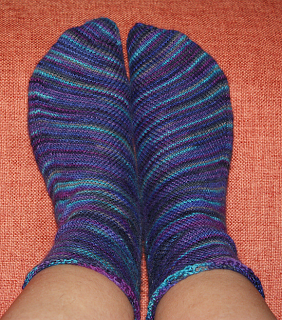
I have new socks!

A few days ago, I have finally finished binding off and weaving in the ends of my new socks.

After knitting a pair of Skew socks one sock after the other (which brought a problem in size, since one was done with very different tension than the other) and modifying the pattern so it would fit my higher instep, I had decided to do another pair, and that time simultaneously. Only... with some more tweaking of the pattern since the original heel is not roomy enough for my foot.


So after some knitting, some re-thinking, some maths, some more maths and lo and behold! not a single rip-back, my new socks are now finished. The heel has become roomy and maybe a tad too baggy even (there's a little bit standing out where the heel graft starts), but they fit perfectly otherwise and are oh so comfy.


I think there might be more socks like that in my future - or at least socks with skewed toes, or with otherwise anatomically more correctly shaped toes than standard socks, since I find the fit thoroughly delightful!
0
JAN.
20
0

Good reasons. (I think.)

When people ask me whether I would have liked to live in the Middle Ages, I usually answer the same: I have four very good reasons to not want to live back then - coffee, tea, chocolate and contact lenses. Those four are quite known not to exist in premodern times, so they (as reasons) are obvious to visitors, and most of the Living History folks get a laugh out of those Fabulous Four.

Have you ever been to a historical fair, market or something where there was no tea or coffee to be had? In my experience, that doesn't exist - or will only when hell freezes over. For every hardcore (and non-caffeine-addicted-in-modern-life) person that will forego tea and coffee while doing LH, you will probably find a hundred that do very much enjoy that cuppa in the morning and maybe also the afternoon, and a few of those might not function at all without their hot beverage starter.

Usually, that's it - I make my joke about The Four Reasons, people laugh or smile, and we move on. But sometimes, there is more behind the question. Sometimes people are trying to figure out whether the Middle Ages (or another given time in history) would have been a better place to live, or maybe a worse one, than our time here and now. And then, this question of "would you like to live back then" gets another answer.

If there actually were a time machine that could go backwards and you would stuff me into it and throw me back into the Middle Ages, it would be very interesting for me - but also very different from what I'm used to, and very difficult as well. I do not drink alcohol, and (low-alcohol) beer was a standard drink if not the standard drink back then. Though I do like my coffee and chocolate, I can do without - but I'm severely short-sighted, and once my lenses are worn out, I would be stuck with an eyesight that might enable me to do fine embroidery or paint miniatures or do something similarly tiny and detailed, but would be a noticeable handicap in day-to-day business. I don't have very resistant tooth material, and I might end up with cariouse or missing teeth quite fast. I would at least have some basic understanding of how to build and control a hearth fire, how to work with textiles, and how to get along on a medieval technology level, but I'd have to learn the language before communicating properly with people, and I'm pretty sure that my way of thinking is thoroughly modern.

It would probably be comparable to somebody from our modern world thrown into a so-called "primitive society" in the rainforest or a djungle somewhere, with a totally different cultural structure, other conventions, another language and a widely different way of thinking and technological level. In short, if you'd pop me back with that time machine, I'd be happy if you would also fetch me back after a few days or weeks.

But that's my modern person we are talking about, rooted firmly in the twentieth century. Like I just did, I can speculate on how I, personally, would feel if thrown back in time.
But the people born into their time naturally did not have these problems because they never knew our modern life and society - which means that life felt for medieval folks just like ours feels to us, normal with maybe an occasional dash of the not-so-normal. If there is no coffee in the world, nobody can miss it. If there is no other way to heat up a pot than to make a fire, that's just the way. And if short-sighted people just have to cope, they will. Daily life is the unspectacular thing, in any time, in any society; it has its ups and downs, but it's business as usual overall. And because we are so far away from living in the Middle Ages, we might look back on an aspect of life then and shudder because we, from our experience and expectations of living here and now, think it unbearable - but so will people frown and shudder in the future when they look back on our life. And if we want to know how daily life felt in any part in history, it's probably just like our daily life feels - with different structures, technologies and conventions, but that is just on the outside.

On the inside, it's all normal. Daily life. Comfort and boredom, linking us to everybody else that ever lived... isn't that a nice thought?
0
JAN.
19
3

The knowledge... it dies off.

When we modern folks are confronted with some archaeological find of yet unknown use, sometimes speculations ensue that seem totally plausible and yet can be quite wild. That's no wonder... knowledge dies out once something is not in use anymore, and that, in the worst case, leaves us guessing wildly on what this or that might have been used for. Or saying "unknown use". A bit like the children in this video...


I had a lot of fun watching it - and it is amazing, and also sobering, to see how easy it is for totally known and common things to drop out of the experience pool of the next generation. It's no wonder that we archaeologists sometimes stand in front of some find and really, really don't have any clue whatsoever at what that might be!
0
JAN.
18
0

Sex sells!

I'm blogging late because I got caught up reading an article that I found (again) via medievalists.net - about medieval sexuality and "erotic" images in medieval art.

The article touches on one of the core questions for any interpretation of historical circumstances: How much does our modern view of things influence our interpretation or appreciation? Sexuality and eroticism are one of the topics very much touched by our modern perceptions, and things have gotten looked at from different angles since the rise of feminist and queer perspectives - a good thing in my eyes, since it helps us re-evaluate our interpretation and our own premade (mis-?)conceptions when approaching medieval art.

Oh, and you can find the abstract and link to the pdf article here, at medievalists.net.
0
JAN.
17
0

Aaaah.

Today is a nice day, since I am going to take today (at least half) off - I spent Thursday and half of Friday in a very constructive get-together about experimental archaeology, then hopped into the car for some ugly travelling to Vechta (there was rain and jam, which is not delightful in contrary to toast and jam), had a workshop there on Saturday and thus spent most of Sunday on the Autobahn, driving home again - so I'm probably due an easy day to relax.

The workshop was very nice and fun, and we managed to get through the very large programme that the participants had wished for - lots of theory and then practice stuff to top it off. I got to spend the night in the museum which has prison cells as part of the exhibition, so now I have also spent a night in an actual cell (thankfully nobody pushed home the bolts on the outside of the door while I was sleeping). And the most curious thing about the workshop for me? Of the six participants, five were... men! Hooray for men in the textile field!
0

By accepting you will be accessing a service provided by a third-party external to https://www.pallia.net/

Kontakt