Latest Comments

Guest - Aislinn Dyestuff Citizen Science.
09. Oktober 2026
This is a great project. I look forward to the results. Thanks for letting us know.
Guest - Aislinn Time for...
09. Oktober 2026
Looks delicious!
Guest - Katrin Sprang Discussion
18. September 2026
Hi Rachel, I have looked for more photos of you, but that was not very successful. I found a link on...
Guest - Beatrix Sprang Discussion
15. September 2026
That lozenge pattern element is not a photograph, but a scan. So it should be to scale. But I pinned...
Guest - Katrin Sprang Discussion
15. September 2026
I was not referring to Rachel's reconstruction (is the reconstruction you refer to the one photograp...
JUNI
18
0

The Cameras.

So... here's the solution to the camera question:

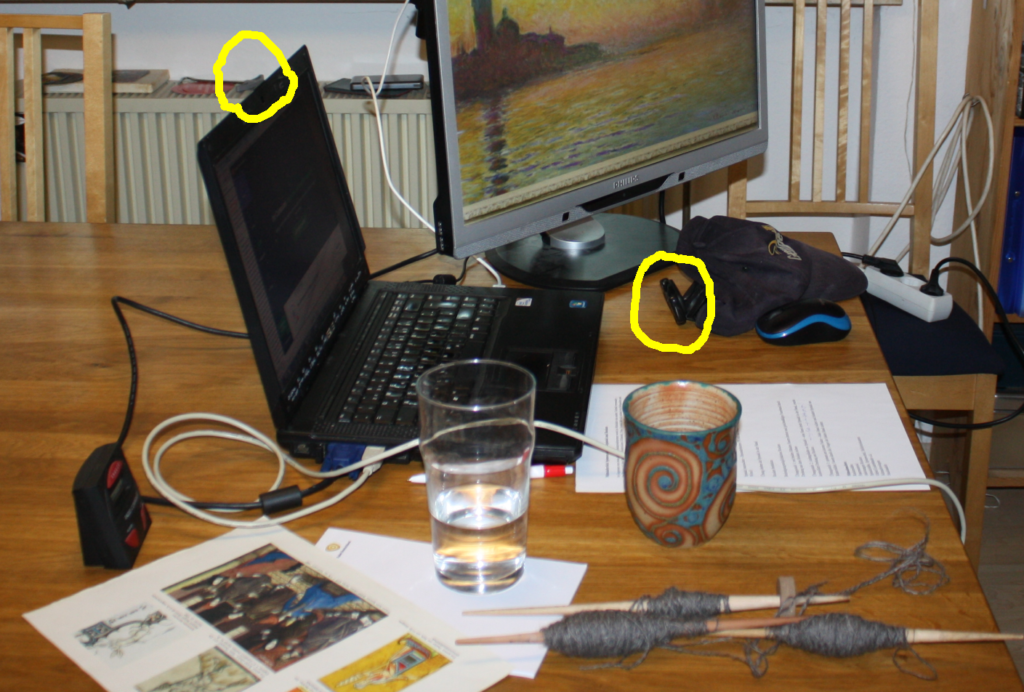
One is, yes, above the screen on my laptop, as would be expected - marked with a yellow circle. One is outside the shot, on a tripod and looking over the upper edge of the extra monitor. The third one is also marked with a yellow circle, and it's fixed to a cap.

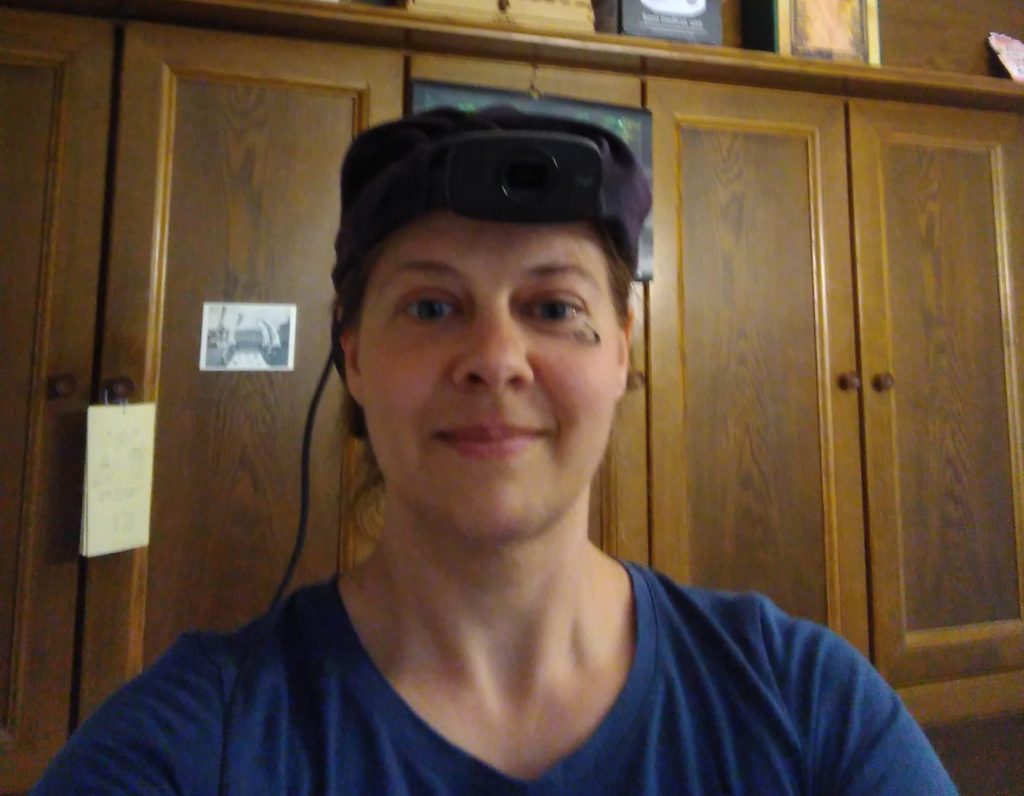
Which I wear. Well, not in that picture, there it's just hanging out on the table. When I do wear it, it looks slightly odd:


However... it means I can show my workshop participants exactly what I am seeing when I am doing things. Which is exactly what they should be seeing when they are doing the same things. And I am really amazed at the difference it makes to explain stuff! Well worth looking a little daft, with a cap with a long USB cable dangling from it...
0
JUNI
17
7

Textile Work Pain.

It's been a very full day again, with more online conference time again, and some more to follow - it feels like it should be Friday already!

The CTR conference covered sensory aspects of textiles and textile work today, which included Alex Makin telling about sensations when embroidering on the Cuthbert Maniple. Her paper made me realise that textile work can often be rather uncomfortable - I've never thought twice about that, however, I just took it for granted that something will hurt if you work too long at one thing, or happen to have bad posture. Usually, I try to plan my worktime so that I can take enough breaks to recover, but it has happened that something went wrong and then I had to work longer hours than I'd prefer. Then, yes, it can get uncomfortable and even painful. I remember very well the notch in my finger that happened after spinning a lot for a long time without a break!

One thing that also helps in preventing pain or discomfort is making sure you have good posture when learning a new (not only textile) technique. Once you've gotten used to slouching while weaving, it is very hard to un-learn that... which is the reason why I pester people in my weaving classes to sit straight. At some point, though, even the best posture will not be enough...

What's your experience with textile techniques and the pain(s) they can cause?
0
JUNI
16
0

Sad news from Scotland.

A sad thing from Scotland - the Scottish Crannog Centre, a reconstructed Iron Age roundhouse, has burned down on last Friday night. Here is a short article about this from the Guardian.

Fire is, and has always been, both a life-saver providing warmth and light, and a danger to people, animals and dwellings. Even with our modern fire-fighting technologies, fire can still do a lot of damage before being extinguished; Notre Dame springs to mind, of course.

At least in modern times, with so little actual open fire being used in daily life, the chances of flames getting out of hand are much reduced compared to a few centuries ago...
0
JUNI
15
5

Whew.

You can tell that I've had a full day if the blog post comes up after 8 in the evening... like today, which included doing some of the usual daily emailing and shop work, then attending the CTR anniversary conference, then going to donate blood, and then...

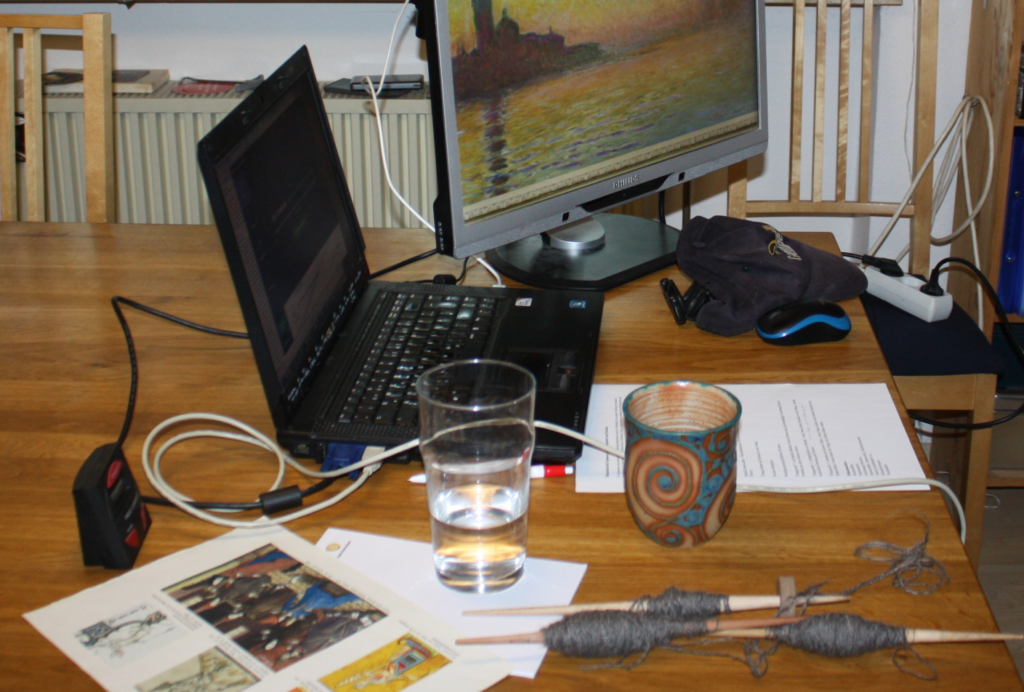
Setup for the online spinning workshop, with two screens and spindles on a table

...then my computer moved into the other room, and some spindles did too, and there were three screens in total and three cameras, and a mouse, and a hot drink, and some water.

And there were people joining me on Zoom, and soon they were all spinning medieval style with spindle and distaff. I'm still amazed on how well this online teaching works - not least, actually, due to the three cameras (and the third screen, which is essential for the use of one of the cameras).

So - here's a challenge for you.

I'm using three cameras in total, one of which I could do without. Two of the three cameras are on this photo, including the one that I'm most happy with, and that makes the course work so well. Can you spot it?
0
JUNI
14
0

Sleeping Bees.

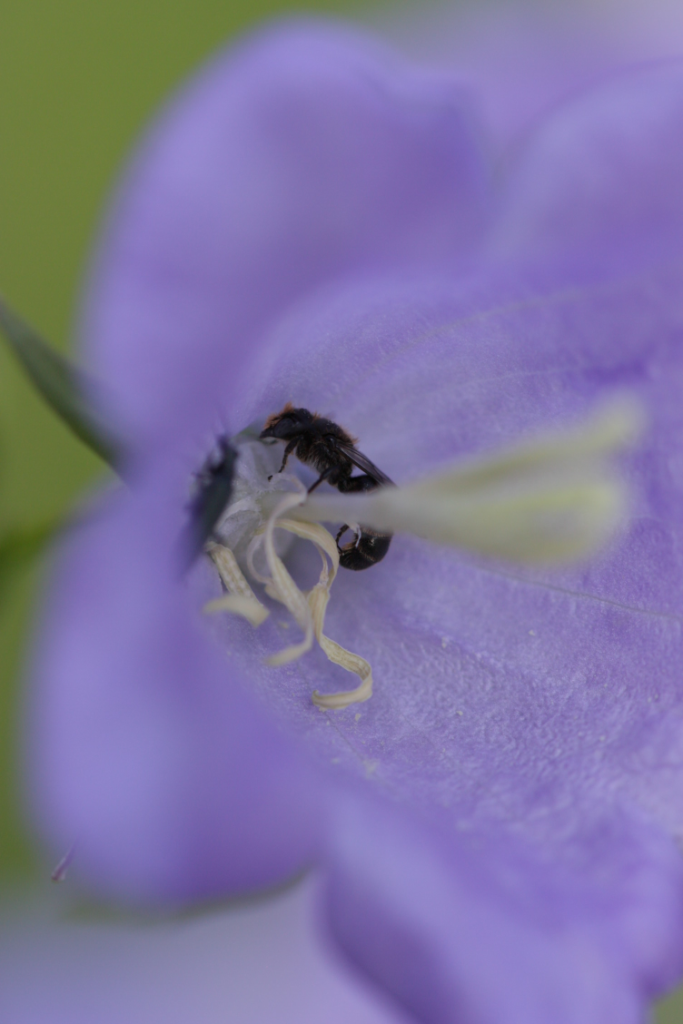
What do bees do at night? Well, they sleep. Sometimes, if you have a lot of (native) flowers in your garden, and there's consequently a lot of bees... you can find them sleeping there. Like this tiny bee, who curled up for a cosy night on the bottom of a bellflower:


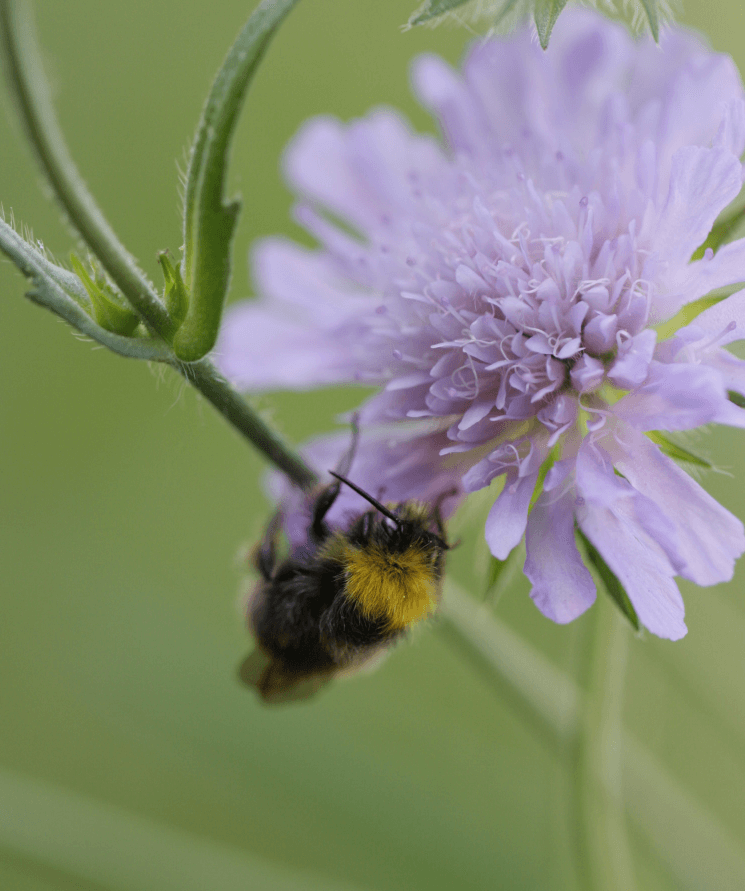
Or this bumblebee, who hung underneath a scabiosa flower:


When they sleep, they are certainly much easier to photograph than when they are flitting around!
0
JUNI
11
2

Update on Things.

Things here are busy, busy, busy - but in a good way. There's sending out of goods ordered through the online shop, I've just sent back the corrected final proof for a paper (about spinning), and I've also sent out the results of a museum/writing project that I did together with Helga Rösel-Mautendorfer, my wonderful colleague from Austria. It's information about Iron age clothing, and how to make it, intended for use by schools to make these kinds of garments for the children.

There's also, to my great delight, more European Textile Forum planning going on. It does look like numbers are falling about everywhere, and that we can go ahead with our Forum plans. So there will be a newsletter as soon as I can manage, and a website update, and much more planning in the background.

Having the Forum to look forward makes the loss of the real-life NESAT a bit more bearable for me... a week or so ago, an email came announcing that NESAT would be online only. Finland is apparently quite restrictive regarding people coming into the country, and the organisers of the conference didn't want to risk issues with participants not being allowed in, or having to quarantine. So it will be a virtual conference only.

I'm really sad about this, though I can understand the reason behind it, and wouldn't want to be caught myself in quarantine in Finland instead of actually attending the conference. Hopefully there will be another chance to visit Finland at some point in the future, and there will surely be a next NESAT which, unless a new pandemic strikes, should be a proper real-flesh-and-blood one!
0
JUNI
10
0

MEMS Festival, 17-19 June

Even more online conferences: The Medieval and Early Modern Studies Festival will take place on June 17 to June 19. It's theoretically in Kent, but with the pandemic, this too has gone online.

There's a lot of interesting papers and two workshops, and participation is free - you can see the programme and register on their website.

 
0

By accepting you will be accessing a service provided by a third-party external to https://www.pallia.net/

Kontakt