Latest Comments

Guest - Aislinn Dyestuff Citizen Science.
09. Oktober 2026
This is a great project. I look forward to the results. Thanks for letting us know.
Guest - Aislinn Time for...
09. Oktober 2026
Looks delicious!
Guest - Katrin Sprang Discussion
18. September 2026
Hi Rachel, I have looked for more photos of you, but that was not very successful. I found a link on...
Guest - Beatrix Sprang Discussion
15. September 2026
That lozenge pattern element is not a photograph, but a scan. So it should be to scale. But I pinned...
Guest - Katrin Sprang Discussion
15. September 2026
I was not referring to Rachel's reconstruction (is the reconstruction you refer to the one photograp...
JUNI
29
0

A Closer Look at Fibres.

I'm back with my Bronze Age Fibre problem. Well, it's not just my problem... it's a pretty common one if you look at reproducing fabrics from that time. Let's take a look...

Modern Merino wool, which is seen as rather fine stuff, has - if of the fine kind - fibre thicknesses of around 20 micron. Sometimes you get extrafine, which is at about 17 micron.

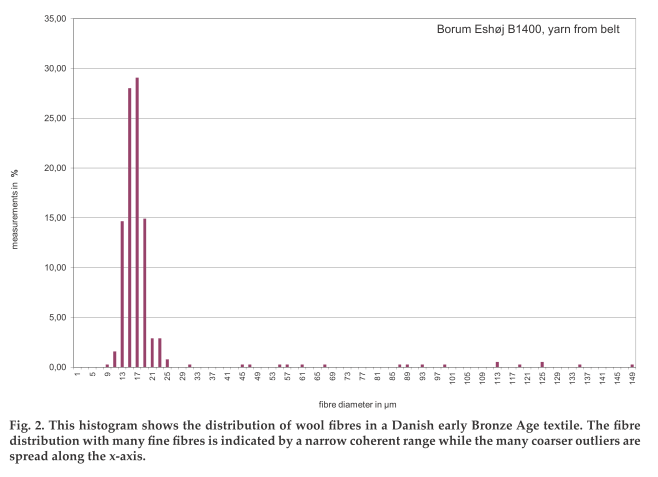
Bronze age fibres were, mostly, around 17 micron. There's fluctuations, of course, but that's the main component of the textiles - really, really fine fibres. Then there's some few extra coarse ones thrown in, with 45-150 micron thickness. A diagram of fibre thicknesses counted was published in Skals, I., & Mannering, U. (2014). Investigating Wool Fibres from Danish Prehistoric Textiles. Archaeological Textiles Review, 56, 24-34, and thanks to the generousness of ATR, you can download the whole issue with the article included here. To save you the search, the histogram is on p 26, and it looks like this:


Getting this mix of fibres is difficult these days. I have gotten some superduperfine special wool now, with (according to my supplier) around 15 micron of fibre thickness. You can see it to the very left in this picture; next to it is a sample of my beloved Eider wool, and on the right Valais Blacknose wool.
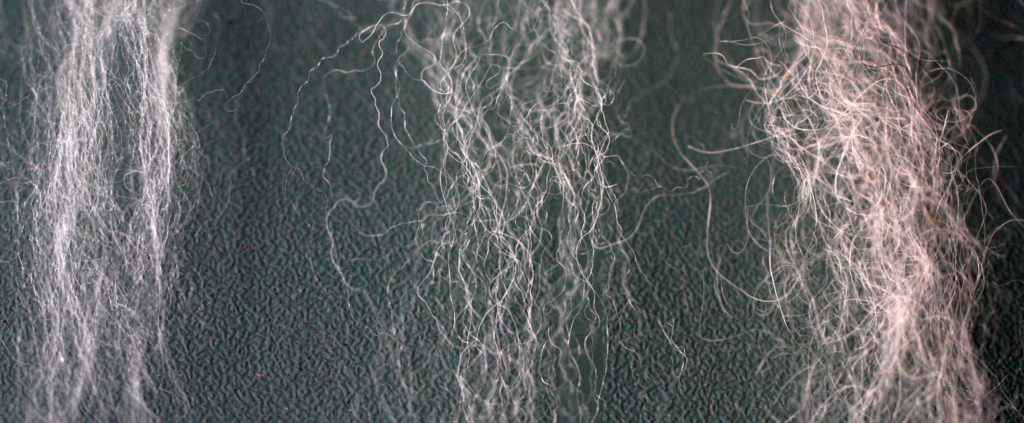


Even though it's just a macro photograph, I think the difference is quite clear. The difference when you touch it is very clear as well - the superduperfine wool feels like silk, and it's supershiny (which is partly due to some post-shearing treatment), while the Eider and Valais are just normal shiny.

I've also compared it to the Manx Louaghtan, which is an old breed, and to another wool sample that I got for these comparison reasons:
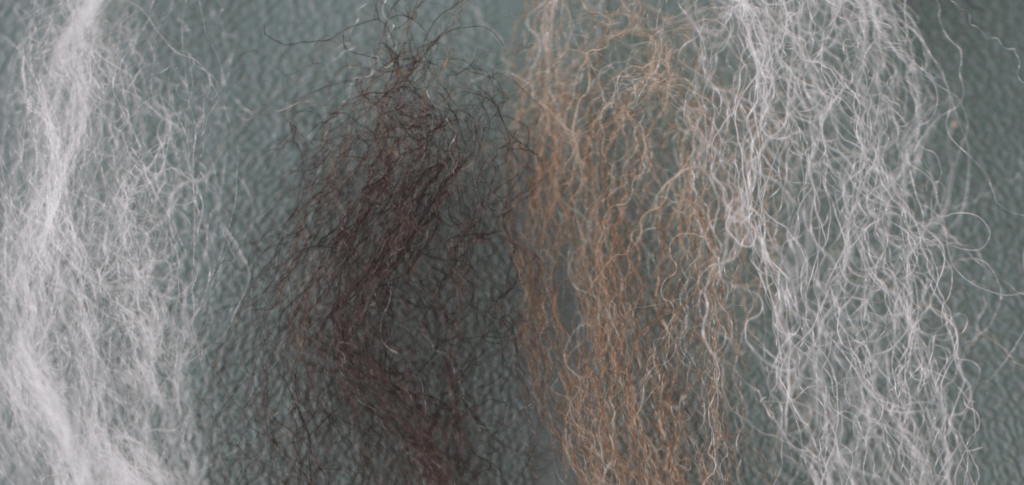


Again the superfine is on the left, followed by my South American test candidate, then the Manx (which appears more saturated brown than in real life) and, for comparison, the Eider wool again. Both candidates are definitely finer than the Eider wool (which should have around 30-33 micron), but considerably coarser than the superduper benchmark.

And here you are. The Bronze Age Fibre Problem, in pictures. The superduperfine wool lacks the coarse fibres strewn in, and has been seriously processed to make it silky, smooth, and shiny. It also is very, very white, and BA fibres are mostly quite heavily pigmented. The two coloured wools have a mix of coarse and fine, but way too many coarse fibres strewn in to match the BA originals. They are, however, nicely pigmented.

So, like with many reconstruction projects, there's the choice between compromises. Use the very fine fibre although it has been heavily processed, dye it, and accept the fact that it lacks the coarse hairs? Try to blend some extra coarse fibres in (it would still need to be dyed)? Or use a wool that is naturally pigmented and not supertreated, but has too coarse fibres, or too many coarse fibres for the amount of fine ones?

Or... would someone please invent a time machine and fetch a handful of Bronze Age sheep? Pretty please?
0
JUNI
28
0

More Bronze Age Textile Stuff.

Bronze Age! Yes, that's a bit before my usual time span, but I'm getting more and more fascinated by these very early textiles. First of all, I wonder how much of a difference the fibre makes - would you be able to tell, from the touch of the finished cloth, whether the fibre has 15 micron 0r 22, or 30?

I'm also fascinated by an oddness in the weaving technique. The surviving blankets were huge - the one from Egtved was 190 by 258 cm. That is a width that would be hard to handle for a single weaver. Add to that the fact that there are weft crossings in the fabric - there's just one weft per shed, but it's not the same one all the way through. Weft A comes from the left, weft B from the right, and at some point roughly in the middle, both go to the surface of the fabric and cross each other. Then weft A continues its journey to the right in the next shed, while weft b goes to the left, and they turn normally at the selvedge. This sometimes occurs with three weft threads instead of two.

Thanks to the wonderful image database of the Danish National Museum, you can have a look at this weft crossing thing in the Trindhoj blanket here. There's some crossings in the area left of the hole - you can download the image and then go hunting for these oddities with your image viewer of choice.

My suspicion is that two (or even three) weavers worked together on these superwide fabrics, and the crossings are where the spools or sticks or whatever they used changed hands from one weaver to the other.

This is really fascinating, and I'd love to try this out. The only tiny issue is that this requires a superwide loom (with the corresponding large number of weights, and large amounts of yarn), and some other people willing to have a go at weaving... Though a bit of testing might be possible with a loom and fabric with less width, to get an idea of the method, at least.

 
0
JUNI
25
2

Transcription Desires?

Yay Friday! I'm looking forward to the weekend, even though there might be some work necessary this time - we're nearing the end of the month, and lamentably, I still have not finished my tax paperwork. Sigh. (I think there's not much left to do, but it's been a while since I did the prop work I already did, and thus I need to catch up on the status and do the rest of it.)

If you are looking for something to fall into during the weekend, not tax-related, you could try... Folgerpedia's digital resources. Folger is the world's largest Shakespeare collection, and you can explore a lot of related topics there as well. And from Shakespeare, you can venture off into the world of manuscripts, and early prints...

There's also EMMO - Early Modern Manuscripts Online - where you can browse all kinds of different transcribed books, for instance. These have been transcribed by volunteers, and you can actually become one, too. That's your opportunity to learn early modern scripts... and get a glimpse into letters from back when. Or recipes. Or... well.

 
0
JUNI
24
2

Things Going On.

Things going on here? All of them.

Planning for the Textile Forum is going on, and our programme is about finished. Prep for NESAT is the next step.

I've also done some research on Bronze Age fabrics for a possible museum project (yay!) and learned that these fabrics are wildly different from the usual medieval stuff. There's fewer threads per cm, for one thing; then the usual warp and weft spinning direction is just the opposite of what you usually get in medieval cloth; there can be several wefts in one shed, and they cross over each other at some point... and the fabrics are quite wide. Quite, quite wide...

One of the problematic points for recreation of these really old fabrics is the fibre, though. Bronze Age sheep were different animals from what we have today, so the wool is mostly underwool, with around 17 micron thickness - with the occasional thick hair thrown in. Now, modern really fine-wooled Merino sheep have about 17 micron fibre thickness... but there's, of course, no coarse hair in their wool.

Which means I've been looking around, and am trying to find good sources for fibre that is at least sort of close to the original. Soay sheep might be an option, but there's not so many of them around, and getting their fibre might be a challenge.

This, by the way, is a rather common problem when trying to reproduce old things - the available material today can be so different from the original that trouble ensues. For instance if you need cattle metapodia, or cattle thigh joint heads, for a certain object... but the modern cow is much, much larger than the Roman era cow was, so your object will have the wrong size, or the wrong proportions.

There we go, then - looking for compromises, or good solutions to the problem...
0
JUNI
23
1

I have never been so happy to have been stabbed with a needle.

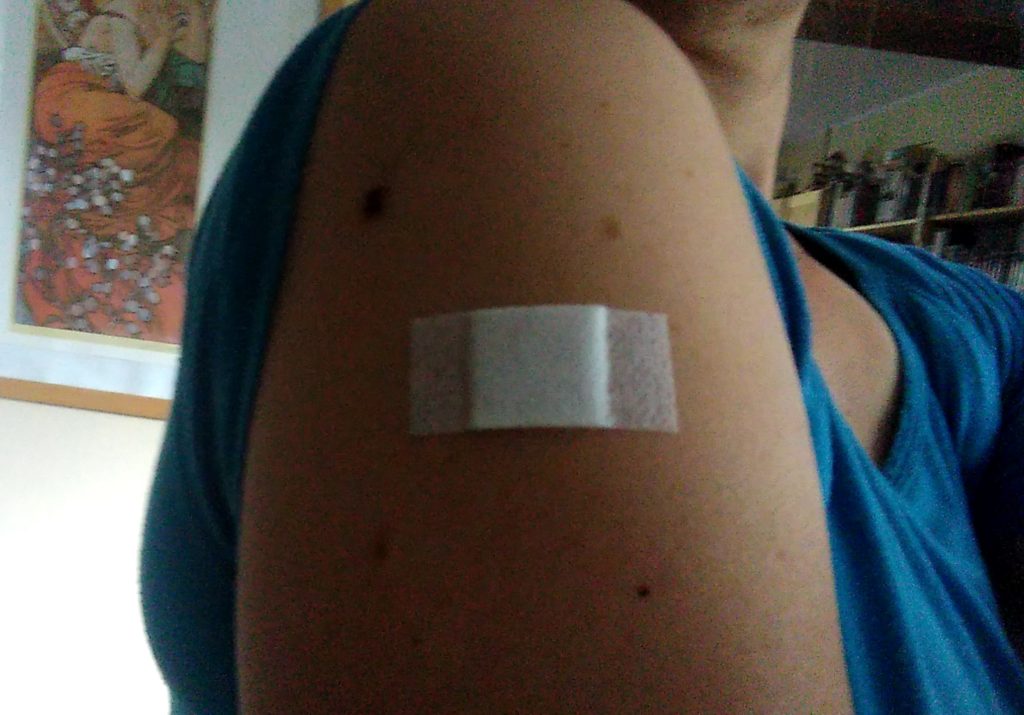
To my very great delight and rather considerable relief, my right upper arm is currently looking like this:


A very friendly doctor stabbed a needle into the muscle this morning and then pressed some of the good juice in. She also did it so gently and carefully that I felt about... nothing. I've actually felt more when grasses rubbed my skin with their prickly ends - not to speak at all about a midge bite, or scratchy madder plants, which both have been able to draw blood.

So... I will gladly forego bouldering for the next two days due to this (no sports for two days, she said). The second shot will be in six weeks' time, which means it's just in time for the full protection to be in place for the Textile Forum.

Whew.
0
JUNI
22
0

Textile Dimensions Conference - This Weekend!

There's a conference about early archaeological textiles this weekend, hosted by the Institute for Christian Archaeology of the Uni Bonn - the timespan goes from Neolithic to Early Medieval textile finds, with a wide range of topics and geographical areas.

If that sounds interesting to you, you can find more information, including the programme, on the Institute's website. Because of the pandemic, the conference is mostly online - which means you can join in and attend via Zoom. If you wish to do so, email Petra Linscheid (her email address is on the conference programme pdf).

 
0
JUNI
21
2

A Gorgeous Tablet-Woven Belt.

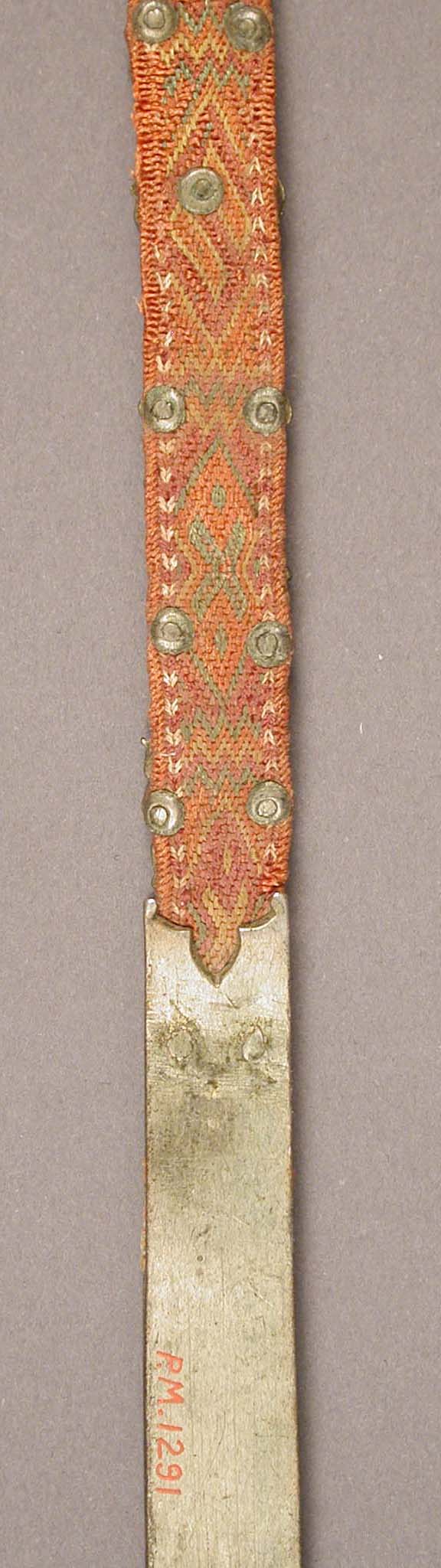
If you need some eyecandy on this Monday evening, you could go to the site of the Met Museum and take a look at this Italian belt from the second half of the 14th century - with lots and lots of beautiful metal ornaments. Lots and lots and lots; so many, in fact, that the beautiful tablet-weave is almost completely hidden.

Fortunately, though, the makers of the Met's digital catalogue also took a photo of the back of the band, at least of one part, and there you can see the weave.

Stunning, isn't it?

 
0

By accepting you will be accessing a service provided by a third-party external to https://www.pallia.net/

Kontakt