Latest Comments

Guest - Aislinn Dyestuff Citizen Science.
09. Oktober 2026
This is a great project. I look forward to the results. Thanks for letting us know.
Guest - Aislinn Time for...
09. Oktober 2026
Looks delicious!
Guest - Katrin Sprang Discussion
18. September 2026
Hi Rachel, I have looked for more photos of you, but that was not very successful. I found a link on...
Guest - Beatrix Sprang Discussion
15. September 2026
That lozenge pattern element is not a photograph, but a scan. So it should be to scale. But I pinned...
Guest - Katrin Sprang Discussion
15. September 2026
I was not referring to Rachel's reconstruction (is the reconstruction you refer to the one photograp...
JULI
08
0

Handspun Stuff in Action.

I'm getting asked time and again about what I do with my handspun. Well... that depends.

Sometimes I spin for a museum reconstruction project, so it's spinning for a certain end result, and the threads then get passed on to the weaver, or I do something with them.

Most of the other spinning I do is for no specific purpose, and a lot of it is yarns I do for demonstration. Thus they can be a little inconsistent... because of explanations like "see, this is how you make thicker yarn, and this is how you make thinner yarn, and this has more twist and this less..."

With that kind of yarn, not much is happening. It mostly sits around on spindles somewhere until I take it off, or until I need some bit of string, or have to demonstrate plying (yarn with little twist also plies up shittily, but ah, one copes).

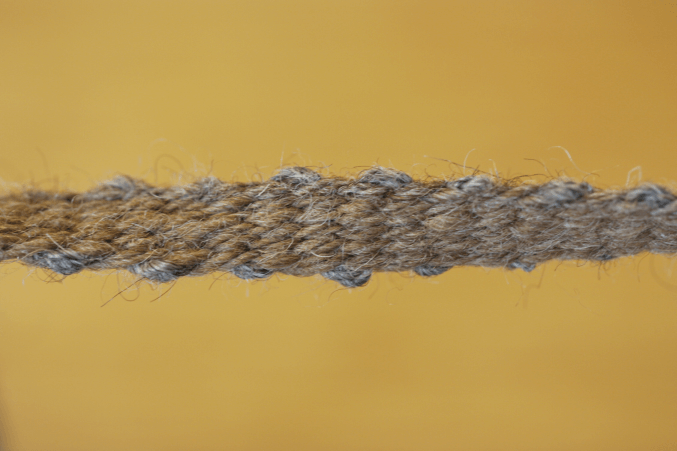
Sometimes, though, I also haul it out (the better, not so inconsistent yarns) to do some experimentation, or fooling around. Like now, when I've set up a warp to test our Blindis band technique reconstruction once more, and (most importantly) take some decent photos of the process.


So... that's a bit of the brown handspun used...
0
JULI
07
0

Maaseik Embroideries

If you've done research about early medieval embroidery, you've probably come across the Maaseik embroideries - silk and goldwork, preserved in Maaseik, and there's pictures of them online at kikirpa.be.

Brand new, though, is this: Alexandra Makin has made a presentation about these pieces, and the results of an examination that she did. Watch it right here:

0
JULI
06
0

Links!

Time for a link post again!

Viking age embroidery, of the spectacular type.

Archaeology in GB is threatened through a new regulation.

Energy efficiency in old buildings can be a problem - for example the old windows don't hold in the heat, or up to modern standards. There's been a project in Germany to test solutions for this, with good success. That is very nice! (Here's an article in German about it.)

Bronze Age fabrics in Denmark were, to a rather large percentage, made from imported wool. How can one tell? By strontium isotope analysis. The future helping to understand the past! You can read more about this here.

In Germany, the pandemic has led to a lot more bikes being sold than before - especially e-bikes. Here's a little article about the beginnings of the bike (in German or English).
0
JULI
05
1

Woad Seeds, Spindle Whorls, Forum Planning.

This was a busy Monday - and I actually snuck some work into the weekend to make it a bit less busy. There was the harvest of the woad seeds, which are now back in stock in the shop.

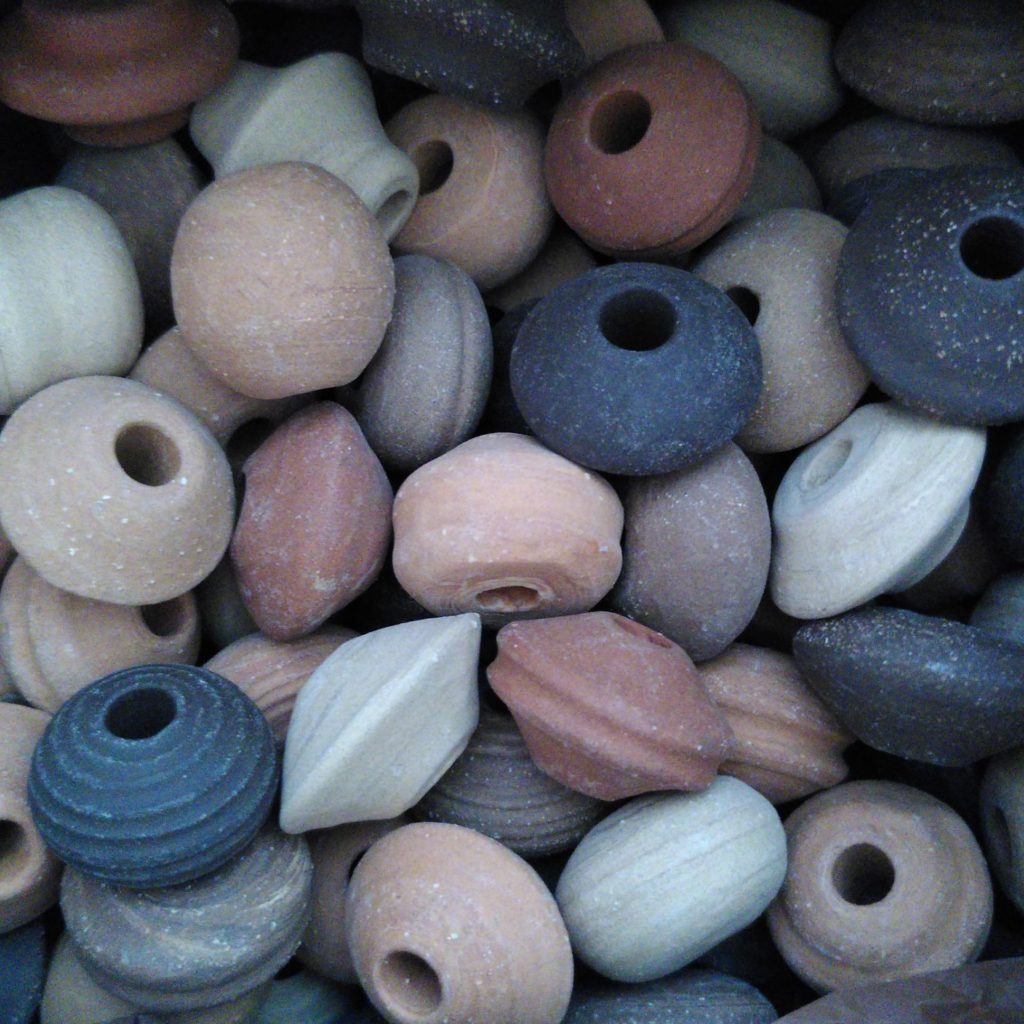
There's also a plethora of spindle whorls again, which now have to be sorted into their weight categories, and then I can start to plan the next online spinning classes. Yay!


I am always happy to look at these sitting in their box in one giant heap.

Finally, of course, there's Forum planning going on. My list of things to bring is growing steadily longer, and my excitement is also steadily growing. It's so nice to have a European Textile Forum again this year, after having to take a break from it last year. My beloved one week of utter textile madness and crazy coffee over-consumption!
0
JULI
02
0

Lengberg Sewing - Tonight!

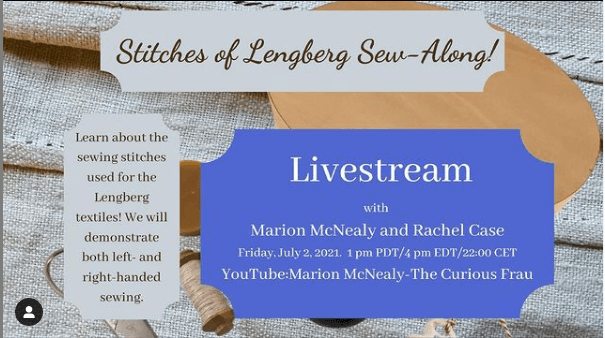
It's very short notice, but maybe you catch it in time (and if not, you should be able to watch the recorded stream later): Marion and Rachel are doing another livestream on the CuriousFrau Youtube channel, showing stitches and seams used in the Lengberg garments:


If you want to stitch along, you should come prepared with:

- two 8x4 inch (20 cm x 10 cm) pieces of medium or heavy linen
- one piece of 6x6 inch (15x15 cm) medium to heavy weight wool and a matching size piece of medium to heavy weight linen
- thick linen thread
- a good handsewing needle
- beeswax for waxing thread
0
JULI
01
0

Viking Bling.

Reconstructions of textile finds are always including a bit of interpretation - the more fragmented the finds, the more interpretation is necessary. That is just normal, but something that is not always mentioned straight out in exhibitions.

So I'm always quite delighted when this is made clear - as is the case in this article about "Fashioning the Viking Age", which shows dress reconstructions based on two spectacular finds. There's also an instagram account with a lot more pretty pictures. Absolutely worth a look!
0
JUNI
30
3

EXAR Conference in September - CfP

This year looks much better for in-person, on-site conferences than last year - though there's nothing really secure still at the moment. However, not only the Textile Forum is betting on everything being good enough, EXAR is also planning a conference this year.

It will take place in Perl-Borg, in a Roman villa museum; I've been there several times for Reenactment fairs, and it's a really beautiful place with lovely people running it. The EXARC conference is scheduled for September 23-26, and the topic is "Experimental Archaeology in Science and Education 2021". The Call for Papers is open until July 31, and registration for the conference is open as well. You can find out more about the conference here, and also register for it.

Talks will be in English and German, with a yet unknown ratio of the two languages. The board asks that slides for the presentations should be bilingual or in the other language than the one used for speaking so that everyone can follow along somehow.

I'm absolutely delighted that EXAR is using this as their current solution to the language dilemma - the society has developed into a larger, more international one from a purely German start, and a lot of the older members struggle with English as a conference and conversation language. Mind you, some of that struggle is probably due to the fact that Germans often underestimate their abilities in speaking and understanding English, and are a bit shy to use a foreign language because they feel self-conscious for all their mistakes.

I'm a proper German in that regard as well, by the way. I like to get everything right, and I do have to tell myself all the time that making mistakes is not bad, not speaking or writing to practise the other language is bad - and if that means making mistakes, that's good. It has gotten better recently with my wholesale slaughtering of the poor Finnish language, and the medieval French lessons where I also enthusiastically threw around interpretations that turned out to be, um... not quite matching the original content of the text. There was lots of learning that way, though.

It did help that the others in the study group also ventured forth with things they were not sure about, too. So offering up tentative solutions, or trying to talk about something where you might be a bit creative with vocabulary or pronounciation does not only help yourself to learn - it also helps others to maybe be more courageous. Good things all around!
0

By accepting you will be accessing a service provided by a third-party external to https://www.pallia.net/

Kontakt