Latest Comments

Guest - Aislinn Dyestuff Citizen Science.
09. Oktober 2026
This is a great project. I look forward to the results. Thanks for letting us know.
Guest - Aislinn Time for...
09. Oktober 2026
Looks delicious!
Guest - Katrin Sprang Discussion
18. September 2026
Hi Rachel, I have looked for more photos of you, but that was not very successful. I found a link on...
Guest - Beatrix Sprang Discussion
15. September 2026
That lozenge pattern element is not a photograph, but a scan. So it should be to scale. But I pinned...
Guest - Katrin Sprang Discussion
15. September 2026
I was not referring to Rachel's reconstruction (is the reconstruction you refer to the one photograp...
OKT.
11
0

Caught Up...

So - it seems I've caught up with the things that happened during summer. I've not quite caught up with work, though, or at least it feels like it. There were things to re-order, things to sort, things to send off, and online workshops to prepare, and somehow there is never enough time in a day. Partly because small extra tasks tend to add up, and eat away at the time, too. Such as ordering new printed folders to tell people about what I'm doing, or making new goodies for the orders I send off. (There's usually something included if you get a package from me - a sample of threads or other things I have in the store, sometimes a small piece of parchment, and if you order something spinning related, probably a fibre sample of some kind.)

Current things on the list mostly involve packing and sending off of orders, and getting the sample threads for the Bronze Age Project labeled, packed up, and sent off. Before I send those off, though, I have to do a bit of re-winding, as only a part of them will go for the weave sampling.

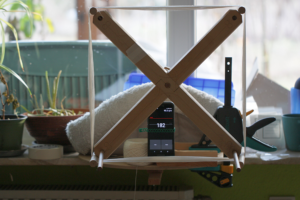
Winding, by the way, has become a lot more fun since installing a counter on my skein winder... as in a magnetic counter app on my phone and a magnet on the skeiner. This is the prototype installation, with the magnets held by a piece of tape, but in the meantime, there are three little screws in the skeiner and the magnets hold on to those.


The phone app recognises the peak in magnetic force as the magnets pass the sensors, and thus counts the number of turns the skeiner makes. There's a beep each time, and it's possible to set the threshold for the magnetic force, and all this is very nice and comfy and also pleases my nerdy side. Smartphone! App! Strong magnets! All that to count the number of loops on a skein... for doing reconstructions of ancient textiles! Just the thing that makes me smile.
0
OKT.
08
0

Things That Happened During Summer Break (part 8)

And after NESAT... holidays! Well, a few days of work inbetween, which included sourcing, portioning, packing, and sending off fabrics for a school project:
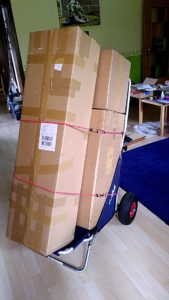


That was a fun thing to do - and I'm looking forward to hearing how it all played out!

After that, though, finally: Holidays. With the pandemic still a factor, we had been thinking about what to do for the holidays, and in the end, we had decided to do a bicycle tour again. Our last one was several years ago (paddling and hiking came inbetween), and The Most Patient Husband of Them All had wanted to do the Bodensee-Königssee-Route for a long time now, so in the end, that was what we chose to do. It was clear before that we had more days than the tour would be good for, so the plan was to ride the train down to Lindau with the tandem, then do the tour, and afterwards cycle homewards as far as we'd get.

Well. That plan did not survive its encounter with reality or, to be more precise, the strike of the train personnel... so we ended up going by train for a short bit, then cycling a bit, then catching a train that was actually going a few days later and riding down to Lindau. Never mind, though - our plan was to have fun on the bike, and that we did.

[caption id="attachment_6442" align="alignnone" width="300"] The bike, loaded up with all our gear.
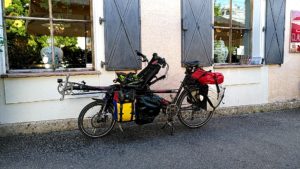

The tour was wonderful, and quite hilly. We spent the nights in our tent and found out that campsites in that alpine area are ridiculously expensive compared to other places - but, well, they're still cheaper than staying in proper buildings, and the tent is a very good choice in pandemic times.

I usually take along something to read (ebooks for the win on trips like that), and something fun to do, and in this case, my pharaoh accompanied me. I did actually get around to do a little bit of weaving - not much, since the evenings were rather short daylight-wise - but enough to make me happy to have taken it along.

[caption id="attachment_6441" align="alignnone" width="300"] Proof of the travelling pharaoh!
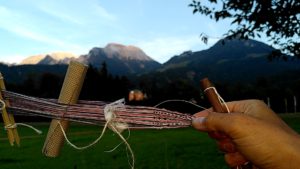

I even managed to re-heddle and fix a heddling mistake! That was very satisfactory.

Altogether, we cycled close to 1000 km, with two rest days (one spent on the train to Lindau, and one spent at the Königssee). We also felt very old-fashioned and a bit odd with all the e-bikes zooming past us, especially on the two first days of the tour proper, where it was quite hilly and quite steep...

 
0
OKT.
07
0

Testing.

Today was mostly spent spinning - I'm doing test yarns for a fabric reproduction project. One that has me very, very excited - it's Bronze Age fabrics, and making the yarns for this is one of the tasks coming up for me now.

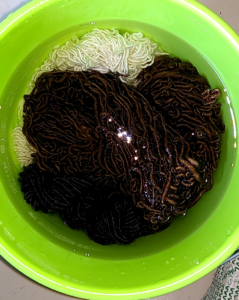
So I'm doing test spins currently, trying to get a feel for the different fibres that come in question (all of them compromises, because of the lack of real Bronze Age type sheep with their very special type of fibres) and getting a feel for the thicknesses and twist levels that should be suitable. Once the test skeins are done, they get a bath:


and then they are hung up to dry.

Afterwards, I weigh them, label them, calculate the Nm value (that is purely out of curiosity, though), document how long it took me to do that amount of yarn, and once the last batch will have gone through this, weaving tests can start.


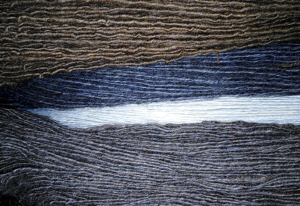
It's always fascinating to see how different types of wool spin out differently, and have different properties afterwards (like the Nm count) - even if the yarns have about the same thickness and the same amount of twist.
0
OKT.
06
0

Things That Happened During Summer Break (part 7)

After the Textile Forum, there was a little bit of a breather, and then there was - NESAT! Only online, sadly. I had been looking forward so much to a trip to northern Finland with friends, and then hanging out and meeting in person all the lovely people that I only see every three years there... but due to the insecure situation with the pandemic, the conference organisers had opted for the online-only version.

Our presentations were all pre-recorded and available on the conference platform a bit before the conference proper started, and the sessions were discussion-only (with a very short summary of the papers to refresh memories). There was a large variety of topics, and it was really, really nice to at least virtually see the friendly faces of all the colleagues, and to hear about current research.

My personal conference was made so much better and more enjoyable by joining up with a friend to attend together - and we even managed to have some Finnish sweets and some snacks made after Finnish recipes, along with the obligatory too-large amounts of coffee that have to be drunk at every conference.

After the conference, some of the presentations were made public, and they are listed on the NESAT website - the presentation I did with Beatrix Nutz is among them, so feel free to enjoy some slightly weird tablet-woven bands from Early Modern mining sites. I also very much recommend watching the video about medieval seal bag textiles, which I found very, very fascinating!
0
OKT.
05
1

Hooray!

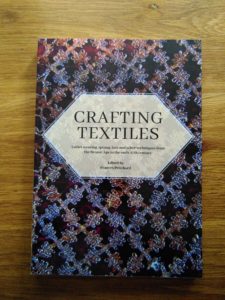
To my great delight, I received an author's copy yesterday - "Crafting Textiles" is now out. It's the conference proceedings from a conference in honour of Peter Collingwood that took place some years ago.


It's always really nice to get an author's copy... it somehow feels like a birthday present.

If you're not as lucky as me and want to order the book, you can do so at Oxbow Books or, of course, at the brick-and-mortar bookshop of your choice. (When buying books, by the way, usually most of the money goes to the place where you buy it - so you can decide for yourself whether you want to support the publisher, your bookseller of choice or, in case they sell themselves too, the author.)
0
OKT.
04
2

Things That Happened During Summer Break (part 6)

(continued from part 5)

There was, of course, even more stuff about looms and weaving. Together with Florian, who works at Lauresham, I'd been pondering and planning a loom made from hardware store parts - things you'd easily get at a typical German Baumarkt. The aim was to have an affordable loom from parts you can get without having special stores, and it should of course also be easy to build.

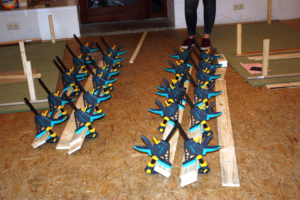
[caption id="attachment_6419" align="alignnone" width="300"] Putting together the two uprights - since we had the luxury of a lot of clamps, we used them. The boards are glued together, and then secured additionally with a few screws.


Most of the cutting-to-length of the parts can be done in the hardware store, where there's usually a cutting service point. That greatly reduces the amount of work and time necessary for making the loom - most of the tasks that are left is assembling the bits by glueing and screwing.

There's still some details to fine-tune, but overall, our little side project was a definite success. The hardest part about this loom is squaring off the ends of the round beam - it would be possible to use another solution, but the square ends will sit very securely in the upper part of the loom, and getting the sawing done was successfully undertaken by someone who does not have a lot of practice with this.

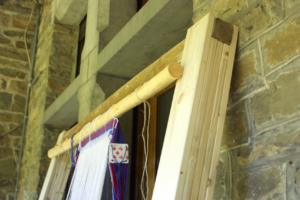
[caption id="attachment_6418" align="alignnone" width="300"] The upper part of the loom, with the square end of the round beam sitting nice and snug in the uprights. For the first test, another beam with a weave already attached was used - for "proper" weaving, you'd attach your weave to the beam directly or via a narrow slat or rod that the starting border has been stitched to.
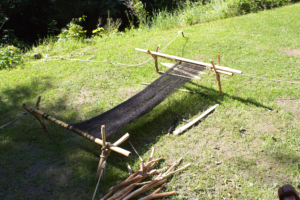

The loom comes in at about 80-90 € for the materials, plus the cost for the loomweights. I did manage to find something hardware-store-y for that as well, though it might need pre-ordering, as it's not an utterly common item. Curious?

It's a certain kind of pipe connector that weighs about 120 g each, is about 3 cm wide, and can be strung up easily. So for someone who prefers to buy weights instead of getting hold of some clay and forming, then drying them, this is a viable alternative. They come in at about 3-4 € per piece, which means that if you want to do a very wide weave, it will cost you quite a bit of money. On the other hand, it also means you can get them from a suitable supplier and will have no work at all with them.

The finished loom is a full-size thing, with 140 cm between the uprights, and a bit more than 2 m in height. It's heavy enough to stand securely in our first tests, and it should be possible to adjust loom position to keep the shed size large enough for easy weaving even for beginners. The prototype is still being tested.
0
OKT.
01
0

Things That Happened During Summer Break (part 5)

(continued from part 4)

The special thing about the pharaoh band is that there's extra heddles and extra warps that, when lifted alternatingly with the regular warps, form a pattern in the middle of the band. It's fascinating, and beautiful, and surprisingly difficult to get everything sorted out and aligned and moving like it should and behaving. You need to have the heddles straight so they can glide down or let the other threads glide up, but they can't be really pulled because you want the other shed.


And, as usual, when somebody skilled at this does it, everything looks easy...

What I personally found much, much easier to do was weaving with goat hair on a Sudanese ground loom reconstruction. That was a very coarse weave, and there was only the natural shed, the countershed had to be picked out with a stick each time. With only a few and very thick plied threads per centimetre, though, this was relatively quick and easy to do. I had a stint of weaving on the loom early one morning, and a second bit of weaving on a sunny afternoon, and I really enjoyed the feel of the smooth, warm goat hair yarn on my hands.

 
I've been wondering about that kind of yarn ever since I read Hald's article about Bedouin spinning and weaving with goat hair for tents, and now finally I've touched it and worked with it. That was definitely one of the many, many "hooray!" moments I had at this Forum.

 
0

By accepting you will be accessing a service provided by a third-party external to https://www.pallia.net/

Kontakt