







Latest Comments

Guest - Aislinn Dyestuff Citizen Science.
09 October 2026
This is a great project. I look forward to the results. Thanks for letting us know.
Guest - Aislinn Time for...
09 October 2026
Looks delicious!
Guest - Katrin Sprang Discussion
18 September 2026
Hi Rachel, I have looked for more photos of you, but that was not very successful. I found a link on...
Guest - Beatrix Sprang Discussion
15 September 2026
That lozenge pattern element is not a photograph, but a scan. So it should be to scale. But I pinned...
Guest - Katrin Sprang Discussion
15 September 2026
I was not referring to Rachel's reconstruction (is the reconstruction you refer to the one photograp...
NOV
01
0

Spinning Demonstration on the Great Wheel.

First of all, sorry for the blog silence yesterday - I was away from the computer most of the day, and during the time I did spend physically close to it, we had internet connection issues. These do happen here occasionally, and they are normally no big deal when they do, as they will be over after two or three hours at most... but yesterday, it did mean no access during the time window I had for blogging.

Today is a holiday in Germany, so I had planned to blog yesterday and tell you there'd be no blog post today. Well, plans and how they work out... anyway, this means you are getting this picture today instead of yesterday:
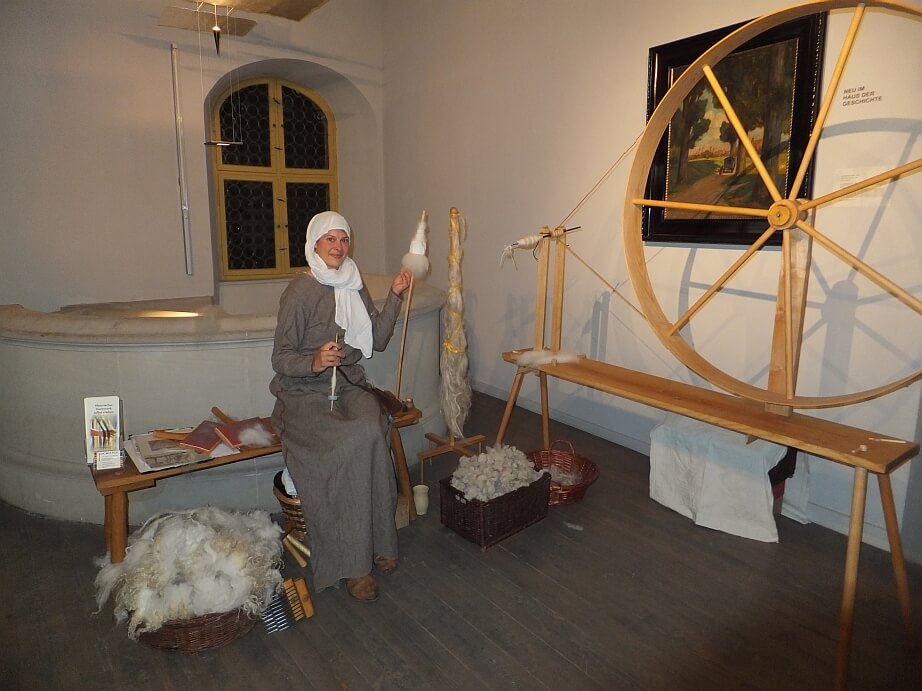
dinkelsbuehl
That was my setup on the Long Night for spinning in Dinkelsbühl. It was a wonderful evening with many, many people stopping by for watching the spinning and asking questions. The picture was taken during one of the rare and short moments when there were no visitors there, right at the end of my presentation.

Time really flew by, and the evening was over before I knew it! I loved all of it, and it gave me the opportunity to demonstrate how much of a difference the fibre and the fibre preparation made when spinning on the Great Wheel. I had rolags made from Eider wool (industrially combed, smooth medium-staple wool that I just rolled together with the cards), from Bergschaf wool (industrially carded, crimpier wool with a shorter staple that I rolled together with the cards similarly to the Eider stuff) and from Rouge de Roussillon wool that I carded up from the washed fleece myself. The differences were astounding, with the smoothest, most even thread coming out of the Eider wool and the clumpiest, least even one out of the Rouge. That was partly due to my bad sorting and carding of the Rouge fleece I brought with me, though, and I am sure that with a bit more getting used to that specific fibre, the thread would also have improved a lot.

Demonstrations like these always yield some thread, but they rarely result in wheel spinning output that I'd find acceptable or even good quality. Talking to people to explain the spinning takes away some concentration from the spinning itself, and while I can happily chat along when making my standard yarn on the spindle and distaff, the wheel does take more concentration for me to get a good thread. Another factor is the quality of the rolags that I work with during those demos.

Even though I explain to people during these demonstrations that textile work takes time, and patience is oh so important, I usually skimp on the preparation of the rolags to speed things up a bit. I also make a rolag or two, then spin them up, then explain something else, then make rolags again - and that results in differences each time, which also has an impact. Finally, the combination of explaining and trying to show off the spinning speeds possible with the wheel means I'm not making the best possible thread out of the fibre I have, and switching frequently between spindle and wheel plus carding and combing means it is hard to find the rhythm and workflow for any of these tasks - because obviously, explaining and demonstrating the individual steps and how they work together is much, much more important on these events than making the best yarn possible.

So in case you are at a crafts demonstration one day and have somebody demo-ing with a lot of explanation, you might get to see slightly sloppier work than they normally do, because the priorities have shifted - from working towards the best result possible with the tools and materials available to giving the best explanation and demonstration for you. And that, I'd say, is one of the best reasons that somebody can have for not working up to the usual standards!
0
OCT
18
2

Misconceptions.

There are a lot of misconceptions about, regarding medieval stuff. Not only about textiles and clothing (the old brown sack, anyone?) but also about crafts, housing, hygiene, and fighting.

These misconceptions are hard to battle sometimes, as they keep being reinforced through many channels - TV and cinema being just two of them. However, media can also be a powerful tool to show research results and helü deconstruct the misconceptions. This is just what the film here is trying to do:


A medieval knight's gear is, weight-wise, about the same as a modern soldier's full kit, or the gear of a modern fire-fighter. So in the film, you can see three men run an obstacle course in their respective kit. It's an impressive display of the agility still possible in a 15th century armour - and also really interesting to see how close the three people are in their results.

This is a really nifty thing!
0
OCT
03
0

Taking a Breather.

Things have been somehow hectic around here, and before the Nobilitas-Akademie and the Textile Forum eat up all my brain and time - first the planning and preparing, then actually being there - I am taking a little breather, and a break from the blog. (The breather includes a few days of holiday travelling with the Most Patient Husband of Them All, which I'm utterly looking forward to.)

I'll be back blogging on October 17!
0
SEP
29
0

Links, to Things in German.

It's been a while since I posted links to German things here, but a few have stacked up, and I find them too interesting to pass them all by. So if you have German (or trust in machine translation), here you go:

Aisling writes about swastika ornaments in Viking tabletweaving. There's quite a few people using this ornament in their garments etcetera, reasoning that it was "just an ornament" in Viking times. Well, let's say that going for this kind of ornament in German Living History/Reenactment is always a slightly peculiar choice. Especially since, as Aisling points out in her blog article, there are actually very, very few of these swastika ornaments actually used in tabletwoven bands.

Niko has posted a tutorial on how to make a medieval belt. With lots of pictures, so it might be interesting even if your German is not good.

A book by the Limburg Brothers (best known for the Tres Belles Heures du Duc de Berry) has turned up in Nijmegen - causing a little sensation. (Pictures here, too.)
0
SEP
28
0

The weirdest animal ever.

I stumbled across something that must be the weirdest animal ever: the tardigrade. If you never heard of it before, you're probably in good company...

These critters have been around since, like, forever. They are water animals, they can live about everywhere and survive extreme heat and extreme cold; they are tiny (usually half a millimetre long), and they look really weird. Really, really weird - and at the same time somehow cuddly (no wonder that they are also called "water bears").

Aliens. Well, almost.

 
0
SEP
21
0

Links to things.

My browser has been acting up for a few hours - which meant no procrastinating by surfing the web.

It also meant that, while I took advantage of this no-procrastinating thing and did all the stuff without browsering on my list, all the work-related things actually done through browsering got stuck in the queue.

Now that everything is working smoothly again (including me!), here are a few links you will hopefully enjoy.

21 more or less amusing things from academic publishing.

Boardgames in the V&A Images collection.

Instead of fat, sugar is becoming the new dietary arch-villain - there's a long article in the Guardian about sugar and the researchers Robert Lustig and John Yudkin. It's not only interesting if you are into nutrition, but also gives a nice (or, rather, not-so-nice) insight into what can happen if one scientist has a hypothesis that is contradicting a lot of other folks' beliefs.
0
SEP
06
2

Tuesday Linkiness.

A while ago, I stumbled over an interesting test about how many English words you know - you have to decide whether a given word is a real word or just a random collection of characters. Associated with this is a word association study - you can participate if you are not a native speaker, provided you are fluent in English. If you go take the word test or play the association game, you not only have the chance to have some fun, but are also helping scientists learn about the nature of the "mental dictionaries" that we all have.

In case all this typing and deciding has made you hungry, there's currently a Kickstarter project running... for protein or energy bars that are made using cricket protein. Eating insects would be a smart move for us, as they are much more sustainable in farming terms than cattle or pigs or even chicken, but as eating insects is not part of our culture, it is rather hard to get accepted. I have this weird mind-problem myself - I do eat shrimps, which are basically nothing but sea insects, but have a real "yuargh" problem when I think about putting a cricket or a mealworm into my mouth. Ground up into oblivion and stuffed into a protein bar, though, I could probably handle it much better (and being curious, I do think about supporting this project, just to try one of the bars...).
0

By accepting you will be accessing a service provided by a third-party external to https://www.pallia.net/

Contact