Latest Comments

Guest - Aislinn Dyestuff Citizen Science.
09. Oktober 2026
This is a great project. I look forward to the results. Thanks for letting us know.
Guest - Aislinn Time for...
09. Oktober 2026
Looks delicious!
Guest - Katrin Sprang Discussion
18. September 2026
Hi Rachel, I have looked for more photos of you, but that was not very successful. I found a link on...
Guest - Beatrix Sprang Discussion
15. September 2026
That lozenge pattern element is not a photograph, but a scan. So it should be to scale. But I pinned...
Guest - Katrin Sprang Discussion
15. September 2026
I was not referring to Rachel's reconstruction (is the reconstruction you refer to the one photograp...
JUNI
21
2

A Gorgeous Tablet-Woven Belt.

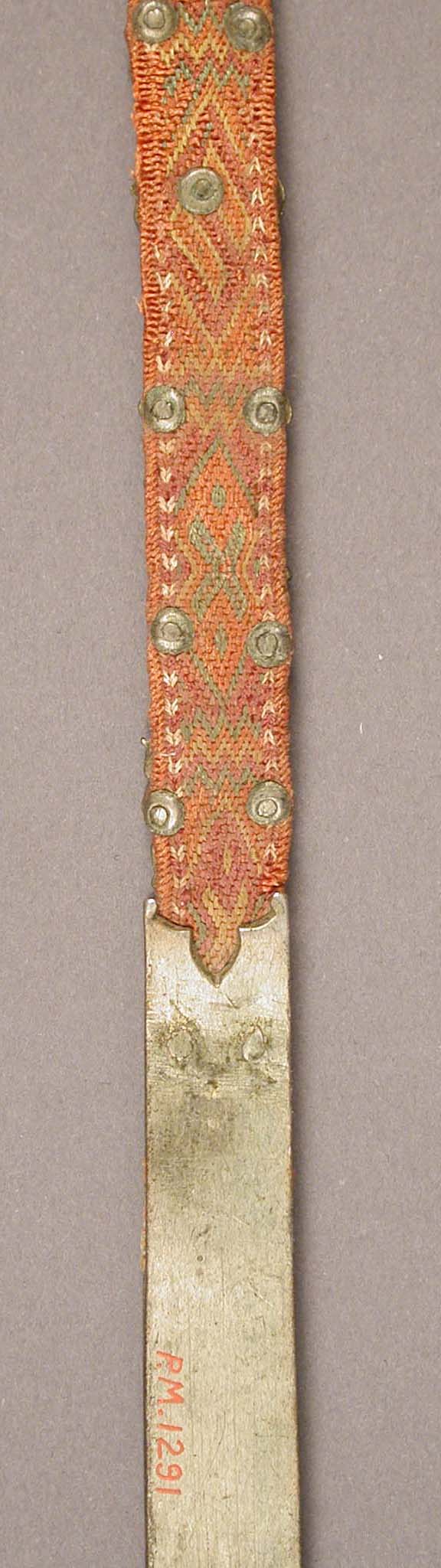
If you need some eyecandy on this Monday evening, you could go to the site of the Met Museum and take a look at this Italian belt from the second half of the 14th century - with lots and lots of beautiful metal ornaments. Lots and lots and lots; so many, in fact, that the beautiful tablet-weave is almost completely hidden.

Fortunately, though, the makers of the Met's digital catalogue also took a photo of the back of the band, at least of one part, and there you can see the weave.

Stunning, isn't it?

 
0
JUNI
07
0

Purple Dye Production

If you're interested in learning more about purple mollusc dye but missed the webinar a while ago - the recording of the session is available in the video archive of the American School of Classical Studies, and you can find it here.

There's a lot more things in the archive as well, sorted by category, so if you're into Classical studies, it's probably worth a look and a browse.

In not-so-classical news, I've been very busy sending out distaffs and spindles in preparation for the next online classes, and I'm already looking forward to the next one. If you'd like to join in for the English language one on June 30, there's still a few days left to book: I've set the deadline to June 10 to make sure that the parcel with the kit will definitely arrive in time within Europe. So don't miss it!
0
MAI
31
0

Test Run: Successful.

Today was a little test run for the camera setup for the online courses - and I'm delighted to say that it was successful. It includes my putting on a slightly daft-looking hat with a camera installed on it to give the workshop participants the maker's perspective... definitely something that you can only do with an online course.

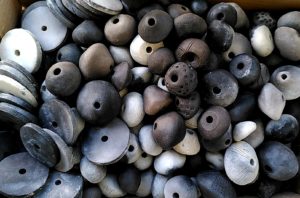
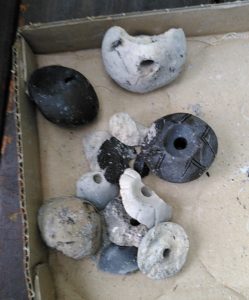
And because delightful things might well be accompanied by other delightful things, here's a picture of the cleaned, dried, not-yet-sorted fresh spindle whorls for you:


0
MAI
28
0

Fire in the Bowl.

My hair still smells a bit like wood fire... a nice smell, if you ask me. It reminds me of many, many different activities, and lovely times with friends and colleagues, in many different settings.

Yesterday's fire was a true work-fire, though - and since I had a lot of other things to do as well, I didn't get to sit down, relax, and enjoy watching the flames this time around. I didn't even make coffee on top of the spindle whorls, that would have been fun, and it's definitely on my list for the next time!

Firing whorls, the way I do it, is a kind of simulated pit firing. Instead of digging a hole in the garden and filling it with wood and the things to fire, I use a clay fire bowl (which is also the bowl that travels to Living History events with me). The bowl keeps the warmth of the fire nicely as opposed to the metal fire bowls, thus making cooking much more efficient in terms of fuel use. And for firing whorls, it is quite good at simulating the dugout pit.

In pit firing, generally, there's a high percentage of reduction firing (most of the whorls will turn out at least partly black). Temperature control is possible only in a limited way, by choosing how you build up your fire/pit, and what kinds of wood you use, and how long you let the fire burn. In my case, the firing temperature is not very high to quite low, and there is also always some loss of whorls if they get heated too quickly, or too unevenly.

But you want pictures, right? Here you go.

It all starts with filling the bowl with wood, wood shavings and, of course, whorls. It's a bit like whorl lasagna.
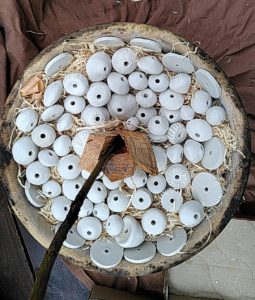


I start the fire on top of the whole thing then, trying to heat it up as slowly as possible. When that does not work out as well as intended, I get to hear cracking sounds... which means exploding whorls.
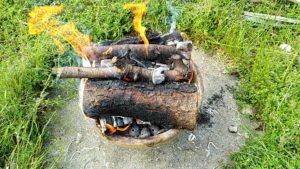


That is not a good sound - but there is some loss, that's just how it is.

Firing then goes on, with me putting more bits of wood on, and trying to have it burn nice and hot all the time:
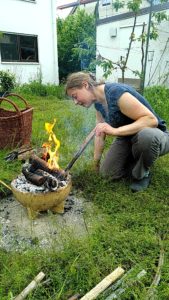


That takes a few hours. It would definitely be enough time to make coffee on top of the whorls!
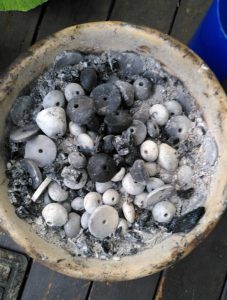


Once the firing is done, the bowl has to cool off a bit before I can take out the whorls. Usually I have a hard time waiting long enough, but I don't want to risk more damaged whorls because of taking them out too quickly. Then, once they're completely cold, the ashes and soot have to be wiped off or washed off, and once the whorls are completely dried again, I can weigh and sort them.

Here's the dead ones from yesterday's pit:


About ten whorls that did not make it, approximately. Not too bad - though I've done better in the past!
0
MAI
27
0

Last Minute Purple Stuff!

There's a webinar on tonight about Murex Purple dye in the Bronze Age Aegean, by the American School of Classical Studies at Athens. The webinar is via Zoom, it's free to attend (you just need to register), and it starts at 6:00 pm German time.

Read more about the webinar, and register here.

In other news: I'm busy as a bee on amphetamines here, and the weather is finally stable enough for me to fire my spindle whorls! Unfortunately, there's already a few dead ones. The salamanders must have been hungry...

More about the firing, and pictures, are to come. Tomorrow, probably.
0
MAI
18
0

Dyes in History and Archaeology

If you're interested in dyeing in former times, there's an Archetype Book Talk with Dyes in History and Archaeology editors and contributors on Tuesday 25 May 2021, 3pm BST.

Jo Kirby, Maarten van Bommel, Ilaria Degano and Joanne Dyer will talk about the Dyes in History and Archaeology meetings and books. The talk is free to attend, but you must register via Eventbrite in order to receive the link to participate on Zoom.

Some of the books are also offered at a discount price until 26th May, for 30 instead of 40 GBP. You'll need to use the discount code BOOKTALK at the checkout of the Archetype Books online shop.
0
MAI
05
6

New Things Afoot.

In German, there's the saying "Alles neu macht der Mai" - May makes everything new. Coincidentally, there's a few new things afoot here...

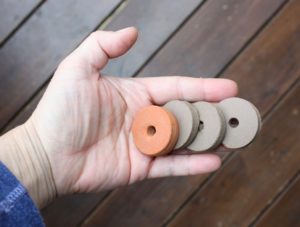
Thing One: Recycling Spindle Whorls! Medieval spindle whorls came in oh so many shapes, forms, sizes and materials... and one of the types was disc-shaped whorls made from broken pottery. This has been on my list for a while now, but finally I've gotten around to getting the tools and the broken pottery to try making them.


These are cut using modern tools, and the material is modern broken pottery. In the best-case scenario, I'll be able to get some potsherds from replica pots in the future... but for now, I think these will do nicely. They weigh somewhere between 11 and 19 g, depending on which pot they came from, and which part of the pot... and I confess that I'm utterly delighted by those.

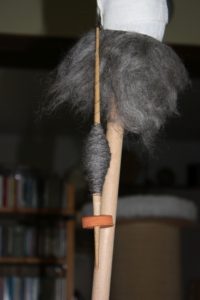
They have been tested first thing, of course:


I find them a bit too light for starting off an empty spindle, but then I am fond of using heavy whorls for that. They do run beautifully on a half-filled spindle, though!

I'll be making a few more the next days, and then they will find their way into the shop as well.

Thing Two: I've finally decided to take the plunge and try online teaching. I've done in-person courses only up to now, and I do think it's so, so helpful to be able to touch and feel things and not just see them, but with the pandemic going on and on, I'm starting to think that half the deal is better than nothing. So now I'm planning an online spinning course... I am still trying to figure out a few details, but it will be about 2 hours, showing how to spin with hand-spindle and distaff. My biggest question at the moment is how to make sure that every participant has suitable tools and materials - in my in-person courses, I just bring a bunch of distaffs and a pile of spindle whorls so everyone can pick one to use during the course, and then either buy afterwards or toss them back to me. That is not so easy when teaching over distance, of course. Unfortunately, many modern spindles will have rotational properties that don't work well with the distaff spinning style. So... do I send out kits as part of the course? Or do I just offer them as an option, with the possible danger of someone participating with entirely unsuitable tools?

If you're interested in a spinning course, feel free to drop me an email, or comment here - and once I've figured out the rest of the open questions, you will also be able to find info in the shop in the workshops/courses section.
0

By accepting you will be accessing a service provided by a third-party external to https://www.pallia.net/

Kontakt