Latest Comments

Guest - Aislinn Dyestuff Citizen Science.
09. Oktober 2026
This is a great project. I look forward to the results. Thanks for letting us know.
Guest - Aislinn Time for...
09. Oktober 2026
Looks delicious!
Guest - Katrin Sprang Discussion
18. September 2026
Hi Rachel, I have looked for more photos of you, but that was not very successful. I found a link on...
Guest - Beatrix Sprang Discussion
15. September 2026
That lozenge pattern element is not a photograph, but a scan. So it should be to scale. But I pinned...
Guest - Katrin Sprang Discussion
15. September 2026
I was not referring to Rachel's reconstruction (is the reconstruction you refer to the one photograp...
JULI
22
0

Wool Prep Rambling Thoughts.

One of the things in textile production that are underestimated, as a rule, is wool preparation. Quite often, spinning is the first task that people think of. There is, however, the tiny little fact that fibre preparation has a rather large influence on how spinning goes, and is thus important. It's also time-consuming, as everyone who has ever hand-processed some fibre for spinning will know quite, quite well.

Wool fibre prep starts with shearing the sheep or with the shorn fleece, depending on how you see it. The dirty fleece needs to be cleaned at some point, and the fibres sorted and prepared for spinning.

It is technically possible to spin the fleece just as it comes off the sheep, with all the dirt in. This will be easier if it's a good-quality fleece that is not too dirty (or if the sheep has been washed before shearing, which is an option as well). I've spun dirty fleece, and I confess that I'm not thrilled by it.

Whether your wool is clean already or not, you can prep the fibres by teasing them apart with the fingers as the most low-tech, low-time option. Next step up is aligning the fibres in some way, which can be done today using either combs or cards. As far as I can tell from historical sources, the Middle Ages used the wool comb only until the Great Wheel starts to turn up, which is when we also get evidence for cards. There's some textile tools found at Hallstatt-Dammwiese in Austria and Liptovska Mara in Slovakia, dating to the Late Iron Age; they were flat wooden boards with holes, and thorns were placed in those holes. Whether they were used for roughing up fabrics, preparing flax (hackling boards) or for preparing wool is unknown, though. (Pics and references can be found in Grömer, Karina. The Art of Prehistoric Textile Making. Wien: Naturhistorisches Museum Wien, 2016, p. 72f.) Combs were found in prehistoric context as well, and it's relatively safe to assume that they were used for fibre/wool preparation.

Wool combs, as they are shown on medieval pictures, are something that can be expected to only rarely turn up in archaeological evidence, due to the usual two reasons: They are made from perishable materials (wood and iron are both not very talented at surviving burial), and they are rather nondescript if falling apart. Added bonus: For something to be findable in publications, it has to be a) identified and b) published (where b usually requires a). So if some weird little piece of wood with a row of holes in it gets found, and there's no or little trace of iron in the holes, it might not get identified as a wool comb fragment, and thus not get mentioned anywhere.

This, by the way, is a problem not limited to textile tools; it's a general problem in archeology. Me writing this is also not intended as criticism towards my digging and publishing colleagues - I do know that they are all taking a lot of care, and trying hard, to identify as much of the weird bits and pieces that are found. Archaeologists working on a find complex look at lots and lots of images and lots and lots of publications of other sites, searching for comparable objects (also for dating purposes). There's also the option of asking colleagues, of course, something that is done as well - and showing mysterious things at conferences.

This general problem is a phenomenon of there being so many, many, many things in daily use and daily life that it is impossible to know them all. Just take a look around your home, or a look around a workshop of some craft that you are not familiar with, and try to imagine how hard it would be to identify things that are broken in half, or where there's only a fragment left.

And now I've rambled off on a tangent... we'll return to wool combs tomorrow.
0
JULI
17
0

Too Many Tabs (Again)

Too many tabs open in my browser - you know what that means: Link Post!

I don't know if you know about the more-or-less satirical party "Die Partei" in Germany, but they actually have two people in the EU parliament. Both of them are sort of doing the job of a medieval fool, trying to point out the absurdities and stupidities that nobody else mentions or dares to mention. With varying effect - but who knows, maybe it will change something over time. At least it's a way of keeping updated on things that are happening in the parliament, and on getting a few insights of how stuff works there (or doesn't work).

One of them, Nico Semsrott, now has started a youtube series he calls the "Nico Semsrott Show", explaining stuff. Here's the first episode, in English (to reach more people) with German captions available:


This article about a special blue dye is already a bit older itself, but I found it still interesting - it was used to dye the tassels on prayer shawls, and provided by a species of Murex molluscs.

The melting glaciers in Norway reveal archaeological finds - which is a wonderful source for archaeology, but still feels like a bad thing overall to me. Climate change will kick us all in the ass before long.

Finally, here's a concert titled "The Wool Merchant and The Harp" in the Leeds programme, featuring Leah Stuttard playing the harp.

 
0
JULI
14
2

Plying Off Two Spindles.

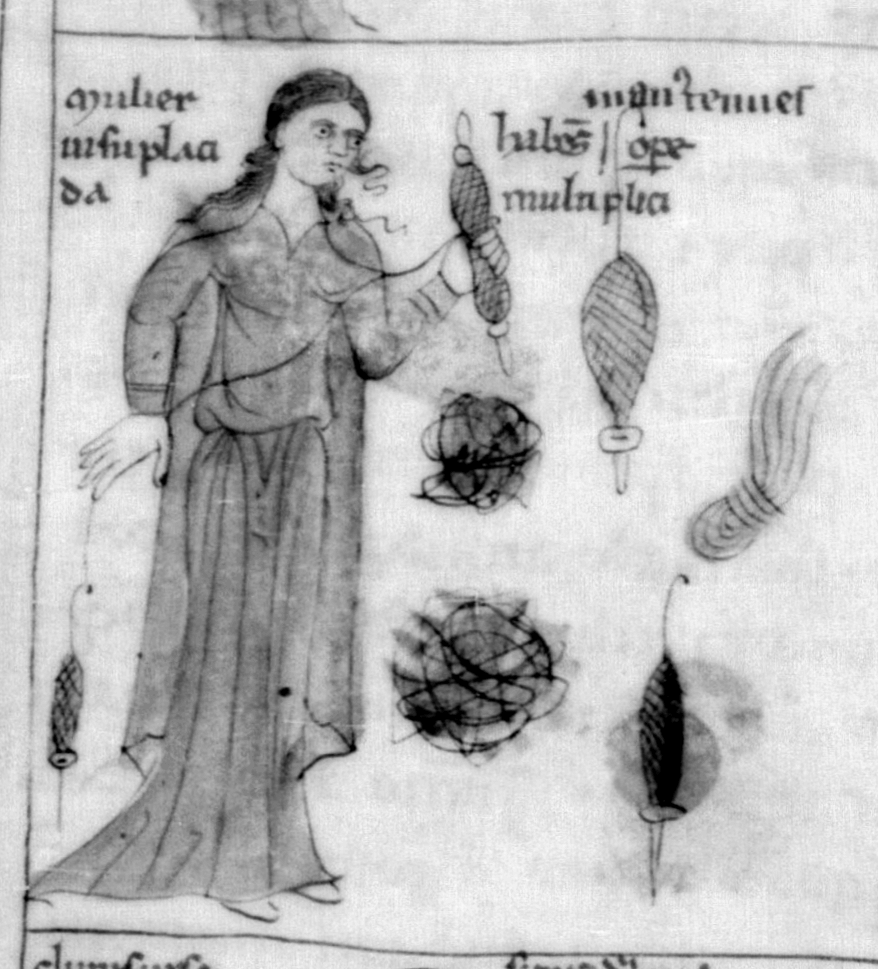
Back in May, I posted about a rare picture showing a woman plying, and there was a bunch of comments (thank you! It's always nice to have some feedback, and some discussion), and now I've finally gotten around to try it.

I dug out two spindles, one quite full and one with just a little yarn on it, and a third empty one, and gave it a go.

Here's the picture again:

[caption id="attachment_5309" align="alignnone" width="411"] Bibliothèque Nationale de la France, Manuscript Latin 7330, liber astrologiae Georgii Zapari Zothori Fenduli, c 1301-1400. Fol. 30r, if I’ve interpreted things correctly. Permalink to the page in the digital BNF.


Because the picture looked a bit like there might be one strand of yarn running around her neck, and the other straight, I tried that first, thinking it might be easier that way to control tension. Well. It didn't work at all for me; it was hard to impossible to control the two spindles and winding off the yarn from them.

Consequently, I tried it straight from the two spindles - and oh, yes, that is much easier for me. Rolling off yarn from the two spindles in the left hand went surprisingly well and evenly, even though there was much less on one of the spindles. What I did was pull a length of yarn out with the right hand, then set the spindle into motion, moving my right hand up and down the length of doubled yarn while the spindle turned, to let the twist distribute evenly. Once enough twist was in the two plies, I wound the finished bit onto the spindle, then repeated by winding (pulling) the next length.

I'm not the Queen of Plying, and it's neither a job I particularly like, nor one I'm very good at, no matter the tool and method. This way to ply, though, felt like it could offer more control that I've had with other methods, not least because it is possible to control both spindles in the left hand individually. Opening or closing the fingers in question some more can fine-tune the tension on one of the yarns, and it's even possible to give one of them some extra turning motion to even out things, or to help when yarn gets "stuck" unwinding, as it sometimes does.

So... back to the picture. While most of the commenters and me suspected that there might be one thread running behind her back, Satekai very rightly observed the woman's also wearing a cloak (which is magically staying in place, but never mind that for the moment), and the "yarn" going across her shoulder might just as well be the outline of her cloak on the shoulder. Which is an interpretation that I'd now totally second, after a) my try and b) judging from two other comments: Joy Wandrey saying she has had good success, and was able to control tension quite well plying off two spindles (I assume that was direct as well, as there's no mention of anything being led around anything else) and Jane's comment about having problems when plying off two spindles, one held in front and one behind.

This is definitely something that I'll try again. It would be wonderful to have a quick, easy, and reliable plying method, and one that is documented for the Middle Ages to boot!

 
1
JULI
10
0

Drying out.

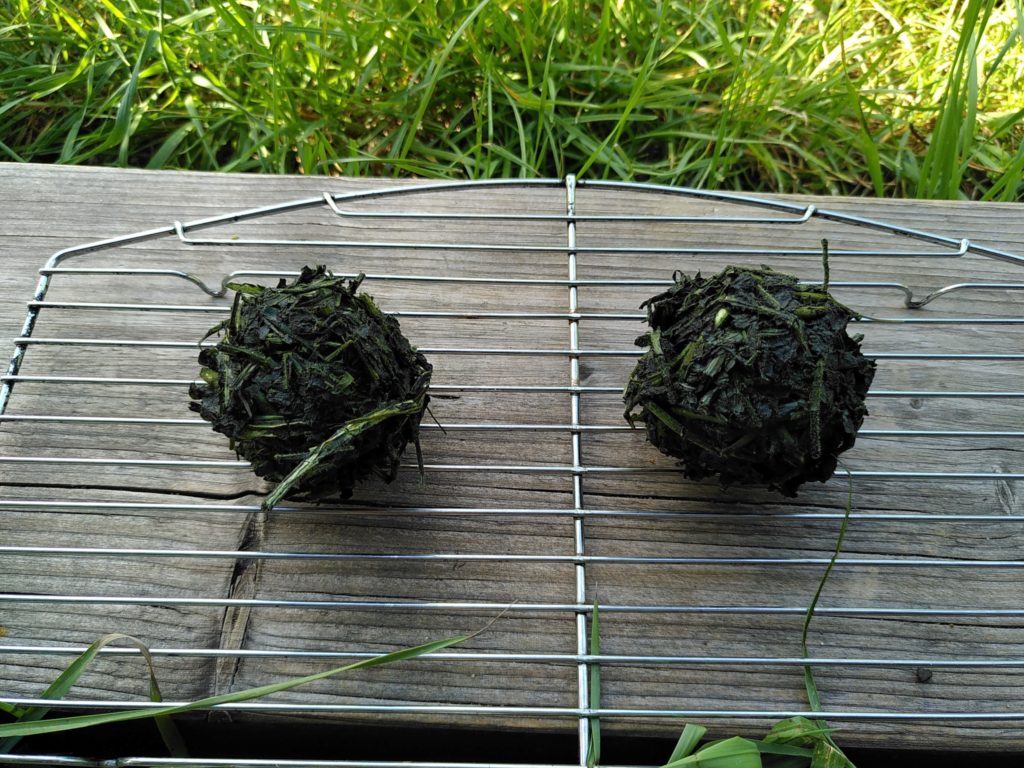
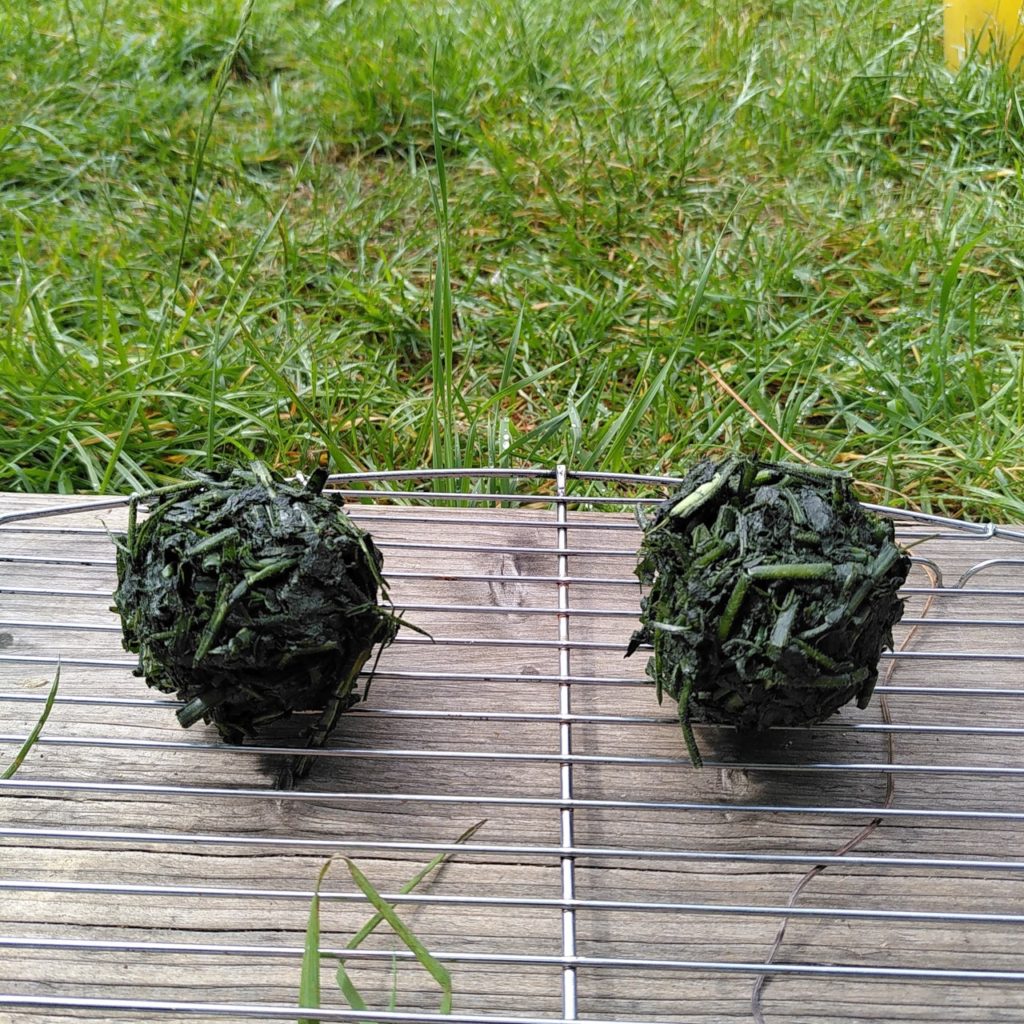
The two woad balls are drying slowly, and their outside is turning darker - blackish blue, or so I think.


Woad leaves, I also learned, have a rather characteristic smell... which is quite green, and quite interesting.

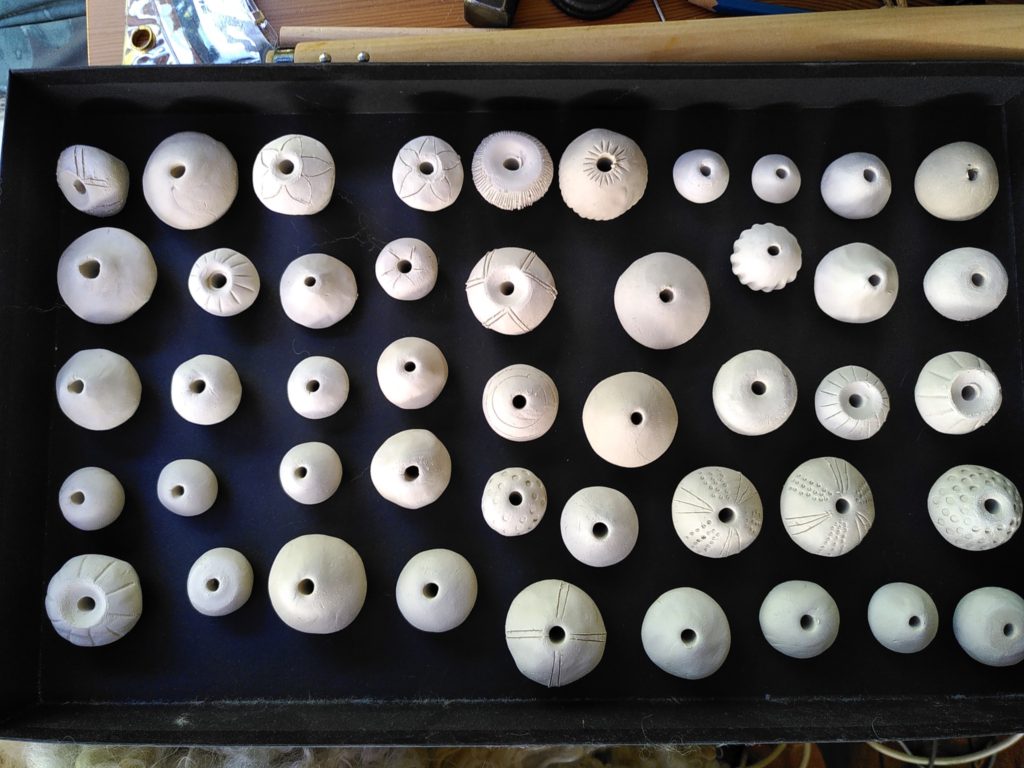
Another thing that is currently drying: The first batch of spindle whorls. It's time to make some more hand-formed ones, so I'll be doing that spread out over the next few days.


Which also means that if you have documentation about a (hand-formed) spindle whorl that you'd like to see in my shop, tell me about it! I'll then attempt to make a few approximations, and if they survive firing (which, sadly, can never be guaranteed) you can buy them...
0
JULI
09
2

Playing around.

Due to this year's special effects, there's been some more gardening than usual... and there's also been the first proper woad harvest, both seeds from the plants that are now two years old, and leaves from the new plants.

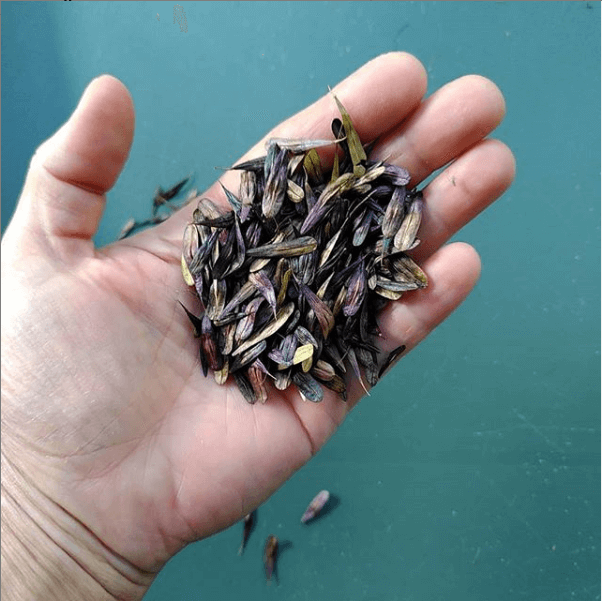
The seeds are beautiful too - I find their colours spectacular:


They are fully dry now, almost falling off the plants by themselves, and some of them are going to find their way into the shop in the next days.

The leaf harvest wasn't huge, but enough for two woad balls, and there's a portion for a third ball currently sitting in a jar, as I want to try fermenting it for a bit before forming the ball.

[caption id="attachment_5428" align="alignnone" width="488"] My very first woad balls! My hands were bright green after making these... and there was even a hint of blueishness to the green after a while.
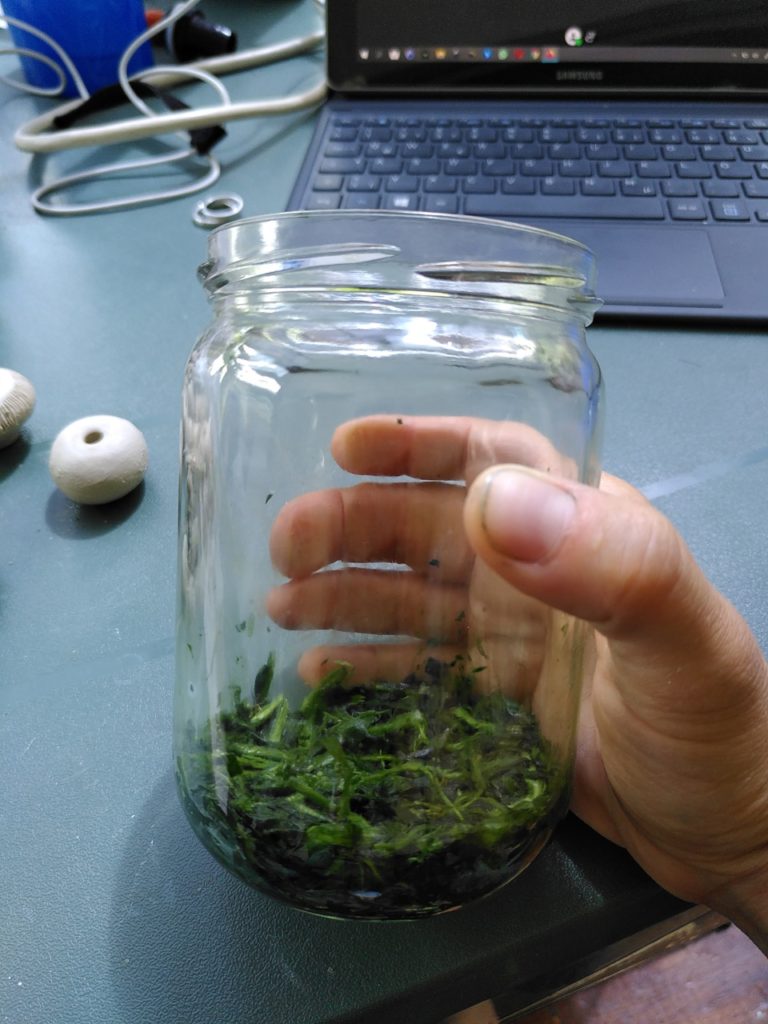

Now the whole thing has to dry out completely, and then it can be crushed and either couched (a kind of fermentation process) or used straight away for dyeing.

[caption id="attachment_5429" align="alignnone" width="382"] More woad crushed up, and ready to ferment for a bit. (Plus bonus fresh spindle whorls in the background...)
I'm having a lot of fun finally playing around with this!
0
JUNI
25
1

More About the Dublin Knife.

Since the question came up - here's some more about the weaving knife from Dublin.

The information I have about is is from a single book:
James T. Lang et al: Viking Age Decorated Wood: A Study of Its Ornament and Style (Medieval Dublin Excavations, 1962-81: Series B, Band 1). 
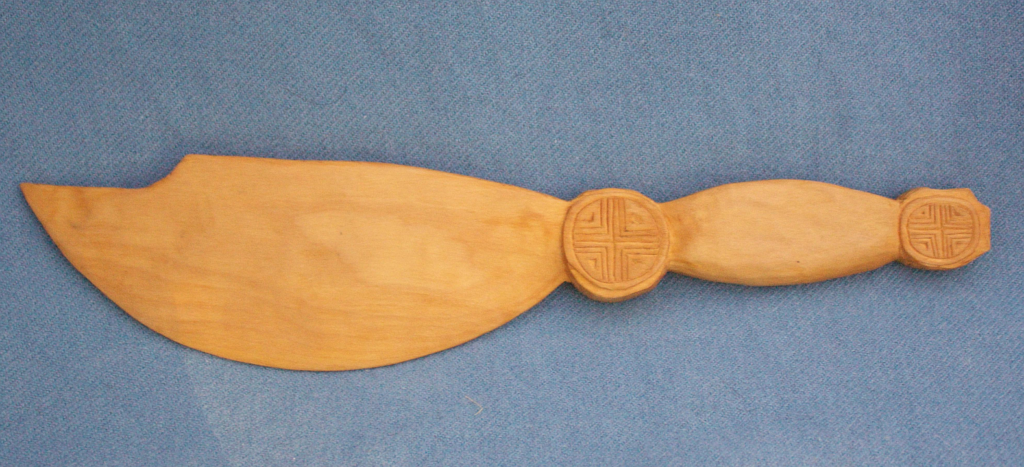
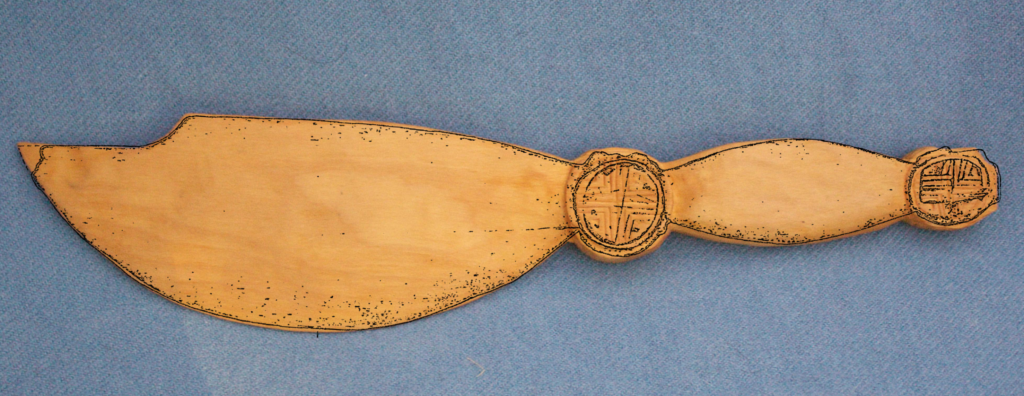
The knife has the catalogue number DW80 and the additional number (1887:143). It was found near Christ Church Cathedral in unknown context. Length ist 26.7 cm, depth 5.8 cm, thickness 1.3 cm. The original has lost its blade tip (it's broken off), so how exactly the blade ended is conjecture. There is no information about the kind of wood used for the knife.

Here's the knife I have, which was replicated by a friend, complete with the carvings:


And here's the same photo, with the archaeological drawing from Viking Age Decorated Wood, p. 77, as an overlay:


As you can see, it's definitely a very good match (and you can also see the conjectured blade tip).

I haven't been able to find out more about the knife. Apparently, the excavation took place in 1972-1976, and it has not been published completely yet. Finds from the excavation date from the tenth to the early fourteenth century, with most of the evidence from the mid-tenth to the twelfth century. You can find out a little more about the excavation on this website from the Irish Heritage Council.

There is a second smaller knife that was found at Fishamble street, which has a similar overall form, including the cutout on the blade back at the tip. It was on display in the National Museum in Dublin, at least a few years ago; unfortunately, the museum has no online catalogue.

Though it is listed as "weaving knife" in the book, there has been quite a bit of discussion on whether it is one or not, and if yes, for what kind of weaving it was used. The shape especially seems to have caused doubts about its usefulness.

From my own experience working with it, I can only say: I love it. It's very useful for both pressing in the weft (with lots of fine control due to the curved blade), and the tip is handy for clearing the shed, picking out individual threads for checking, it can be used to create a brocading shed, and I also find it very useful when weaving back to undo mistakes. You can read more about my personal experience using it in this post here.
0
JUNI
17
0

Looking the Dog in the Eye.

The eye, the nose, the neck. Ah well.


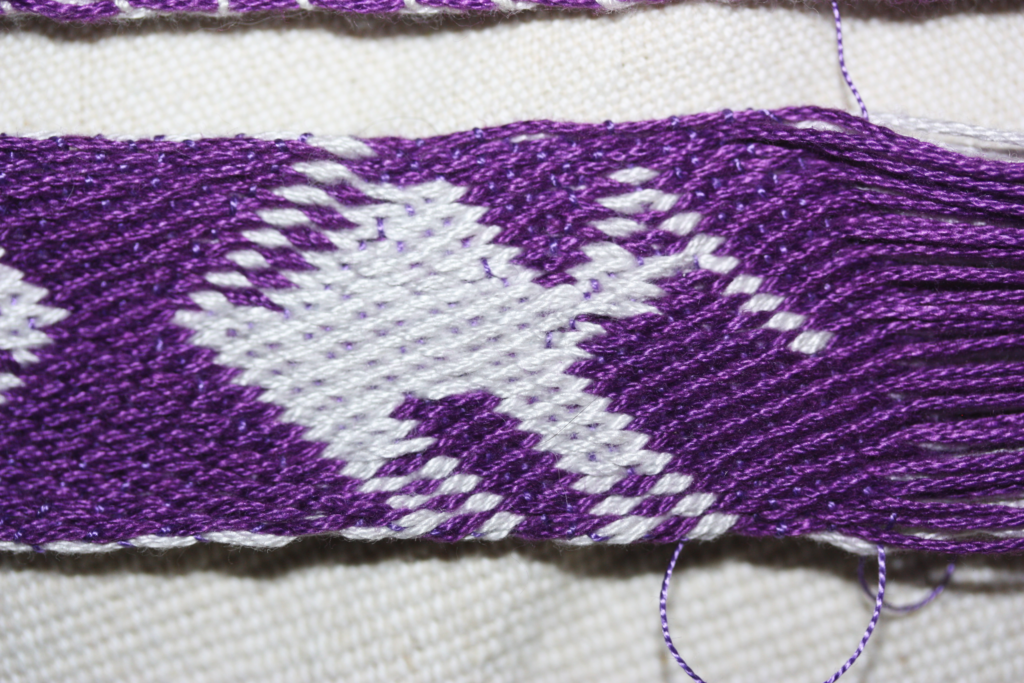
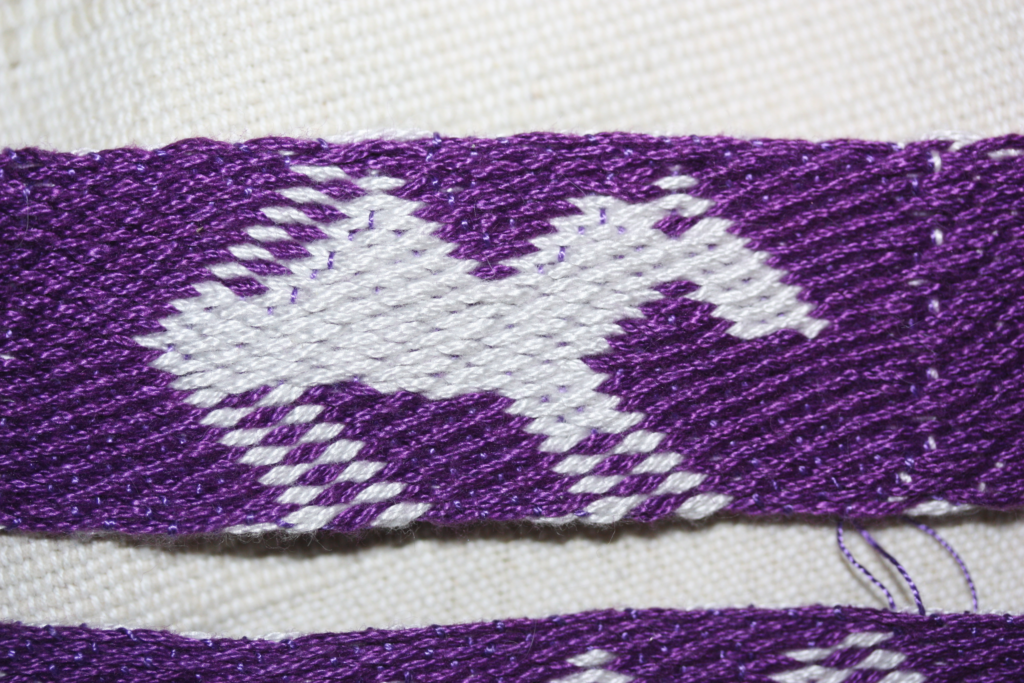
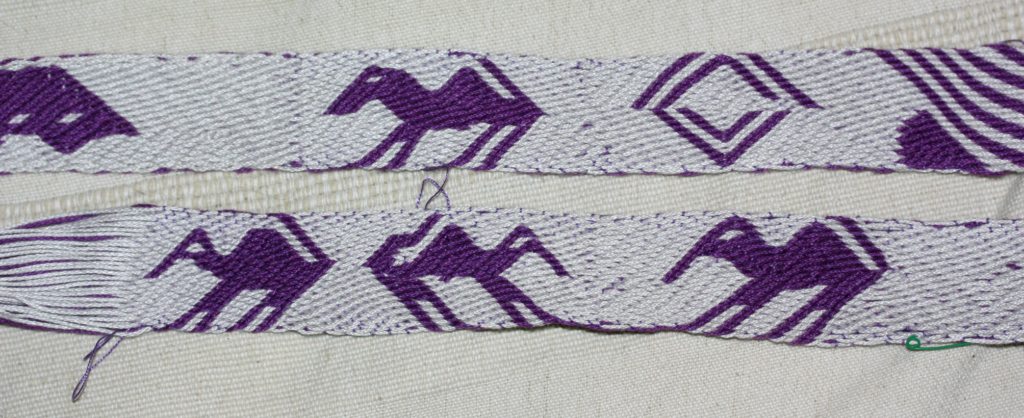
First, let me tell you about the main difference, for me, in weaving ass-first versus nose-first: When starting with the nose, I will very easily end up with a baboon ass on the dog because of getting the timing of leg slope start and back slope start not quite right. When starting with the tail, I have a high probability of ending up with a too-thick neck because of somehow fuddling things up in the middle, and then getting the timing for the neck not quite right. I suspect that if woven cleanly, the thick-neck-problem might evaporate. (It's on my list to manage that the next time.)

The nose area, however, is a different beast.

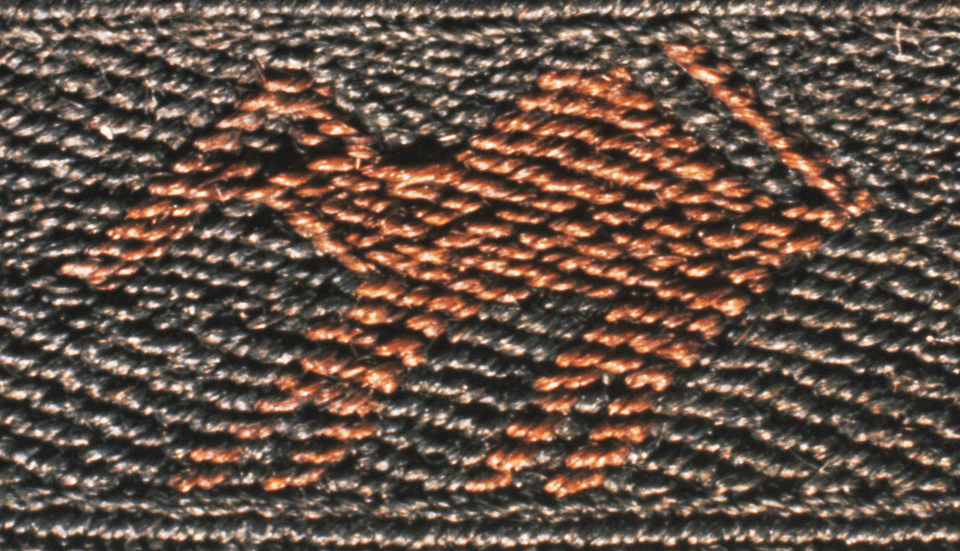
[caption id="attachment_5364" align="alignnone" width="328"] Photo from UNIMUS.no


[caption id="attachment_5365" align="alignnone" width="441"] Photo from UNIMUS.no


If you compare the look of the back of the band in the tail and leg region, you can see that there is a characteristic look of broken narrow lines - that's the back of the regular diagonals structure, which is exactly what we have on the front for a while: white, purple, white, purple.


The noses on my dogs are all one of these regular stripes as well - white, purple, white; a single (two-thread) line on top of the band, and the regular broken line on the back. Except in the very first dog, where I did a wide nose.


Now, the rules of normal twill dictate that a line you "draw" on the background is either one line (two thread's worth) wide, or three lines (in order to go out with a nice clean line again). Three lines because you have, in the diagonal base setup, a white line coming out of the twill, then your pattern dark line, a light line, a dark line, and then a white line going back into twill again. For a wider line, you cover up the light between the two dark lines by change of tablet turn direction, but you still have to weave into the regular dark line to get a clean shape. So. Two or six is the choice you have.

The original animal's nose is wider than a single line (of two threads) and much more narrow than a regular wide line, though, and that is technically not possible without doing Strange Things (TM).

I suspect the sneaky and ingenious use of some double-turns here, to get the effect. I'm not sure yet how and where they need to get started, though. This is one of the cases where I'll actually sit down with pen and paper and start drafting this to see where lines meet normally, and where lines have to start, or change, to get the desired effect.

And then I can see another dog-weaving stint in my future...

(By the way, in case it interests you: If I don't make silly mistakes and have to weave back, weaving a doggie takes me about one and a half hours. Do try this at home, but not late in the evening when tired, especially not late in the evening when tired plus distracted by other stuff going on in the room that you feel the need to participate in while making silly mistakes in your weaving.)
0

By accepting you will be accessing a service provided by a third-party external to https://www.pallia.net/

Kontakt