Latest Comments

Guest - Aislinn Dyestuff Citizen Science.
09. Oktober 2026
This is a great project. I look forward to the results. Thanks for letting us know.
Guest - Aislinn Time for...
09. Oktober 2026
Looks delicious!
Guest - Katrin Sprang Discussion
18. September 2026
Hi Rachel, I have looked for more photos of you, but that was not very successful. I found a link on...
Guest - Beatrix Sprang Discussion
15. September 2026
That lozenge pattern element is not a photograph, but a scan. So it should be to scale. But I pinned...
Guest - Katrin Sprang Discussion
15. September 2026
I was not referring to Rachel's reconstruction (is the reconstruction you refer to the one photograp...
MAI
03
0

Instagram Live... Conserved.

Botanica Yarnfest this weekend was a lot of fun, and I found out, once again, that I get quite, quite nervous before doing an online livestream demo thingie. It's worse than doing  a real-life demo somehow, even though there are no people present. Probably because there are no people present... there's just no feedback whatsoever, nobody sitting down and waiting for you to start, no room vibes to be read and acted upon. I find I actually prefer having a bunch of people look at me and being able to look back instead of having just that tiny little screen showing myself, so I can make sure I'm not running out of the picture.

Anyway, I did my demo, there were a few questions, I had some fun, and I did get some very nice feedback afterwards. I also managed to download the whole thing to my phone (which did the filming). It was not possible to re-post it to my own Instagram account, though; apparently that is only supported for videos up to 15 minutes, and mine is a bit over 30.

But there's youtube... so here you go, in case you'd like to see it: My demo of medieval spinning, with all the funny "big nose" camera effects that you get when you go close to the camera, and the weird portrait screen ratio helpfully provided by my phone.
0
APR.
22
0

CfP Early Textiles Study Group - and EXARC textile chat.

The Early Textiles Study Group has opened their Call for Papers for the next conference, which is planned for Manchester on September 9-11. In case in-person is not possible, it will be held virtually.

The title is ‘Legacy: textile studies, the past informing the present’. The ETSG is thus looking for papers that explore any aspect of the legacies of the study of early textiles. Topics may include, but are not limited to:
  • Pioneers in the study and reconstruction of early textiles,
  • Collections, their histories and their futures,
  • Fresh insights gained by applying new methodologies to old collections and archives.
The CfP is open until June 1st.


Definitely virtually, and taking place this Saturday, is the next EXARC textile chat. As usual, you can find it on their Discord server, and it will start at 15:00 CET. This month, the topic is embroidery.
0
APR.
21
0

Embroidery Videos.

In case you're looking for something to watch, Alexandra Makin of the Cuthbert Project (yes, that one with the lovely embroidery silk threads that I was involved in) has started a YouTube channel, and she's already put three videos into it - two of which are about the Cuthbert maniple.

You can find her channel here. Enjoy!
0
APR.
12
2

What is "Full"?

Yesterday, I got asked on Instagram how much wool I can get on a spindle... which is a very good question.

It's been a rather long time since I last tried and measured this. Most of my spinning is done for a specific purpose, and most of the time that is demonstrating or testing something - which means I usually spin smaller amounts of yarn, frequently of very thin yarn. So it's rather rare for me to try and pack as spindle with yarn until it's really, really full.

What is "full", anyways? Different people have different opinions about that. For me, it means that the spindle will not run easily and efficiently anymore when I flick it. The point where this occurs will, of course, depend on a number of factors: The type of spindle, the technique you are using to spin, the kind of yarn you are making, the density of the fibre, the density of the yarn, how you wind it onto the spindle, the placement and size and weight of the whorls you are using. I also find that with the growing cop, it can be necessary to adjust how I wind the yarn. At the beginning, it's helpful to spiral the leading thread up the spindle shaft before making the half-hitch. With a large cop, this can sometimes stop working so well; then I wind around the bottom of the cop, go straight up to the tip of the spindle, and place the half-hitch.

As my spindle fills up, I also replace the whorl I used at the start with a smaller, lighter one, so that the spindle turns quickly and nicely again. At one point, no whorl is the best whorl. At some point, the spindle, now whorl-less, is so full that it will be harder and harder to flick it into a speedy rotation, and that is when I declare it full.

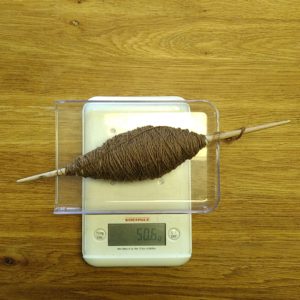
In yesterday's test case, that happened at a total weight of a little more than 50 grams. The spindle stick comes in at about 8-12 g, depending on the stick, so that means I fit about 40 g worth of thread onto the spindle.


Which, if you ask me, is a pretty decent amount.
0
MäRZ
25
0

New Whorls!

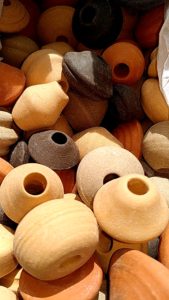
I spent part of the day today standing in the wonderfully sun-warmed wintergarden, sorting these wonderful new arrivals:


Fresh wheel-thrown spindle whorls, with a new colour - there are some grey ones among the mix now, too! I'm all delighted with them.

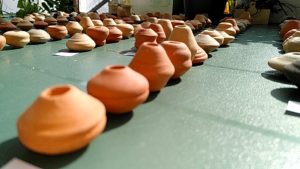
They were lined up in neat rows according to their weight range:


Now they are in my shelf, sorted away, waiting to be sent to new homes... and, of course, waiting to be properly photographed so they can be listed in the shop! That will happen tomorrow, though, when the light is nice and bright but not too bright yet.
0
MäRZ
11
0

17th Century Braids.

Just in case you totally need to look at a 17th century manuscript today, which has examples for braids and instructions on how to make them, here you go:

V&A Unknown Manuscript with nine pages, vellum, c 1625-1650.
Ah, they look pretty. Preeeeetty.
0
MäRZ
05
0

Braiding Fun.

I've been doing a bit of evening playing around research stuff recently - a colleague has sent me some images from braided bands attached to relic purses, and we're trying to figure out how these were done.

Loop-braiding remains absolutely and utterly fascinating for me. The ease with which it is possible to do complex braids, with different patterns; the mindboggling efficiency of this technique, compared to braiding with single ends; the possibility to have several braiders work together on one piece, making it wider and more complex - it's just wonderful.

I have also, in the tests and trials for these technique reconstructions, found out again that sometimes the simple approach is the one most likely to be the right one. There was a good amount of pottering around with just five loops for the first puzzle, moving them from one finger to another, until I finally realised that it was just a very simple braid which I have done gazillions of times before... that was a nice d'oh moment. I was smarter for the next one, though!

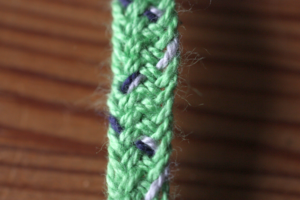
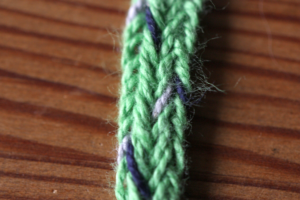
So here's two pictures of the current puzzle in progress, braided with seven loops:

They show front and back of the band; one of the loops is a bicolour one (grey and dark blue) to make things more clear for me when testing the effect of twisting the loop vs. taking it straight. It also shows how one single loop/element travels through the whole braid.

Can you tell I'm having fun with this?
0

By accepting you will be accessing a service provided by a third-party external to https://www.pallia.net/

Kontakt