Latest Comments

Guest - Aislinn Dyestuff Citizen Science.
09. Oktober 2026
This is a great project. I look forward to the results. Thanks for letting us know.
Guest - Aislinn Time for...
09. Oktober 2026
Looks delicious!
Guest - Katrin Sprang Discussion
18. September 2026
Hi Rachel, I have looked for more photos of you, but that was not very successful. I found a link on...
Guest - Beatrix Sprang Discussion
15. September 2026
That lozenge pattern element is not a photograph, but a scan. So it should be to scale. But I pinned...
Guest - Katrin Sprang Discussion
15. September 2026
I was not referring to Rachel's reconstruction (is the reconstruction you refer to the one photograp...
FEB.
03
2

More knitting blogging.

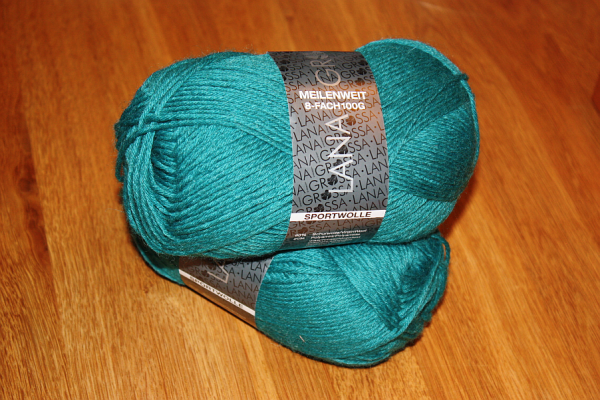
There is a lovely stack of wonderfully teal-coloured wool sitting around here, waiting to get turned into a sweater:

[caption id="attachment_2175" align="alignnone" width="600"]These two have more friends, of course. One sweater's worth of them. These two have more friends, of course. One sweater's worth of them.


They're not going to get cuddly and up close to knitting needles just yet, though - there are a few other things that need finishing or taking care of first (such as the sprang thing that is still waiting on its frame, happily, for instance). I've done the swatch already though, and picked out a pattern - the wool will, eventually, turn into a nice cardigan.

Eventually.

Speaking of turning yarns into knitted items, I've been following @WoolsackUK on Twitter for a while now, and one of the recent tweets linked to an article about knitting with a specific technique in Yorkshire, called "swaving". From what the Knitting Genealogist writes on that blog, the technique is lost today - but it does sound like a fascinating field of study. If you're interested in old knitting techniques, you might enjoy that article (and possibly others on the same blog.)
0
FEB.
02
0

Archaeology Grand Challenges and WWI Knitting

It's the start of February, and Doug has curated all the Blog Carnival entries for the Archaeology Grand Challenges. It's 60+ posts from all over the world, and from a lot of different perspectives - from sex and gender over personal identity challenges to funding, finances, and archaeology and games. If you like to read about archaeology, go check out these blogs - you might find something to put on your reading list!

If you're more interested in knitting, there's a project called "Centenary Stitches" focussing on the knitting done at home for WWI soldiers. The project has also resulted in an exhibition currently being shown at the National Archives in Kew, Surrey (ending March 19).
0
JAN.
20
0

Oh Wool of Bad Decisions.

I have a stash of wonderful, hand-dyed, soft-spun single wool hanging out here, and it's been hanging out here for a long while, too. It's indigo-dyed in two shades of blue, plus there's a grey and a brownish grey to go with it. However, it seems to have some make-a-bad-decision vibe hanging to it.

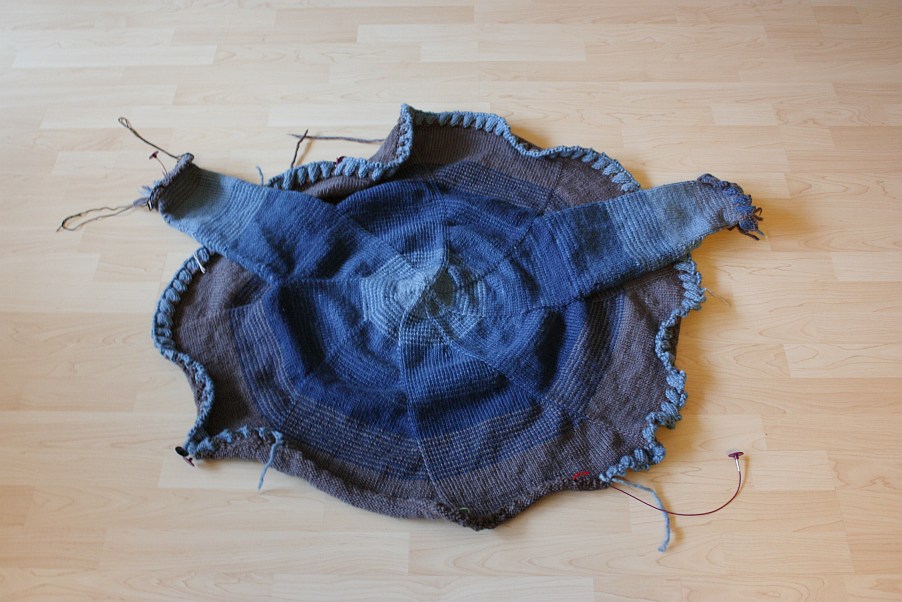
Originally, I bought it to knit myself a Pinwheel Sweater - only to find out, when the thing was almost finished, that it does not flatter me at all and, to be blunt, actually even looked butt-ugly on me.

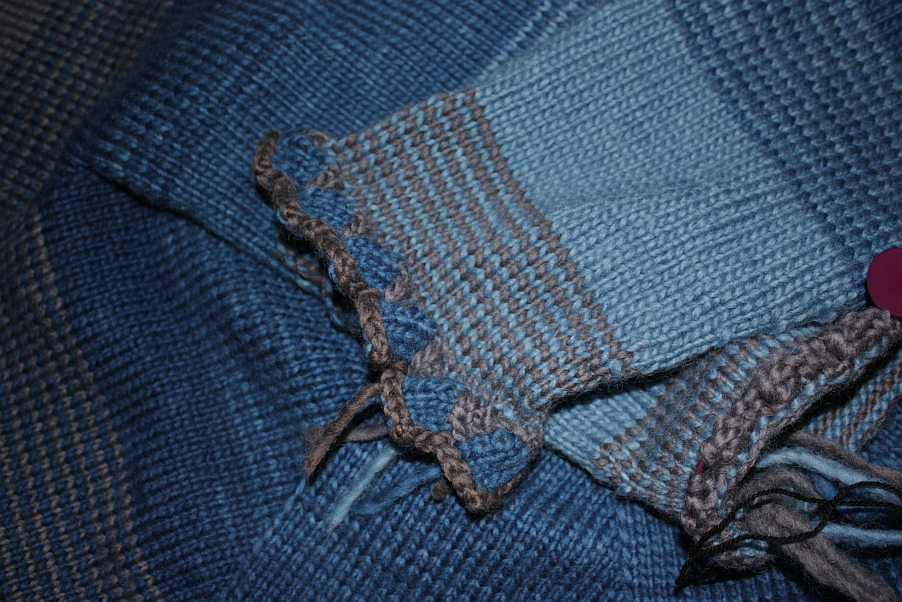
[caption id="attachment_2149" align="alignnone" width="902"]Almost done. And unfortunately not The Thing For Me. At all. Almost done. And unfortunately not The Thing For Me. At all.


[caption id="attachment_2148" align="alignnone" width="902"]Sleeve finished with a tiny bit of entrelac-like knitting. Sleeve finished with a tiny bit of entrelac-like knitting.


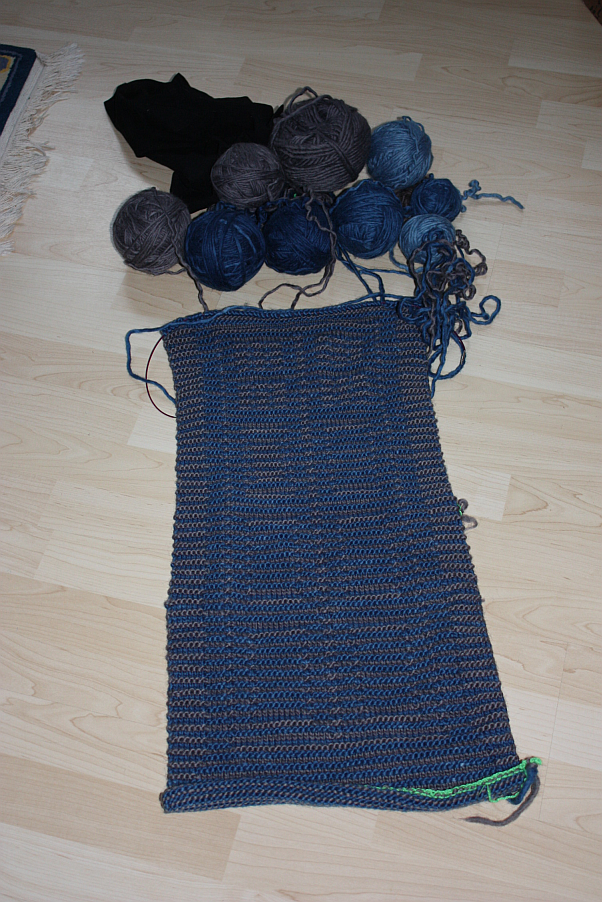
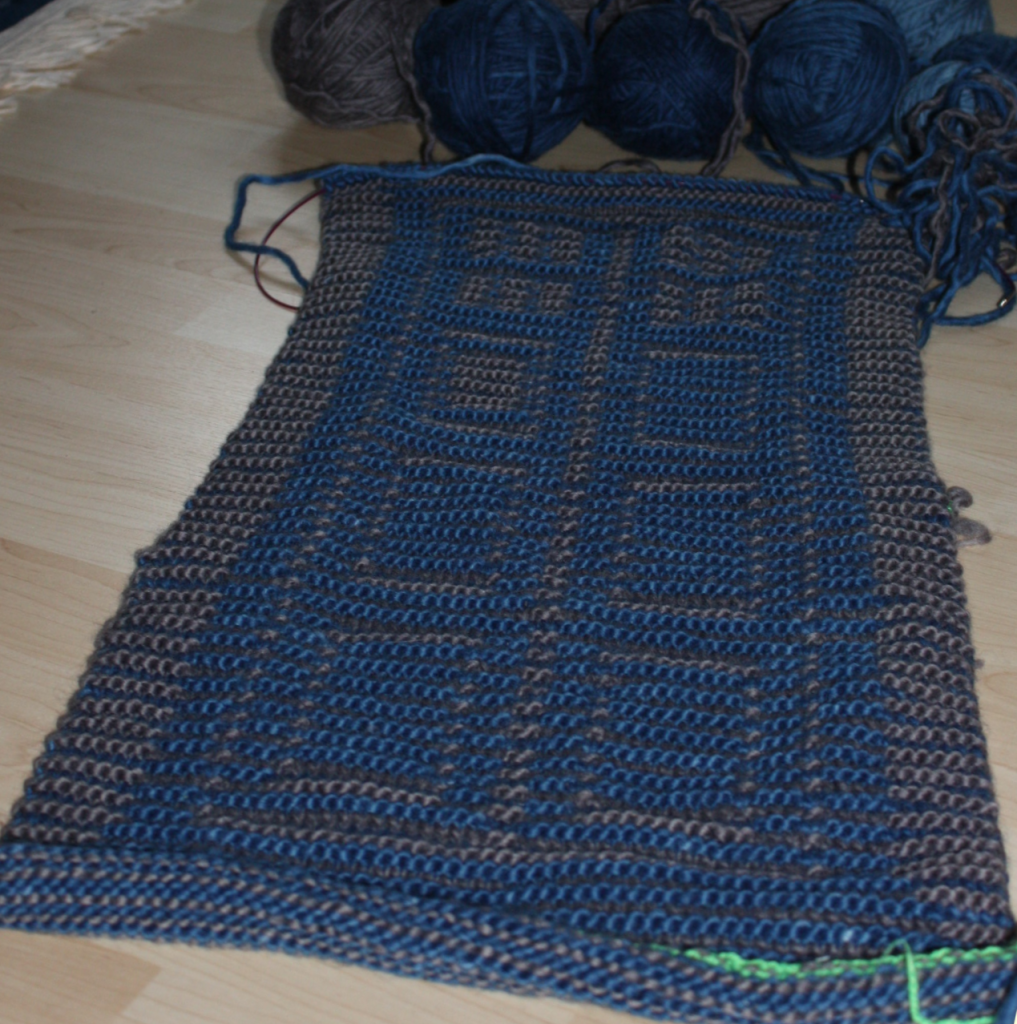
So I frogged it. And then thought about what to do with it, and I came up with the idea to do an illusion-knitted Tardis scarf. Which I started, and I made good progress on,  and now it has been almost finished for a while...

[caption id="attachment_2147" align="alignnone" width="602"]The Tardis knit, seen from above... The Tardis knit, seen from above...


[caption id="attachment_2146" align="alignnone" width="640"]... and at an angle. It really looks Tardis-y! ... and at an angle. It really looks Tardis-y!


This, however, has proven to be another bad decision. Illusion knitting, to work properly, needs to be rather firm. The result of this? A very wide, very firm piece of knit fabric that will not be comfortable or easy to wear as a scarf. Or anything else, actually. And I do intend to wear my knit things - otherwise I could decide to use it as a rug, or wall-hanging, and it might do nicely there, but somehow, I'd prefer it to be wearable. (It's also not as illusionary as I had hoped; the motif is rather visible from straight downwards still.)

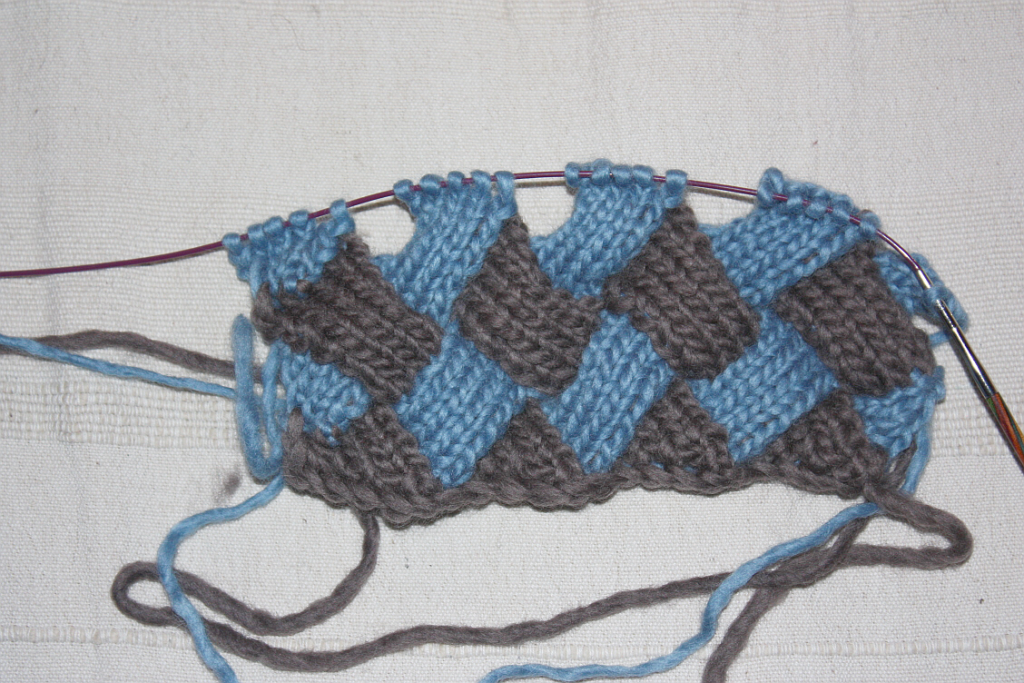
So I will frog it again. And next time? Well. I'm thinking about trying to make a jacket/cozy sweater-like thing out of the wool again, but this time, using a pattern that actually flatters me, and probably employing the mix of colours to do some nice entrelac.

[caption id="attachment_2145" align="alignnone" width="640"]Entrelac knit with the same kind of wool. I think this will be the thing. Entrelac knit with the same kind of wool. I think this will be the thing.


After all, this looks promising, doesn't it?
0
DEZ.
18
0

I'm back home, and I have stuff for you.

You're getting a late blogpost today because I had slow internet today, and it even ate a half-written post... but you are getting one, and it is one with free stuff! (Very fitting for the season...)

First of all, as a reminder - free ebook in Aarhus Uni Press this month is Woven into the Earth. Go download it if you haven't done so yet, and tell your friends who are interested in archaeological textiles. This is a wonderful book, and it is definitely good to have.

You already downloaded it? You would like more books? Here you go.

On a completely different, and very much non-archaeological note - there is a free e-book about working with MS Word, "Microsoft Word for Publishing Professionals" by Jack M. Lyon. A few years ago, the author's newsletter "Editorium" helped me a lot when prodding my thesis text into shape, as well as later when I had typesetting to do. If you're working with Word (as so many people in the social/historical/archaeological sciences do), you might want to give it a look.

And now on to the juicy bits.

I had the opportunity to visit Estonia for a few days, and I didn't only meet lovely fellow textile people and fellow archaeologists and got to see exciting finds in several museums and a good number of the Estonian textile finds, I also brought home some books (about, who would have guessed it, Estonian textile finds). Two of them are about the finds from Siksälä, which is a burial site used continuously from the 11th to the 15th century - the Estonian Iron Age and Middle Ages. Siksälä has yielded exceptionally rich finds, including textiles wonderfully decorated with bronze spirals. There's a publication in two parts, a text part and a catalogue part; both are in Estonian*, but anyone can look at the pictures and construction drawings. And if I say anyone, I do mean it - both the first volume and the second volume are available online, free of charge, thanks to the University of Tartu.

Another absolutely amazing Estonian find is the craft box from Lohavere (which should be written with a little ~ sitting on top of the o), which comes from the hillfort of the same name, dated to the 12th and early 13th century. If you know the Mästermyr find and have always dreamt of something similar, but related to textiles? Here it is. The craft box, made from birch bark, contained textile remains, prefabricated and half-finished products, bronze ornaments and tools, some of them neatly stored in smaller boxes or little pouches. It is an absolutely fascinating find and gives so much information about how the spiral decorations were worked... and it, too, is published in a little book, and that, too, is available online free of charge.

These finds absolutely deserve to be better-known - so feel free to spread the word, and of course enjoy the publications of these gorgeous finds!

*Estonian is a language belonging to the Finno-Ugric group, and more or less related to Finnish. A few fun facts: Estonian has fourteen cases. Yes, fourteen - because there are no words to signal direction (like "into" or "from"), and a case is used instead. More fun facts? Estonian has no genders, so there's no problem with being politically correct. Because there were a lot of Germans in Estonia in the Middle Ages (Hanseatic League was a reason for that, for instance) there are quite a few German words still around, which makes not understanding most of the rest even more peculiar. Final fun fact for today: as I'm easily amused, it diverted me no end that the greeting "Tere" sounds much like the southern German colloquial "Dere" (which is very short for "Habe die Ehre", I have the honour). If you're intrigued now, here are a few useful Estonian phrases, and here is a very interesting pdf with facts about Estonian.
0
DEZ.
15
2

Look! Sprang!

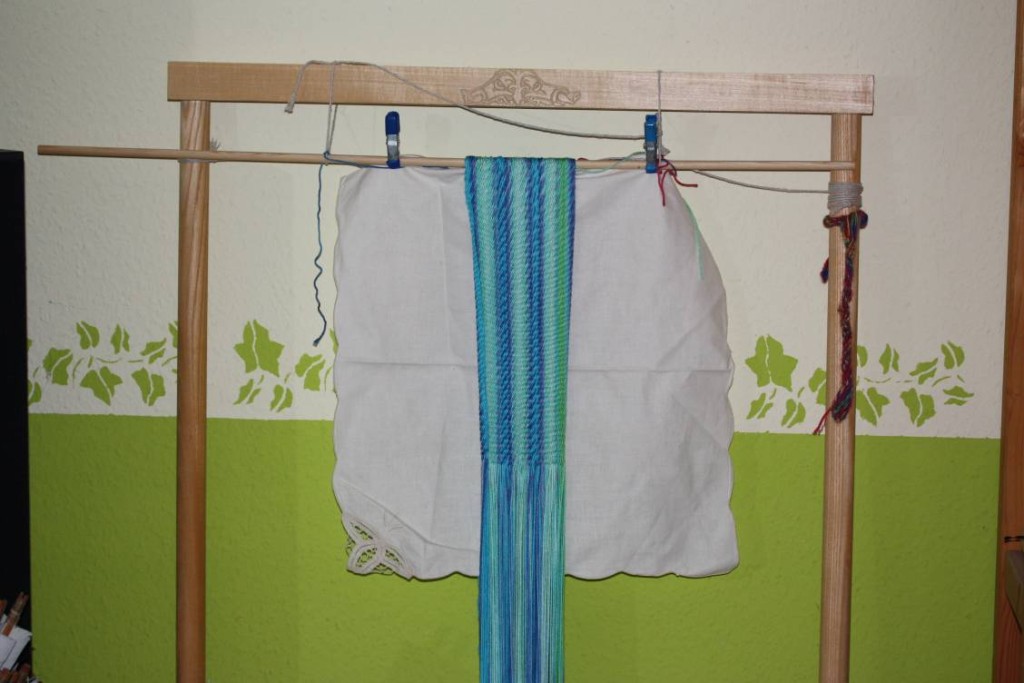
A while ago I mentioned finally having gotten the hang of sprang, and here's proof - my current on-the-side work-on-this-while-rewatching-stuff piece of sprang on the frame:

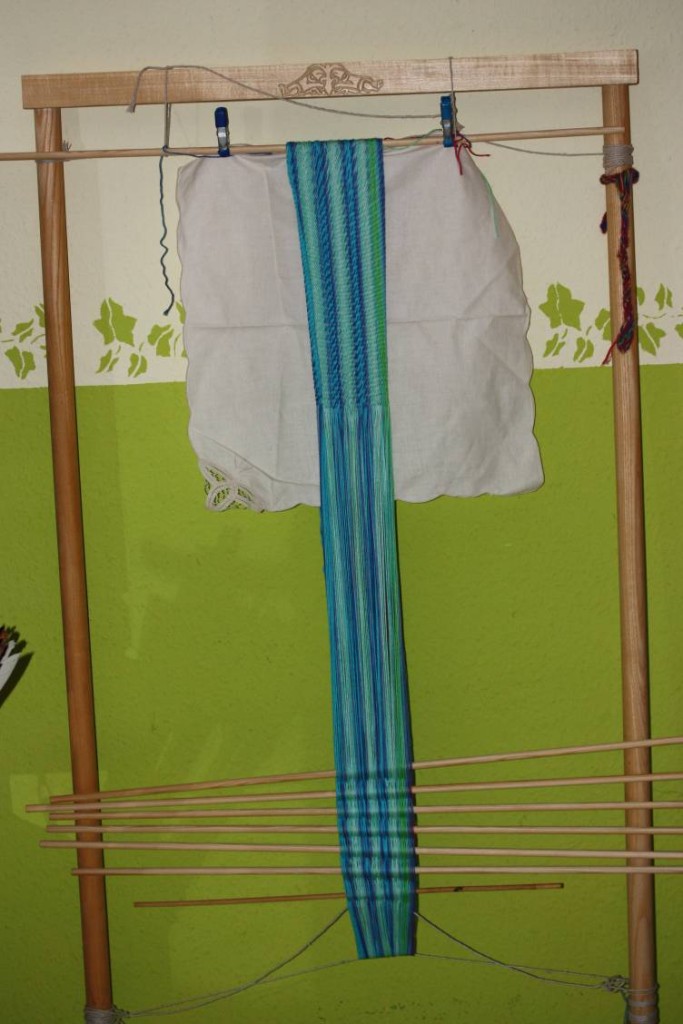
[caption id="attachment_2088" align="alignnone" width="640"]Circular sprang - this is one continuous loop; the white cloth is in there to help keep me less confused. Circular sprang - this is one continuous loop; the white cloth is in there to help keep me less confused.


It's one continuous loop, and the shed is worked in the front; after that, the lower crossings are pushed to the back and up. That's also why you see so many sticks stuck in my work:

IMG_8271

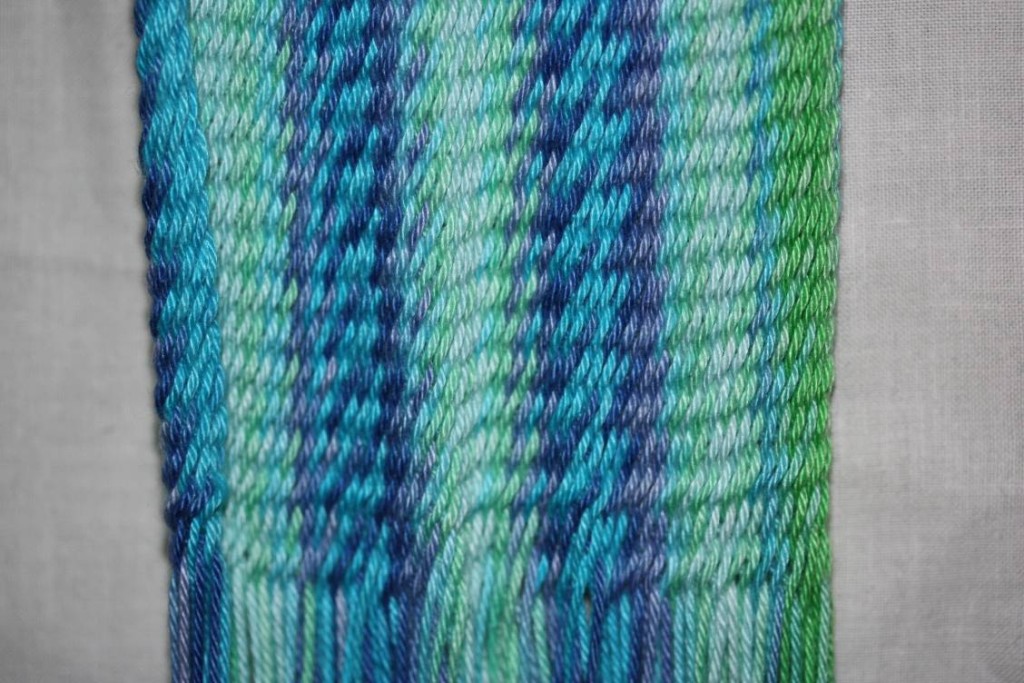
Each of the dowels holds one shed that is waiting to be carried to the back. And here's a closeup of the fabric:

IMG_8273

There's still quite a lot of warp to do, but I'm already looking forward to the point where work has progessed so far that I can move the whole shebang, bringing both ends of the worked fabric part to the front. No more carrying the shed around the lower edge! That will be bliss!
0
DEZ.
04
1

Very Old Knitting, Part 5.

Slipping stitches is nice, and can be very helpful, but it takes time. Also, it tends to annoy me when I have to do an abundance of it... so I was thinking of alternative methods to get the new stitches to go through two previous ones, but without slipping stitches. I was thinking about just knitting into the row below in addition to the current row, or about having two needles parallel in the knitting... and, as we were hanging out together, I told the most patient husband of them all about this, and explained about the necessity to slip stitches with the other method because otherwise the stitch to discard won't go over the newer ones in the proper direction.

After mulling this over and thinking a minute about it, he asked "Why don't you just align them differently?" Brilliant man. So once I had yarn and needles handy again (this might have involved buying a set of simple metal needles to live in my handbag, because you can always find a use for metal sticks, and there was yarn in the bag already) I tried both my ideas (which did utterly not work, both of them, but it was interesting to see how spectacularly they failed to work) and then the different alignment.

So here you go, courtesy of the Most Patient of All Husbands, a second method to do compound knitting, with no slipping at all as long as you work in the round.

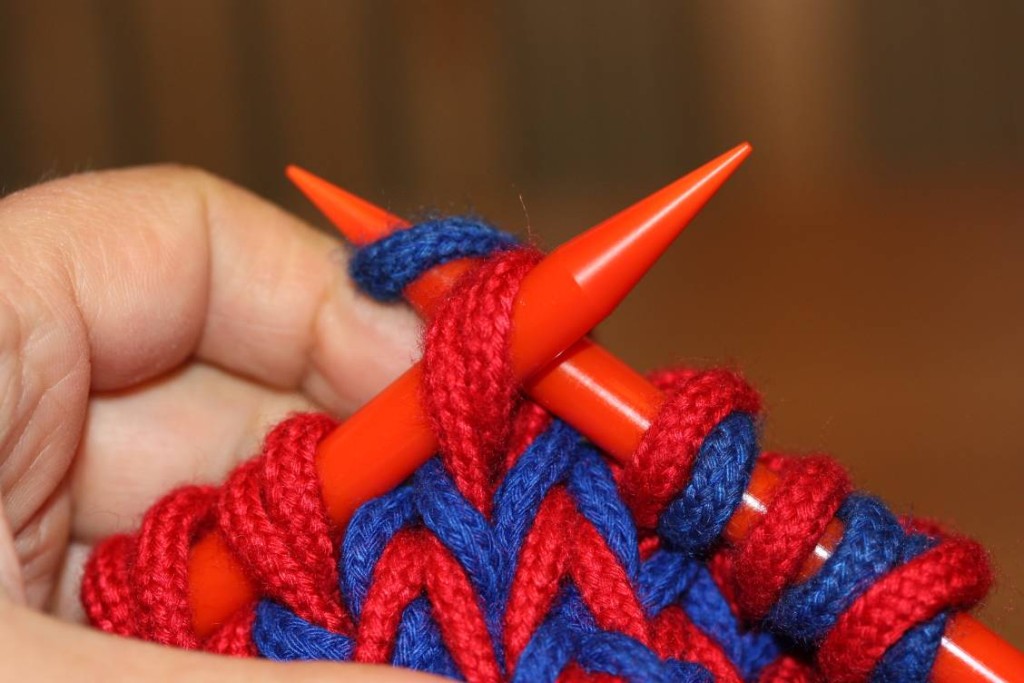
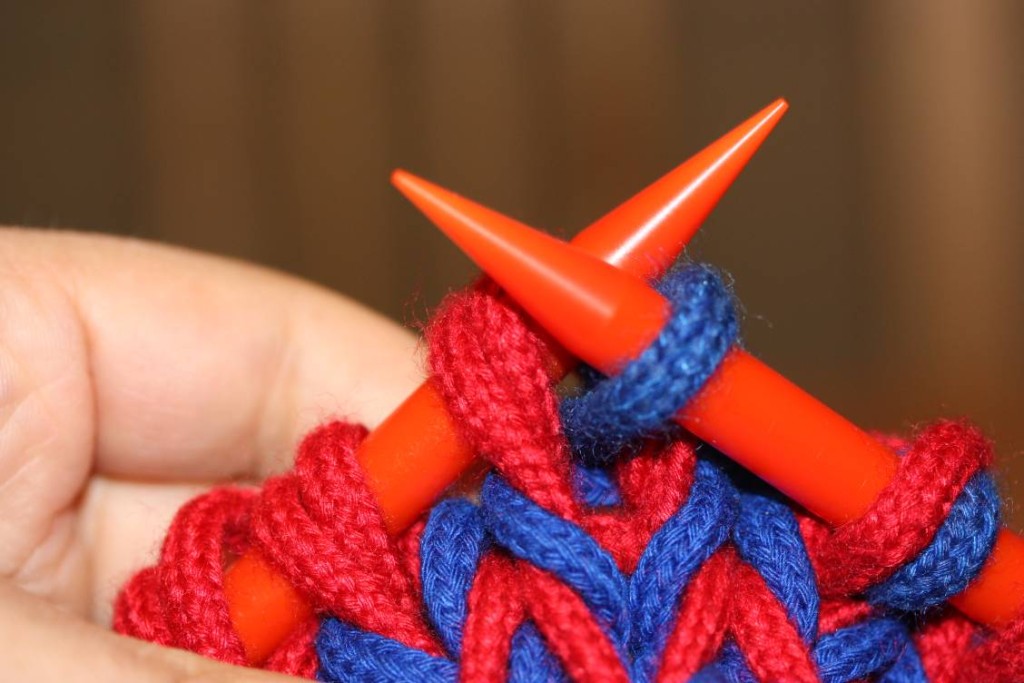
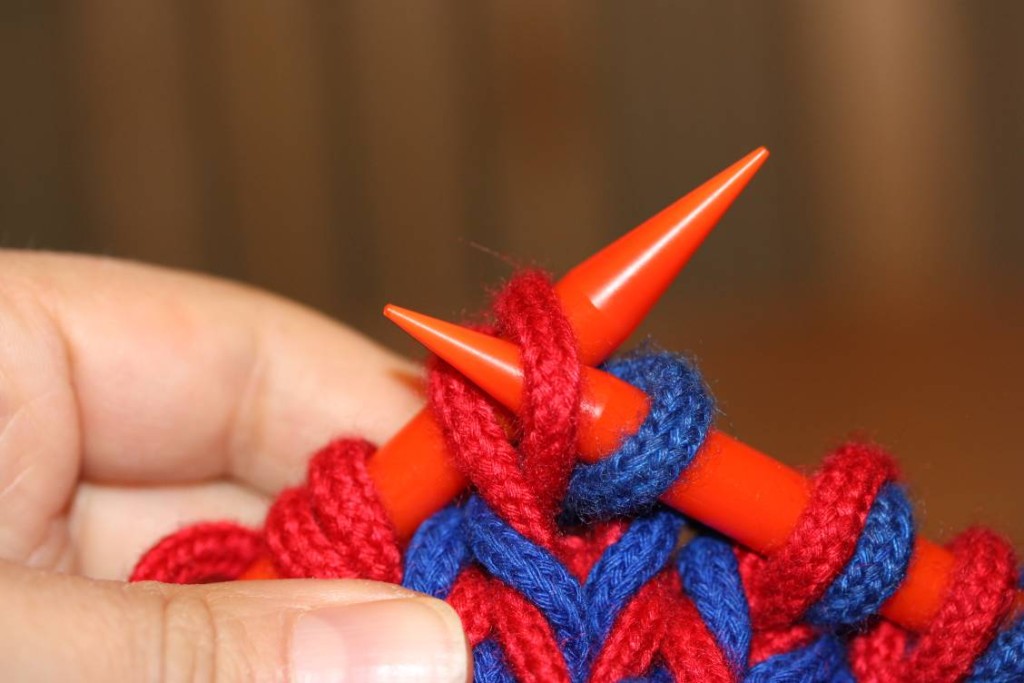
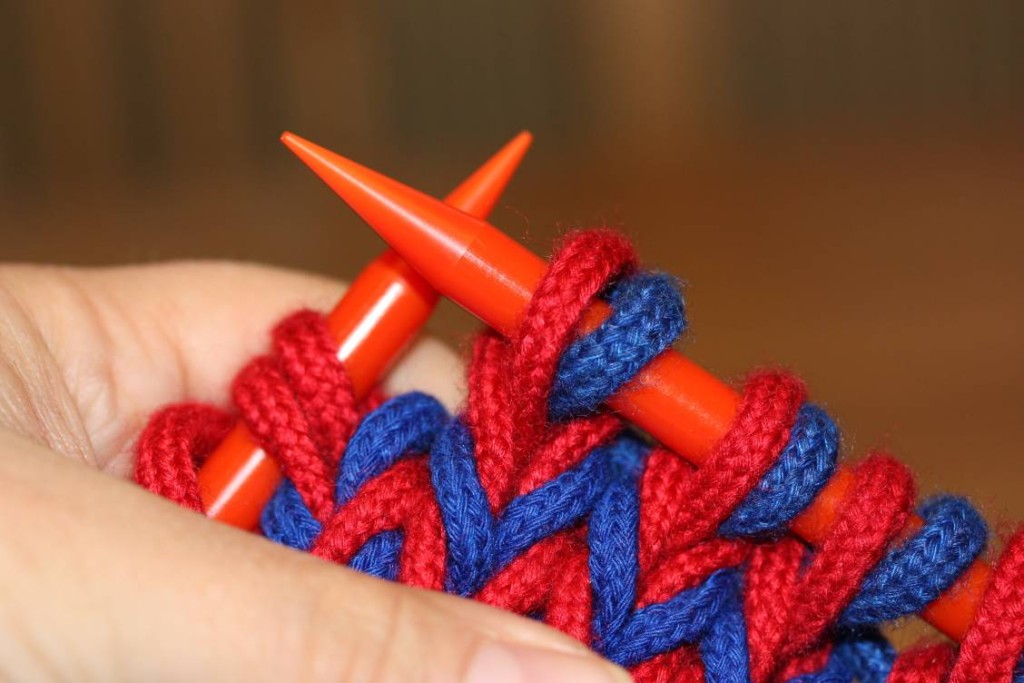
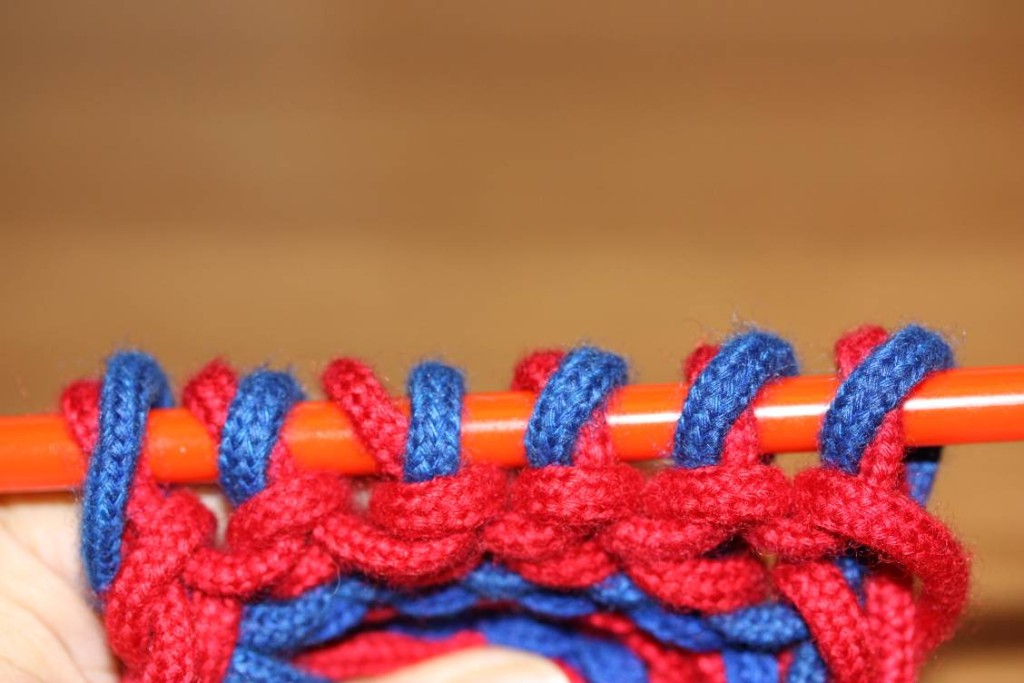
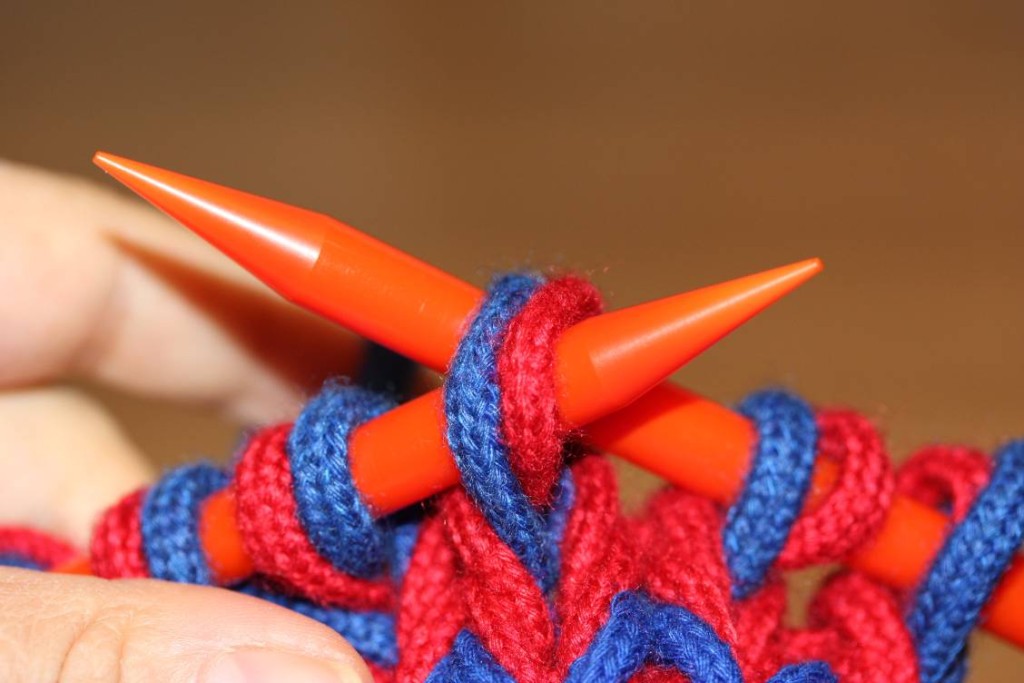
All stitches are aligned with the right leg behind the needle. The older stitch is now always on the left side, the newer stitch on the right side of the pair.

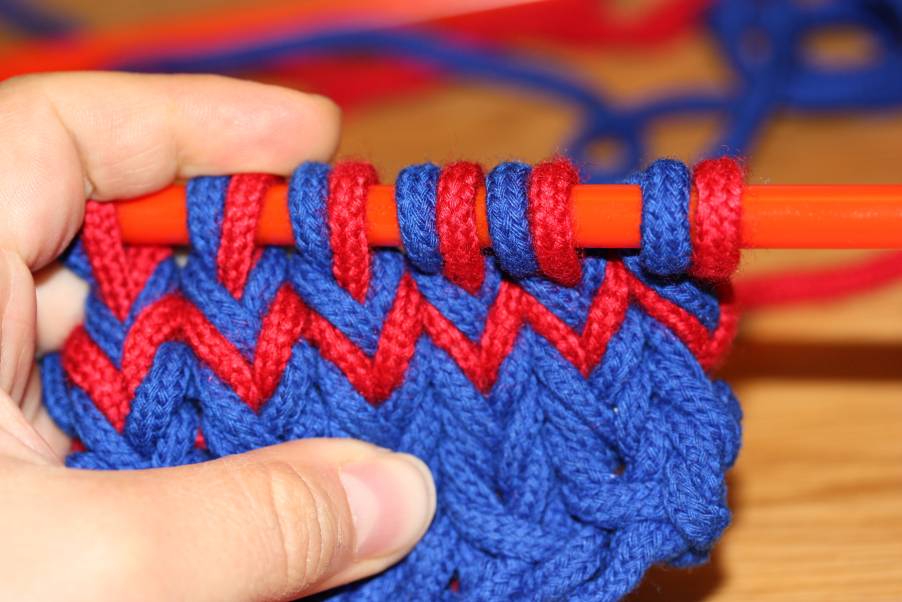
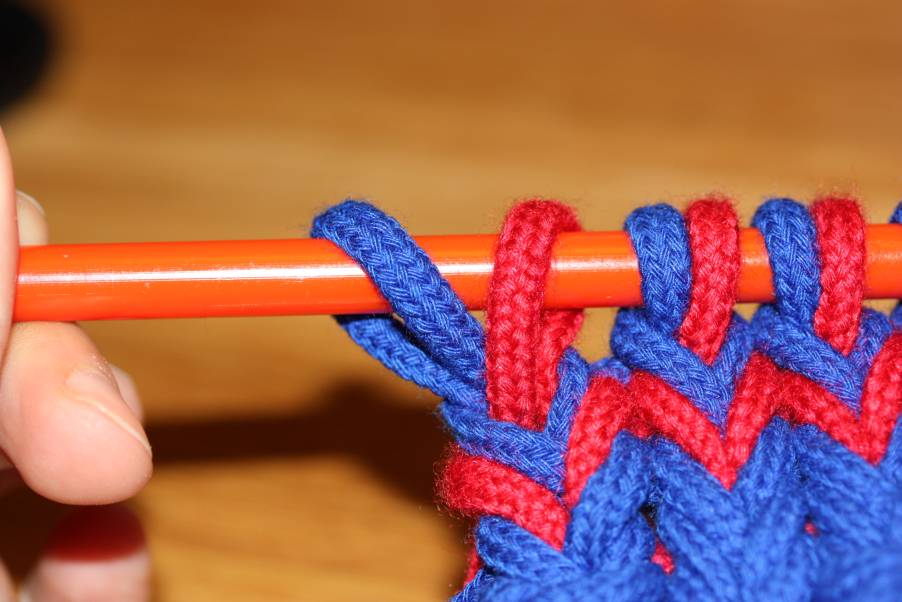
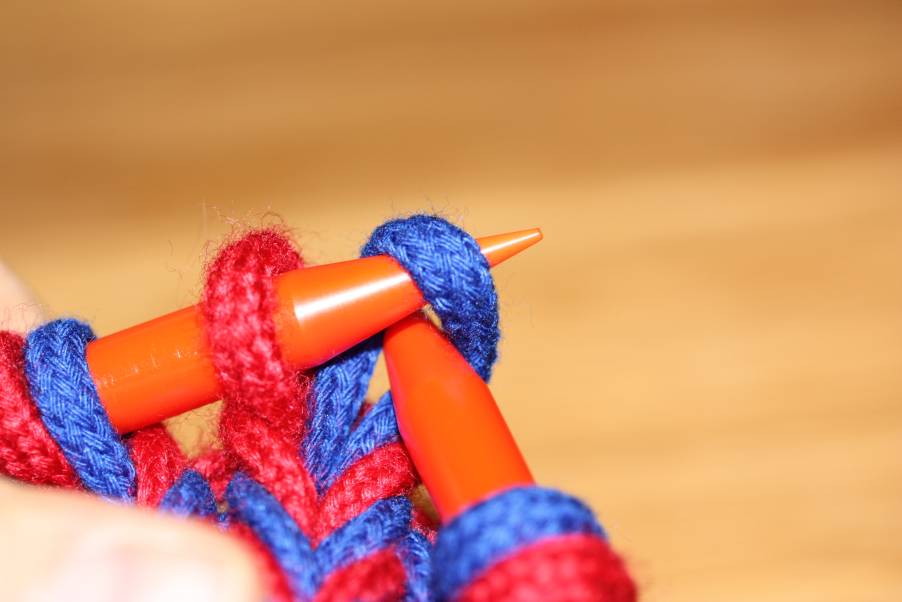
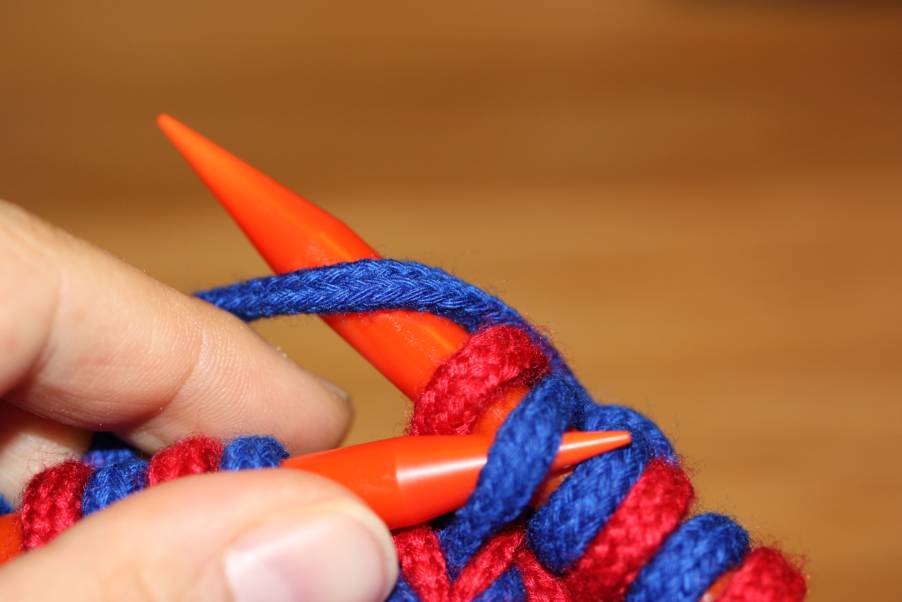
[caption id="attachment_2062" align="alignnone" width="640"]Insert right needle straight through both stitches on the left needle and wrap yarn from back to front (so the right leg of the new stitch will lie in the back)... Insert right needle straight through both stitches on the left needle and wrap yarn from back to front (so the right leg of the new stitch will lie in the back)...


[caption id="attachment_2061" align="alignnone" width="640"]...draw through both stitches on left needle... ...draw through both stitches on left needle...


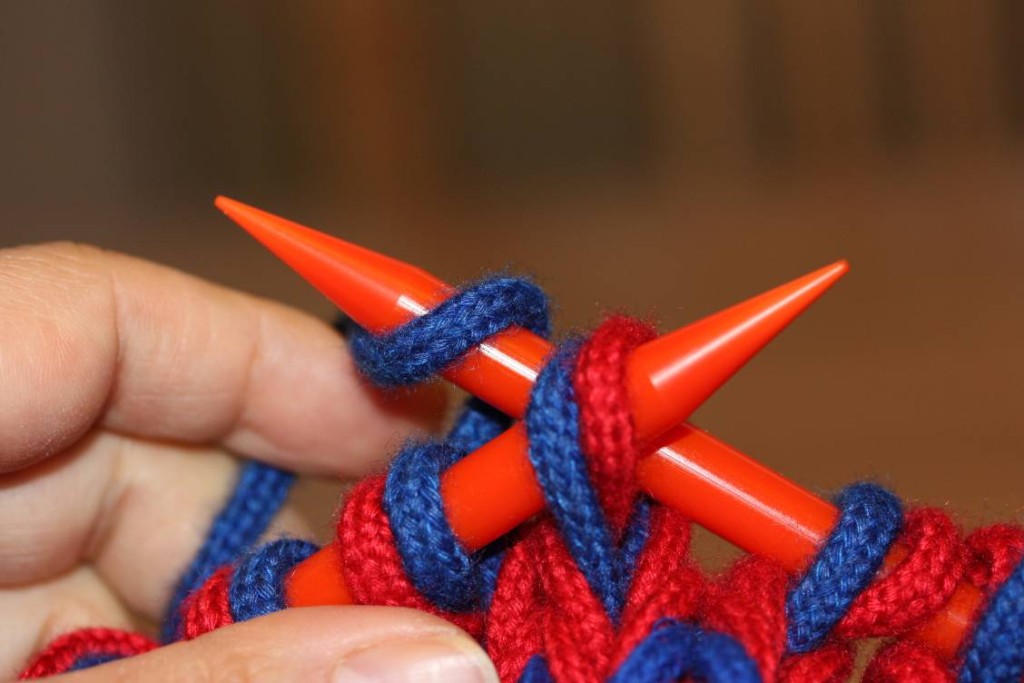
[caption id="attachment_2060" align="alignnone" width="640"]...and move the first stitch on the left needle over to the right. ...and move the first stitch on the left needle over to the right.


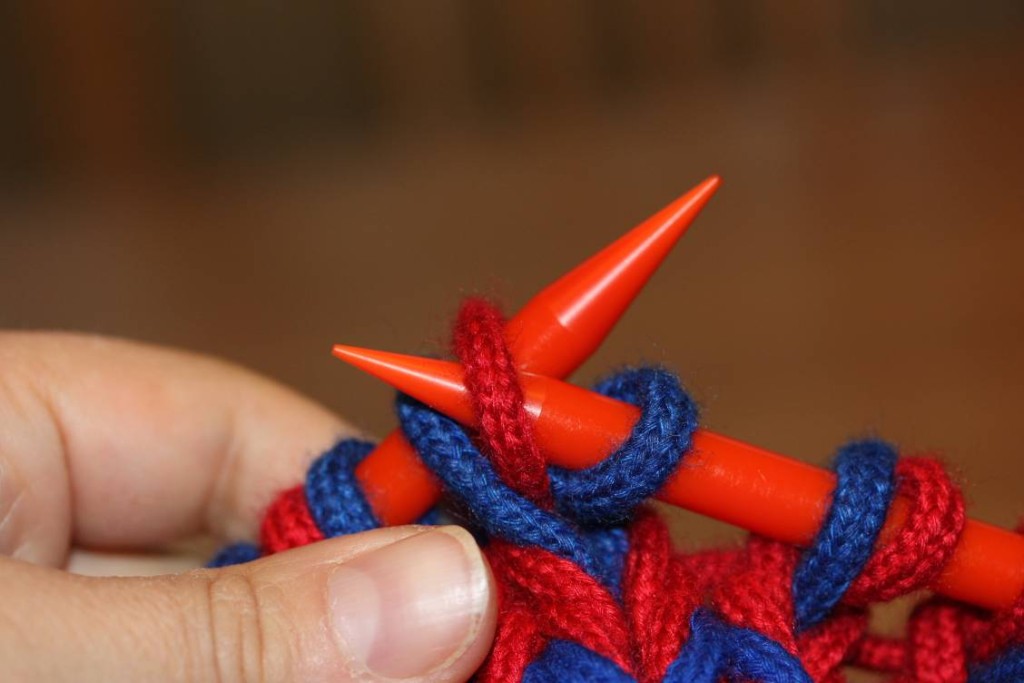
[caption id="attachment_2059" align="alignnone" width="640"]The new stitch lies on the right, the older stitch on the left. The new stitch lies on the right, the older stitch on the left.


[caption id="attachment_2058" align="alignnone" width="640"]View from the back - you can see how the stitches sort of cross over each other on the needle. View from the back - you can see how the stitches sort of cross over each other on the needle.


This is nice and relatively fast to work, and involves no slipping. There is a little danger of stitches swapping positions, though, especially in the first and last stitch of the row, mostly due to them being much looser. Knitting in the round eliminates that problem, and it also lets you work without having to deal with a return row, because that... well. That's an entirely different beast.

To get the stitches that have to be discarded to move over their new counterparts in the correct direction, there needs to be some slipping of stitches again. I tried doing a return row, similar in method to the original instructions, and lo and behold - there were twisted stitches again:

[caption id="attachment_2057" align="alignnone" width="640"]Insert left needle through both stitches on right needle. Insert left needle through both stitches on right needle.


[caption id="attachment_2056" align="alignnone" width="640"]Wrap yarn from back to front around right needle, pull through both stitches... Wrap yarn from back to front around right needle, pull through both stitches...


[caption id="attachment_2055" align="alignnone" width="640"]... and transfer first stitch on left needle to right, dropping the second stitch off the needles. ... and transfer first stitch on left needle to right, dropping the second stitch off the needles.


[caption id="attachment_2054" align="alignnone" width="640"]Then transfer both stitches to the left needle. Then transfer both stitches to the left needle.


[caption id="attachment_2053" align="alignnone" width="640"]The result after one more regular row: after the return row, the stitches that were discarded are twisted... The result after one more regular row: after the return row, the stitches that were worked in the return row are twisted...


I'm quite sure that the twisted-stitch issue can be resolved by different alignment or some other shenanigans. There remains, however, an interesting fact: no matter which method, the original or this one, working in one direction only is much easier than turning around and working knitting in the flat. So knitting with stitches through two previous rows instead of just one seems to be much better suited to working in the round, not in the flat.

Which sort of fits into the picture of early knitting being done in the round only, as far as we can tell from our evidence. So maybe there was a point in time when flat knitting, going back and forth in rows, was developed and it didn't work so well with the stitches in double depth, leading to the development of the knitting through just one previous row? Who knows - but maybe, some day, we'll have a few more knitting finds to help with these questions.

I hope you enjoyed this series about knitting - and if you find a better method, or a good way of working the return row, please let the rest of us know in the comments!
0
DEZ.
01
0

Very Old Knitting, Part 4.

Time for some more knitting stuff! In the last installment of this little series, we've identified the stitches in the row worked from the left onto the right needle as the culprit for the twisted stitches - or, to be more precise, the alignment of these stitches. The stitches worked in this row sit with the right leg in front of the needle, and when they are pulled over the newer stitches off the tip of the needle, their legs cross.

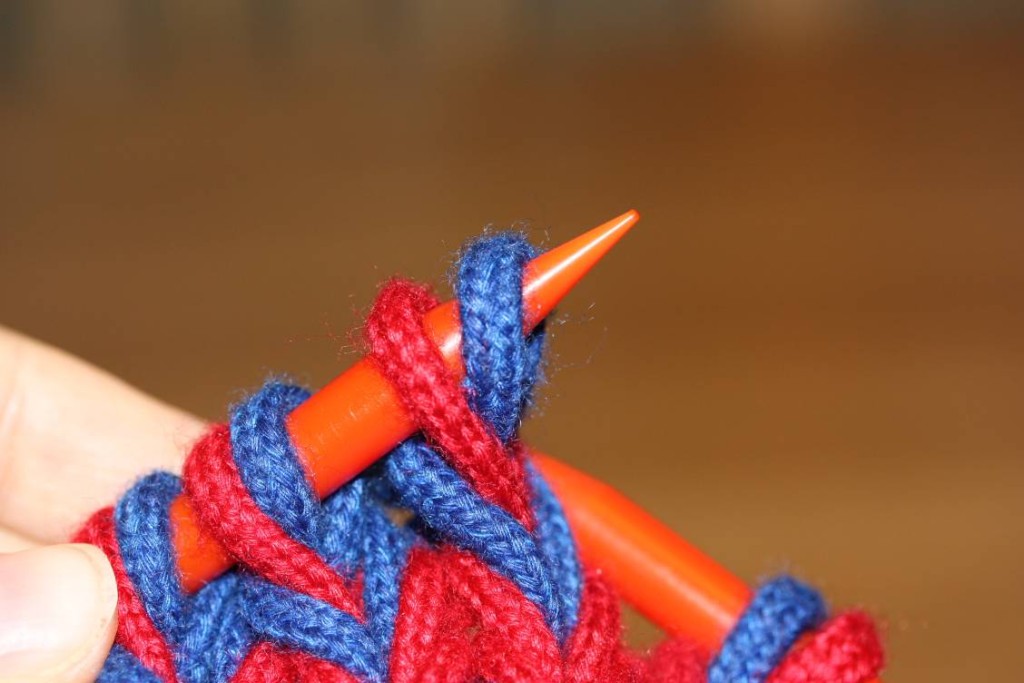
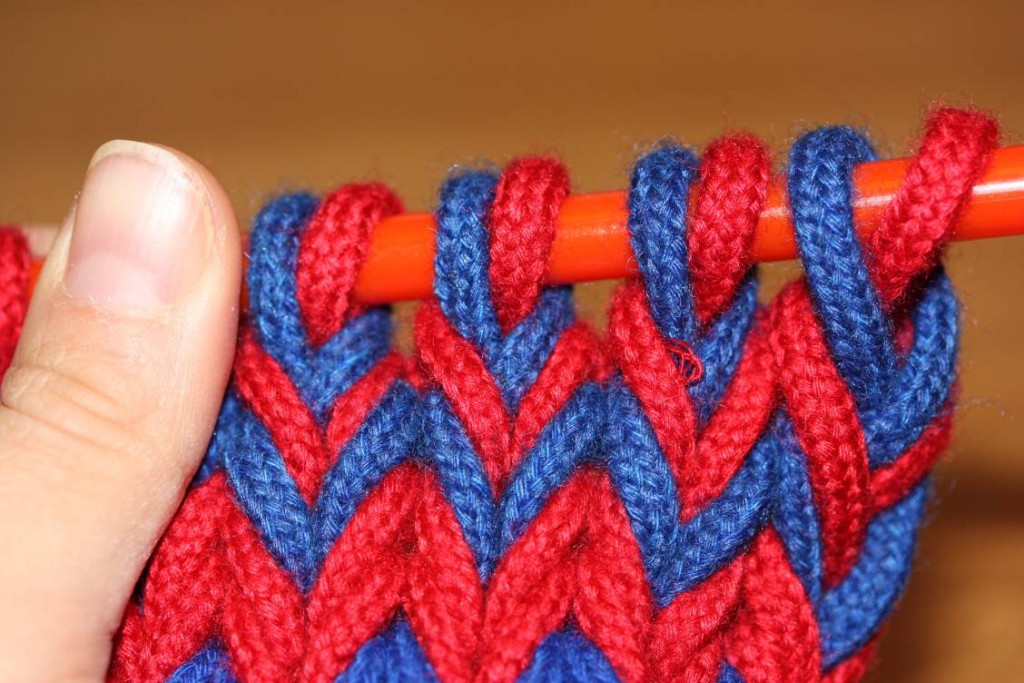
Oh, and I've taken the whole shebang over to utterly oversized demo needles - so things should be clearer visible now. The "regular" towards-the-right row is knit in blue, the return row in red. As you can see, the blue stitches are all twisted (left leg crosses over right), while the red stitches all are untwisted.

[caption id="attachment_2043" align="alignnone" width="300"]The result of the return row: the stitches are untwisted. The result of the return row: the stitches are untwisted.


Remember the observation that the stitches lie differently from the first post in the series?

[caption id="attachment_2042" align="alignnone" width="300"]Stitch alignment as resulting from following the instructions correctly: red stitches with left leg in front, blue with right leg in front. Stitch alignment as resulting from following the instructions correctly: red stitches with left leg in front, blue with right leg in front.


The instructions result in a different alignment of the stitches, so that the stitches of the return row (which is worked onto the left needle) are sitting with the right leg in the back. Consequently, when working only the return row, all stitches will be untwisted, resulting in the correct fabric. When working the two rows alternatingly, the towards-the-right row (blue) stitches are twisted and the return row (red) stitches aren't.

There are two possibilities to deal with this. As you are slipping stitches a lot anyways, you could just slip the two stitches individually on the towards-the-right row, re-aligning the first one (the one on the right) so that the left leg is in front.

[caption id="attachment_2041" align="alignnone" width="300"]One option: realign the stitch to be pulled over so the left leg is in front of the needle. One option: realign the stitch to be pulled over so the left leg is in front of the needle.


Or you wrap the yarn around the needle the opposite way when knitting the towards-the-right row.

[caption id="attachment_2040" align="alignnone" width="300"]Wrapping yarn the other way around, so the left leg of the stitch will lie in front. Wrapping yarn the other way around, so the left leg of the stitch will lie in front.


Both options will work, and you will end up with the fabric as intended: each stitch going through two other stitches instead of just through one, as modern knitting does as a rule, and with no twisted stitches. It will still involve a lot of slipping, however, even if you work in the round.

So, to return to one of the earlier questions... is there a less slippery, possibly more efficient way to do this? Stay tuned to find out more!
0

By accepting you will be accessing a service provided by a third-party external to https://www.pallia.net/

Kontakt