







Latest Comments

Guest - Aislinn Dyestuff Citizen Science.
09. Oktober 2026
This is a great project. I look forward to the results. Thanks for letting us know.
Guest - Aislinn Time for...
09. Oktober 2026
Looks delicious!
Guest - Katrin Sprang Discussion
18. September 2026
Hi Rachel, I have looked for more photos of you, but that was not very successful. I found a link on...
Guest - Beatrix Sprang Discussion
15. September 2026
That lozenge pattern element is not a photograph, but a scan. So it should be to scale. But I pinned...
Guest - Katrin Sprang Discussion
15. September 2026
I was not referring to Rachel's reconstruction (is the reconstruction you refer to the one photograp...
JAN.
28
0

Documentation is key.

If you've heard one of my presentations about Experimental Archaeology, the chances are high that you have also heard me talk about what defines an archaeological experiment. ExpArch has become a buzzword in recent years, and the term has often been applied to things that are not real experimental archaeology - because it seems to sell well, or excite people, or those doing the description don't know better, or for whatever other reason(s).

Experiments in general are very clearly defined: They are a process that is designed specifically to answer a question. The experiment design has a very great influence on how much of an answer you get, and on how general the answer can be - if you are doing a chemical experiment with, say, helium, you cannot tell things about what would happen with oxygen, or hydrogen in place of the helium.

Experiments, to be called such, also have to be documented clearly, accurately and objectively enough to allow the experiment to be repeated - and the outcome, if things are done correctly in each instance of the experiment, should be the same or at least very similar. This means anybody can, theoretically, replicate a given published experiment to test the reliability of the experiment itself and the answers it gave.

Which means that a proper archaeological experiment needs to be objective, it has to be repeatable, has to be designed to answer a specific question, and the design of the actual process has to be suitable for this  answer - you cannot say something about oak working if you used beech, and you cannot say something about the suitability of old tools if you use modern ones. It also has to be documented accordingly. Everything else is not archaeological experiments - it can be tests of tools and techniques, or archaeotechnic, or playing around, or making replicas, but it's not an experiment.

Now, very obviously, as soon as you go into archaeology, things get a little messier than in a nice, clean chemistry lab or physics facility, where you have controlled environments, controlled substances, and measurable outcomes.

The materials for archaeological experiments are very often natural stuff - and there can be a huge difference between wood and wood, even if it's the same tree species. Plus there's the human factor - craft skills are an important factor, and they are hard to quantify. Many things are also subjective, such as the preference of one style of working over another, or one tool variant over another. Which means that "objective" will, in various instances, turn into "as objective as possible" and "repeatable" into "as repeatable as possible" - since you cannot use the same tree twice. (In some cases, modern stand-in materials can be used to get better repeatability. I've learned about experiments about flint-knapping, for instance, that use specifically made ceramic cores for knapping: similar characteristics for the breaking, and uniform without flaws.)

One of the key things to still get workable results is... documentation. There's no such thing as too much documentation! This is especially important when human factors come into play. It's also important to keep in mind that these human influences may be very significant, and to document (and describe, and publish) accordingly. Even if it's not a proper, full-fledged archaeological experiment, but someone or a group trying out techniques, good documentation of the tests can make a world of a difference when you are trying to make sense of things - or just trying to get an inkling about a single person's skill development.

A very good example of documentation for this can be found on Agata Ulanowska's site. She's lecturing in Warsaw and has been giving courses about old textile techniques for several years, teaching students how to do things like tablet-weaving. For those courses, she's giving out documentation sheets, making it possible to track the progress of each student as well as getting an overview about times for designing, weaving, and finishing projects. The sheets are downloadable from her page (scroll down to find them) - maybe they will be helpful for you as well!
0
DEZ.
15
0

Links for you.

It's time for links again!

Here's one to an ongoing comparison of fingerloop braids, together with instructions for each band, from Silkewerk.

Variations on yarn-overs, from Ysolda's blog. Just in case you want to tweak the size of your yarn-overs to make them exactly the same size.

If you read German and like things that make noise and stink (also known as ancient fireweapons), the page of the Bummsbrigade Hamborch should be just the thing for you. (If you don't read German, they are working on an English version of the page, according to said page, and you could look at the pictures of their stuff, "Zeug", meanwhile.)
0
DEZ.
03
0

Winter!

It's very grey and wintery outside these days, but we still have no snow - as opposed to where my parents live, they've already had some of the white stuff.

It is nice to slowly migrate towards the calmer time of the year, though. While there are still plenty of things left to do hereabouts, there is no more fair or show or market for now, which greatly reduces the urgency of certain things. And that is a very good thing, as I still feel like I could use some more days off to relax and regenerate.

For now, though, having some nice quiet time in the evenings and looking forward to the weekend will have to do. Oh, and motivational hot beverages help as well. Plus chocolate. And the fact that it is pleasant work, overall - even if it is still work.

Just in case you would rather like to learn something new (or old) instead of reading me rambling on about the weather and wanting some holidays, here's a website helping you learn Middle English. Chaucer, anyone?

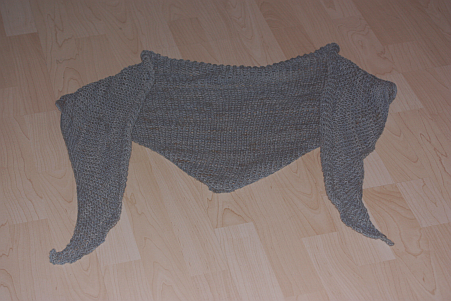
Or maybe a gratuitous knitting pic? I've succumbed to the lure of all that yarn while at the Kreativ, plus it was cool in the hall - so I just had to cast on for a snuggly triangular scarf/shawl. It's made from one skein of sock wool in the "Jeans" colourway, dyed by Margit from Alte Künste. (Here's the shop link.) I finished it a few days ago, and I've been enjoying its snugglyness ever since.


0
NOV.
26
4

Tool Talk: The Ashford "Student" Handspindle.

Ashford is a New Zealand company that is well known for its spinning wheels, and I have heard quite a few people rave about said wheels. They also offer a small assortment of drop spindles, both bottom whorl and top whorl ones.

These spindles are... well. Very simple in form, with a wooden disc (that may be partly hollowed out) as a spindle whorl, attached permanently to the spindle shaft, which features a hook at the whorl end in case of the top-whorl or dual-purpose spindles. The spindle shaft itself is just a ramrod straight rod.

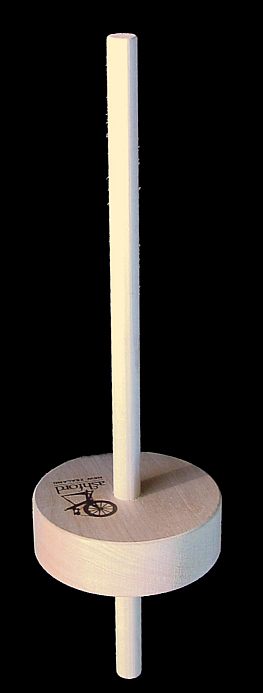
I've seen pictures of these spindles before, but I had not seen one in real life, or held one in my own hands. That, dear reader, changed this last weekend. One lady who was at the Kreativ fair brought her spinning, done on an older model of the Ashford Student spindle, and I was really, really shocked. Not about the spinning, or I should rather say I was shocked in a good way about the spinning.* The real shock was the thing they had sold her as a spindle. FOR BEGINNERS. It looked like this:


As you can see, it's a tree trunk glued into a wagon wheel. This is not a spindle. It's very, very far from being such a thing. It's even less a spindle than the specially designed spindles that I used during the spinning experiment back in 2009, and I haven't yet heard the end of how horrible those things were.


After recovering from the first shock, I put the thing onto my scales. The spindle weighed a whooping 118 g. One hundred eighteen grams. That's about three of my normal spindles together. (There was a bit of wool on it, but not more than 2 or 3 g at the most.) The spindle shaft was about 1.5 cm thick throughout, even at the top, and the whorl was probably about 3 cm in thickness.

This is like handing a sledgehammer to a child to learn how to hammer little nails into a little piece of wood. It's like handing a blunt-edged sword to someone and expecting that someone to cut neat filet pieces from a mouse carcass. It is that unsuitable to learning how to spin. Firstly, there's biomechanics: You need to get the spindle into motion. That is usually done by flicking it between your fingers. Have you ever tried to flick a tree trunk into motion? Seriously, it's a big deal how thick or thin your spindle end is - the thicker, the less effective your flicking motion will be.
Add to that the sheer weight of the thing attached to the tree trunk, and you need serious muscles to get that thing going. Once it turns, it will go on for a bit - but that is only if you actually managed to get it going. (I didn't. I failed miserably at trying to produce a thread on that thing. This is the first thing that calls itself a spindle that I did not really manage to spin with. Granted, I only tried for about 30 seconds because it was just so much not a spindle that it was very not-fun to use it.) Oh, and because the shaft is not tapered, the spindle will have a serious wobble: the thread attached with a half-hitch is a good bit away from the centre of rotation of the spindle, which obviously goes down the center of the tree-trunk-and-wagon-wheel contraption. Result: An ungodly amount of wobble.

In addition, the sheer weight does what spindle weight always (and exclusively) does: It gives you a realtime quality control. Your thread will break if it cannot support the weight of the spindle. That, per se, is not a bad thing - you don't want your spinning to break on the loom, for example, and then it's much better to find the weak spots during production of the thread. However, to spin a thread that will support 100+ g of weight, you need a serious amount of fibres. Even more if your spindle doesn't deliver twist fairly quickly... which, guess what, this thing doesn't, as you cannot get it to turn quickly.
Theoretically, now, you could use a spindle that is too heavy to spin supported. Which only works if the bottom of the spindle shaft is... pointy enough so you don't lose too much momentum to friction. The bottom of that thing was exactly as tapered as the top: not at all. There you go. Producing anything vaguely yarn-like on that is no mean feat and deserves a lot of respect.

How on earth can anybody recommend that thing to a beginner?** I know that there's an inclination to hand indestructible boat anchors to beginners, but this is even worse than the least appealing of boat anchors I have seen before. Much worse. It is suitable to pound nails into walls, or to cook a three-course meal over an open fire using only one of the spindles as fuel, but not for spinning. You can probably learn better how to spin if you stick a stroopwafel*** onto a pencil, or a grape onto a toothpick. Spindles like that thing are the reason why competent wheel-spinners say that they cannot use a hand-spindle. They are probably also the reason why people who want to spin very quickly buy a spinning wheel.

If you are an aspiring spinner, find yourself a spindle that turns reasonably fast and is reasonably easy to set into motion. If the spindle seems too fast and you can't keep up with drafting, you can always park-and-draft. Don't go above a weight of max 70 grams - that is plenty to learn with, will result in a sturdy enough thread and still allow you to spin a little thinner than rope. (You can as well start with a weight of 30 to 50 g - still enough.) Make sure the spindle shaft tapers enough towards the top so you can twist it easily, and the spindle won't wobble too much. If you like to have options, look for a taper at the bottom of the shaft too, so you can spin supported. And if you like to have even more options, get a spindle shaft without permanently attached whorl, then you can randomly stick all kinds of roundish objects with a hole onto it and see what you like best.

If you have tried to learn hand-spindle spinning with a similar inappropriately named object, but have given up? Please give it another try. Take a round chopstick and fix a 30 g bead to it, or something similarly roundish and in a weight range of 30-50 g. A few round cardboard coasters, glued together, are a more slowly turning alternative. Don't let the tree trunk glued into a wagon wheel keep you away from that wonderful and wonderfully portable technique.


* The spinning was fine. I'm still amazed at the sheer tenacity it must have taken to spin on that thing. She went away with new spindles, by the way. And with a much happier look!

** To be fair, Ashford have since changed their spindle form and weight a bit, though only slightly, and I would not recommend the more recent ones for spinning either. Especially not for a beginner spinner.

*** A stroopwafel is a round, thin, sticky-sweet Dutch speciality: a wafer filled with syrup (stroop).

****Hint: the first makes for a very wobbly spindle, but also for a good snack; the second one is very small and will fall apart as quickly as the first, but is a healthier snack.


0
OKT.
27
4

Gaah. Sometimes it just won't work.

I have worked some more on the spinning wheel tuning project - and it was frustrating. Sometimes, you sit down and try things and make a prototype and do the maths and then you go for the real thing and everything works beautifully. This, however, was not one of these times. About nothing in the current setup worked as planned.

The two whorls I 3D-printed are too slippery to give good traction to the drive band. (3D printing is still very cool.) So... I tried to make the drive band less slippery. I had had wonderful de-slipping success some years ago with using Seamgrip, a sort of glue originally intended to fix holes in outdoor stuff like tents. Unfortunately, the new tube of SG that I ordered made the thread I had planned to use stiff and slick, not supple with a rubbery outside.

So, after a while of fiddling and some more fiddling and lots of cursing, I have now switched back to the prototype setup from before, which was always intended to be temporary. For the current spinning tests that I have to do, this is what I will have to use - provided it will work well enough.

After that, I will have to sit down and plan again. I have not given up yet - but it looks as if there has to be some more fiddling and making of parts before my original plan can be implemented.
0
OKT.
24
3

More Open Access stuff. And a bleg.

The OA week has provoked some more blogging, not only here. Doug has posted a longish article about OA publishing concepts that sound a lot more reasonable than the ones I ridiculed yesterday. And one before that, with a lot more information about free or affordably-priced OA journals, and links to said journals. Go read it here.

In other news, I'm still busy editing (the Beast is losing words - it's like a book diet!) and also preparing for the Textile Forum. Additionally, I am thinking about offering an embroidery set for doing a small medieval motif, about 4 cm in diameter. I would like to offer that as a complete package with cloth (that has the pre-inked design), naturally dyed silk thread, maybe gold thread, short instructions and possibly also a small (non-medieval, but affordable) embroidery frame. Suggestions as to motifs would be greatly appreciated!
0
OKT.
17
0

Even more sprang.

After yesterday's blogpost, I had some more of a look around the internet - and lo and behold, there is one of Dagmar Drinkler's presentations online.

You can download it, as a pdf file, here. It's in German, but even if you do not read the language, it might well be worth a look, since it contains a huge number of pictures of tight-fitting legwear, plus a number of pictures of sprang with diverse patterns.

And with that, I shall leave you to the weekend : ) which I am planning to enjoy thoroughly!
0

By accepting you will be accessing a service provided by a third-party external to https://www.pallia.net/

Kontakt