Latest Comments

Guest - Aislinn Dyestuff Citizen Science.
09. Oktober 2026
This is a great project. I look forward to the results. Thanks for letting us know.
Guest - Aislinn Time for...
09. Oktober 2026
Looks delicious!
Guest - Katrin Sprang Discussion
18. September 2026
Hi Rachel, I have looked for more photos of you, but that was not very successful. I found a link on...
Guest - Beatrix Sprang Discussion
15. September 2026
That lozenge pattern element is not a photograph, but a scan. So it should be to scale. But I pinned...
Guest - Katrin Sprang Discussion
15. September 2026
I was not referring to Rachel's reconstruction (is the reconstruction you refer to the one photograp...
SEP.
18
3

Normal life has me back.

Now, slowly, I remember the things that I was planning to tackle before the Forum took over completely - smaller things as well as medium to big things (like the website relaunch, finishing an instructional video for netting and finding out how much fabric is needed for the new small market stall).

Yesterday, though, was mostly spent with the experiment dataset. I'm still looking at and photographing each spinner's individual output and playing around with the weights spun to see if there are general tendencies. And there are, and yet not. While for example spinner A made a totally predictable yarn only influenced by the fibres - with one fibre smoother, thinner yarn than the other - other participants have two sorts of yarn, quite thin and very thick, and they have no obvious connection to either spindle or fibre. It does need a seriously wacky spinning instrument to throw them out of their usual yarn type and thickness range, though, and sometimes not even the wackiest of spindles will do that. So this is a very intriguing start, and I hope I will find some more connections or possible connections.
0
SEP.
04
0

I can't believe it...

I have a really hard time believing that the Textilforum will be so soon. After preparing for it since we conceived the idea last year in October, which feels like ages ago, it's a kind of weird feeling that it all actually happens. And I am really, really excited about it, packing, printing and preparing like a madwoman. I would like to take my entire stack of things, projects and literature, but alas - I will have to sort out a few things that are most important to me and take only those.

While I'm busy, you can go and look at two Youtube videos about spinning worsted style and woolen style, posted by Ruth MacGregor (who will also come to the Forum). She's showing how to spin woolens and worsteds, and I finally really understood the difference between them. Besides, when you can't do some actual calming, comforting spinning, these videos are almost as good for calm and comfort - thank you, Ruth!

(And watching this video made my fingers itch. Badly. Very, very badly. I think I need to sit down for some quiet wheel time one of these days...)
0
SEP.
03
0

Repetitio est mater taediorum!

I think that the red digits of numbers 9, 10 and 11 are already burned into my retina from weighing and packing about 300 portions of wool. And making little paper documentation slips for packing with the spun threads is not as tedious as writing each by hand, but still... change spindle type. change date. save as. print as pdf (two pages). change spindle type. change date. and so on. repeat with changed session and wool. That's somehow... mind-numbing. (But I'm finished now, and only need to print out the .pdf files.

Add to this the fact that I have decided (half-last-minute) that it would be nifty to make a statistic of how all the whorls turned out, and that it would be good to have a more accurate weight for all the plastic bags with wool in them, and voilà! there I will sit weighing things again. Once I've made it into town and bought some appropriate scales, that is.

Otherwise, not much has happened - I'm still thinking and preparing for the Forum and the experiment, while inbetween trying to take care of the last things that have stacked up during my holidays. And as usual, things always take longer than they ought to - and I'm sorry for whining that much, right in front of your eyes, right on your screen...
0
SEP.
02
0

Experiment, more of the (almost) same

Since yesterday afternoon, fourty plywood discs in two different sizes and thicknesses are peacefully lying on a heap together, completing my selection of experimental spindle whorls. Thank goodness for the invention of power tools and "circle cutters"! Though even with that multi-watt support, it took me a while of fiddling with the large plywood sheets, the cutting gadget (a very cheap tool and accordingly fiddly to use) and the drill in its stand before I found out how to best cut the discs. But in the end, the archaeologist prevailed!

Now all the hard bits of the preparation are finally finished, and the whorls have turned out not to be perfect, but at least very good, and absolutely sufficient for the experimental purposes. So whew! The power of trial runs and solid calculations (with a huge lot of help from André Verhecken) is proven again.

A lot of the wool is already portioned and packaged, and today I'll take care of the rest of packaging before finishing the plywood with a light sanding around the edges and then... glueing the spindle whorls and spindles together.

This is something I would never do under ordinary circumstances. Who would want a spindle that can't be equipped with a different whorl, after all? "Those folks" back in the middle ages certainly didn't need glue to keep their spindle whorls on the spindle, the double-conical form was enough.

But since I am using chopsticks as spindle sticks (totally non-medieval, just like the plywood and the modern glue for assembling these), and since the plywood needs some glue to keep on the stick, and because I just want to make sure that none of the whorls slips off during the experiment, glue it is.

After the spindles are assembled, there's not much left to do for the experiment - preparing the documentation, writing down my notes for the "prep talk" before we start and packing all the things needed for transport to Eindhoven, no more. And well that this is so, since the experiment will start on Tuesday morning next week.
0
SEP.
01
0

Experiments are Awesome - but lots of work...

I'm still weighing and packaging wool, preparing spindles and preparing "starter yarn" for the spinning experiment, so the living room is quite taken over by the huge box of unpacked wool and the boxes with wool in plastic bags. Thankfully, once the air is out of the bags and they are sealed, they are pretty slim and thus quite manageable. I think I've never weighed and portioned off so much wool in my entire life!

While thinking about experiment details yesterday, I have also found a solution to keep all the spinning procedures as much the same as possible - which means to slide off the spun yarn after the first hour and start a new batch with the second wool type, again with an empty spindle and using a starter thread. And fortunately, I have also found something to slide the spun wool on.

There's still things left to decide, though. Should the spinning be done with the two wools in the same order every day? Say, first the fine and then the coarser wool, or vice versa? Is it better to do spinning of one spindle on one day, or is it better to change spindles and spin with two different ones, a new one after the first hour? Maybe this changing would diminish a big "getting-used-to" effect (but then, I'd guess that getting used to a new spindle won't take longer than five to ten minutes). Still, changing spindles would give at least a bit of the need to get used to it back, especially since changing spindles in the experiment means a vastly different tool to work with. And it would give me enough time to slide each bunch of spun yarn off the spindle stick and onto its storage tube, weigh it and label it as necessary.

Details like these are what I find so very fascinating about archaeological experiments. Even if you take a very simple thing to find out about as the basis of the experiment, it will get down to details that might not seem much at first glance, but that might be making or breaking the whole thing.
Our experiment basic idea is quite, quite simple: Find out about the influences of the different factors in spinning with a hand spindle. There are only three main factors, the spinner, the fibre, and the spindle itself; but the latter already offers two influencing elements, its moment of inertia and its weight. The spinner's influence can only be estimated if all the other influences are well known, so we only need to find out about these. The approach to that is like in any laboratory work: If you want to find out what a specific value does, just change that value and nothing else. And that is exactly what we did in designing and calculating four whorls, starting with a "reference whorl" corresponding to an actual archaeological piece in both weight and moment of inertia. (This, by the way, was not easy - the calculating was, but trying to guesstimate the shrinkage of clay from wet to fired and developing a method to get whorls all alike each other did prove difficult.)

So now we have five whorls and two sorts of wool, fine and coarse - the only thing we need to do now is run the actual experiment, with up to twenty spinners each spinning ten hours altogether, one hour per fibre and spindle. And, of course, deciding which spindle goes into action when, and with which fibre, and in what order. And what to document, and when, and how (you can never document too much, but you can't write down something that you haven't thought about...). And how to label each test batch. And, and, and...

Which gets me back to the title of today's post: Experiments are Awesome! But they always seem to multiply their demands on time and brain cells. And they never end up as harmless as they seem at the beginning.
0
AUG.
31
3

Back on Blog!

I'm back home from a wonderful, relaxing holiday time, and now I'm settling down to the last preparations for the Textile Forum.

The whorls have been fired in the meantime, and they are now safely sitting in a box on my table, waiting to get equipped with a spindle stick each. Using the special "whorl-cookie cutters", that were custom made to my calculated measurements, worked really well. The whorls came out very much alike, they fit the sticks very nicely with their holes, and so I'm quite confident about the whorl part. I snuck back to work yesterday already, spending some time to portion and package the small parcels of wool to give out at the experiment, making sure that everybody gets the same amount of wool to work with.

Now there's the obligatory stack of e-mails to go through - as usual after being away for some days - and the last bit of preparation to make. And very soon it will be time to start writing the lists for packing and gather together all the stuff!
0
AUG.
06
2

To Loop or Not to Loop?

I'm sorry this blog post comes so late, but I seem to have caught some kind of summer flu or similar illness. There will be no blog post tomorrow, but I hope to be fit and blogging again on Monday.

I have long been fascinated with fingerloop braiding (or loop manipulation braiding, if you prefer). It is an amazing technique with some disadvantages, but many advantages - the two most important, in my opinion, being ease of working and speed.

There has been a discussion recently in Cathy's costuming blog concerning the manufacture of a six-ended braid in red and yellow to go on a viking apron dress. And I'm afraid I haven't convinced the participants yet that fingerloop would be the thing to use...

What makes braiding difficult is the number of strands. Everybody who has done some single-end braiding knows this: While three ends are easy to handle, five ends demand considerably more attention and practice, and more ends even more so. For a braid with six ends, this means it will be quite time-consuming.
Here enters Fingerloop - to the rescue! With a loop-braiding pattern, it is possible to create almost any* traditional braiding pattern, with exactly half the amount of "ends" to handle. A six-end conventional braid becomes a very fast and easy three-loop-braid, resulting in the same braided pattern as the single-end version. For uneven numbers of ends, the solution is nearly as simple: for a five-end braid, just braid a normal five-loop pattern without turning any of the loops, and you'll end up with two five-end braids.

Because I find that the loops are much easier to handle than single ends, I personally do prefer the loop-braided version. The disadvantages are there - like a tendency to get a tighter braid towards the end, the stubbornness of mistakes (they are very hard to undo) and some technical difficulties for longer braids (though you can enlist somebody to carry the shed, or carry it with your toe, or even build a contraption for beating), but to me, they are far outweighed by the ease and speed of loop-braiding versus single-end braiding.

And to come back to Cathy's problem with the six-end braid, here are some possibilities for a three-loop braiding solution:

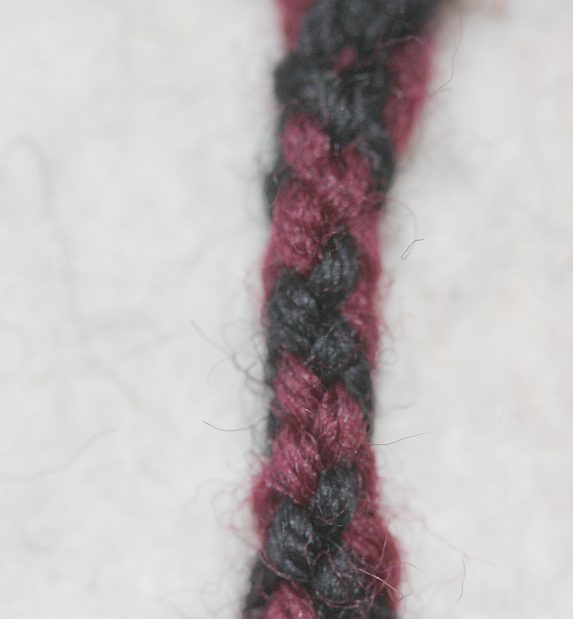
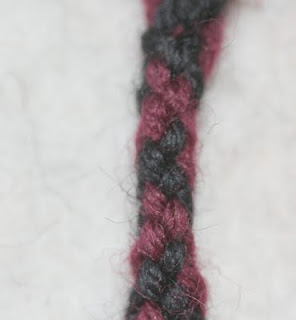
This is a simple three-loop braid, with loops consisting of one black and one red shank, both hands taking the loop turned (the lower shank becomes the upper shank on the other hand). It's quite firmly braided, bringing out a nice pattern of triangles in red and black.


This is the same setup, braided more loosely, with the loops turned 360° instead of 180° (so the same colour stays always on top).


This is a 3-loop braid made with 3 differently-coloured loops - one red, one black, one light gray, to show the structure better. Both hands taking their loop turned.


And this is the same setup, but only one hand taking the loop turned - resulting in a double-width band.


Such a double-width band with parted loops (half red half black) will result in a band that is black on the left and red on the right (or vice versa) if the loop taken turned is turned 360° and a kind of "checkered" band with black left and red right, then changing to red left and black right after a while and so on.

There are actually lots of variations using only two colours. And that's another thing I like with fingerloop - even if the colour scheme will not be intuitive, by changing the loop colours, making them from two differently coloured ends, or changing the turning sequence, many different variations can be produced.


*The exception to this is four-end whipcording. It's not possible to recreate this, but then, it's not necessary: whipcording is easily done with bobbins, and quite fast with two persons working.
0

By accepting you will be accessing a service provided by a third-party external to https://www.pallia.net/

Kontakt