Latest Comments

Guest - Aislinn Dyestuff Citizen Science.
09. Oktober 2026
This is a great project. I look forward to the results. Thanks for letting us know.
Guest - Aislinn Time for...
09. Oktober 2026
Looks delicious!
Guest - Katrin Sprang Discussion
18. September 2026
Hi Rachel, I have looked for more photos of you, but that was not very successful. I found a link on...
Guest - Beatrix Sprang Discussion
15. September 2026
That lozenge pattern element is not a photograph, but a scan. So it should be to scale. But I pinned...
Guest - Katrin Sprang Discussion
15. September 2026
I was not referring to Rachel's reconstruction (is the reconstruction you refer to the one photograp...
JUNI
03
2

Oh, do we have a video?

For the exhibition next month in Bad Staffelstein, we have planned to install a TV somewhere in the rooms and show some video snippets of textile techniques there - because if you've never seen a handspindle before, you can probably not imagine how it looks being used and how it works. So today is the day that we will make the video for the snippets - thank goodness for friends who are always helpful!

I'm planning to do spinning, netting, tablet weaving (showing some twill sequences) and a bit of fingerloop braiding. I hope we can get all this done, and I have to get buzzing now to prepare everything so it won't take too long to change technique.

And I still have to decide whether to wear modern or medieval clothing...
0
MAI
29
3

Netting Needles, hooray!

I've been busy with some scheming, and it looks as if I'll be able to teach netting soon in the future. We have found some material to work netting needles that does not involve hours and hours of hammering a thick rod down into a thin rod, and thus needles can be made that won't cost a fortune. The first two of the new generation are still unpolished but about finished otherwise...

Beautiful tools, made after a proper source (an archaeological find from London), to spread again knowledge about an old, beautiful textile technique - what's not to love?
0
MAI
22
5

Chopsticks, chopsticks!

I am inundated in chopsticks, and that is a Good Thing - because these cheap, all-alike, slim and slightly conical things will serve as the spindle sticks for the Spinning Experiment.

I have thought long and hard about what I could take for the experiment. One of the first ideas was to have twenty spindles and four different whorls each, and rotate the whorls during the spinning process. But then there is another variation in the process, one we can't measure or calculate: The order of spinning with different spindles in the test. What if it makes a difference whether someone starts the experiment spinning with spindle A and then B as opposed to spinning with spindle C and then A? And so on? So I arrived at the conclusion that the safest bet would be to give everybody the same spindle at the same time.

Which means making one hundred twenty spindle whorls (plus a few to spare in case of unforeseen desasters). And ideally, attaching all those whorls to a spindle stick so that they can't slip when you drop the spindle (something I do fairly often with an unknown, new and maybe awkwardly running spindle). Which means - as one possible solution - to glue a stick to each whorl. Which in turn means making one hundred twenty spindles glued together... with identical whorls and identical spindle sticks. There. Since our budget is not so big (read: nonexistent), cheap was not an option but a requirement. And slim, identical, slightly conical-at-the-top, round sticks for little money? You got it. Chopsticks.

That is why I am sitting here with a box, newly arrived, containing one hundred pairs of Taiwanese bamboo chopsticks. Next time, when we have won the lottery got a budget for a similar experiment, we might use proper sticks for another spinning experiment. For now, bamboo will do.
0
MAI
14
0

Progress... and tablet weave insights

I've almost won my struggle with the unwieldy article - just the pictures left to insert, a once-over on the text and bibliography, and then it's finished. Whew!

In other progress news, I did a bit more on the play-band yesterday evening, so the warp is almost used up now. Besides playing around with turning sequences and finally trying a few pattern variations I've wanted to try for ages, I have arrived at the conclusion that for weaving freestyle knotwork patterns, the "less is more" approach won't work properly.

I set up this play-band with twelve tablets only, because that is a number that will already allow to see some interesting patterning, can be divided into two small, easy to handle packs of six tablets when doing a split of direction in the middle, and is fast to work even in twill - since there aren't many tablets to shift from one pack to the other. Because the band is intended as a teaching tool/workshop helper, those were things I thought important (and I'm still sure it is a very good width and setup for learning how to do twill).

To give me a greater variation of things to try out on the band, I looked for pattern inspiration on other bands (both my own, older play-band sequences and pictures of bands on the internet). There were some simple knot-style patterns that I drafted for trying on my band, and to my delight I found that an astounding lot of patterns will just be possible to do with such a slim band.

However, when weaving those tiny patterns with knotwork elements, I found that while twelve tablets will technically work, it is utterly complicated... because there is so little time. I'd finish one of the red pattern lines, running from the outside to the middle of the band and going back into twill to have only that pattern line visible on the band. But the band is so slim that I can't get into a proper twill pattern there, because already a complete reversion of weave direction is needed, or I have to start out on the next pattern bit. And the other tablets also need attention because of go-into-twill, come-out-of-twill or some patterning in their sequence. That is just too much on too short notice and too little room - and I imagine that on a wider band with more tablets, there is much more time to let this section twill on quietly while you care for the pattern bit in the other section. Also, the sets of tablets going mainly this or that direction were too small. Try working a twill structure with 12 tablets divided into four sets - that is three tablets only per set; much too few to see the structure or get into the rhythm of the thing. And rhythm and structure both are very important to me when weaving, since I hate nothing more than following a pattern draft line by line and counting off tablets (first forward, second backwards, third and fourth forwards, yuck!)

Well, since the play-band is almost finished, and since I have some nice silk lying around for a wider band, and since I wanted to weave a slim belt for some fittings I still have around... I think I'll make the warp for the new band a tad longer and play for a bit, just to see if freestyle knotwork is better possible on a band with 40 tablets.
0
MAI
12
2

Spinning Experiment Calculations

In preparation for the spinning experiment on the Textilforum, I need to figure out how much fibres to calculate for each participant. And to get a first impression, I spun with the carded and combed wool I have at hand - one hour in my normal thickness, and another hour as thick as I could manage.

Now I'm one of those people who have a very limited range of thickness when spinning. And (unfortunately for this purpose) it is rather on the fine side. So I ended up with two very different-sized balls of yarn; I wound them off today and weighed them with my letter scales.

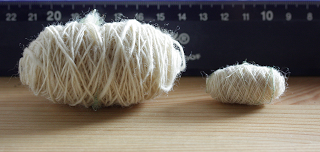
The "Thick Yarn" weighs in at about 8 g for one hour's spinning time. It is pretty uneven, in spite of my trying oh-so-hard to spin a decently smooth and even yarn. Thick stuff is just not for me. Here you see the sorry results of my thick-spinning:


Beside the huge (haha), bulky and uneven ball of thick yarn, you can see what I spun as my normal thin yarn. The weight? Somewhere between one and two grammes. Both yarns spun with the same wool on the same spindle (which was about double the weight of the reference whorl for the experiment, and fitted with a rather heavy wooden spindle stick). When wound onto a ruler, the thick wool gives about 20 threads per inch, the thin one about 12 threads per quarter-inch.

So now I've outed myself as a thin-spinning freak, can any spinners of thick yarn out there give me a rough estimate of how much fiber in grammes they hand-spindle away in one hour? Just to check against my calculations? I'd be very grateful...
0
MAI
11
2

The sun is shining, the grass is green...

That was a really pleasant, wonderful and relaxing weekend - spent mostly at home, doing necessary things for the medieval gear (like cleaning and shining shoes and washing textile stuff) at a leisurely pace, eating yummy things (like really tasty asparagus and strawberry cream cake), reading and doing some fun weaving.

The fun weaving is in preparation for a tablet weaving workshop, scheduled for August. The workshop is meant to teach people already experienced with threaded-in patterned tablet weaves how to do free patterning and double-faced weaves in twill structure, by showing the underlying mechanics of the weaving process. And in preparation of this, I'm weaving a "play-band". A band like that - used for playing around with different turning techniques and developing patterns - is what we'll weave in the workshop, to each her (or his) own play-band.


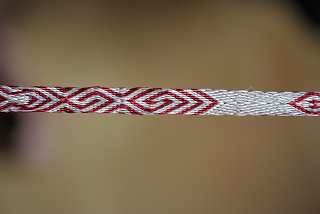
The warp I made for my preparation thing is relatively thick, plied silk yarn in red and off-white. I used the opportunity to try some patterns I had drafted from other bands before proper playing, but the hours yesterday were spent with fun combining of turning sequences, pattern pieces and twill. The thing I like most about play-bands? First of all, there are no real mistakes. You can just do things. The worst that can happen is that either you get totally blown away pattern-wise and have to turn the tablets back into starting sequence, or that you end up on the back of the band with your pattern. Then you can either tablet-turn your way up again or you just flip the band and go on where your pattern has gone to. And occasionally, there's a real nice pattern piece in the sequences that turns up by chance... and on a play-band you can take the time and space to isolate this pattern bit by placing it on a twill background.

And I had an obscene amount of fun yesterday weaving this pattern bit:


Guess which of these three will win the race?
0
MAI
07
0

The new hairnet

Because the spiralled net was more or less a practice piece (to try out spiralling and to get my fingers back into netting) and because netting really is a surefire way to attract attention to textile works while keeping the mind unoccupied enough to chat with people, I started a new net right away in Freienfels.

It has the same huge 4 mm mesh size, but is worked with much thinner thread, so it's much closer to historical pieces. The thread might still be thinner, and the mesh could be smaller, but I'll take it slowly for a change. Plus it's not so easy to get superthin yet resilient silk thread.

Here you see the new net after nine hours of work. Cast-on went a lot smoother this time, since I stuck to the tried and tested method described by Therèse de Dillmont. Even though, it felt really fiddly due to the thin, fly-away threads (and since I did this out of doors, there actually was some wind to "help" from time to time). I'd say that netting with the fine thread does take a bit longer than with the thicker thread, even with identical mesh size and numbers, because the thin silk likes to crumple or curl up, and I'm a bit more careful with the fine net than with the sturdier one. Hence a little less work speed.
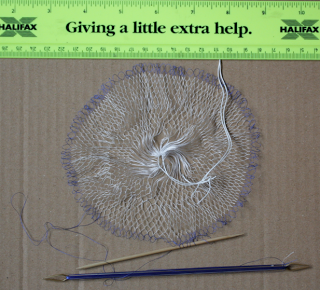

Cast-on loops are about 2 cm long, and cast-on was on a thick linen ply. A second loop of the linen thread serves as holding loop. I have switched completely to working with my new "Nähstein" now that I have finished making it. In case you didn't ever hear of that before, a Nähstein is a weighted pincushion that serves as the third hand to hold netting work or sewing work - and it's so practical! I'll post a picture of the Nähstein in action as soon as I get somebody to take it.

The new net is worked in YLI Silk 100, with the same netting needle and the same mesh stick that I used for the last one (hence the same mesh size). It is worked in the round, and on this picture you can or cannot see the meshes where transition into the next row takes place. Click on the picture to see it larger. Making one full round with the full number of mesh loops takes me about half an hour - so you can go ahead and try to calculate how long the whole thing would take with straightforward netting all through.
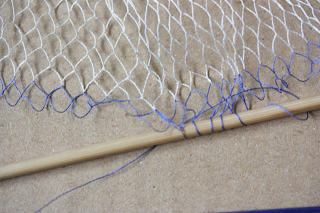

I used the hairnet with the embroidered arms as an inspiration - that is why you see the first rounds of blue netting on the pictures. I'm planning to put pearls on the net, in blue sections. The first test of getting a pearl over the mesh was successful, but it will still need some rows before I do it for real. I'm really, really excited to find out whether it works like I planned it!
0

By accepting you will be accessing a service provided by a third-party external to https://www.pallia.net/

Kontakt