Latest Comments

Guest - Aislinn Dyestuff Citizen Science.
09. Oktober 2026
This is a great project. I look forward to the results. Thanks for letting us know.
Guest - Aislinn Time for...
09. Oktober 2026
Looks delicious!
Guest - Katrin Sprang Discussion
18. September 2026
Hi Rachel, I have looked for more photos of you, but that was not very successful. I found a link on...
Guest - Beatrix Sprang Discussion
15. September 2026
That lozenge pattern element is not a photograph, but a scan. So it should be to scale. But I pinned...
Guest - Katrin Sprang Discussion
15. September 2026
I was not referring to Rachel's reconstruction (is the reconstruction you refer to the one photograp...
JULI
03
6

Steel Needles, Take Two

Yesterday's post is the first to accumulate its comments so fast, and the questions have prompted me to stay with the topic of needles for a second post.

Pins and even more so needles are an archaeological problem - because... yes, you have guessed it: they are so small. This means that unless there is a nest of pins or needles (like we once discovered in a church excavation on the women's side of the aisle, pins upon pins upon pins, probably lost during service and not retrievable, because they fell through the spaces between wooden floorboards) or unless there is a huge stroke of luck, these tiny metal rods will never be found. If they ever survived the corrosive surroundings in damp soil, that is - something that iron or steel might not take as kindly as copper alloy. And then these rare items are so much overlooked - because duh, of course they had needles, that's an everyday item, isn't it? - that there is no collation of needle articles or archaeological needle knowledge yet.

So LH folks today are faced with a problem: What to sew with? Which time knew what kinds of needles or other sewing implements? (And archaeologists as well, should they want to write about needles.)

We have two possible ways to find out what needles were in use. One way is to find surviving specimens, analyse them, and if possible make some replicas and try them out. That, of course, is a really nifty way - only quite difficult because of the scarcity of finds and (you know the sad song by now) because it's oh-so-hard to find published needles.
The other way is by deduction. Nobody can tell me that medieval people (or people in what age soever) bought extremely costly materials like gold thread and fine silk to weave enormously fine fabrics and embroider them all over with beautiful, awe-inspiring motifs using a (needle) bodkin (for the Germans: "Nähdolch" is the term. The term.) and dragging this huge metal abnormity through their costly fine fabric! Fine fabrics require fine tools, after all. And at least I have not had much fun running my well-beloved copper alloy sewing needles through linen or silk instead of wool; they are just not suited to these. So fabric type makes a difference, too.
Deduction, though, will only tell us that some fine needles must have been there, out of due necessity, but no more than they must have been suitable for this or that work and material. So it's back to no. 1 for harder evidence.

There are a few needles in my picture collection, so I bring to you: The Needle Parade!

First, from the glorious and long-past 3rd and 4th century, needle boxes and needles on one of my bad photographs, taken in the Historical Museum Oslo, viking section.


Next finds from Konstanz (Lake Constance), from the 14th century, an array of small things including sewing needles. From LANDESDENKMALAMT BADEN-WÜRTTEMBERG und STADT ZÜRICH (Hrsg.): Stadtluft, Hirsebrei und Bettelmönch. Die Stadt um 1300. Stuttgart 1992. P. 433.


Everybody knows this copper needlecase missing its lid, from the late 14th century London. It still contained an iron needle - and that needle size would match a modern sewing needle. From CROWFOOT, ELISABETH, PRITCHARD, FRANCES und STANILAND, KAY: Textiles and Clothing c. 1150-c.1450. Medieval Finds from Excavations in London:4. London 1992. P. 151. There you go:
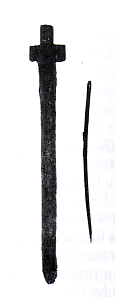


From a special exhibition in the Alamannenmuseum Ellwangen, a needle from the graves at Kirchheim/Ries. My photo, taken with kind permission. It lacks scale, but I would use a needle like that in daily life without finding it special. Graves at Kirchheim/Ries date to the early middle ages, between 6th and 8th century if I remember correctly.


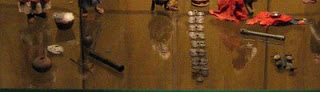
Again from the 14th century: Needles and thimbles from Copenhagen, National Museum, photo taken in the Medieval Section. If you come to Copenhagen, make double sure you visit that wonderful museum - reserve a full day for it, if you can. It is worth it.


That's all I have gathered together during the years - but at least it shows steel sewing needles from as early as at least the early middle ages. If any of you have more needles, please give me a hint - I'm collecting evidence ; )
0
JULI
02
10

Hand-made needles

A few days ago, the postie brought me a small, unspectacular-looking packet. But the contents are really, really spectacular, and another addition to my product range in the stall: Steel needles, completely hand-made!


I had to hunt quite a while to find those beauties, and I'm really happy to have them in hand now. The steel is not stainless, so it needs a little loving care inbetween stitching sessions, but a drop of oil or a scrap of wool still containing lanolin (or a scrap of cloth with some lanolin rubbed on) will take care of them nicely. They are also shorter than I'm normally used to, but this, on the other hand, makes it possible to use more of the thread than with a longer needle.

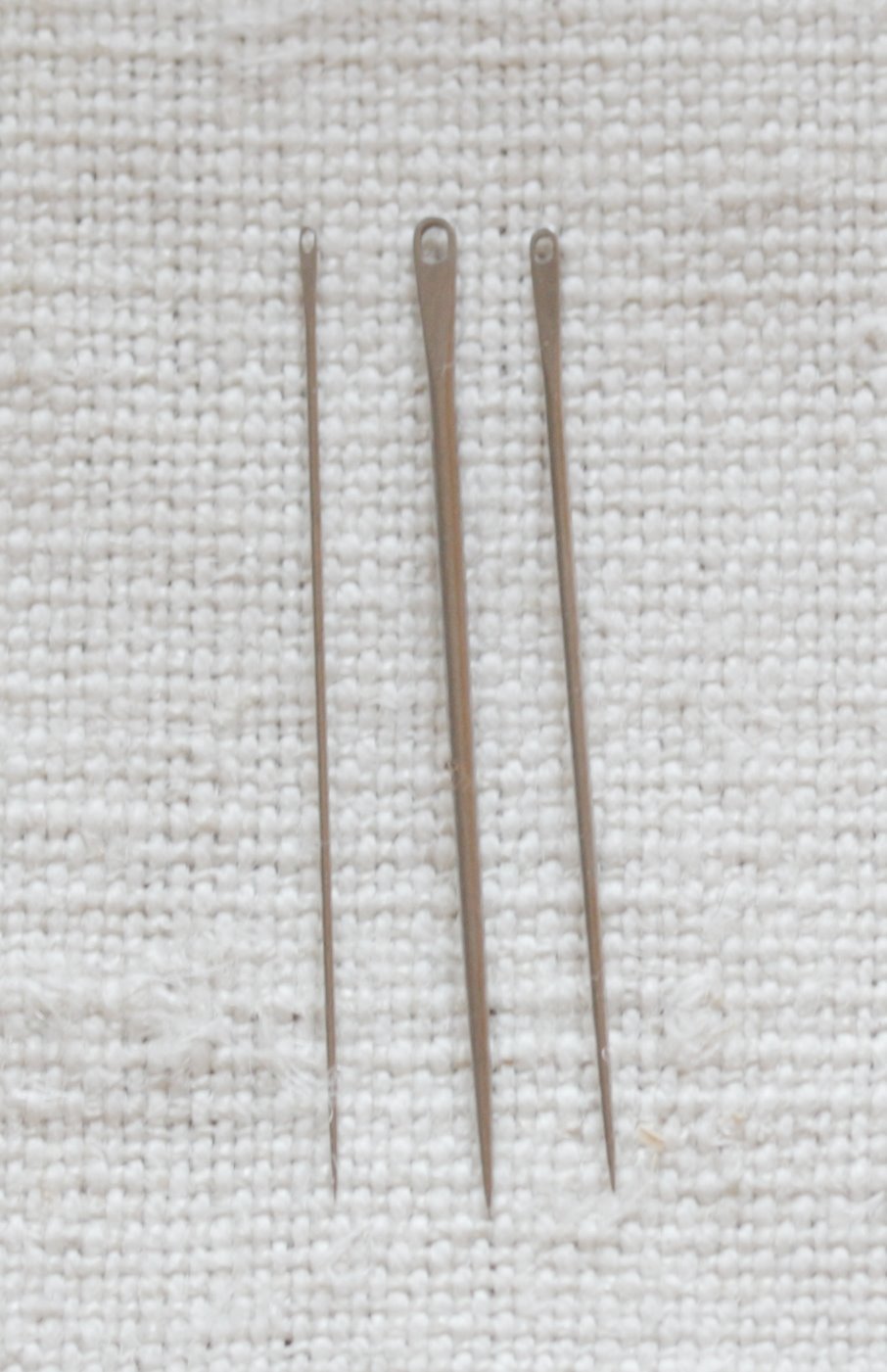
They have relatively large eyes in a flattened head, designed to take the thread through the fabric without rubbing it and are thus perfect for embroidery with delicate silk or gold threads. I can now offer three sizes for sale, a quite thick and sturdy needle with large eye, a medium-thick one and an extremely fine one. It's awesome to look at them knowing they are all made by hand - I had problems only photographing them!

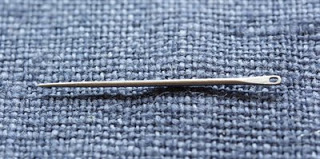
In this picture, you see the three sizes side by side: extra-thin, thick and medium. I'm really looking forward to working with handmade needles in the future and stash the modern needles out of sight, whipped out only when needed in an "emergency".


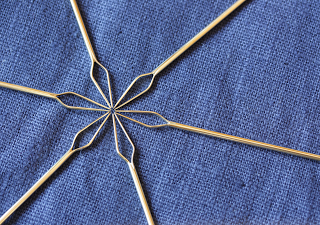
And just because I can, I made a closeup photograph of the needle heads and eyes. Isn't that amazing?

0
JUNI
29
0

Monday, Fun day!

I had a really nice weekend, including a wonderfully productive and fulfilling Friday and Saturday. Much of Friday was spent chatting and plotting things with two fellow archaeologists - one of them in personal union the goldsmith making my netting needles. So on that afternoon, a few more ideas developed for the range of goods for me to carry. The stall is developing into something catering to textile workers and enthusiasts of all textile disciplines current in the middle ages: Tailoring and sewing, narrow wares, netting, embroidery, and some more odds and ends. I won't carry fibres (since there are enough people for that, and most textile folks already have one or more sources for fibre), but odds, ends, and things connected to stitching and textile crafts.

Since the visit on Friday, I now have six more netting needles, as tools when holding workshops or for sale. They are just as beautiful and just as polished as my own one, and here's proof:


And just because of that incredible net from St.-Truiden, I had also ordered a really small netting needle. Really really small. And here it is, made from copper wire, with a shank diameter of a gigantic full millimetre! I'm really delighted with it, and I will try it out with my new, extra-fine silk thread - another thing that will be offered for sale.


I talked about a really productive weekend, didn't I? Saturday morning gave me a head start on something nice and special for the embroidery fraction, though that idea is still under development and therefore still top secret. The wood for the netting gauges is standing in the living room, waiting to be cut into pieces and sanded down. The concept for the stall is also developing - but more about all those things in another post...
0
JUNI
26
3

Google Penance

Inspired by Got Medieval's Google Penances, I'm going to do one, too. When I checked my blog stats some days ago, I found somebody had done a search for "tricks to faster hand sewing", thus landing on my blog. I actually had a few conversations about our modern love for speed during show-and-tell last weekend, so sewing faster by hand or concern about the length of time needed seems to be the thing at the moment.

Well, gentle reader, I regret to tell you: There is no trick. Or, to put it more precisely: There is an end to getting faster. Somehow, our modern age got obsessed with speed. Add a new machine, make a process more efficient, tune an existing machine and voilà - the process is a bit faster. Well, if you are working hand sewn seams, I can tell you: forget that. Yes, you will get faster in the beginning, when your motions for sewing are still not second nature, and of course your stitching will get more even and (usually) smaller over time. But there is a point not of no return, but of no additional speed, because pulling a needle through fabric just takes a certain amount of time, and nothing will change that. And for hand sewing - just as for many other crafts that use no machines, gadgets or automatons - there is no use in trying to push that limit.

Think of it like hand-writing, a process you will all know (hopefully): You can write extra slow for special nice characters (though that might result in the contrary, if one tries too hard); you can write in normal speed for efficient, well-discernible writing (unless you have a bad scrawl by default); or you can try to write faster, usually resulting in less discernible writing, a lot of stress and a cramped hand for a small gain in speed.

With sewing, it's the same. I once tried to sew a hood as fast as possible, just to try - it took me exactly the same amount of time as when sewing normal speed, but with sloppy, bad seams instead of the regular neat ones. And if that's not an argument against hurrying, I don't know what is.

So for these kinds of (historic and modern) handiwork, you'll just have to face it: It will take a certain minimum amount of time. You can tweak your sewing times for handsewing by not using a huge load of pins and pinning every seam before sewing (that's for machined work), but by only using one or two pins and transferring them as you progress, or basting if you need a longer stretch; by using the appropriate stitches - like not back-stitching unstressed lines of thick woolen fabric; and by using appropriate, good tools (needles) and threads (the latter not in excessive length). And after that? Face it. It takes me about 30 hours of work (not including breaks - I work with a stopwatch) to make a simple dress, about 20 hours to make an underdress, and about 25-30 hours to make a simple hairnet. A hood will typically take between 4 and 8 hours, depending on cloth, buttoning, liripipe, seam and hem finishes etcetera - something that always figures in the time needed and that cannot always be calculated exactly beforehand. I have tablet weaves where I progress a full 5 cm in an hour, due to the fineness of the threads and the pattern. And that is just the time it takes. Even if I tried, I could work no faster.

But I find that accepting this fact leads to a different view of time and of work, and it can help to calm down in our modern need-for-speed world. And that, too, is something to treasure - just like the finished hand-sewn pieces that took their time.
0
JUNI
17
6

Acquiring a product line

Parallel to all the other things going on work-wise, I'm using some of my time to build a product line for medieval textile fun. A product line, of course, centered on
a) things that have their use for medieval sewing, tailoring and other stitching and
b) things that are not readily available in gazillions of other stalls or internet shops for Living History. Well, the latter part should not be such a problem, since there are not so many offers for sewing stuff around. Ever noticed how sparsely stocked "sewing and needlework" sections are, compared to "weapons and armour"? Which also means that b) encompasses all those things that I've been searching unsuccessfully for years. Like handmade steel needles, in a size where you can actually use them - and for sewing, not as assassination tools. Like netting needles, formed after medieval finds and so smooth it is a joy to work with them. Like real gold thread in thicknesses that are truly medieval (which, by the way, is quite, quite fine - about 0,2 mm). Like fine smooth linen thread and extra-fine silk thread for sewing. Coloured fine wool and silk threads for stitching - sewing or embroidery - or fine weaving, coloured with natural dyes (that will still take a bit, though). Like heavily weighted sewing cushions ("Nähsteine") and good, firm pin-cushions, no modern techniques used in making them, of course. And proper, spindle-shaped spindles for your favourite stickless whorl. Small trinkets like needle-cases and thimbles that are seldom offered. Have I forgotten something?

And once I have all this... I'll see if I get rich or ruined trying to sell it.
0
JUNI
15
4

Back home...

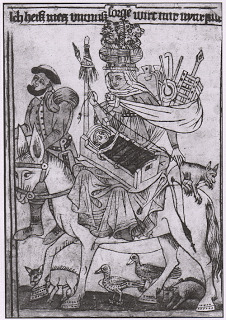
I'm back from our little vacation and working my way through the list of e-mails that arrived during the last few days. While I'm busy getting both my real and my virtual household back into working order, you can amuse yourselves with this picture of a medieval wandering household, complete with baby:


The image caption says it's jugglers/artists travelling. It's a coloured xylograph, single-leaf prints from about 1450. Today at the Herzog-Anton-Ulrich-Museum, Braunschweig.

What I really like about this picture is that it shows a lot of medieval household items. You can see half a kitchen sticking out from the woman's carrycloth around her back... and as a true multitasking female, she's not only travelling, keeping all the household stuff, looking after the livestock (see the chickens on her head?) and looking after the baby, she's also spinning at the same time. Amazing. And modern folks say there's a lot of pressure on women nowadays...

Source: UITZ, ERIKA: Die Frau im Mittelalter. Wien 2003. Page 102.
0
JUNI
04
1

Feeling expensive today?

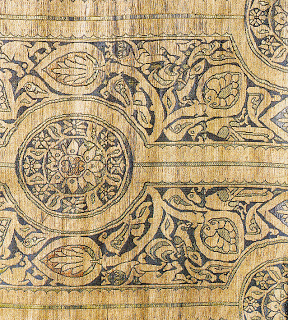
I'm feeling like something classy and really pricey today. So here's something for those that feel like me: A fabric photo of so-called "St. Elisabeth's Cloak". It is a silk and gold fabric, woven probably in Sicily, 2nd quarter 13th century. It's in a Elisabethine convent in Klagenfurt nowadays.


I'm amazed again and again by cloth like this. Something made of rich gold-and-silk must have been worth a fortune, or several fortunes, and still it was woven, sold and made into garments. In some cases, there has been so much gold in old garments that it could be "recovered" from church garments after secularisation - by burning the cloth.

And, as usual, using finer threads or costly materials isn't the only thing for "upgrading". Instead, the fine, expensive materials are usually connected to more work, more complicated patterns - even if halving the thread thickness would already mean more work time, because of four times the number of threads.

But then, textile work seems to always rise exponentially when going finer or more complicated. Thinner threads for weaving? Much more work, regardless of loom type (and it is also true for tablet weaves). Smaller mesh for netting? Much more work. Thinner threads for embroidery? You know the answer. Add an extra pattern weft? Guess what happens. Braiding with fine threads? Uuuuh, takes ages. And it doesn't start with handling and manipulating threads - it starts with making them. Spinning fine will mean more time needed to spin for the same amount of fabric - because half the thread thickness means four times the number of threads. And then, spinning fine makes reattaching the spindle after a break more difficult; increasingly difficulty with thinness. I've tried to go as thin as possible, and sometimes it takes several tries after the thread broke to get a good connection between spun and unspun again. So it really pays to spin a little slower and with more concentration - and once more, it takes longer.

It's the same every time you go "finer, thinner, more" with textile: Work time does not scale up proportional to thread thickness. And that's something to keep in mind when looking at historical textiles, too.

Picture source: TROPPER, PETER (Hrsg.): Hemma von Gurk. Katalog der Ausstellung auf Schloß Straßburg/Kärnten, 14. Mai bis 26. Oktober 1988. Klagenfurt 1988.
0

By accepting you will be accessing a service provided by a third-party external to https://www.pallia.net/

Kontakt