







In case you are like me and, while you know that there are lectures organised by the CTR in Denmark and that they are available via zoom as well (so you don't need to go to Copenhagen, though the city is definitely worth a journey) but then completely forget to check their lecture calendar, here's your reminder that you might to do so. Especially since there is a lecture coming up about colour terms and how they changed over time - something that is quite good to know!


Search the Blog
Latest Comments
Guest - Aislinn
Dyestuff Citizen Science.
09. Oktober 2026
This is a great project. I look forward to the results. Thanks for letting us know.
Guest - Aislinn
Time for...
09. Oktober 2026
Looks delicious!
Guest - Katrin
Sprang Discussion
18. September 2026
Hi Rachel, I have looked for more photos of you, but that was not very successful. I found a link on...
Guest - Beatrix
Sprang Discussion
15. September 2026
That lozenge pattern element is not a photograph, but a scan. So it should be to scale. But I pinned...
Guest - Katrin
Sprang Discussion
15. September 2026
I was not referring to Rachel's reconstruction (is the reconstruction you refer to the one photograp...
MäRZ
20
0
MäRZ
18
As you will probably know, finding and identifying textile tools in the archaeological record can be tricky - especially things that are not as blatant as spindle whorls or maybe a rigid heddle.
So it's rather a sensational find that remains of a Bronze Age loom could be identified - including some carbonised wood. Wood, people! Of a loom, and clearly belonging to the loom as it was found right next to an assembly of loom weights.
I will say no more, but send you on to the open access article itself, so you can get it straight from the horse's mouth:
MäRZ
17

I'm back home from a whirlwind two weeks - first a little journey to South Tyrol where I got to meet the people from the Archaeoparc and do some wool prep and spinning sessions together with them, and then it was back home to repack and go to Cambridge for more spinning - this time including cotton, and involving the replicas of some Colombian spindles that were used about 600 or 700 years ago. One of the questions was which spinning technique might have worked with them - but in addition to this, we were also exchanging spinning and fibre preparation knowledge with two lovely indigenous women from northern Colombia. There were a few eye-opening moments for everybody, and there was oh, so much fun and laughter.
There was also some table accessories collateral damage. It turns out you can use extra straws very well to explain and demonstrate some cotton fibre properties, and some harm was done to a few paper napkins (which found themselves torn into strips and used to show twist effects, or solve questions about twist issues that turned up at one point).
These were by far not the first napkins* that I've seen repurposed for explaining textile stuff. I've seen them used to make impromptu threads or bast strips, to be torn into garment shape to explain draping, or to be torn into bits to show how garment construction works. They have proven so useful and versatile over the years that I am actually considering now to make one or two of them part of my teaching kit. Just in case, you know.

An explanatory napkin used in some other way - because you might just need to draw some stuff. Right there and now. Yes, that includes the dinner on the last evening, when everybody really was very tired already.
There was also a lot of splicing in some ways, and some stitching (the traditional bags are made in a variant of nalbinding and fitted with a braided strap). I have understood a lot more about cotton spinning now, and am much, much better at turning spindles into my previous non-favourite counter-clockwise direction. (Still not good at this clockwise and counterclockwise direction thing, though.
Now it's back to all the things that have assembled here to make me go back to the desk and catch up. I also need to go on a diet, we were fed very well and I have a hard time not eating all the delicious food that you get in Britain, but not in Germany... so it feels like I've eaten half the island now.
I do hope though that there will be some sort of follow-up thing of this workshop at some time - not because of the food, but because of the amazing experience of meeting other textile people and seeing so many different approaches to one thing, and being able to learn from each other. It really was fantastic.
* I actually associate hearing "would you hand me that napkin, please" from any textile people so much with that poor napkin now being either drawn on or ripped up in some way that I was sort of shocked when I heard that phrase, handed a napkin over, and then found out it was to be used as a tissue.
FEB.
27
I've gotten the information that there's a new open access book out, about - natural dyes! The book is the result of an EU project to help revive natural dyeing, but is mainly geared towards educational and artistic users.
You can download the pdf for free from this website. I hope you enjoy it (and thank you Mari for the information!)
FEB.
23
Thanks to my lovely textile colleague Sarah Goslee, I've been pointed to the DOAB - the Directory of Open Access Books. And yes, it does contain quite a number of textile-related books!
You will probably have to filter down if you only search for "textile", as there's a lot about modern speciality textiles and modern textile manufacture in the list, but fortunately an "archeology" filter exists, as do several others.
You can find the main directory at https://www.doabooks.org/en. I hope it will be helpful for you!
FEB.
20
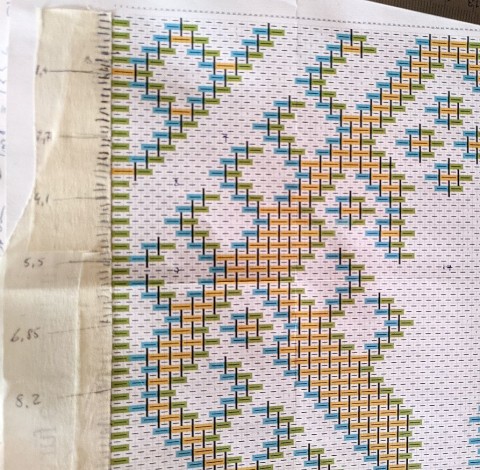
I have been dabbling a bit more with the Lengberg cap sprang - on and off, though mostly off in the last months, and now it's more on again. (I am on row 48 or so of almost 200, and I realised that I will need the frame for the Sprang workshop in June, which gave me a nice bit of extra motivation to finish before then.)
While I did make the pattern for the hands-on piece for an exhibition about women's networks by marriage, due to start in May, the piece was done with slightly thicker threads and ran much longer than the original for the same amount of rows. Our solution was for me to make fewer rows - it's enough so you can still get a nice impression of the pattern, but it also was a good compromise for the museum budget. In this case, being a bit "off" from the original was thus not really bad.
It still irked me a little, especially after taking more looks at images of the original and realising how incredibly dense it was. So I made another set-up (with probably way too long threads, but I wanted to have room to manipulate at the end still), with slightly thinner threads, and made it my main task to get the fabric really, really, really, really dense.
By now I am far enough to see how well it worked - and I am actually not too far off the original this time!
This image shows you part of the pattern chart written by Carol James, with my marks of "done" rows and, more importantly, small numbers giving the length in centimeters at that place on the original, calculated from the amount of overall rows and the full length of the original piece. It's a guideline, thus, nothing more - but I find it very helpful.

As you can see (more or less well), I should be at about 6.85 cm of length now. I am at...
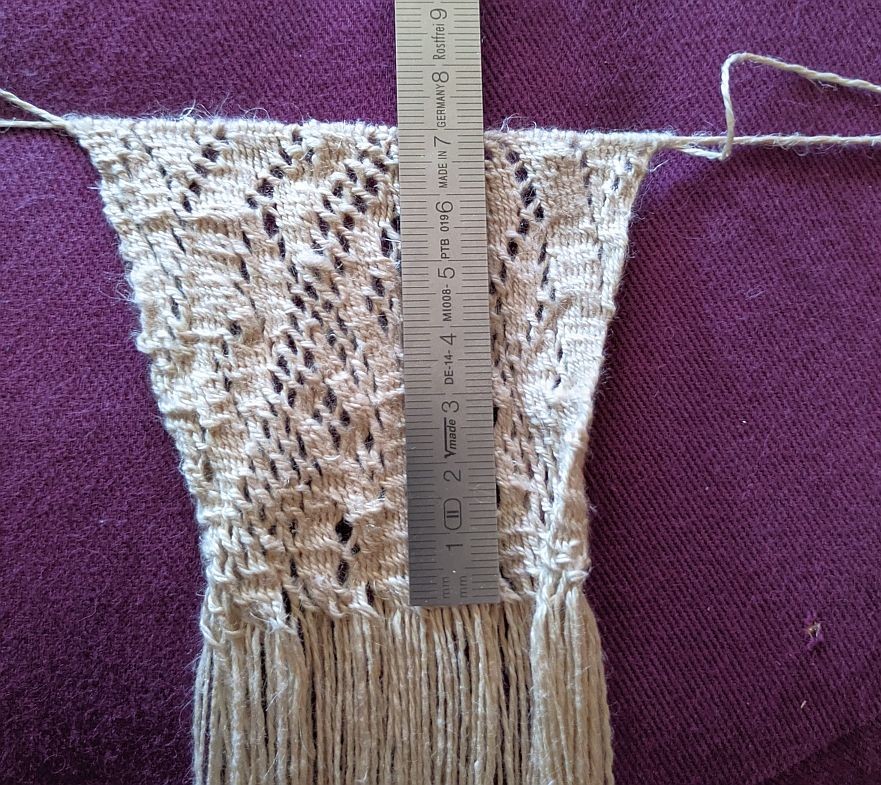
...about 7 cm. That is not too bad! The bottom piece is a little more irregular, and I measure something between 7 and 7.3 cm there, but I still have hope that it might even out again some more.
The trick to getting there was, apart from having the right thickness of threads, working with very little tension and pressing the new row in very, very, very hard. That includes pulling the threads against the weaving sword in small bunches, and repeating it across the width several times. It doesn't take quite as long as the braiding row itself, but it feels almost like it!
So this is how the frame looks, and yes, that is my working "tension".
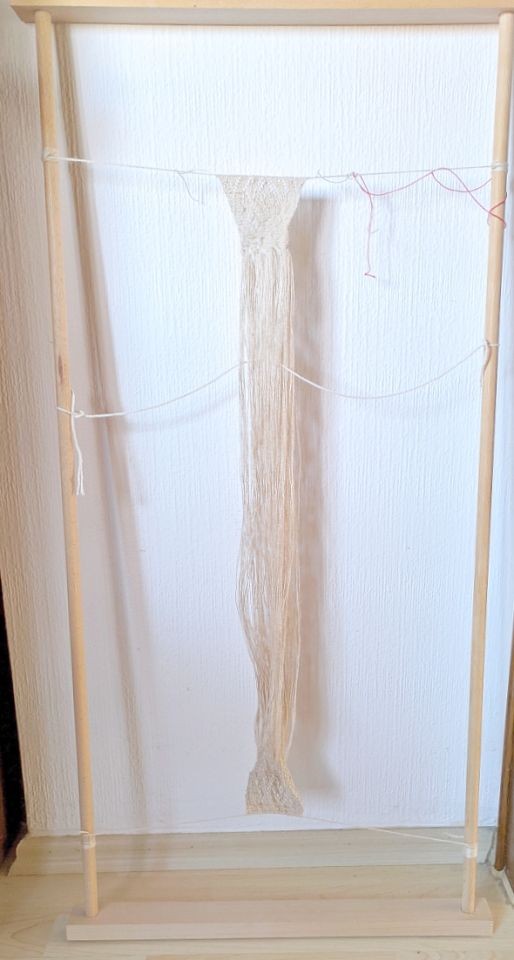
It does work, though! And I can have a little more working tension when doing the manipulation, too, as I am working close to the top fell. Now only about 150 rows to go, and I will be done!
FEB.
19
There's a book out, published at Brepols, with essays in honour of Eva Andersson-Strand - and the very good news is: It's not only available to buy in printed form, but also as a free e-book!
The book has 24 chapters, and you can find it (including the open access link) here.
By accepting you will be accessing a service provided by a third-party external to https://www.pallia.net/