Latest Comments

Guest - Aislinn Dyestuff Citizen Science.
09. Oktober 2026
This is a great project. I look forward to the results. Thanks for letting us know.
Guest - Aislinn Time for...
09. Oktober 2026
Looks delicious!
Guest - Katrin Sprang Discussion
18. September 2026
Hi Rachel, I have looked for more photos of you, but that was not very successful. I found a link on...
Guest - Beatrix Sprang Discussion
15. September 2026
That lozenge pattern element is not a photograph, but a scan. So it should be to scale. But I pinned...
Guest - Katrin Sprang Discussion
15. September 2026
I was not referring to Rachel's reconstruction (is the reconstruction you refer to the one photograp...
MAI
12
0

Up and away for the rest of the week...

...while the little cat will have our upstairs neighbour to look after her. There's cat food freshly prepared (and frozen) so she also can't complain about that. (Well, complaining is always a possibility. She's a cat, after all.)

The test hose are still missing the finishing touches on the feet, as this and that came up and somehow I haven't managed to finish - but that will happen in the next few days. The main plan is all done, though, and the reports from the weaving are all sounding very, very good - and like the scary cutting bit coming up soon.

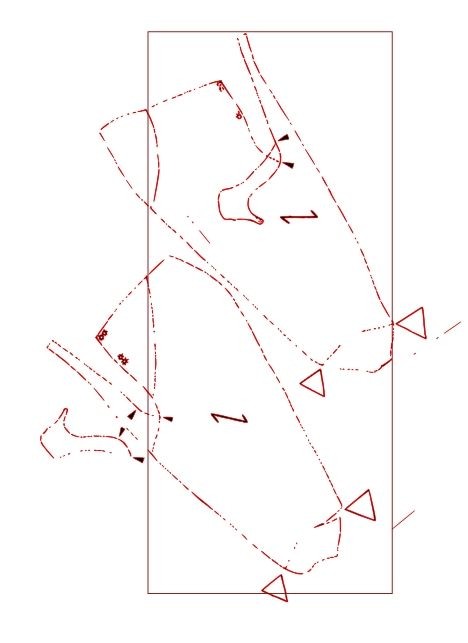
My test fabric was wider than the original was, and the reconstruction fabric will be, but I did lay the pieces out like on a more narrow fabric. Same with the mini version, which gives a nicer image of how, approximately, the pieces are cut: 

Not drawn in here are the soles for the foot parts, the codpiece parts, the small triangles for the feet, and the waistband plus the extra bits for the front slit. Also not drawn are the toe pieces for the top of the feet, should they be necessary - I'm still not a hundred percent sure about that, but will be once that part is also done.

The codpiece is also still up to some potential tweaking. It stays interesting. 

I will be back on the blog next week!

0
MAI
11
0

Progress Report.

The test hose is almost done - one foot piece is under construction, the second one still has to be done, otherwise about everything is finished. It does fit very well - only the legs have the tendency to twist around the wearer's legs when worn. This should be much better (read: gone, hopefully) once the feet are on.

The upside of the twist: There's some extra room, due to folds in the fabric, at the knee region. It might also be an effect of the fabric (which is, in fact, rather thick and stiff). Or it might be an error in my reconstruction. Or it might be an error in the pattern drawing in the publication. 

Once the feet are both on, and fit properly, we will see how it works, and looks. 

The fabric, meanwhile, is being finished and made ready at some place up in beautiful Sweden, and soon it will be all finished and washed and dried and on its way down south to me... which is when the real fun will begin.

The sprang piece is also progressing, though I don't know if I want to call it "nicely" - it does look very much like I will not be able to do the full amount of rows, as I am quickly running out of free thread space now. I have already progressed to using a knitting needle for the picking hand, while the holding hand can still squeeze in. Because I have been running a little longer per row than the original, though, it should be fine and large enough for a cap.

Pictures will come once it's really done. I'm also hoping that washing and blocking it might even out some of the irregularities that occur mainly in the bottom part. Here, too, we will see.

0
MAI
05
0

More Alpirsbach.

About everybody who has done reconstruction work on late medieval legwear and used the Alpirsbach pattern as one of the sources has mentioned (if they have written about it, obviously) that the crotch as drawn on the pattern will not work.

I can confirm. It's too pointy, so that you will have the full length for the crotch drawn in on the pattern, but it is not usable in its full length - the little pointy point will be pointless, you could say. So why did I go for the pattern style anyways? Well, because a) I wanted to see how it did not work, and b) I didn't want to make something up before having an idea of what to make up.

I have now changed it to a sort of narrow U-shape for the second leg, and it looks much better. 

I have also mapped all the long and short seam allowances so I can do the felled seam in the right direction. And I have cursed (frequently) my choice of test fabric, which is rather heavy and stiff and needs some wrangling to work with the relatively narrow seam allowances.

Yes, this will be just enough to fell. No, it's not enough to be nice and easy... but the original seams were relatively narrow, too.

One leg is sewn (though not hemmed) all the way down, the other halfway, and the butt seam is in (that's the one being done in the picture). They have a tendency to twist around the wearer's legs, which is a little weird and may be a) normal and totally okay or b) something that will turn out to be not so good, and will need an adapted pattern making process in future iterations. But it might also be one of the reason why these hose were footed: So that the seam stays where it's supposed to stay. 

Now the only step left (apart from the feet, and finishing the long seams) is to figure out the final version of the codpiece, and cut, sew, and install that. It will also be very interesting to see if the thing really stands nicely on its own or whether it needs to be filled with something.

All very interesting : )  

0
APR.
20
5

Surprisingly (well, not really) complex...

So. There's still pondering taking place regarding the Alpirsbach trousers  legwear... because, well, my way of thinking.

The task is to make a reproduction of the trousers for an exhibition, which technically means that I could take the pattern published after the examination of the trousers garment, read the description, enlarge the pattern and then cut exactly that. But that, to me, would be sort of... cheating. I would much prefer to understand how the pattern was constructed originally, then re-do that construction process, and make the trousers with that re-done pattern.

Which, in turn, means that I have to understand the pattern. Not just which body measurement is found where in the thing, or where which part goes to sit on the body, or which bits to measure, or how much seam allowances to add to a given part, but also how to place the thing onto the fabric.

You see, in the original there's two main parts, and they look quite similar but they have different bits tacked on due to the fabric width not being enough to cut everything in one piece. My current hypothesis is that one leg was constructed first, cut out, flipped over, placed on the fabric and traced to make the second leg. For this, the (to me) logical choice would be to cut the right leg first, as this has only a small bit on the butt added in, and all the relevant long measurements are fully on the fabric.

It would look like this, laid out:

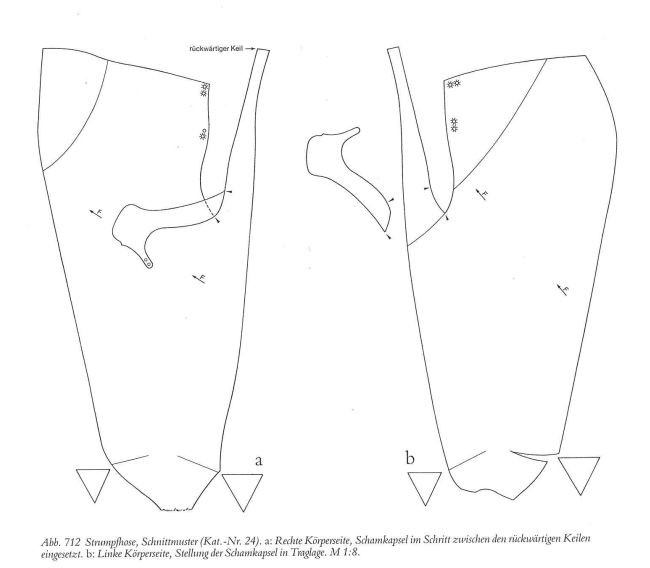
Pattern after Ilse Fingerlin.

Some of the bits are very clear (there's a crotch middle spot, and the butt strip, and the foot part, and the thigh circumference), but the exact shape of the crotch cutout is a lot smaller and more pointed than a lot of the re-creation patterns of joined hose that I have found in other places.  So... is this correct? Will this work? How to reliably construct it?

Questions over questions. It does remain interesting, I can say!

0
APR.
14
0

Rules and Regs Fun (or, erm, not.)

I am, as you might know by now, a staunch fan of the European Union and all its opportunities. I am only a medium big fan of the extra bureaucracy that can come with it... especially if there's rules that are long, convoluted, and not very easy to understand. 

Obviously, especially especially if they actually impact my own life and business. One of them is (or, phew, not really) the new regulations for better sustainability in packaging.

Packages and yes, that includes the packages sent out from the many, many online shops, make up a lot of the waste that we have today. They are, however, a necessary evil to some extent - and while I am all for reducing waste and have tried at the start of the online shop to use recycled packages, once you are above a certain volume, it's just not feasible anymore. One, you have to get the necessary amount of packages (and I don't order that much stuff!); two, it has to fit, at least approximately, the stuff you are sending out (no use if I have a huge box and pack one spindle whorl into it); and three, that means you have to search for a box that fits in your stack (which takes time, and a good bit of space for the stack if you don't want to collapse all the boxes first to tape them up again when they are needed). The switch to packages of set sizes and thus known dimensions, where I know that they will fit product X or Y, has made packing goods so, so much easier and quicker for me, so it's worth paying some money for the packaging just for that.

I'm also quite fine with the general idea of those causing the packaging waste to help with their recycling or disposal, though I will be grumbling about the steps in the costs for this, as I always pay more for the overhead than my small amounts of actual paper and tiny amounts of other materials. But, eh, well, I guess that's just what has to be done.

Now the EU guys have banded together and have decided it's time to do things more internationally if you send stuff to other places... or so. I've gone through the law, the short version of which you can find here (with a link to the long one) and if I understand it correctly, I'm too small for the whole stuff, but there's a German law which still lets me know they'd like my money for the waste management thankyouverymuch.

It's complicated. I'm pondering what to do now, but at least my first big fear - that I'd need to register everywhere, and pay fees everywhere because I'm offering to ship there - seems to have been unneccessary. Because, well, that would have meant the end of my international shipping...

I'll keep you updated once I have cleared stuff up some more!

0
APR.
09
0

Trouser Ponderings.

I've been wondering in the back of my brain for most of the night, since looking at the Alpirsbach pattern yesterday: How would it have been constructed?

You see, the pattern, as published in Fingerlin, I., 2001. Textil- und Lederfunde, in: Landesdenkmalamt Baden-Württemberg (Ed.), Alpirsbach. Zur Geschichte von Kloster und Stadt, Theiss, Stuttgart, pp. 715-818 on p. 737 looks like this:

The whole thing is placed at an angle onto the fabric, as indicated by the little arrows - so you can use the elasticity on the bias to make everything work better.

So far, so good. But... we're in the late 15th, early 16th century here. There's definitely no Burda-style patterns made from paper, and the thing is not lined, so you can't use the lining for construction. Which leads me to the question, as always when looking at garments from medieval times: How do you construct this? Which measurements do you take, and how do you transfer them to the fabric to cut out your thing, especially since there's bits not cut in one piece due to the fabric width?

Of course you can construct one leg first and then use that as template for the other one. But in this case, which one do you do first, the one with the bits of the front and the back strip cut extra, or the one with the solid bit of the ass part cut extra? 

Questions over questions. First step for trying to solve them is printing out the thing and marking it up with all the known bits - which pieces are definitely the same length, which bit correlates to a known body measurement, how are the warp and weft aligned in the extra bits. Which is exactly what I am going to do today, in a bout of slightly brain-bending fun!

0
MäRZ
26
0

Out of the closet!

I spent the morning in the closet, successfully so (at least I hope the recording will be fine, the talking was successful) and only realised after posting the blog yesterday that I had not linked to the previous podcast. So here it is - in German, again. 

In theory, we are talking about tablet weaving. At least that was the plan, but there were... distractions, which means that there's less tablet weaving and more general textile-related ramblings in there. 

We did actually fix that in today's chat, but you will have to wait a few weeks until it comes out. Meanwhile there's this two-hour monster to keep you entertained, hopefully. 

0

By accepting you will be accessing a service provided by a third-party external to https://www.pallia.net/

Kontakt