Latest Comments

Guest - Aislinn Dyestuff Citizen Science.
09. Oktober 2026
This is a great project. I look forward to the results. Thanks for letting us know.
Guest - Aislinn Time for...
09. Oktober 2026
Looks delicious!
Guest - Katrin Sprang Discussion
18. September 2026
Hi Rachel, I have looked for more photos of you, but that was not very successful. I found a link on...
Guest - Beatrix Sprang Discussion
15. September 2026
That lozenge pattern element is not a photograph, but a scan. So it should be to scale. But I pinned...
Guest - Katrin Sprang Discussion
15. September 2026
I was not referring to Rachel's reconstruction (is the reconstruction you refer to the one photograp...
MAI
30
5

Down below, deep under the museum...

One of the things I love, in general, is getting to go behind the scenes and see the things not everybody sees. Whether that is being backstage in a theatre, being behind the scenes in an event, or going into a museum depot - I just love to get a look around the nuts-and-bolts areas, to see how the mundane day-to-day things are handled, how stuff is stored.

Fortunately, doing museum presentations, giving workshops and demonstrating crafts at events means that I get plenty of opportunities to go backstage in the wider sense, and in a lot of different places. (Next up: the Adventon. I'm already looking forward to that.)

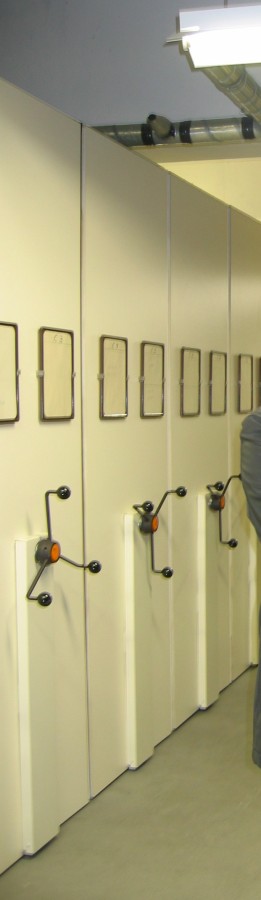
What is especially wonderful about the backstage-going are depots. Museums have most of their things not in the exhibition, but somewhere in storage, and these depots are absolutely fascinating. (They also serve a purpose - they are not only safe storage for historical items, but also help the museums to fulfill their obligation to further research; and not all items are in a condition that they can be on display continuously, so the depot and rotation of objects makes sure that they will last.) I have next to no pictures of depots that I can show you, though, only pictures of individual items - but then, different storage areas have as many different solutions as you can imagine, ranging from regular shelves to specialised drawer cabinets. And of course there's the good old space-saving solution:
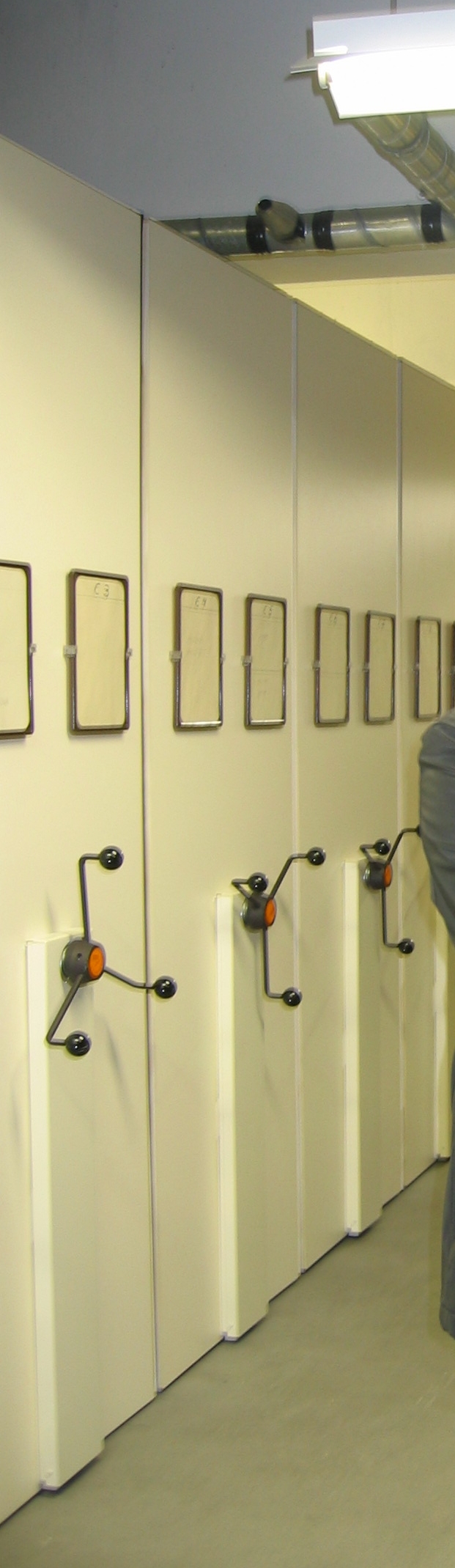
depot
I have no clue what these are really called, but they are basically sliding shelves that form a closed box when they are sitting right next to each other. Turn the handles (slowly - always slowly and carefully!) and a whole block of these shelves gently rolls to the side, letting you access the spot you need. These are... awesome. Absolutely, utterly awesome.
0
MAI
20
0

There shall be... Spindle Whorls!

Spindle whorls are lovely things... whether they are made from ceramics or from glass. Or from stone. Or bone. Or antler. Or lead.

Speaking of which - I've been selling ceramic spindle whorls for a good while now, but these are just a small part of the picture. So I'm really happy to have found, quite recently, two crafters who are willing to make spindle whorls from bone and spindle whorls from stone. Which means I get to broaden the material selection of whorls on offer a little.

Which also means I have to pick out whorl shapes and whorl types for these crafters to make. That's a task I like - but I also know that it's not easy to get a good overview over spindle whorl finds, and that tastes can vary a lot. So - if you are a spinner, and you know a specific spindle whorl find from stone, bone or antler that you would love to have replicated: do let me know about it. I cannot make promises at this time, but if it's not too outlandish in shape, size or weight, it might become part of the new stock! (If you have specific ceramic whorls that you'd like to see for sale, I'll be happy to hear about these too!)

So... any wishes?

 
0
MAI
18
0

Prepping things.

There's a nice list lying in front of me (right underneath the cat, who had to conquer my desk again for some cuddles), a box of things already collected and made ready for Sunday, and I spent the last hour in the wintergarden doing some more prep work... including things like this:

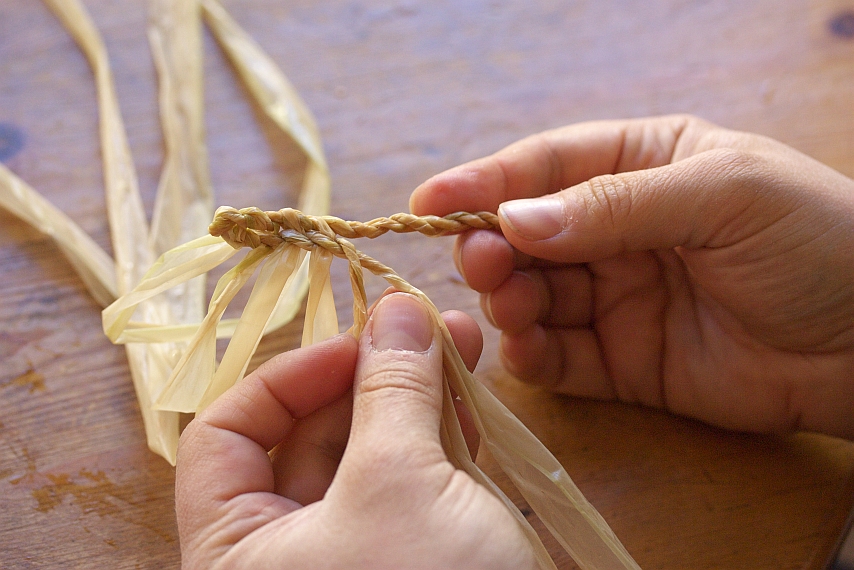
twining
Twining with bast is an incredibly interesting technique, and the oldest textile technique (or proto-textile technique, depending on your definitions) there is. It's really fascinating what you can do with a bit of bast and your fingers alone, and the resulting items are incredibly sturdy and can be mind-bogglingly fine.

All that was, by the way, done in preparation for the demonstration at the Landesmuseum in Darmstadt this Sunday. I'm almost finished, though; just a few last-minute things need to be added to my box of stuff.

Which means I will have no excuse tomorrow not to sit down and finally tackle the taxes...
0
APR.
18
0

New bits on the page.

A long while ago, I wrote a blog post titled "How to untangle a skein of yarn". The reason for this post was my having had a, hm, let's call it an incident with a winder and a skein of yarn. Of very fine, lovely and pricey silk yarn.

Cue the necessity to find out how to untangle said skein and salvage the yarn. That inspired the blog post, and it's since been one of the most read posts, as well as a rather high-ranking result when looking for instructions on how to untangle yarn in a search engine.

So I've finally translated the post into German, and it's now available as text in both English and German on my main website. I do hope it will help more people in the future!

In completely unrelated news - we went indoor bouldering on Sunday, and that was a lot of fun, plus resulted in sore arms for me today. We'd been climbing (classical top-rope climbing) years ago for a while with some friends, but never got into it on our own. Bouldering doesn't require ropes or harnesses and somebody you can trust to secure you; instead, you pick a route and get started. Plus the climbing gym had a nice café to hang out with friends. We're definitely planning to do that again in the future!
0
APR.
06
0

New things in the shop, too!

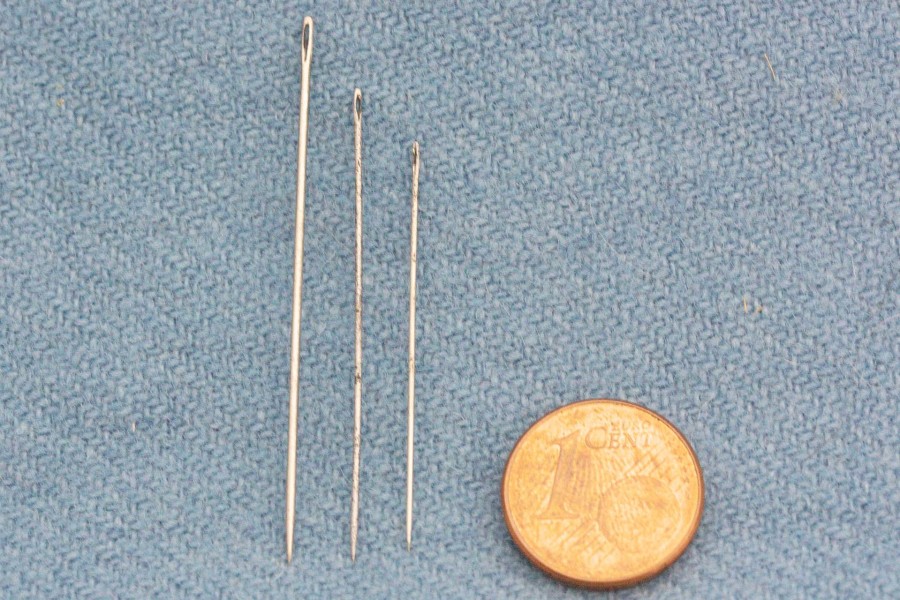
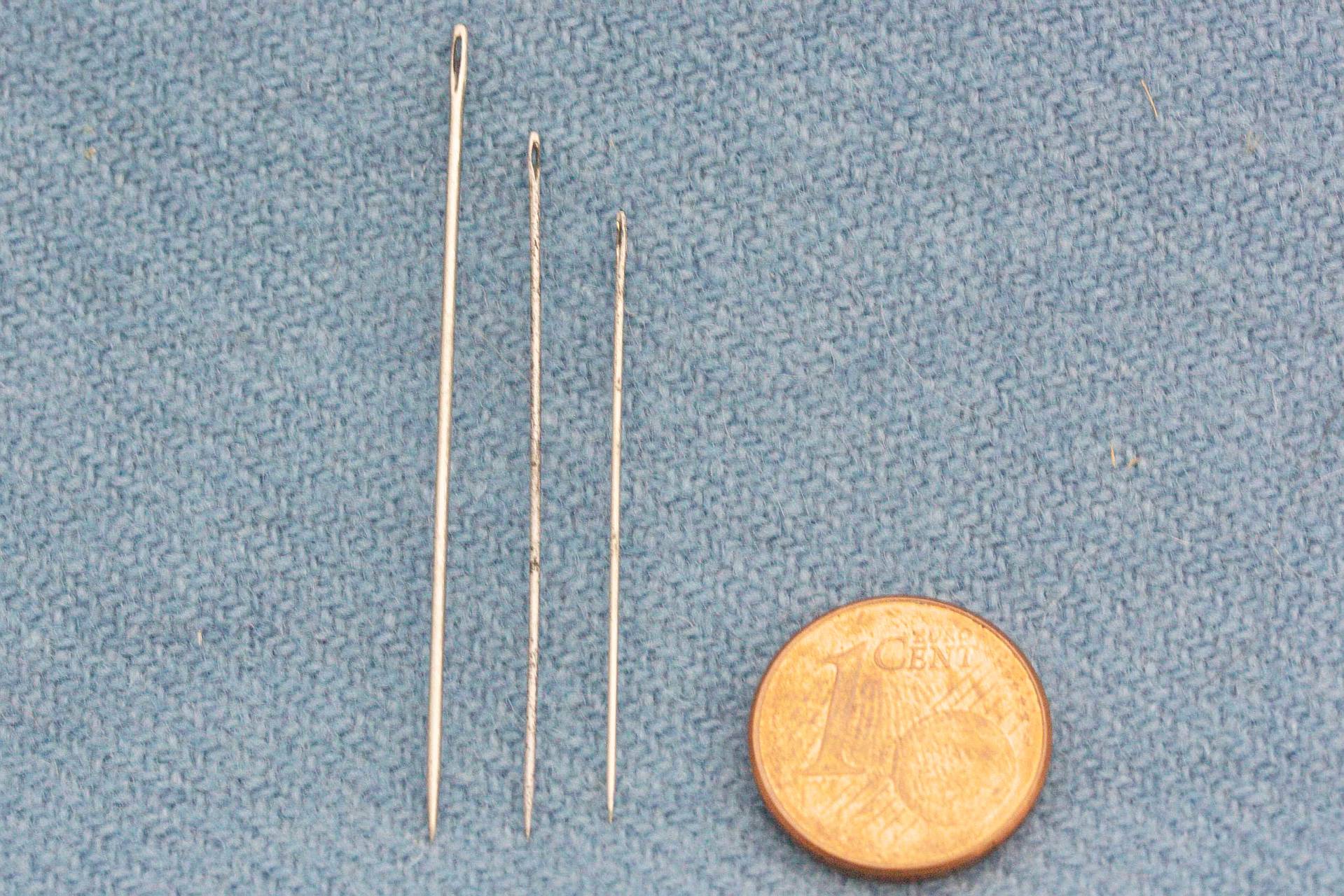
There's not only seedlings sprouting, there's also, finally, something new in the shop again: Handmade iron needles!

eisennadeln1
I was able to buy the remaining stock from someone who made these needles for a while, and they are finally all sorted, polished, and ready to be sold.

Making needles such as these, I've been told, is not easy - there's a lot of breakage when the eye is punched in, for instance.

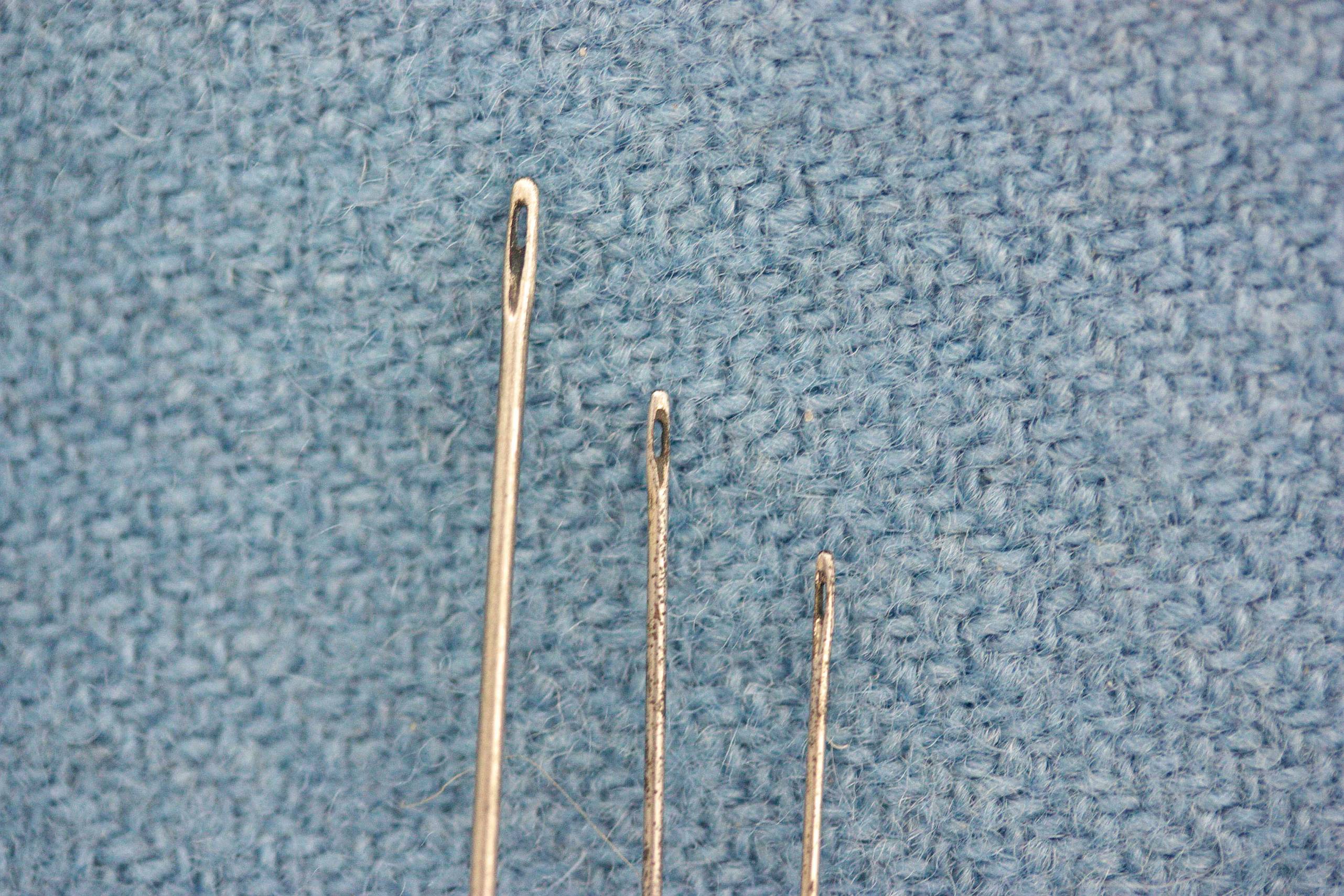
[caption id="attachment_2330" align="alignnone" width="640"]Closeup of the needle eyes. You can still see some of the dark oxidisation residue from the process of making the needles. Closeup of the needle eyes.


That's one of the reasons the needlemaker stopped doing this, so the small stock I have of these needles are all that remain, and probably all there will be. So, like so often when I get my hands on remaining stock, I'm all torn between happiness that I have at least a few of the wonderful items, and sadness that these are the last, and there will be no more of it in the future.

For now, though, there are needles - and I am very happy about that!
0
MäRZ
31
0

You Should Not Work For Free.

If you've been reading this blog for a while, you will know that I have strong opinions about fair payment for work (see the Fair Prices for Crafting posts). If you are working a full-time job, no matter what the job is, you should be able to live off your job. That means if you are a professional knitter, your knitting should pay for your life needs. It does not matter whether you are a writer, or an artist, or a cashier, or a carpenter, or a nurse - your job should support you.

I can totally understand if somebody asks me about pricing for, say, a dress; I tell them what to expect, and the answer to this is "well, thanks but no thanks". I do know that having a dress or some other garment made to measure, sewn by hand, possibly using special materials will be beyond what a lot of people (and incidentally also quite a few institutions such as museums) are willing or able to spend. I am fine with that. I'm also fine with getting together with the prospective client to explore possibilities and alternatives that will result in finding a different plan of action, and both of us being happy with the price point for that. If that is not an option, I don't care whether the "no thanks" is due to not being willing, or not being able. There's a reason that I have arrived at the pricing I've given, and doing the same work for less will not work out in my favour.

The calculations I make for my offers, whether it's a service (such as making a garment), teaching, or the goods I offer in the online shop and at my stall at markets, are solid. The prices I charge do allow me to support myself. I'm not calculating overly generously for my benefit, though - if there's a slow period with few sales and few or no projects, I can definitely feel it, and my one-woman company still falls into the "small microbusiness" category.There are occasions when it is necessary to put in some work to make a proper offer for something, so I'll do research and planning and calculations, and I don't get money for this unless the offer is accepted - but that is normal, and that is acceptable, and something that is calculated for. But something I will not do at all? Definitely not? Work for free. Or for "exposure", which basically means "go work for free for us, and we will tell a lot of people so you might have trouble explaining later why you won't go on working for free for others, too".
I also get cranky if I get asked, by some institution or company that does turn a profit, to work under my price point. This does happen rarely these days, by the way - but it does still happen occasionally. Professional work should be paid.If you're wondering what brought on this ramble, it's the "offer" of the World Fantasy Convention to submit a new award design. Key phrase here is "there will be no monetary remuneration." Yes. For an award design that will be used for nobody knows how long. That they want to have all copyright for.Much to my happiness, this "offer" has already led to several people stating very, very clearly that it is a bad offer, and a bad idea to submit artwork for it. Jim Hines writes about working for exposure only (though not directly linking to the Award Kerfuffle). Mary Robinette Kowal has strong feelings about the award specs and whole thing. John Picacio already posted about the issue in November 2015. I'm really curious to see how all this will turn out - and whether the critical voices will lead to a change in the submission guidelines or not.

0
MäRZ
22
0

Multi-Lingual Textile Terminology Resource!

Textile terminology, as many of you will probably know, can be a never-ending headache. Especially when you are looking at texts in a foreign language. Consequently, there have been a few attempts at making glossaries or catalogues; sometimes, there is a small multi-language glossary or dictionary in the appendix to a book or article. Burnham's "Warp and Weft" also states the terms for different weaves in several languages.

However, there's a whole book with textile terminology that I had never heard about before: “Nordisk textilteknisk terminologi- Förindustriell vävnadsproduktion”, written by  Elisabeth Strömberg, Agnes Geijer, Margrethe Hald and Martha Hoffman and published in 1967. The title of the book translates to “Nordic textile technical terminology - pre-industrial fabric  production”. The book consists of Swedish term definitions, with synonyms in Danish, Icelandic, Norwegian, Finnish, English, French and German. The edition was revised by Geijer and Hoffmann in 1979. The Icelandic and Finnish terms were compiled by Elsa E. Guðjónsson.

So there's a whole book out there - and it gets even better. Amica and Maria from historicaltextiles.org have brought together KulturNav, a website where museums and other organisations can have shared lists of things hosted; the Textile Museum in Borås, who agreed to manage the dataset from the book, and friendly help from fellow nerds to convert the whole book into a database.

And now it's done - the Terminology is online and available, for free, via KulturNav. You can find the whole back story, and some instructions on how to use the database, on the Historical Textiles blog, including instructions on how to contribute should you find something is missing, or would like to suggest a change.

This is a wonderful thing - and my thanks to everybody involved who made this possible!
0

By accepting you will be accessing a service provided by a third-party external to https://www.pallia.net/

Kontakt