
Latest Comments

Guest - Aislinn Dyestuff Citizen Science.
09. Oktober 2026
This is a great project. I look forward to the results. Thanks for letting us know.
Guest - Aislinn Time for...
09. Oktober 2026
Looks delicious!
Guest - Katrin Sprang Discussion
18. September 2026
Hi Rachel, I have looked for more photos of you, but that was not very successful. I found a link on...
Guest - Beatrix Sprang Discussion
15. September 2026
That lozenge pattern element is not a photograph, but a scan. So it should be to scale. But I pinned...
Guest - Katrin Sprang Discussion
15. September 2026
I was not referring to Rachel's reconstruction (is the reconstruction you refer to the one photograp...
MAI
12
0

Not nice, but good to know.

There's weird things happening in Germany these days - demonstrations against the measurements taken to curb the spread of the Corona virus, because some people feel that having to wear a mask, or not being allowed to do everything like in normal times is taking away their personal freedom. Just like the ban on public religious services is seen, by some, to take away their freedom of religion. (I always thought that freedom of religion means you can believe whatever you want, and do religious things accordingly as long as that hurts nobody else, without being prosecuted or discriminated because of it. And that is still very much the case in Germany. Nobody prevented anyone from praying - just praying in groups was not allowed for a while.)

The problematic thing about these demonstrations is that a) obviously, those demonstrating are often not taking the virus seriously, and don't keep their distance from each other, and b) the people there come from a variety of different backgrounds and with different agendas, and a lot of those are not necessarily things that are, um, equipped with a positive attitude to our current democratic society. Or, to put it bluntly: A lot of right-wing extremist idiots happen to be among those demonstrating groups, trying to make the best out of the pandemic situation (as in make Germany Nazi again). Gah. At the same time, conspiracy theories are getting a lot of attention, and a lot of people fall for them. I find that scary.

One of the commonly repeated things in these theories is that Corona/COVID-19 is no worse than influenza is. Well. First of all, influenza is no joke, and it kills a lot of people each year (which could probably be avoided or lessened if we all behaved a bit differently during flu season... and who knows, maybe we will, in the future, knowing how to act in the fight against a virus now?). The argumentation is that obviously, a lot of the things predicted (like the German healthcare system collapsing) have not happened, and thus the virus can't be as dangerous or as deadly as it has been said, and in some cases it's even postulated that it doesn't actually exist at all. (Yes, the system has not collapsed yet - due to the measurements taken.) Fortunately, this is rather quickly cleared up, as there's such a thing as excess mortality - the difference between the number of people dying in a certain period compared to the average over the rest of the year, or the same period in previous years. The website EuroMOMO (short for European Mortality Monitor) has a lot of very impressive graphs showing the higher rates of death due to the current spread of COVID-19, and how different they are in countries that had their healthcare system brought to the edge of collapse or beyond, and in countries where the spread has been curbed strongly enough to prevent that. They are chilling graphs - but it's good to have them, and good to know.
 
0
MAI
11
0

Digital Lauresham Event - that was nice.

I spent a wonderful weekend, here at home and at the same time virtually at Lauresham, learining a lot about draft cattle, hearing about the pit houses, and connecting with a lot of fellow experimental archaeology people via Discord. That was definitely the first conference where I was able to learn about pit houses by listening to the discussion while at the same time tidying up in my kitchen, or removing some old leaves from plants in the wintergarden.

It was very new (and very exciting!) for me to connect via the voice channel, answering questions regarding the Albecunde reconstruction project, but I think it went quite well (and hope I did not ramble too much in my answers). I was also very amused by textile people taking over the channel with their discussion at one point... well, as we tend to do.

If you missed the weekend, you can still watch all the videos on the Lauresham Youtube channel, and I'm told that EXARC (who graciously hosted the event on their Discord channel, and who did an absolutely splendid job with all the tech in the background) are planning to make the voice discussion parts available as well, once they've tidied up the files.

Speaking of EXARC - do check out their website for the #FinallyFriday events, where an archaeological topic is discussed every last Friday of the month, and where you can find a list of virtual events and tours to keep you amused.
0
MAI
08
2

The Fabric Question.

Hannah asked in the Ask me Anything:

I have this question which kind of follows me around since I got involved in all this medieval stuff. It is a quite common topic and I have of course discussed it with fellow fans of the Middle Ages but still I am very unsatisfied with the answers. So, here it comes: which fabrics were used for which type of garments (e.g. is it true that linen was only used for undergarments?). Or do we just not know enough about this yet?


The answer to this is... it's complicated. Which, by the way, is the answer to a lot of general questions regarding things in the Middle Ages. The reason for this is a) our source material, which often does not cover things in detail; b) the fact that many things were probably just as varied and different from household to household and region to region as cooking recipes are; c) the Middle Ages are a long time, and things also changed over that time.

The sources we have for use of fabric (types) in garments are mostly the garments themselves and in second rank descriptions of clothing, both in form of literature and of lists or inventories. Both of them have their pitfalls. Extant garments are few and far in between, and if they are archaeological textile finds, there's almost no chance for linen or other plant fibres to survive. From extant clothing, we do have evidence for wool and silk upper garments, plant fibre fabric linings for these upper garments, and plant fibre fabric used for undergarments. As far as I know, there's no evidence for plant fibre fabrics as upper garments.

The High Medieval German texts mention plant fibre fabrics for undergarments and silk or wool for upper garments. Silk can also be used for undergarments, in some cases, according to these texts.

So - we have good evidence for the use of silk and wool for upper garments, and for the use of plant fibre fabrics (which could be linen, nettle, hemp, or cotton) for linings and undergarments. This, by the way, includes padded and quilted undergarments. There's no good evidence for the widespread use of wool as undergarment fabric to my knowledge, and there's no good evidence for the use of plant fibre fabrics as upper garments. Both cannot be excluded completely, of course.

When you go into detail more, it gets even more complicated, as the preferred weave types for wool and silk fabrics also change over time, according to the amounts of (mostly wool) fabric scraps found in archaeological context. Plainweave, though, can be found through all ages in quite large quantities - so if in doubt when looking for fabrics, this is your friend. For the decision on which fabric to use for clothing regarding a specific time and area, I'd recommend to try and find out about textile finds from there, and then try and find a fabric that is approximating the finds - which can, unfortunately, be quite a challenge, as many of the "typical" medieval fabrics are not available today anymore.

0
MAI
07
0

Lots of Things to Read!

If you're looking for things to read and learn about something, you might find something at the Springer homepage - there's a package of textbooks available that is currently free of charge. The books are mostly introductory books (there's a lot of "principles of" in the titles), and they cover a huge variety of topics. There's little archaeological stuff among them (I found one book about zooarchaeology), but if you always wanted to know things about quantum mechanics, data analysis, programming, machine learning, biomechanics, or social marketing - you might find what you were looking for there.

The books are downloadable both in pdf- and in epup-format. Enjoy!
0
MAI
06
0

Twist matters.

Things I learned in the past days:
  1. Filming a video presentation of something makes me extra-super-duper nervous. Part of this is the thought in the back of my mind that every "erm..." and every silly facial expression and every little imperfection in speech will be recorded and thus preserved FOREVER, and thus I should be absolutely perfect, and that is hard to do.
  2. Writing subtitles in English underneath a German spoken text is hard, not only because I can (duh) talk much faster than I can type. There's also the temptation to deviate (too) much from the things I actually say, to make it more clearer to the reader, or to cram more info into the text... which I as a viewer would find confusing, and not ideal.
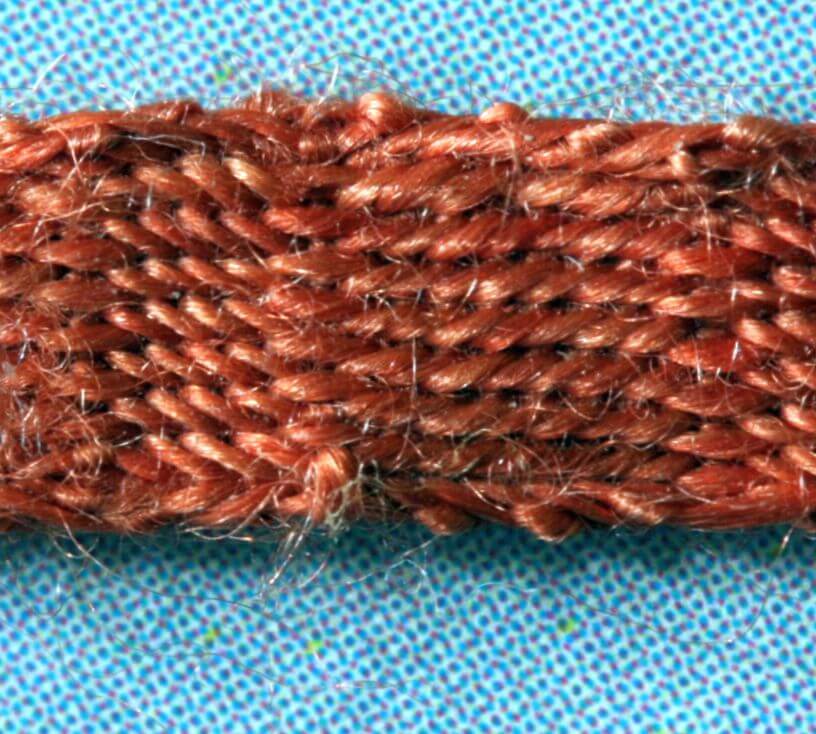
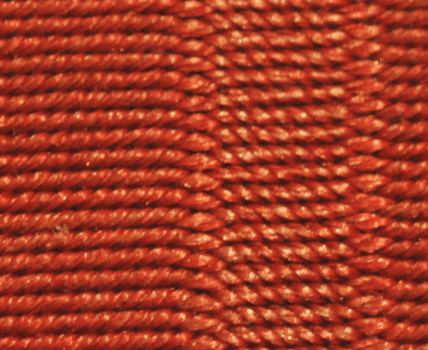
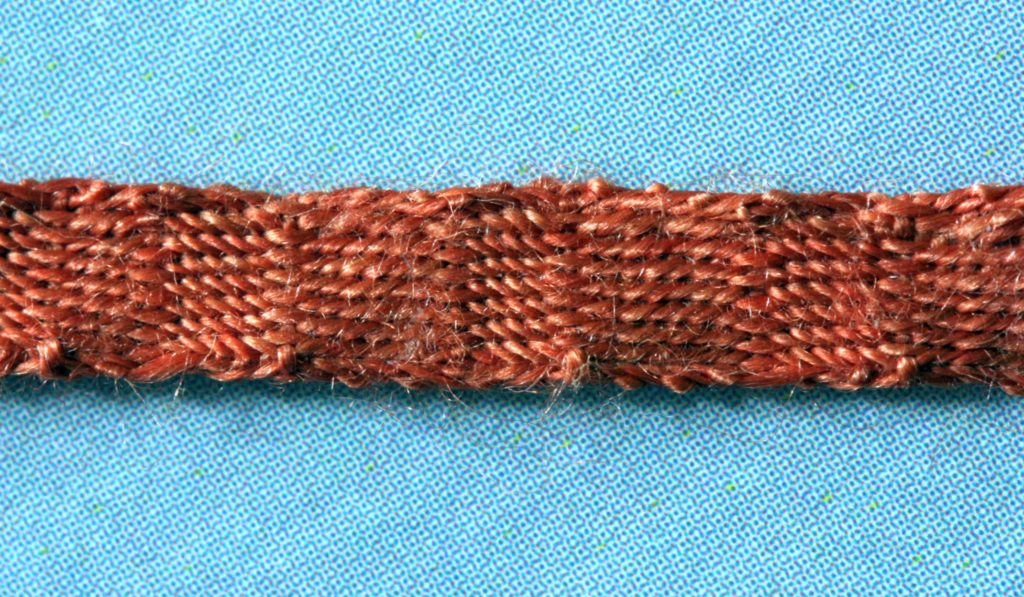
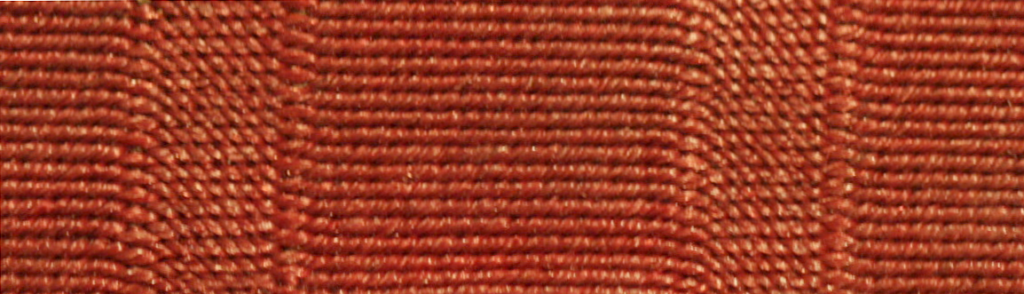
  3. There was very, very, very little twist in the threads used to weave the Albecunde belt. My tests done with my (only very slightly twisted) embroidery silk look like this:


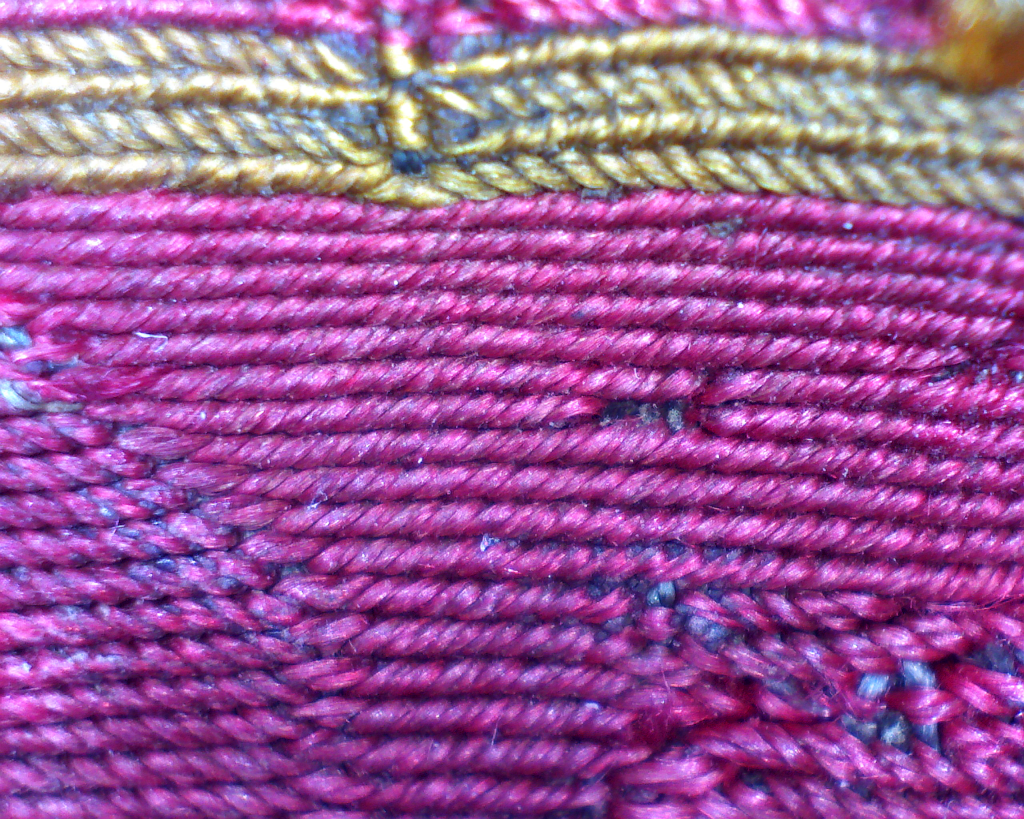
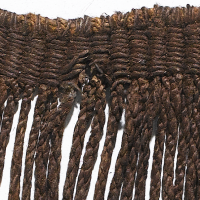
While the original belt looks like this:


You cannot see the pattern as clearly on my test piece as you can on the original - it looks very pronouncedly diagonally structured in one twist direction, but more like a mushy solid surface in the other. On the original, there's a diagonal structure visible in both directions, and it's only a very little more pronounced in one compared to the other.

Here's closeups to make things even more clear:


You can see that the diagonals with an S-slant are much more defined than those with a Z-slant. That's because my thread is slightly s-twisted. It's not much, but enough to make quite a visible difference in the outcome; enough of the z-twist the tablets introduce is levelled out by the yarn twist to show. The twist is visible, if you look closely, in the areas where I changed tablet twist direction.


This is a detail, closeup, of the original. Here, too, you can observe the individual thread twist in the places where tablet turn direction changes - but it is so slight that it's almost impossible to detect. The best indication of it being a hint of an s-twist is that the S-cords in the tablet weave are a little bit more defined than the Z-cords.

Here's a microscope picture, going even closer to the threads:


This shows how important even a little bit more or less of twist can be when you are weaving a pattern that relies, for its effect, exclusively on the shine and the light refraction of the silk used - and how much knowledge and skill went into this band.

You can hear more about the Albecunde band on Sunday in the presentation at Virtual Lauresham (and see my video thingie...)!

Thank you to the Diözesanmuseum Augsburg for letting us study the belt in detail for our reconstruction project!
0
MAI
05
0

Weekend Event!

I'm beyond delighted to be part of an event this coming weekend: The Open-Air Laboratory Lauresham has made their Experimental Archaeology Weekend go digital!


Originally, this was planned as a weekend event at Lauresham, but due to the Corona closures of all museums, and the restrictions on meetings of people outside one's own household, this was of course not possible.

So instead, the weekend event will now take place online, and Lauresham has taken the opportunity to make it more international as well, by having English presentations and German presentations with English subtitles. My contribution will be on as a part of the presentation "Made with gentle hands" on Sunday, 11:30 to 12:30 German time. There will be a discussion on Discord afterwards - all very new and exciting for me!

Go check out the schedule, and maybe I'll see you virtually on the weekend!


0
MAI
04
4

Oillight Stuff.

I've recently started to bake bread again (I blame one of our friends, who reminded me of the joys of sourdough), and if you bake traditional sourdough bread, the dough needs to hang out in a warm enough place for quite some time.

The typical hack for this is to put the dough in its covered bowl into the oven and turn on the oven light - just the lamp; this puts out enough heat to warm the inside of the oven to about 30° C if you leave the door open a bit. However, our oven is a shiny new-fangled thing with a light that goes out after about 15 seconds... so I needed another way to gently heat it up.

The solution? A candle or, in my case, an oil light. There was a bit of trouble at first, though, as the light went out after a short while - and it took me a little time to discover the reason. Which was... old oil on the swimmer.


When I sell these, I usually tell my customers that if they are not using the light for a while, it's a good idea to take the swimmer out and give it a good rinse to clean it, then dry it.

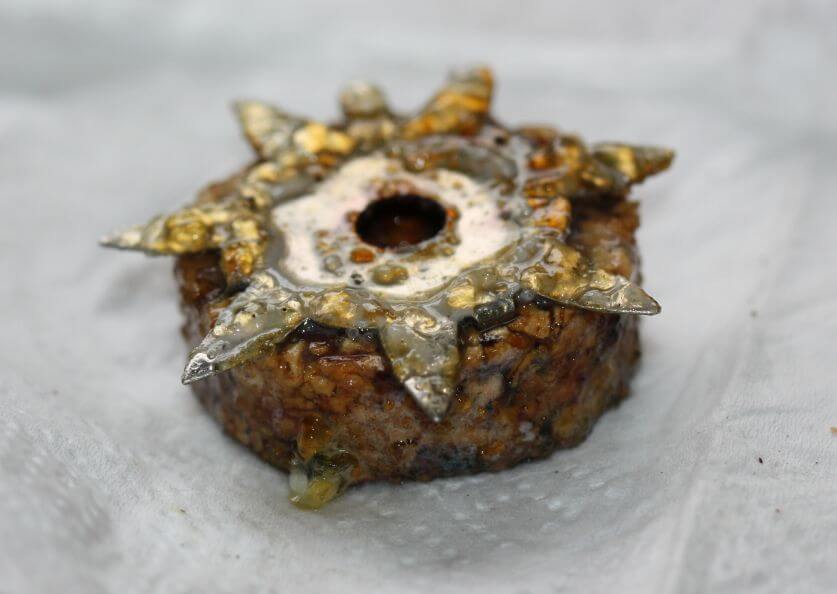
Very obviously I'm not always taking my own advice... this swimmer has been in use for a rather long time, with breaks inbetween uses where I sometimes took it out and rinsed it  and sometimes not. Over all this time, a good layer of gummified oil has accumulated both on the metal bit and on the cork.

That is, unfortunately, not just an optical issue - the gummified oil warms up when the light is burning, and then seems to get just liquid enough to get into the wick, blocking it up. Which means that the wick cannot get enough oil through anymore, and the flame goes out.

So - should you have an oil light that does not work properly anymore, check it for gummified oil; clean it if necessary (hot water and soda, and a good long soak in there, will help), or get a replacement swimmer.
0

By accepting you will be accessing a service provided by a third-party external to https://www.pallia.net/

Kontakt