Latest Comments

Guest - Aislinn Dyestuff Citizen Science.
09. Oktober 2026
This is a great project. I look forward to the results. Thanks for letting us know.
Guest - Aislinn Time for...
09. Oktober 2026
Looks delicious!
Guest - Katrin Sprang Discussion
18. September 2026
Hi Rachel, I have looked for more photos of you, but that was not very successful. I found a link on...
Guest - Beatrix Sprang Discussion
15. September 2026
That lozenge pattern element is not a photograph, but a scan. So it should be to scale. But I pinned...
Guest - Katrin Sprang Discussion
15. September 2026
I was not referring to Rachel's reconstruction (is the reconstruction you refer to the one photograp...
JULI
20
0

Workshops at Cave Gladium

Today is an exception to my normal posting rules, since you are finding mostly German text here - it's the info for the workshops at Cave Gladium. Our idea was to offer a learning space and opportunity at the Cave, since that is a time and place where lots of living history people are already together, so travel costs and extra organisation time for the participants would be really, really low.

Since the info about the workshops seems to have gotten a little lost in the forum pages at the Cave website, I'm posting the description here again. So if you are interested in attending a show fighting workshop, or would like to learn how to dye with plants, or how to forge a knife, or how to weave 3/1 twill on tablets without counting and sticking to a pre-made pattern, or learn a few new loop-braiding patterns, you can Diese E-Mail-Adresse ist vor Spambots geschützt! Zur Anzeige muss JavaScript eingeschaltet sein.. At least the forging and textile workshops should also be possible in English, if there should be any language problems.


Schaukampf - aber richtig
Unter diesem Motto freuen wir uns, in diesem Jahr einen Workshop anbieten zu können, der zeigt, dass es nicht einer blutigen Nase und ein paar ausgeschlagener Zähne bedarf, um auf höchstem Niveau einen Zweikampf zum Besten zu geben. Dabei werden alle Aspekte der Sicherheit und Erhaltung der eigenen Gesundheit beachtet, ohne damit der Begeisterung der Mitwirkenden und der Zuschauer Abbruch zu tun.
An drei Tagen werden die Grundlagen des unbewaffneten Kampfes, Fallen und Rollen bis hin zum Schwertkampf vermittelt. Das Ergebnis wird am Ende des Workshops in einer kleinen Choreographie dem Publikum präsentiert.
Voraussetzungen: Es ist durchaus hilfreich, wenn der Teilnehmer bzw. die Teilnehmerin über eine durchschnittliche körperliche Fitness verfügt und schon einmal ein Schwert in der Hand gehalten hat.
Mitzubringen sind: sportliche Kleidung, festes Schuhwerk (Trainingswaffen werden gestellt)
Kursgebühr: 140,- € pro Person
Zeiten: Freitag: 16 bis 20 Uhr
Samstag: 9 bis 12 Uhr
Sonntag: 9 bis 12 Uhr

Brettchenweben mal anders
Keine Lust mehr, einem festgeschriebenen Schnurbindungsmuster zu folgen? Neugierig, was sich mit Brettchenweberei und einem ganz einfachen Aufzug alles anfangen lässt? Im Workshop webt jede/jeder ein Band zum spielerischen Ausprobieren in zwei kontrastierenden Farben. Der Kettaufzug lässt verschiedene Diagonalenmuster und Köperbindung zu, die mit etwas Hintergrundwissen zu den Grundlagen der Köperbindung frei kombiniert werden können.
Voraussetzungen: Der Kurs ist kein Anfängerkurs, sondern richtet sich an Brettchenweberinnen und -weber, die bereits etwas Erfahrung gesammelt haben.
Mitzubringen: Zum Aufziehen der Kette werden helles und dunkles Garn benötigt; empfehlenswert sind nicht zu dünne Webgarne, etwa in Stärke von Sockenwolle. Das helle und das dunkle Garn sollten jeweils auf zwei Knäuel gleicher Größe aufgeteilt werden, weil dies den Aufzug stark vereinfacht. Pro Knäuel werden mindestens 25 m Lauflänge benötigt (reicht für eine zwei Meter lange Kette). Mitzubringen sind außerdem, falls vorhanden, 12 Vierlochbrettchen.
Kursgebühr: 70,- € pro Person (ganztägig)
Material bei Bedarf bitte vorbestellen
Zeiten: Samstag 15.08.2009

Schmieden bei David Schütze
Der Einsteigerkurs ist für Menschen geeignet, die von der historischen Technik der Metallverarbeitung fasziniert sind, sich aber bisher nicht aktiv damit beschäftigt haben. Vorkenntnisse sind nicht erforderlich. Werkzeug- und Materialkunde werden ebenso vermittelt, wie die grundlegenden Techniken des Schmiedens und ein kurzer Einblick in die Geschichte des Handwerks. Die Teilnehmer stellen ein einfaches Messer selbst her.
Voraussetzungen: Einsteigerkurs (keine Vorkenntnisse notwendig)
Fortgeschrittenenkurs (mit Vorkenntnissen)
Mitzubringen sind: --
Kursgebühr: 140,- € pro Person (Einsteiger)
210,- € pro Person (Einsteiger)
incl. Material, Werkzeug und Versicherung
Zeiten: Samstag 15.08.2009

Färben bei Sabine Ringenberg
Pflanzenfarbe ist ein faszinierendes Thema. Wie wird sie auf der Faser haltbar gemacht? Welche Unterschiede gibt es beim Färben von Seide, Wolle oder Leinen? Auf diese Fragen gibt der Einsteigerkurs von Sabine Ringenberg Antwort. Mit selbst gesammelten Pflanzen wird die eigene Wolle oder Seide gefärbt. Dabei werden die gängigsten Beizverfahren ebenso behandelt, wie die Nachbehandlung und weitere Verarbeitung des Färbeguts. Vorkenntnisse sind nicht erforderlich.
Voraussetzungen: Einsteigerkurs
Mitzubringen sind: Eigene Wolle kann gefärbt werden
Kursgebühr: 85,- € pro Person (eintägig)
zzgl. Färbegut
Zeiten: Samstag 15.08.2009, Beginn 09.00 Uhr
Sonntag 16.08.2009, Beginn 09.00 Uhr

Fingerschlaufenflechten
Flechten mit Schlaufen statt mit einzelnen Fäden hat in den letzten Jahren an Bekanntheit gewonnen - ist aber immer noch nicht sehr verbreitet. In dem Kurs werden verschiedene Flechtvarianten, zum alleine oder gemeinsam Flechten, erlernt und geübt.
Voraussetzungen: Einsteigerkurs
Mitzubringen sind: ---
Kursgebühr: 45,- € pro Person (halbtägig)
incl. Material
Zeiten: Sonntag 16.08.2009, Beginn 09.00 Uhr
0
JULI
17
4

Hairnet: Finished and Reloaded

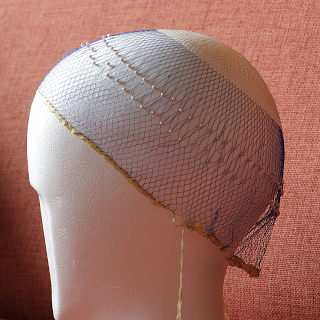
Though I hadn't posted about it anymore, I have obviously continued working on the blue hairnet, since it's finished now. I have sewn it to a drawstring made from birch-leaf-dyed silk (a thin silk ribbon), using one of the handmade steel needles (which worked like a dream).
Here it is, already brought into shape on a styrofoam head. That is also the form in which this net will be exhibited at Bad Staffelstein.

It took me about 30 hours to net (again); the large meshes with the pearls in the middle did obviously save some rounds, while fiddling on the pearls took up that time again.
The large mesh is something that has to be worked with utter and extreme care, though, or they will come out slightly uneven, resulting in netting problems further down.
It took me another hour for the finishing works - sewing on and inserting the drawstring and rinsing the net as well as bringing it into form over the styrofoam head. It has about 30 cm diameter; because it is cast on with rather few meshes (only 68), the circumference at the bottom is not too great.


Altogether, I think that the next time around, I'd rather attach the pearls afterwards by sewing them over individual knots of the mesh. I'm not too content with some of the parts of the net, where there are irregularities and where you can see how often the thread broke at places, I guess because of increased friction with the pearls. Overall, I'd say it looks quite nice, though - and my respect for the medieval net-makers is growing and growing!

Because I've grown quite fond of netting as a show-and-tell procedure (as the regular readers here know already), and I want to include netting in the demonstrations at the exhibition vernissage, I have spent yesterday evening doing the cast-on for another net. And this time around it's really close to an original net, found in London and published in Crowfoot et al's "Textiles and Clothing". Ages ago, I had already done some analysis and counting for one of the nets, coming up with 210 loops for cast-on, doubled after about 14 rows of mesh. After misfiring the first cast-on start (the loops grew nastily in length), I have now finished about 210 meshes and their connecting row successfully. I'd love to know how often I have mis-counted during the three hours I needed, but I'm much too lazy to count the loops again. I can however tell you that 210 loops is a lot.


The netting is done in extra-fine silk thread, and with a gauge of 2 mm diameter, resulting in meshes with 3 mm side length. This just fits with the large netting needle - which in turn fits in well with the fact that 3 mm seems to have been a quite common mesh size. If it comes out like the find (read: if I have not mis-counted ages ago when doing the analysis), it will have a lower edge circumference of a whooping 960 mm. That is almost one darn metre to net for about 50 rounds! I'm really curious to see how this net will turn out. And I can promise you that it won't take only 30 hours to complete, this time, since I have about tripled the mesh count...
0
JULI
16
0

Progress but still behind

I'm making good progress, but I'm still behind - at least that's how it feels to me. A few extra (and time-sensitive) things to do during the last days have sort of nudged me behind schedule; not far, but far enough that I get the queasy "Oh no I'm behind" feeling.

So... although there is some progress on the blue hairnet with pearls (which I'm hoping to finish today) and some more progress on the exhibition stuff and finally some more progress with the product line (though not all ready for telling yet), you only get this short text post today, and I'm off to write some more, net some more, weave some more, cut and edit the last videos (with short demonstration snippets of the textile techniques for the exhibition) and so on. And once the hairnet is really finished, you'll see a photo of it here, of course.
0
JULI
15
0

Exhibition work

I'm getting to appreciate more and more all the work going into designing an exhibition. I've been involved in several exhibitions in the last years - writing articles, helping to decide on exhibits, and making garments to exhibit. But I've never done most of the conceptual work on my own.

Luckily, I'm in the last stages: Packing out and putting together the exhibits for the several places and topics, and writing up the labels/descriptive texts for them. And I should be in the last stages, since the exhibition will next week on Sunday!
0
JULI
14
2

Can't be too thin, really!

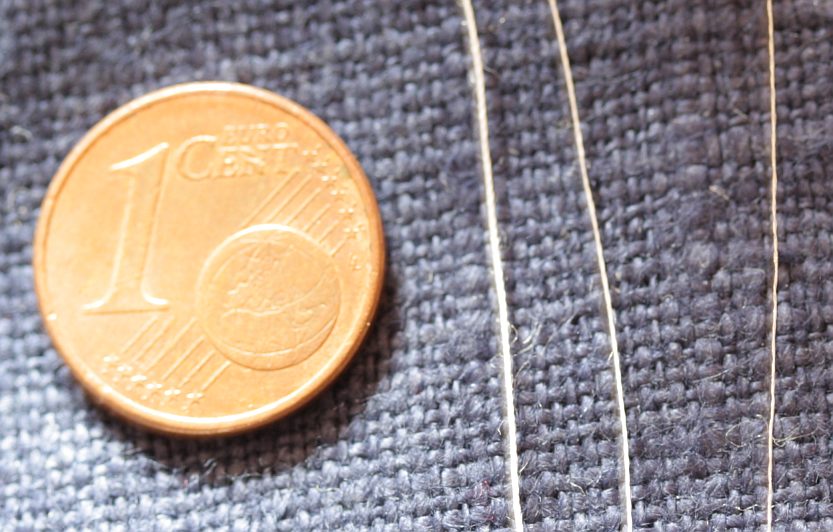
I've been sewing for ages now with Gütermann Silk thread (the thread on the blue plastic spool) whenever I needed sewing silk. Why? Because it's available in almost every second sewing shop around here. But a few things did irk me about it. First of all, it's on a blue plastic spool - that makes it easy to tell the silk thread from the cotton and polyester variations coming on the same spool type, but not so easy to use the thread on medieval events. Then it is - of course - coloured chemically. And then it's just so thick and bulky! Fine for tablet weaves, but for sewing really fine silk? Nah. And for authentic hairnets, too, it's just too thick.

So a while ago, I found out about YLI silks - the sort they call "Silk 100", to be precise. It comes on plastic spools (white and quite short-and-thick, this time) and is much lankier than Gütermann. So I was happier for a while - but the plastic spool problem still applies (and I was not about to re-wind 200 metres of fine silk thread from a plastic spool to a wooden one, I'm one of those rather hiding their spools). And while YLI says it's the finest silk thread on the market, it is still a little thick for making hairnets. And while we're at it, I'd like a finer thread for the really fine stitching on thin silks (think Pongé 05 quality here) and for couching works or sewing something on "invisible". So now YLI is not the thinnest thread on the market anymore, at least not on the medieval markets!


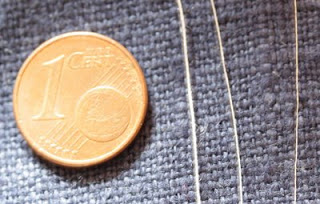
Here you see from left to right: All the money I will have left after investing in this market stall, Gütermann sewing-quality white silk thread, YLI Silk 100 in white, and my extra-thin silk.

It will come wound in portions on paper cores, so while it is not properly medieval, it's at least not plastic. The thread is fine for making hairnets, attaching small embroideries to a garment, for using as weft thread in tablet weaving with thicker silks if you would like your motifs a little less lengthened, or for stitching really fine silks or - of course - couching work. The only thing left to decide for me now is how much of the thread to use for one portion: one hundred metres? two hundred metres? More or less?
0
JULI
13
0

Textilforum Again

Things are also progressing with the Textilforum planning, even if there was a long silence in the last weeks. The metal "cookie cutters" for making the experiment spinning whorls are in production, the wool is already waiting for September, and while there is quite a lot still to prepare for the experiment, there seems to be no catastrophe lurking around the next corner.

There's also progress on other parts; we now have two very interesting lectures for each evening programme, covering a variety of aspects; so one of the things on my to-do-list today is getting the Forum website up to date and mailing around to keep people informed...
0
JULI
09
1

Have a nice weekend!

I'm away on rather large errand runs today and tomorrow, and I did not find the time to prepare blog posts in the last days, so I'm taking time off. Regular blogging will resume on Monday. So have a nice, relaxing, fun weekend everybody!
0

By accepting you will be accessing a service provided by a third-party external to https://www.pallia.net/

Kontakt