Latest Comments

Guest - Aislinn Dyestuff Citizen Science.
09. Oktober 2026
This is a great project. I look forward to the results. Thanks for letting us know.
Guest - Aislinn Time for...
09. Oktober 2026
Looks delicious!
Guest - Katrin Sprang Discussion
18. September 2026
Hi Rachel, I have looked for more photos of you, but that was not very successful. I found a link on...
Guest - Beatrix Sprang Discussion
15. September 2026
That lozenge pattern element is not a photograph, but a scan. So it should be to scale. But I pinned...
Guest - Katrin Sprang Discussion
15. September 2026
I was not referring to Rachel's reconstruction (is the reconstruction you refer to the one photograp...
JUNI
29
0

Monday, Fun day!

I had a really nice weekend, including a wonderfully productive and fulfilling Friday and Saturday. Much of Friday was spent chatting and plotting things with two fellow archaeologists - one of them in personal union the goldsmith making my netting needles. So on that afternoon, a few more ideas developed for the range of goods for me to carry. The stall is developing into something catering to textile workers and enthusiasts of all textile disciplines current in the middle ages: Tailoring and sewing, narrow wares, netting, embroidery, and some more odds and ends. I won't carry fibres (since there are enough people for that, and most textile folks already have one or more sources for fibre), but odds, ends, and things connected to stitching and textile crafts.

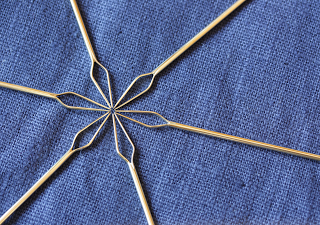
Since the visit on Friday, I now have six more netting needles, as tools when holding workshops or for sale. They are just as beautiful and just as polished as my own one, and here's proof:


And just because of that incredible net from St.-Truiden, I had also ordered a really small netting needle. Really really small. And here it is, made from copper wire, with a shank diameter of a gigantic full millimetre! I'm really delighted with it, and I will try it out with my new, extra-fine silk thread - another thing that will be offered for sale.


I talked about a really productive weekend, didn't I? Saturday morning gave me a head start on something nice and special for the embroidery fraction, though that idea is still under development and therefore still top secret. The wood for the netting gauges is standing in the living room, waiting to be cut into pieces and sanded down. The concept for the stall is also developing - but more about all those things in another post...
0
JUNI
26
3

Google Penance

Inspired by Got Medieval's Google Penances, I'm going to do one, too. When I checked my blog stats some days ago, I found somebody had done a search for "tricks to faster hand sewing", thus landing on my blog. I actually had a few conversations about our modern love for speed during show-and-tell last weekend, so sewing faster by hand or concern about the length of time needed seems to be the thing at the moment.

Well, gentle reader, I regret to tell you: There is no trick. Or, to put it more precisely: There is an end to getting faster. Somehow, our modern age got obsessed with speed. Add a new machine, make a process more efficient, tune an existing machine and voilà - the process is a bit faster. Well, if you are working hand sewn seams, I can tell you: forget that. Yes, you will get faster in the beginning, when your motions for sewing are still not second nature, and of course your stitching will get more even and (usually) smaller over time. But there is a point not of no return, but of no additional speed, because pulling a needle through fabric just takes a certain amount of time, and nothing will change that. And for hand sewing - just as for many other crafts that use no machines, gadgets or automatons - there is no use in trying to push that limit.

Think of it like hand-writing, a process you will all know (hopefully): You can write extra slow for special nice characters (though that might result in the contrary, if one tries too hard); you can write in normal speed for efficient, well-discernible writing (unless you have a bad scrawl by default); or you can try to write faster, usually resulting in less discernible writing, a lot of stress and a cramped hand for a small gain in speed.

With sewing, it's the same. I once tried to sew a hood as fast as possible, just to try - it took me exactly the same amount of time as when sewing normal speed, but with sloppy, bad seams instead of the regular neat ones. And if that's not an argument against hurrying, I don't know what is.

So for these kinds of (historic and modern) handiwork, you'll just have to face it: It will take a certain minimum amount of time. You can tweak your sewing times for handsewing by not using a huge load of pins and pinning every seam before sewing (that's for machined work), but by only using one or two pins and transferring them as you progress, or basting if you need a longer stretch; by using the appropriate stitches - like not back-stitching unstressed lines of thick woolen fabric; and by using appropriate, good tools (needles) and threads (the latter not in excessive length). And after that? Face it. It takes me about 30 hours of work (not including breaks - I work with a stopwatch) to make a simple dress, about 20 hours to make an underdress, and about 25-30 hours to make a simple hairnet. A hood will typically take between 4 and 8 hours, depending on cloth, buttoning, liripipe, seam and hem finishes etcetera - something that always figures in the time needed and that cannot always be calculated exactly beforehand. I have tablet weaves where I progress a full 5 cm in an hour, due to the fineness of the threads and the pattern. And that is just the time it takes. Even if I tried, I could work no faster.

But I find that accepting this fact leads to a different view of time and of work, and it can help to calm down in our modern need-for-speed world. And that, too, is something to treasure - just like the finished hand-sewn pieces that took their time.
0
JUNI
25
0

Morning Routines

I seem to have slipped into a new routine - I'm taking care of the odds and ends first thing in the morning, like replying or sending off and e-mail and similar small tasks. Somehow, I find this pleasing - and I have the added benefit of starting the day with small, manageable things that give some satisfaction on completion. And that is really nice to have if the rest of the day is spent with long-term work.

The only downside I see at the moment is that the odds and ends might take a little longer than planned - like today, where I thought I had plenty of time to take care of this, that, and that, and still get to blogging before ten. Obviously, that has not happened. But as reconciliation, I can tell you that one of the mails this morning was in pursuit of nice, exciting textile tools to offer in the future!
0
JUNI
24
0

The End is Nigh!

I'm almost through with translation work - which has dragged on longer than planned because I just didn't manage to work very long at translating without a break But now I'm very close to sending it out for a read-over (thanks to J.P.), and that will be one burden off my back.

All the rest of the thesis work is going on, too - transforming pics to grayscale, checking picture sizes, sorting in colour and monochrome. But here, too, I'm making progress, and at the moment, I'll be content with just that. I've also done some small jobs on the side to get onwards with my product line acquiring, and feel like good things can happen here too...
0
JUNI
23
1

Work as usual

I'm making progress on several of my front lines, though not as fast as I would like to - for example, there is still a lot of stuff in my car from the weekend, waiting to get carried back inside and put away (maybe washed before, or sorted out) until next time.

Meanwhile, the product line ideas are coming in (and suggestions are still welcome, if you know of something textile-related that you'd like to see in a stall), the summary is getting translated, I have about caught up on missed sleep and am generally quite happy, if a little whelmed by things still left to do and think out. And that also means I'll keep you updated here, but will probably not present a very sciency or time-consuming blog post during this and next week - even if that bugs me, because I have a beautiful idea lying around half-prepared in the draft section. (Now that I've hinted at it, you can look forward to that like I do, and I'm not alone in waiting!)
0
JUNI
22
0

Back home from talking two days non-stop

Today's blog is a little later than usual, because I came home rather late from the Lamboy-Fest in Hanau. In case you are living in the Hanau area, I can tell you: it's well worth a visit. A colourful, beautiful street festival with music, walking acts (creative and fun walking acts with stunningly beautiful costumes) and loads of exquisite international food. And, of course, we added our "mobile museum" to the scene, on a totally well-suited location. Our "artisan's market square" was on the little square in front of the Goldschmiedehaus in Hanau, right inside the Lamboy-Fest area and yet separated enough by the change of city topography to be something special.

We had lots and lots of visitors, and I found myself either drinking, eating, or talking, demonstrating (again) making of medieval hairnets. Filet, I find, is very well suited for demonstrating medieval textile stuff, because it catches people's eyes and makes them linger. And then they are mine to talk to! (Insert maniacal laughter here.) But I also had quite a few talks and explanations about medieval sewing and garments - and a lot of visitors asked me whether there are any customers for my filet work nowadays. Which was a wonderful opening for me to explain about textiles as status symbols and that most people today will decide in favor of the modern status object when deciding whether to invest the sum (about 700 Euros upwards) in a medieval knotted hairnet or in Gucci sunglasses, a new-fangled TV, a new computer, a pair of designer jeans, you go on with the list. And that to my regret, knotted hairnets usually lose this contest today - while in the middle ages, there would have been many more customers!

And isn't that a nice way to drive the importance of medieval textiles home to unsuspecting visitors?
0
JUNI
19
2

Oh wow it's Friday already!

Unfortunately, printing in colour is really, really expensive, so for the thesis publication, my editor and I agreed on a reasonable number of colour plates. Which means that there are quite a few colour illustrations that have to be converted to grayscale, since I just kept all colour pics for the submission copies. So most of yesterday was spent converting colour figures and pictures from my thesis to monochrome pics while making sure that the important details stay discernable.

Picture editing work is half exciting and half mind-numbing. The same processes and checking files for the same things over and over again makes it mind-numbing - but tweaking contrast, brightness and gamma curves for best results has to be done for each pic individually, so it's nothing for a batch job. Sometimes the details come out even better in the monochrome version - that is when it gets really exciting - while sometimes it's a battle you can hardly win. Because I knew that not all would transfer nicely to monochrome, I checked first - there should be enough colour plate for all the really difficult pics in addition to the pictures that I want printed in colour for other reasons (like, usually, exciting colours on real garments).

So... I made good progress with the conversions, though there are still quite a few left to do. Good thing my thesis has only four hundred and eight pics!
0

By accepting you will be accessing a service provided by a third-party external to https://www.pallia.net/

Kontakt