Latest Comments

Guest - Aislinn Dyestuff Citizen Science.
09. Oktober 2026
This is a great project. I look forward to the results. Thanks for letting us know.
Guest - Aislinn Time for...
09. Oktober 2026
Looks delicious!
Guest - Katrin Sprang Discussion
18. September 2026
Hi Rachel, I have looked for more photos of you, but that was not very successful. I found a link on...
Guest - Beatrix Sprang Discussion
15. September 2026
That lozenge pattern element is not a photograph, but a scan. So it should be to scale. But I pinned...
Guest - Katrin Sprang Discussion
15. September 2026
I was not referring to Rachel's reconstruction (is the reconstruction you refer to the one photograp...
JUNI
18
0

Spinning Experiment, again

A huge box blocks the entry to my study - wool for the spinning experiment has arrived! We now have wonderful wool for the experiment, one very fine Merino and one medium-fine wool, all beautifully prepared, thanks to the Wollmeister. With the last batch of test whorls it now really feels as if serious progress is taking place.

Speaking of which, since I'm off to Hanau tomorrow for the "Lamboy-Fest", I'd better make some serious progress on the rest of my work...
0
JUNI
17
6

Acquiring a product line

Parallel to all the other things going on work-wise, I'm using some of my time to build a product line for medieval textile fun. A product line, of course, centered on
a) things that have their use for medieval sewing, tailoring and other stitching and
b) things that are not readily available in gazillions of other stalls or internet shops for Living History. Well, the latter part should not be such a problem, since there are not so many offers for sewing stuff around. Ever noticed how sparsely stocked "sewing and needlework" sections are, compared to "weapons and armour"? Which also means that b) encompasses all those things that I've been searching unsuccessfully for years. Like handmade steel needles, in a size where you can actually use them - and for sewing, not as assassination tools. Like netting needles, formed after medieval finds and so smooth it is a joy to work with them. Like real gold thread in thicknesses that are truly medieval (which, by the way, is quite, quite fine - about 0,2 mm). Like fine smooth linen thread and extra-fine silk thread for sewing. Coloured fine wool and silk threads for stitching - sewing or embroidery - or fine weaving, coloured with natural dyes (that will still take a bit, though). Like heavily weighted sewing cushions ("Nähsteine") and good, firm pin-cushions, no modern techniques used in making them, of course. And proper, spindle-shaped spindles for your favourite stickless whorl. Small trinkets like needle-cases and thimbles that are seldom offered. Have I forgotten something?

And once I have all this... I'll see if I get rich or ruined trying to sell it.
0
JUNI
16
0

Oh my...

The heap of work lying before me (and the list listing even more things to do) has not only stayed the same, but grown yesterday. Actually grown... and since quite a few of these tasks are things that take a bit longer than five to ten minutes... I can't complain of boredom. Add to that the fact that on a first day back at work after vacation I never seem to accomplish much, I'm feeling a bit inundated.

At least I managed to fetch the next test whorls for the spinning experiment, nicely fired, and I already did a short test run. I won't tell how it went in detail, but the reference whorl (about same weight and same moment of inertia as an archaeological object) spun very nicely. I also made some progress on the translation part, did a little bit of proofreading of an article, and wrote the obligatory few e-mails. And now for more of the same agenda.
0
JUNI
15
4

Back home...

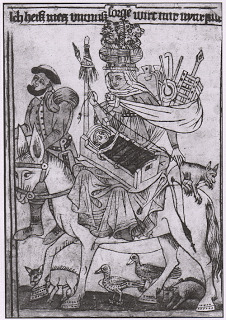
I'm back from our little vacation and working my way through the list of e-mails that arrived during the last few days. While I'm busy getting both my real and my virtual household back into working order, you can amuse yourselves with this picture of a medieval wandering household, complete with baby:


The image caption says it's jugglers/artists travelling. It's a coloured xylograph, single-leaf prints from about 1450. Today at the Herzog-Anton-Ulrich-Museum, Braunschweig.

What I really like about this picture is that it shows a lot of medieval household items. You can see half a kitchen sticking out from the woman's carrycloth around her back... and as a true multitasking female, she's not only travelling, keeping all the household stuff, looking after the livestock (see the chickens on her head?) and looking after the baby, she's also spinning at the same time. Amazing. And modern folks say there's a lot of pressure on women nowadays...

Source: UITZ, ERIKA: Die Frau im Mittelalter. Wien 2003. Page 102.
0
JUNI
08
1

Feeling lonely?

It's been ages since I last posted about the Textilforum, so it's high time. And I have a reason, too: We have extended the deadline for registration to June 30. There are still some spaces left for participants at the museum, so if your occupation includes historical textile crafts - research, reconstruction, analysis, conservation, replicating - you are welcome to join us at the Forum. We also need a few more handspinners (handspindle only) to make the required twenty that we need for the spinning experiment. If you are a handspinner and able to spin an even thread for two hours, you could be part of this nifty bit of science!

If you don't know what I'm talking about: The Textilforum is intended to get people working with historical textile crafts into contact with each other - because it can be a very lonely affair. So we would like to link both professionals and amateurs (like living history folks) in this Forum, where there will be ample time to work, chat, and exchange hints and tips with each other. There will be some programme provided - presentations about research or projects in the evenings - and we'll run an archaeological experiment, the spinning experiment, during the mornings. The rest of time is free; think "gigantic enormous conference coffee break".

You can read more about the Forum on our website, www.textilforum.org, and you can also register there: Go to Call for Papers site, and on the bottom, you will find the link for registration. See you in Eindhoven!

Oh, and you can read me here again next week - I'm off for a few days' vacation, before summer work stress really hits...
0
JUNI
05
0

Productivity things

Yesterday I had to spend some of my work time away from the computer, which resulted in a ginormously long list of things to do - and now I'll see how much of it I can tackle and cross off today, before the week is over. And this has led me to think about productivity and productivity-boosting.

Today I have actually managed to try out one of the productivity hints floating around over the internet: Don't read email first thing in the morning. I think I'll give this another try on Monday, because working for an hour straight before looking into the mail the first time really feels nice - like having achieved something already before taking care of the important and (many more) not-so-important mails. And who would mind a bit more productivity?
0
JUNI
04
1

Feeling expensive today?

I'm feeling like something classy and really pricey today. So here's something for those that feel like me: A fabric photo of so-called "St. Elisabeth's Cloak". It is a silk and gold fabric, woven probably in Sicily, 2nd quarter 13th century. It's in a Elisabethine convent in Klagenfurt nowadays.
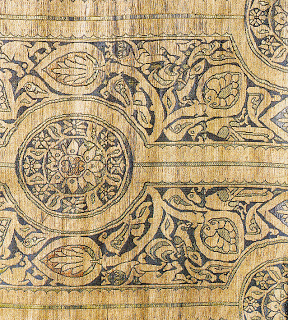

I'm amazed again and again by cloth like this. Something made of rich gold-and-silk must have been worth a fortune, or several fortunes, and still it was woven, sold and made into garments. In some cases, there has been so much gold in old garments that it could be "recovered" from church garments after secularisation - by burning the cloth.

And, as usual, using finer threads or costly materials isn't the only thing for "upgrading". Instead, the fine, expensive materials are usually connected to more work, more complicated patterns - even if halving the thread thickness would already mean more work time, because of four times the number of threads.

But then, textile work seems to always rise exponentially when going finer or more complicated. Thinner threads for weaving? Much more work, regardless of loom type (and it is also true for tablet weaves). Smaller mesh for netting? Much more work. Thinner threads for embroidery? You know the answer. Add an extra pattern weft? Guess what happens. Braiding with fine threads? Uuuuh, takes ages. And it doesn't start with handling and manipulating threads - it starts with making them. Spinning fine will mean more time needed to spin for the same amount of fabric - because half the thread thickness means four times the number of threads. And then, spinning fine makes reattaching the spindle after a break more difficult; increasingly difficulty with thinness. I've tried to go as thin as possible, and sometimes it takes several tries after the thread broke to get a good connection between spun and unspun again. So it really pays to spin a little slower and with more concentration - and once more, it takes longer.

It's the same every time you go "finer, thinner, more" with textile: Work time does not scale up proportional to thread thickness. And that's something to keep in mind when looking at historical textiles, too.

Picture source: TROPPER, PETER (Hrsg.): Hemma von Gurk. Katalog der Ausstellung auf Schloß Straßburg/Kärnten, 14. Mai bis 26. Oktober 1988. Klagenfurt 1988.
0

By accepting you will be accessing a service provided by a third-party external to https://www.pallia.net/

Kontakt