Latest Comments

Guest - Aislinn Dyestuff Citizen Science.
09. Oktober 2026
This is a great project. I look forward to the results. Thanks for letting us know.
Guest - Aislinn Time for...
09. Oktober 2026
Looks delicious!
Guest - Katrin Sprang Discussion
18. September 2026
Hi Rachel, I have looked for more photos of you, but that was not very successful. I found a link on...
Guest - Beatrix Sprang Discussion
15. September 2026
That lozenge pattern element is not a photograph, but a scan. So it should be to scale. But I pinned...
Guest - Katrin Sprang Discussion
15. September 2026
I was not referring to Rachel's reconstruction (is the reconstruction you refer to the one photograp...
JULI
08
2

More Sewing Necessities

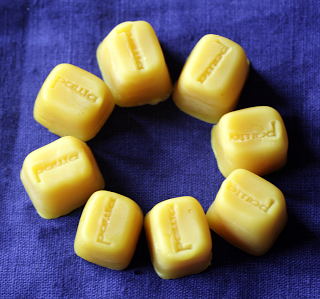
Today's choice for the blog presentation: Beeswax. Everybody needs beeswax! Each sewing bag, pouch, chest or other sewing-goods-container needs a piece of beeswax! And because carrying a candle for that is not the most practical of things, and because there are not so many nice chunks of good-quality beeswax on the market, these are the latest addition to my product line:


In case you don't know why beeswax is a sewing tool: It is invaluable to wax threads for sewing, especially linen threads. It makes them much more durable, they are less prone to fraying where they rub against the needle's eye, and the thread will not kink itself into knots as easily. Plus it smells heavenly! Just draw the thread across the chunk of wax once, and you are all set. Use of beeswax in textile work is documented for medieval times through different accounts, and once you are used to lightly waxing threads, you won't want to be without it anymore.

You can also use beeswax to neaten the edges of fine cloth - though that does take quite a bit of practice, and of course that will eat up your chunk of beeswax much faster than drawing threads through them.
0
JULI
07
0

Work Rave

I'm slowly gaining on my gigantonormous list of "To-do-and-double-quick" and finally feel as if things are looking up a bit. Whew.

And speaking of "looking up" - in this case, looking up from the computer screen and resting the eyes and stretching - a friend pointed me to a neat little programme a few days ago. It's called "Workrave" and intended for those folks (like me) who never manage to take a break when necessary. The programme can be personalized for your preferred work time and break time lengths, and it will then nag you to take micropauses and longer rest breaks. And best of all, the icon is a little sheep, so it's perfect for fabric freaks. While you can ignore the pauses, it makes taking a short break now and then so much easier, and that can really improve performance. Which is something I can always use.

If you are spending as many hours a day in front of the computer, you might also enjoy using workrave as a small helper. It runs both on Linux and Windows, it's completely free, and you can download it here. Healthy computer working to you!
0
JULI
06
6

The Alternative to Playing Cards

When I learned tablet-weaving, I used either beer mats or butchered playing cards. For my small hands, beer mats are definitely too large, so I went over to playing cards cut up and punched with holes for good. They are slim, lightweight, quite sturdy and cheap - the only problem is that you have to cut them to squares and punch holes. And as I'm a bit demanding about my hole placement, wanting them all in the same place, this did always take some time; time spent to prepare weaving equipment that was obviously so not historical. So I've been looking for alternatives for a long time now.

I tried to weave with small (really small) bone tablets one time - they are nice, smooth and good-looking, but they are also tiny with their side length of 2,4 cm, and I did not manage to get a smooth weaving sequence with the tiny things in a band with more than just 5 or so tablets. I also got wooden tablets made as a present once - again, carefully cut, bored and sanded for smoothness, and just the right size to weave. However, wooden tablets add a huge amount of bulk to the tablet-stack and are quite heavy.

So despite all these tries to use more medieval materials for the tablets, I always returned to my trusty playing-cards for weaving work. Since I don't weave for show on medieval events, it was never a problem. But there's a difference between not needing and not wanting... and I wanted.

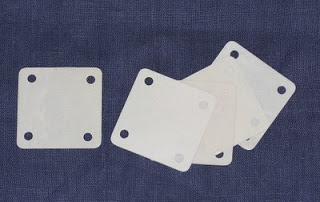
And now I have - and I have to spare, so they are on offer at the market stall. I present to you the museum-compatible, slim alternative to cardboard and playing-card tablets: Weaving tablets made of parchment.


These tablets measure 6 x 6 cm, a convenient size when weaving and large enough that you can handle them well and even weave with the tablets standing on the corners, for tubular or other special weaving actions. The parchment is prepared by hand, in one of the last traditional parchment manufactury. In this case, it is calf parchment. Rounded corners for smooth turning, large holes for ease of setting up the warp.

The tablets, being parchment, can be marked, coloured, scribbled on - whatever you desire. With a thickness of about 0,6 mm for most of them, they are slim enough so that handling a larger stack is easily possible - but stiff and wide enough to grasp them easily. So... no more excuses about not having acceptable weaving tablets to work with!
0
JULI
03
6

Steel Needles, Take Two

Yesterday's post is the first to accumulate its comments so fast, and the questions have prompted me to stay with the topic of needles for a second post.

Pins and even more so needles are an archaeological problem - because... yes, you have guessed it: they are so small. This means that unless there is a nest of pins or needles (like we once discovered in a church excavation on the women's side of the aisle, pins upon pins upon pins, probably lost during service and not retrievable, because they fell through the spaces between wooden floorboards) or unless there is a huge stroke of luck, these tiny metal rods will never be found. If they ever survived the corrosive surroundings in damp soil, that is - something that iron or steel might not take as kindly as copper alloy. And then these rare items are so much overlooked - because duh, of course they had needles, that's an everyday item, isn't it? - that there is no collation of needle articles or archaeological needle knowledge yet.

So LH folks today are faced with a problem: What to sew with? Which time knew what kinds of needles or other sewing implements? (And archaeologists as well, should they want to write about needles.)

We have two possible ways to find out what needles were in use. One way is to find surviving specimens, analyse them, and if possible make some replicas and try them out. That, of course, is a really nifty way - only quite difficult because of the scarcity of finds and (you know the sad song by now) because it's oh-so-hard to find published needles.
The other way is by deduction. Nobody can tell me that medieval people (or people in what age soever) bought extremely costly materials like gold thread and fine silk to weave enormously fine fabrics and embroider them all over with beautiful, awe-inspiring motifs using a (needle) bodkin (for the Germans: "Nähdolch" is the term. The term.) and dragging this huge metal abnormity through their costly fine fabric! Fine fabrics require fine tools, after all. And at least I have not had much fun running my well-beloved copper alloy sewing needles through linen or silk instead of wool; they are just not suited to these. So fabric type makes a difference, too.
Deduction, though, will only tell us that some fine needles must have been there, out of due necessity, but no more than they must have been suitable for this or that work and material. So it's back to no. 1 for harder evidence.

There are a few needles in my picture collection, so I bring to you: The Needle Parade!

First, from the glorious and long-past 3rd and 4th century, needle boxes and needles on one of my bad photographs, taken in the Historical Museum Oslo, viking section.


Next finds from Konstanz (Lake Constance), from the 14th century, an array of small things including sewing needles. From LANDESDENKMALAMT BADEN-WÜRTTEMBERG und STADT ZÜRICH (Hrsg.): Stadtluft, Hirsebrei und Bettelmönch. Die Stadt um 1300. Stuttgart 1992. P. 433.


Everybody knows this copper needlecase missing its lid, from the late 14th century London. It still contained an iron needle - and that needle size would match a modern sewing needle. From CROWFOOT, ELISABETH, PRITCHARD, FRANCES und STANILAND, KAY: Textiles and Clothing c. 1150-c.1450. Medieval Finds from Excavations in London:4. London 1992. P. 151. There you go:


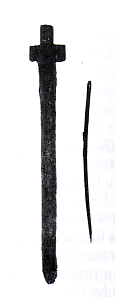
From a special exhibition in the Alamannenmuseum Ellwangen, a needle from the graves at Kirchheim/Ries. My photo, taken with kind permission. It lacks scale, but I would use a needle like that in daily life without finding it special. Graves at Kirchheim/Ries date to the early middle ages, between 6th and 8th century if I remember correctly.


Again from the 14th century: Needles and thimbles from Copenhagen, National Museum, photo taken in the Medieval Section. If you come to Copenhagen, make double sure you visit that wonderful museum - reserve a full day for it, if you can. It is worth it.


That's all I have gathered together during the years - but at least it shows steel sewing needles from as early as at least the early middle ages. If any of you have more needles, please give me a hint - I'm collecting evidence ; )
0
JULI
02
10

Hand-made needles

A few days ago, the postie brought me a small, unspectacular-looking packet. But the contents are really, really spectacular, and another addition to my product range in the stall: Steel needles, completely hand-made!


I had to hunt quite a while to find those beauties, and I'm really happy to have them in hand now. The steel is not stainless, so it needs a little loving care inbetween stitching sessions, but a drop of oil or a scrap of wool still containing lanolin (or a scrap of cloth with some lanolin rubbed on) will take care of them nicely. They are also shorter than I'm normally used to, but this, on the other hand, makes it possible to use more of the thread than with a longer needle.

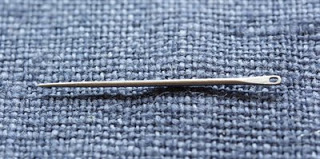
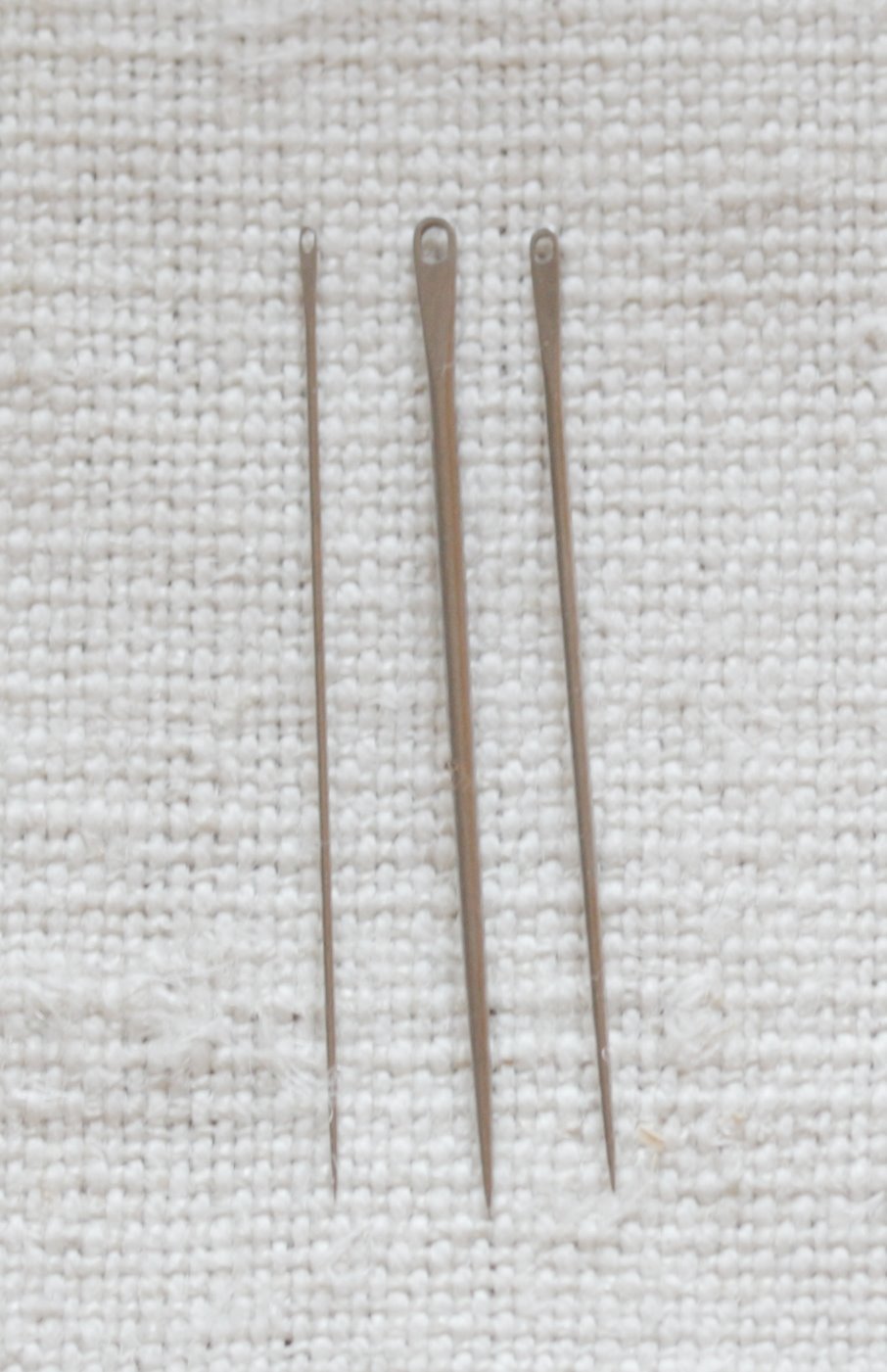
They have relatively large eyes in a flattened head, designed to take the thread through the fabric without rubbing it and are thus perfect for embroidery with delicate silk or gold threads. I can now offer three sizes for sale, a quite thick and sturdy needle with large eye, a medium-thick one and an extremely fine one. It's awesome to look at them knowing they are all made by hand - I had problems only photographing them!

In this picture, you see the three sizes side by side: extra-thin, thick and medium. I'm really looking forward to working with handmade needles in the future and stash the modern needles out of sight, whipped out only when needed in an "emergency".


And just because I can, I made a closeup photograph of the needle heads and eyes. Isn't that amazing?

0
JULI
01
0

Delightful Contacts

I just love working with people who love what they do and take it seriously. Add to that the generous portion of competence those folks always have - and it is so immensely enjoyable to deal with them.

You need a special material or tool or product for your idea - a quick mail or phone call to get into contact, some conversation, and they will offer solutions and possibilities that are often much better than you thought possible. And it's an incredible feeling to know that should there be need for this or that... you have somebody on hand who does it.

And that is the reason I enjoy myself so much at the moment, acquiring my product line. I'm trying to deal locally where possible, and that lands me with traditional, often smaller companies. And those are sure the best places to go if you need somebody for special requirements!

I have had the pleasure of talking and dealing with quite a few delightful contacts like that recently, and it is always something to lift the spirits. Hooray for such people!
0
JUNI
30
3

Tents and Stalls

Though really beautiful, our current tent is not very well suited to show-and-tell or sale of goods on medieval markets or events. So I'm saddled with the need for an additional market stall to take with me when I'm on my own for a market. And that, as usual, brings all sorts of problems.

First of all, the medieval markets we have here today are mostly show-events for the enjoyment of visitors, both contemporary and LH*-visitors, while a more comparable event to the real medieval markets/fairs would probably be a modern (business) fair or one of the old-fashioned "Jahrmärkte" where there are mostly stalls selling things and only some muncheonettes and very, very few amusement rides (like a carousel for children, and that's it). So for the medieval market, there is a lot of logistic but very, very varying sales figures for the sellers (while stuff to munch on is always bought).

Today's medieval markets are roughly split into two sorts of events: Those for the modern visitors and those for the LH folks. Both types are, of course, frequented by both groups, but usually an event has its focus on one of the groups. Markets for modern visitors will either offer information (or should I write infotainment, since it is usually perceived as entertaining) and a few goods for sale (that might or might not be on sale for actually selling a lot, but also for displaying things on offer in the middle ages). That is a good visitor-oriented market. If it's a bad one, it looks a bit like Disneyland trying to go into the past: Usually some non-medieval music somewhere, foodbooths liberally using potatoes and other modern food, and the stalls are obviously geared towards selling Hollywood-medievalistic-seeming trinkets to unsuspecting visitors. Sprinkle this with a generous serving of bad clothes, clichés and misinformation, and you are done. These can be a really bad experience.**
Markets geared towards LH folks ("Lagermärkte" in German) usually have lots of non-selling LH people there for their enjoyment and a large market area with booths and stalls selling mostly things needed (or wanted) for LH purposes. Those events are where you can buy naturally dyed cloth and yarn, hand-made copper-alloy pins and needles, buckles and brooches, boxes from wood, plates, beakers, glasswares, leatherwares, you name it. Target buyers for the stalls are mostly LH participants and visitors. In case you ever wondered, this is where we do lots of our shopping, planning, and drooling over things too expensive, not in our time or not in our status range, but still so beautiful they are worth sighing over.

So the LH markets are more like a modern business fair in some respect and as such closer to the real medieval market (probably minus the hundreds of large tents on the camp areas). And like the sellers going to the markets a few hundred years ago, today's sellers are faced with rather large logistics problems.

As a seller, you need a place and way to present the goods and some space to sleep. You need to hide your own clothes and paraphernalia somewhere (like a chest or covered basket), you need to bring decoration and, of course, the goods. All that stuff has to fit into a vehicle for transport and you have to be able to set up your tent or stall in an adequate time and preferably without lots of helpers. And for those who like it authentic today, there's not too much documentation.

Since bringing stalls would have been a huge logistic effort in the middle ages, but stalls are regularly seen on pictures, I'm wondering - were those stalls semi-permanent fixtures, set up in spring and taken down after the last market in autumn? Were they stalls of regular market sellers from the region? Did sellers for a larger market with wider catchment area bring their own stalls and booths? Everything - cloth and wood - or just the cloth, cutting the wood parts from nearby? Did they bring cooking gear (I'd doubt it) or did they buy their food? And how did the stalls look like? What worked for what kind of profession or offered goods?

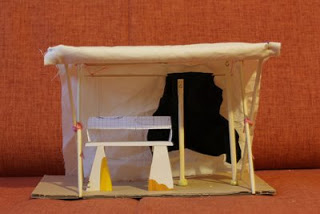
While I'm wondering about that, I'm trying to design a stall that will at least look plausible to the not-too-critical eye. And meets my requirements: Fits in the car (this limits the maximum length of the poles); is made of cloth, wood and leather with little or no metal; can be closed completely for nights and for bad weather; small yet offering enough space to display/sell, show-and-tell and sleep; cloth from linen, tightly woven so no water comes through, and half-bleached for enough light inside the stall; with a crossbeam for hanging garments in the typical medieval way of garment presentation at a tailor shop; and if at all possible, can be set up by me on my own (which also limits total height, since I cannot reach higher than 2,15 m without something to stand on.

So after a lot of planning and great fun while tinkering (and even fun doing the maths required), I present to you: My model of the future market stall. The small chopstick figure beside the table, that's me, and the tall chap (or chop?) is a 2 metre tall visitor (who had to duck a tiny bit for coming in). It doesn't have the side parts, of course, but there's a crossbeam with a dress hanging over it and my future table with a display stand on it and there's even a curtain to close off a little space for sleeping and storing stuff in the back. And all on the rather small footprint of ca. 2,5 on 2,5 metres. I like it!


* Living History, of course. I warned you several times in this blog that I'm lazy, didn't I?
**Unfortunately, it's hard to tell which kind it will be just from reading "Medieval Market There and Then" on a poster. There could be money made with a detector, I guess...
0

By accepting you will be accessing a service provided by a third-party external to https://www.pallia.net/

Kontakt