Latest Comments

Guest - Aislinn Dyestuff Citizen Science.
09. Oktober 2026
This is a great project. I look forward to the results. Thanks for letting us know.
Guest - Aislinn Time for...
09. Oktober 2026
Looks delicious!
Guest - Katrin Sprang Discussion
18. September 2026
Hi Rachel, I have looked for more photos of you, but that was not very successful. I found a link on...
Guest - Beatrix Sprang Discussion
15. September 2026
That lozenge pattern element is not a photograph, but a scan. So it should be to scale. But I pinned...
Guest - Katrin Sprang Discussion
15. September 2026
I was not referring to Rachel's reconstruction (is the reconstruction you refer to the one photograp...
JUNI
09
0

Calculations.

Well, after a very nice day off yesterday, today was eaten up by doing this small thing and that one and another one, all good and necessary, but somehow it led to me not getting done what I wanted to do today. Mind you, my brain was quite scattery anyways, so the flitting from one small task to another suited the day's mood, but still - the main task for today did not get dealt with. (Yet. I am planning to squeeze in a little bit more time to at least get it pre-organised.)

Part of today's planned and not-yet-done task involved calculations on the costs of fabric reconstructions. Only approximate ones at the moment, but they are still complex to do, and need some brain power and checking of lists (of previous similar, or sometimes not-so-similar tasks), and checking of material availability and costs.

On a similar vein -  I've been asked if the membrane thread will eventually make its way into the online shop. Ah. Well. Theoretically... it could. But practically... I'm not convinced it will be a well-selling item. It will, however, definitely be a very, very pricey item.

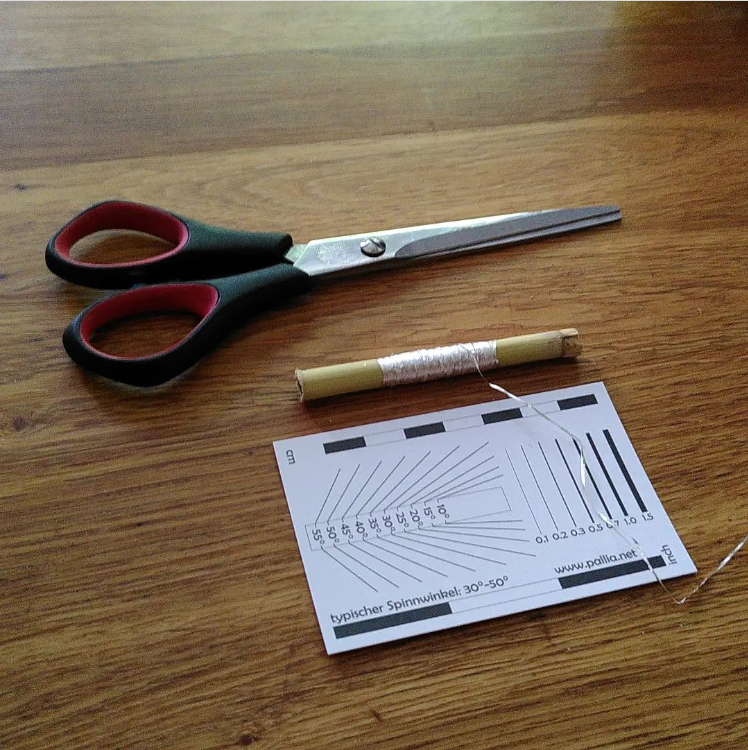
Membrane strip, wound up, my current favourite tool for cutting it, and a little helper card - this time not for yarn thickness or twist angle check, but for strip width check!
The easy part for calculating the price of membrane silver thread like this is adding up the material costs. There's the goldbeater's skin as the basis, the parchment glue (which has to be prepared, too), the leaf silver, and the core thread. The core thread I currently use is vintage linen yarn, and I can't really remember where I bought it, but it's possible to find comparable yarn and see how much that costs. For the rest, I have the numbers... and adding them up, they are not pretty. But that, of course, is only the first part of the calculation process.

Now that I've more or less gotten the hang of cutting the strip and winding it around the core, I can do some time measurements for how long things take, and add those up. For the gilding process, though, I will have to estimate - I have not done that often enough yet to have a good established process, and the last approaches at stretching the skin in a frame for the glueing and gilding did work, but took a disproportionate amount of time. 


Those bits in the calculation process are the hardest for me. I don't want to shortchange my customers, but nor do I want to end up with a much lower wage than intended because I underestimated the time necessary by a lot. And unfortunately, when you do those estimations for work time, that is very easy to do. 

So... I've made a rough guess on where I will end up, per metre, if I calculate properly. I can tell you that the material costs for about 30 metres of thread are at around 40 €. Added to that is the work time necessary to do all the steps from naked membrane to finished thread: Framing the membrane, treating it with glue, gilding it, glueing it into a cylinder, cutting the strip, preparing the core thread (which means winding two single yarns onto a spindle), and finally wrapping the core thread with the cut strip.

Want to guess along with me? Then let me know in the comments where you'd see the price for a metre of the membrane thread end up!
0
JUNI
08
0

Osprey Webcam.

It's a holiday here today, so you're getting this stream from a webcam watching ospreys instead of a proper blog post: 

0
JUNI
07
0

NESAT 15 - CfP is out!

If you're a textile archaeologist, there's one highlight, conference-wise, that comes up every three years: the NESAT. Short for Northern European Symposium for Archaeological Textiles, this started as a very small thing to make a few lone textile researchers a little less lonesome - and now it has grewn into something relatively large, and absolutely awesome. My first NESAT was the one in Copenhagen, Number ten (and I still have the t-shirt, literally). 

Now the Call for Papers for NESAT 15 is out. It will take place in 2024 in Warsaw, Poland; the CfP is open until the end of October this year. Find out more, if you're interested, on the official conference page here.

0
JUNI
06
0

Things I Do, Sometimes.

A long, long time ago, I stumbled across EscapePod - the weekly science fiction podcast. I don't remember exactly how, or why, but listening to the episodes became a wonderful way to keep me entertained during long hours of textile work, or long hours of driving in the car. I managed to listen my way all through the whole back catalogue, and there were very, very few episodes that I didn't like.

So at one point, liking it so much, I got myself listed in the Escape Artist narrator database... thinking that I might, at some point, get sent a nice story for EscapePod, and read it, and that would be very cool.

Well. I did get narration requests - but not from the 'Pod, but from Cast of Wonders. And apparently it wasn't completely horrible, because I did get more (very occasionally, but that's totally fine with me - it does take a chunk of time to do the recordings and the primary editing). The most recent one has come out in May, and if you're curious, you can listen to it here.

0
JUNI
05
0

Visitors, hungry ones.

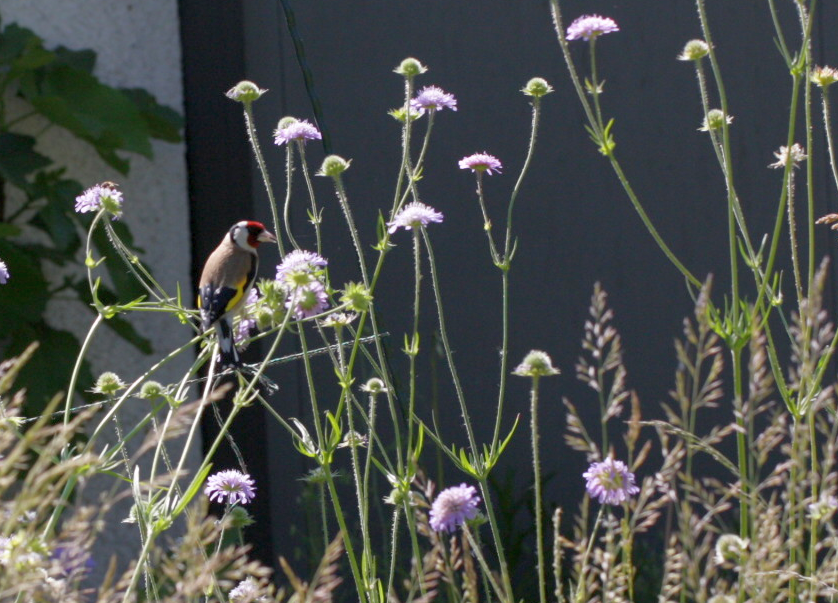
A few years ago, we stopped mowing our lawn - which, back then, was consisting to about equal parts of grass, wild thyme, and moss. It still has these three components, but now a lot of flowers are blooming in the ex-lawn. Most prominent are scabiosa flowers, with their distinctive pink pollen - and we know our neighbour's bees come to visit them a lot, as he tells us they come home with pink pants.

The flowers are not only making the bees happy, though. There's also some flower heads that are lacking their half-ripe seeds, and some of the stems of these flowers are broken. And here's one of the reasons:

There's a pair of these, and they stop by quite often. They are very shy, though, making it hard to get a decent picture of them even with a tele lens... 

0
JUNI
02
0

Manuscripts Online: St. Elisabeth's Psalter.

I'm absolutely delighted every time I find a new manuscript fully digitised and freely accessible online - it makes research so much easier, and really helps to get a better overview of what was used and available in the Middle Ages.

Yes, not every book has illuminations, and of course not everything is shown in manuscripts, and also of course one needs to take what is shown with a grain of salt, or sometimes maybe even a teaspoon of salt. But still - the more different images you get to look at, the more chances you have at seeing something for the first time, or seeing something way clearer than before.

That all said, here's one of the richly illuminated books, online for your pleasure: St. Elisabeth's Psalter, made around 1201-1208. Click on the eye on the book at the right edge to leaf through the book. 

0
JUNI
01
0

Spinning Gold.

If you're following me on Instagram, you may have seen some pictures of this on-going project already. It is, so to say, a left-over from last year's European Textile Forum, where we tried to explore the making of membrane gold threads.

Membrane gold threads are the cheaper version of real gold threads - it's a gilt animal membrane wrapped around a fibrous core. In our case, we built on the analysis results of some Italian threads that Cristina Scibé is researching.

There's a lot of unknowns or insecure things in the reconstruction of the process, and we were (and mostly still are) unfamiliar with most of the materials involved, so there was a really steep learning curve and there were plenty of "d'oh" moments.

But we have arrived at a process that is working, and that would be plausible also for production.

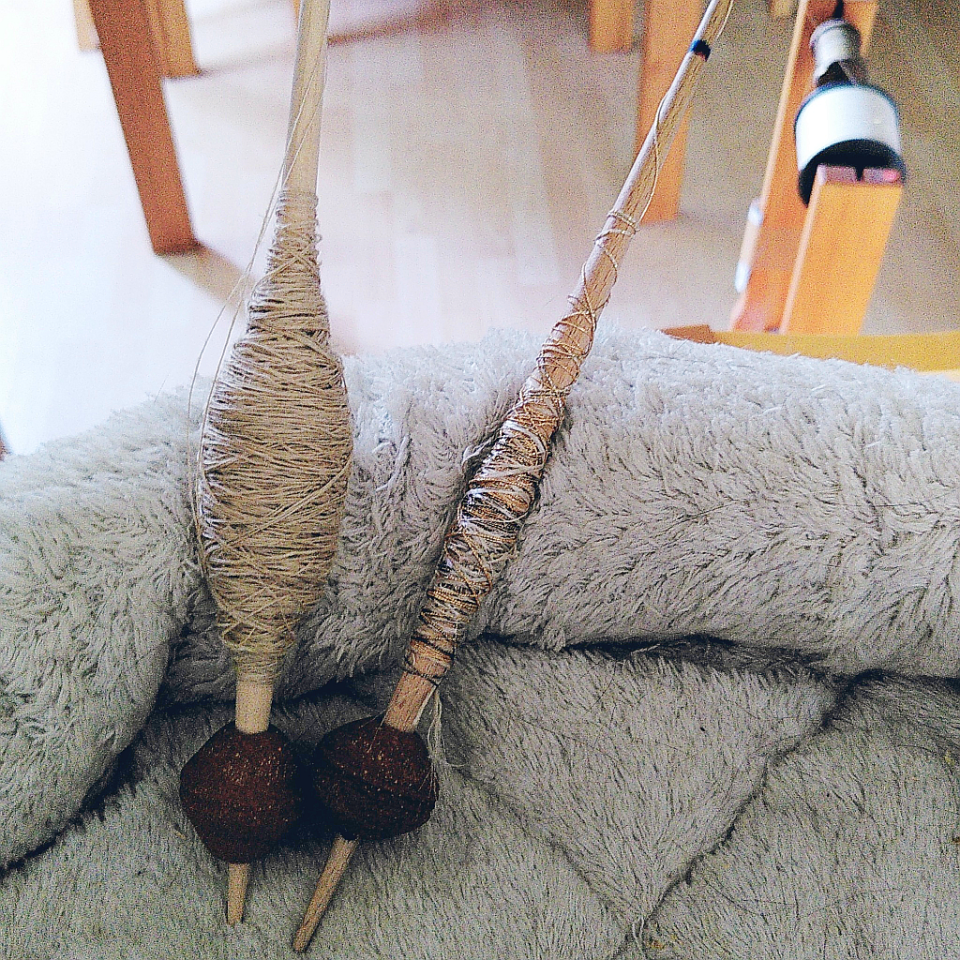
The photo shows the two spindles I am working with for wrapping strips of stuff around the core - one with the two linen single yarns, and the other with the wrapped yarns. These are not membrane strips, but modern metal and metallised plastic strips, done for practise purposes, as the membrane is a little too much work and too much of a resource to use as training material.

It's an utterly fascinating project... and I will give a little presentation about it on the EAA in Belfast this year. I'm already very excited about that!

0

By accepting you will be accessing a service provided by a third-party external to https://www.pallia.net/

Kontakt